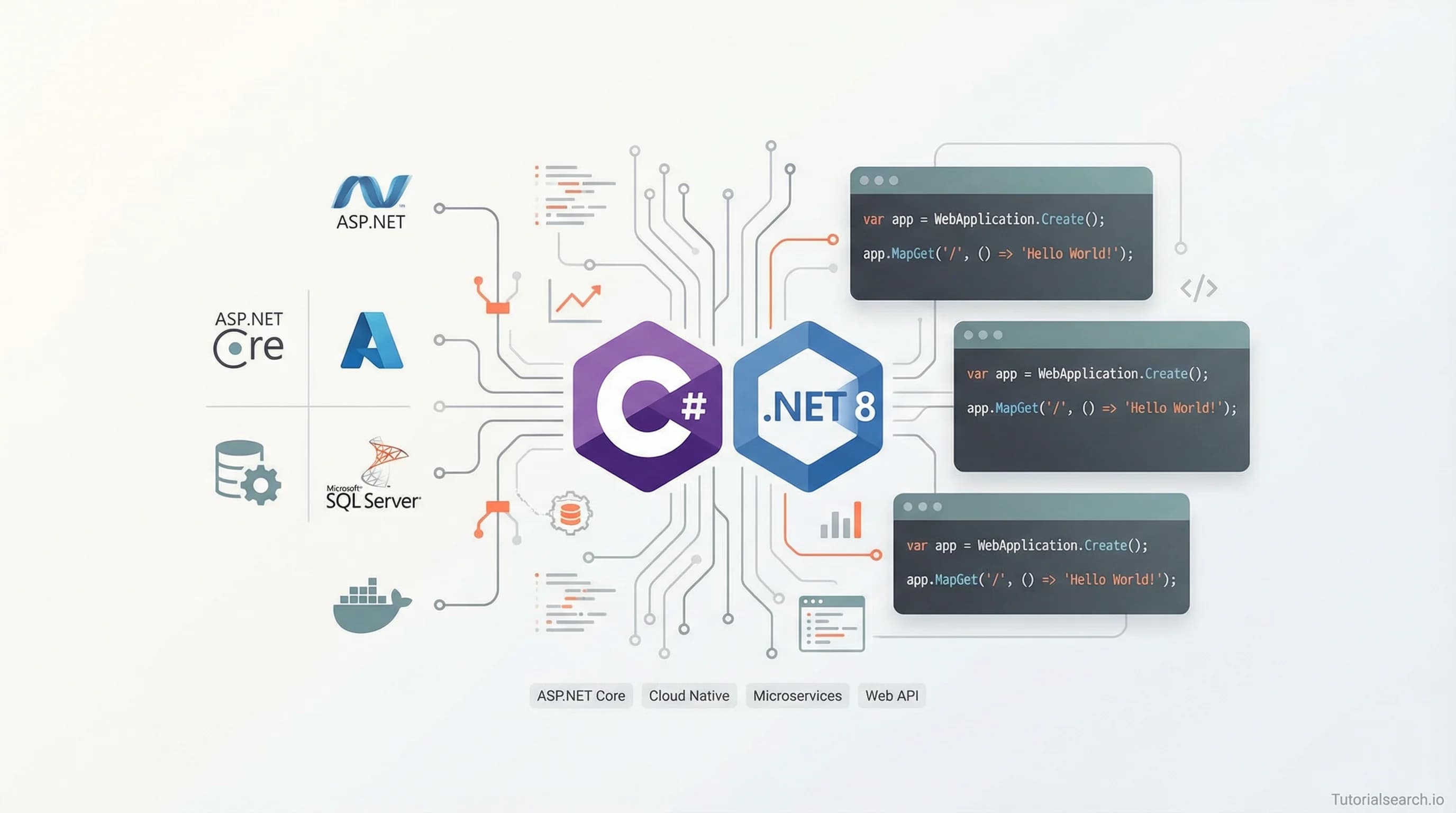
Everything You Need to Master C# .NET 8
C# .NET 8 is Microsoft's fastest runtime yet. Here are the best courses, free resources, GitHub repos, and YouTube channels to learn it — all in one place.
Need a web app built? Hire the team behind TutorialSearch.io
We ship fast, production-grade full-stack apps (Next.js, React, edge infra) — the same stack that powers this site.
C# .NET 8 is the fastest server-side runtime Microsoft has ever shipped. In the TechEmpower benchmarks — the gold standard for web framework performance — .NET 8 landed in the top 5 globally, outpacing Go in several test categories. For a language often dismissed as "just enterprise Java," that's a remarkable result.
The language itself has moved forward too. C# 12 introduced primary constructors, collection expressions, and inline array types. Native AOT (Ahead-of-Time) compilation now lets you build apps that start in milliseconds with a 70% smaller memory footprint. These aren't cosmetic changes — they matter if you're building microservices, CLI tools, or cloud functions where startup time directly affects cost.
If you're ready to explore C# .NET 8 courses and tutorials, this guide lays out the best structured courses, free resources, GitHub repos, YouTube channels, and books — built as a path from your first setup to shipping real software.
Key Takeaways
- C# .NET 8 is Microsoft's fastest runtime ever, with Native AOT cutting startup time by up to 70%.
- Beginners should try free Microsoft Learn or freeCodeCamp content before buying a paid course.
- The top-rated C# .NET 8 courses on Udemy and Pluralsight consistently score 4.6+ out of 5.
- GitHub repos like awesome-dotnet curate thousands of libraries, tools, and C# learning paths.
- Most developers land a C# role within 6-12 months of consistent, focused practice.
In This Article
- Getting Your Hands Dirty With C# .NET 8
- C# .NET 8 Courses That Actually Deliver
- The C# .NET 8 Open Source Goldmines
- C# .NET 8 YouTube Channels Worth Watching
- C# .NET 8 Books for When You Want to Go Deep
- The C# .NET 8 Community: Where Developers Actually Help
- Related C# and .NET Skills Worth Exploring
- Frequently Asked Questions About C# .NET 8
Getting Your Hands Dirty With C# .NET 8
Before spending money on a course, spend an afternoon with the free stuff. It's better than you'd expect.
Microsoft Learn's .NET documentation is genuinely good. Interactive tutorials, browser-runnable code, and structured learning paths from beginner to advanced. The page on What's New in .NET 8 is worth bookmarking even if you're experienced — it's comprehensive and updated regularly.
Foundational C# with Microsoft on freeCodeCamp is the best free starting point for absolute beginners. Over 35 hours of text-based lessons and interactive coding challenges. It covers variables, conditionals, loops, methods, and debugging — all the core concepts before you touch a framework.
C# Interactive Notebooks from the official dotnet team let you run C# in VS Code with .NET Interactive. This is a great way to experiment with C# 12's new features — primary constructors, collection expressions, inline arrays — without setting up a full project. The repo includes notebooks on language fundamentals and data science with .NET.
Setup is painless: download the .NET 8 SDK, install VS Code or Visual Studio 2022 (17.8+), and run dotnet new console -n HelloWorld. You're writing code in under five minutes.
One thing that trips up beginners: they start with WinForms or WPF because the tutorials look familiar, then find their knowledge doesn't transfer to ASP.NET Core or modern console apps. Start with console apps and Minimal APIs. Those teach the patterns that matter in .NET 8. If you later decide to add JavaScript Development for full-stack work, the architectural thinking you build here will translate directly.
C# .NET 8 Courses That Actually Deliver
Free resources get you started. A structured course keeps you moving when things get complicated.
Here are the courses I'd recommend at each level — with honest assessments rather than star ratings.
Beginner C# .NET 8 Courses
1. Complete C# Course – Beginner to Expert (C# 12 Updated) (Udemy)
Taught by Robert Gioia with over 8,200 students enrolled. This covers C# 12 syntax, OOP concepts, LINQ, and project work. Gioia builds things deliberately without handholding. The update to C# 12 keeps the examples current. It's the course I'd send a friend who asked "where do I start with C#?"
2. C# .NET Core 8 Masterclass with MS SQL Beginner to Pro 2025 (Udemy)
Martin Kleinbooi combines C# fundamentals with SQL Server right from the start. Database integration is where most beginners stall — learning it alongside C# removes that friction. Good for anyone who wants to build data-driven apps without taking two separate courses.
Intermediate C# .NET 8 Courses
3. C# 13 and .NET 8: Unveiling the New Era of Programming (Udemy) [Editors' Choice]
Rating: 4.90/5.0. Instructor Sandeep Soni focuses on what's actually new — primary constructors, collection expressions, Native AOT, performance improvements. It's not a C# 101 rehash. If you already know C# 10 or 11, this is the most efficient path to getting current. Soni explains why features were added, not just how to use them. Most courses skip that.
4. ASP.NET MVC Complete Guide using .NET Core (.NET 8 Updated) (Udemy)
Sameer Saini, 7,100+ students. One of the most complete ASP.NET Core MVC courses available — routing, controllers, views, Entity Framework Core, authentication, real project work. The .NET 8 update keeps it current. The right pick if backend web development is your goal.
5. What's New in .NET 8 (Pluralsight) [Editors' Choice]
Rating: 4.7/5. Pluralsight's version-specific courses are underrated. This one moves fast — it assumes you know .NET — and covers performance benchmarks, runtime changes, Blazor updates, and AOT improvements with before-and-after code comparisons. Pairs well with Soni's C# 13 course for a complete picture of the .NET 8 ecosystem.
6. What's New in C# 12 (Pluralsight) [Editors' Choice]
Rating: 4.9/5 — the highest in this entire list. Focused entirely on C# 12 language features with hands-on examples. Short, dense, and efficient. Not for beginners, but if you're moving from C# 10 or earlier this is the first thing to watch.
Advanced and Specialized C# .NET 8 Courses
7. Master Multithreading & Asynchronous Programming in C#/.NET (Udemy) [Editors' Choice]
Instructor Frank Liu, rating 4.66/5, 3,000+ students. Multithreading and async are where C# gets genuinely difficult. Most beginners avoid them until a bug forces the issue. This course covers async/await, the Task Parallel Library, thread safety, and cancellation tokens with practical examples. It's one of the few courses that explains why async code fails — not just how to write it.
8. ASP.NET Core 8 Web API Authentication Playbook (Pluralsight)
Rating: 4.8/5. Authentication looks simple until something goes wrong in production. This Pluralsight course focuses entirely on getting auth right in .NET 8: JWT tokens, OAuth 2.0, OpenID Connect, and ASP.NET Core Identity. Worth it if you're building APIs that serve real users.
9. Learn C# Full Stack Development with Angular and ASP.NET (Udemy)
Denis Panjuta, 6,200+ students. If your goal is full-stack development, this is the logical next step after C# basics. It combines Angular (TypeScript/JavaScript frontend) with an ASP.NET Core backend. Not the deepest dive into either technology, but gives you the complete picture in one course.
10. 2025 Automation Framework Development with Selenium C# .NET (Udemy)
Over 11,500 enrolled — the highest student count in this list. If your C# path leads toward QA automation or DevOps, this covers Selenium WebDriver with C# from scratch. Building a proper automation framework in .NET is a marketable skill, and this course is thorough.
Pick Your Path
| Your Goal | Start With | Then Go To |
|---|---|---|
| New to C# entirely | Complete C# Course (Gioia) | ASP.NET MVC Guide (Saini) |
| Know C#, upgrading to .NET 8 | What's New in C# 12 (Pluralsight) | What's New in .NET 8 (Pluralsight) |
| Backend web development | ASP.NET MVC Guide (Saini) | Auth Playbook (Pluralsight) |
| Full-stack development | Complete C# Course → ASP.NET MVC | Full Stack with Angular (Panjuta) |
| QA/Test automation | Complete C# Course | Selenium Framework (Karthik KK) |
You can find all 210+ C# .NET 8 courses on TutorialSearch.io with ratings, student counts, and platform comparisons side by side.
The C# .NET 8 Open Source Goldmines
Need a web app built? Hire the team behind TutorialSearch.io
We ship fast, production-grade full-stack apps (Next.js, React, edge infra) — the same stack that powers this site.
The .NET ecosystem's GitHub presence is one of its strongest advantages over competing languages.
awesome-dotnet is the essential starting point — a community-curated list of libraries, frameworks, and tools for .NET development. ORM libraries, serialization, logging, caching, testing frameworks: all there, well-organized. Before searching Google for a .NET library, check here first.
awesome-dotnet-core-education by Mehdi Hadeli focuses specifically on learning. Curated articles, videos, and resources for .NET Core and modern .NET development. Dense but genuinely useful for intermediate developers who want to go beyond courses.
awesome-csharp covers the C# language specifically — tools, libraries, tutorials, and community resources organized by category. A good complement to the .NET-focused repos above.
dotnet/csharp-notebooks is an official Microsoft repo with interactive notebooks for learning C# in VS Code. Great for experimenting with C# 12 features without setting up a full project.
ASP.NET Core Developer Roadmap is a visual roadmap widely referenced in the .NET community. It shows what skills you need at each stage — from C# basics through Docker, caching, message queues, and cloud deployment. Save it now; you'll refer back to it repeatedly.
The C# learning roadmap by gridlocdev is a more language-focused alternative. Good for beginners who want a sequence of what to learn before jumping into a framework.
If you're curious how C# compares to other modern languages, TutorialSearch's Programming Languages category has 3,420+ courses covering Rust, Go, Kotlin, and the rest of the modern stack.
C# .NET 8 YouTube Channels Worth Watching
YouTube fills the gaps that written resources leave. These channels consistently produce good C# content.
IAmTimCorey is probably the most consistently useful C# channel on YouTube. Tim Corey publishes long-form practical tutorials on C# and .NET — Clean Architecture, unit testing with xUnit, Blazor, real-world project patterns. His teaching style is methodical without being dry. He covers patterns that actually survive contact with production projects.
Nick Chapsas is the channel for performance-focused .NET development. Chapsas deep-dives into .NET internals, benchmarks, and modern C# patterns — often comparing approaches with Benchmark.NET results. If you want to understand why one approach is faster, this is your channel. His videos on LINQ optimization and Span-based APIs are particularly sharp.
The official dotnet YouTube channel from Microsoft publishes conference talks, feature walkthroughs, and weekly .NET news. The .NET Conf recordings alone are worth several hours of watching. Their "What's New" series tracks each C# and .NET release well.
Programming with Mosh has a free 4-hour C# for Beginners course that's frequently cited as the best YouTube entry point. Clear, concise, well-paced. If you're completely new to C#, watch this before committing to a paid course.
One honest note: most "advanced" C# YouTube content stops at intermediate. For genuinely advanced topics — Roslyn analyzers, Source Generators, memory-mapped files — you'll need to combine YouTube with the official docs and GitHub repos.
If Object Programming patterns like SOLID, design patterns, and OOP architecture interest you, they're directly relevant to .NET development — and there are 900+ courses on that topic.
C# .NET 8 Books for When You Want to Go Deep
Courses build practical skills. Books build understanding. The best approach uses both.
C# 12 and .NET 8 – Modern Cross-Platform Development Fundamentals by Mark J. Price (Packt) is the most direct match for this topic. Price updates this book with each major .NET release. The .NET 8 edition covers everything from C# 12 syntax through EF Core 8, Blazor, and performance profiling. At 800+ pages it's a big book, but organized well enough to use as a reference.
C# in Depth by Jon Skeet remains the gold standard for understanding how C# actually works. It doesn't cover .NET 8 specifically — it focuses on the language's evolution — but if you want to understand why certain C# patterns exist, this book is irreplaceable. Skeet is a longtime Stack Overflow C# expert, and that depth shows in how he explains the nuances.
Everyone recommends these two books, but honestly I'd add a third that gets less attention: C# Notes for Professionals from GoalKicker is a free PDF compiled from Stack Overflow documentation. Not a learning path on its own, but extremely useful as a reference when you hit a specific question mid-project.
The ASP.NET Core Roadmap on roadmap.sh is a free complement to any book. It shows the full learning path for an ASP.NET Core developer visually — which makes it easy to identify gaps in your knowledge.
If you're thinking about adding Python Basics to your skill set, Python and C# pair well in enterprise environments — Python handles scripting and data work while C# handles the application layer. The transition between the two is smoother than it looks.
The C# .NET 8 Community: Where Developers Actually Help
Learning alone only gets you so far. Communities accelerate the process.
The C# Discord at discord.com/invite/csharp has over 25,000 members and 200,000+ messages a month. Channels cover beginners, intermediate developers, job seekers, and specific topics like Blazor, Entity Framework, and ASP.NET Core. Active and genuinely helpful.
The .NET Foundation community hub lists local meetups, GitHub discussions, Stack Overflow, and official forums. Better for structured community engagement if Discord feels too noisy.
Reddit's r/csharp is active for questions, job advice, and discussion. The signal-to-noise ratio is decent — r/csharp tends to be technical and focused rather than meme-driven.
One thing worth saying: the .NET community is larger and more active than its reputation suggests. It sometimes gets overshadowed by JavaScript ecosystem noise, but enterprise .NET development is very much alive, and the community reflects that energy.
If your C# work touches QA or DevOps, the Automation Development section has 838+ courses on related testing and automation skills where C# is a primary language.
Related C# and .NET Skills Worth Exploring
If C# .NET 8 interests you, these related skills pair well with it:
- Modern Languages — 3,420+ courses on contemporary languages like Rust, Go, and Kotlin, which share modern design philosophies with C# 12.
- Programming Fundamentals — 1,122+ courses on core concepts that apply across languages, useful if you're new to programming.
- Object Programming — 901+ courses on OOP patterns and design, essential for C# at any level.
- JavaScript Development — 1,062+ courses. JavaScript is the natural complement to C# for full-stack web development.
- Java Objects — 972+ courses. Java and C# share significant design overlap; Java knowledge transfers well to C#.
- Python Basics — 1,216+ courses. Python is commonly used alongside C# in data science and enterprise scripting.
- Automation Development — 838+ courses on test and process automation, where C# with Selenium is a standard choice.
- Python Applications — 735+ courses. If you're building mixed-language systems, Python is the typical scripting complement to C#.
Frequently Asked Questions About C# .NET 8
How long does it take to learn C# .NET 8?
Most beginners reach working competency in 3-6 months of consistent daily practice (1-2 hours/day). Getting to intermediate level — where you can build and deploy a real ASP.NET Core app — takes 6-12 months. If you already know C# 10 or 11, expect a few focused weeks to get current with .NET 8 specifics. Browse the full C# .NET 8 course library to find a structured learning path that matches your current level.
Do I need to know C# before using .NET 8?
Yes. C# is the primary language for .NET 8 development, and you need at least basic C# knowledge before the framework makes sense. Start with the freeCodeCamp "Foundational C# with Microsoft" course or Microsoft Learn's interactive C# tutorials. Both are free and will get you to a working baseline before you start with ASP.NET Core or Entity Framework.
Can I get a job with C# .NET 8 skills?
Yes — C# .NET 8 skills are in high demand for enterprise backend development, cloud applications (especially Azure), and game development (Unity uses C#). The enterprise segment especially values .NET experience. Most C# developer roles pay well, and demand for senior .NET developers consistently outpaces supply in most markets.
What are the biggest new features in C# .NET 8?
The three that matter most in practice: Native AOT compilation (faster startup, smaller binaries for containers and serverless), C# 12 primary constructors (cleaner, less verbose class initialization), and performance improvements across the JIT compiler and garbage collector. The What's New in .NET 8 page on Microsoft Learn has the complete breakdown.
What programming languages are compatible with C# .NET 8?
C# is the primary language, but .NET 8 also fully supports F# and Visual Basic. The .NET runtime also enables interoperability with C and C++. Most developers stick to C# exclusively, but F# is worth exploring if functional programming patterns interest you — it runs on the same runtime and shares all the same libraries.
The clearest path forward: start with free Microsoft Learn content or freeCodeCamp to build your C# foundation. Pick a structured Udemy or Pluralsight course for ASP.NET Core and EF Core. Join the C# Discord to stay unstuck when things don't work. Build something real — a REST API, a CLI tool, a simple web app. That's when C# starts to click.