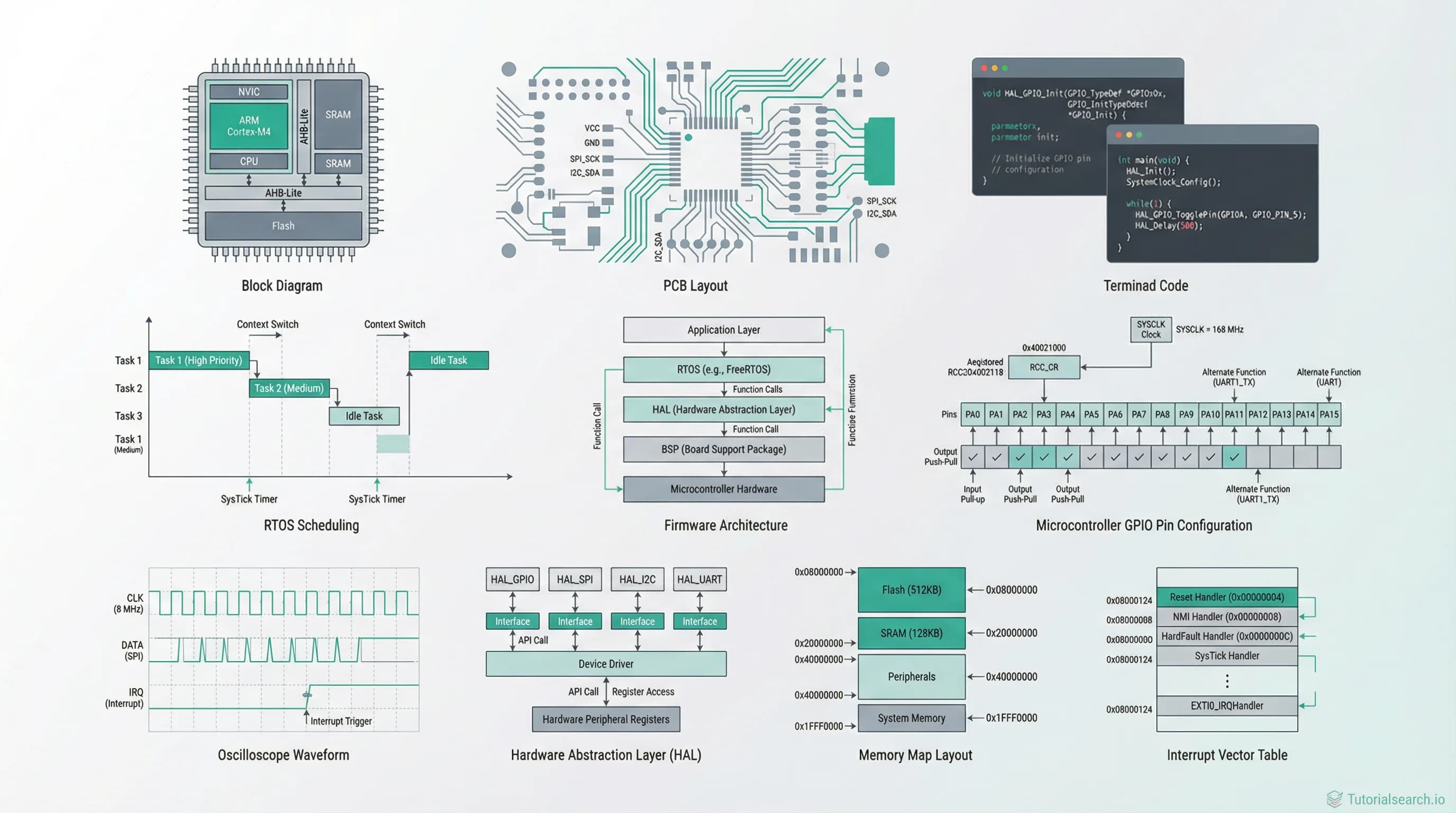
Embedded Systems Courses and Resources That Deliver
Embedded systems combine hardware and software at the lowest level. Here are the courses, free resources, GitHub repos, and communities that'll actually help you learn them.
Need a web app built? Hire the team behind TutorialSearch.io
We ship fast, production-grade full-stack apps (Next.js, React, edge infra) — the same stack that powers this site.
Most beginners make the same mistake with embedded systems: they buy a dev board on day one, stare at a blinking LED tutorial, and then wonder why they feel lost three weeks in. Embedded systems aren't just programming. They sit at the intersection of hardware, software, and real-time constraints — and jumping in without understanding that gap is why so many people quit early.
This guide covers the courses, free resources, GitHub repos, YouTube channels, books, and communities that will actually help you get good at embedded systems development. If you want a shortcut to the full list, browse the embedded systems courses on TutorialSearch.io — there are over 520 of them.
Key Takeaways
- Embedded systems combine hardware and software — you need both to succeed, not just coding skills
- C and C++ remain the dominant languages in embedded systems, though Rust is gaining ground fast
- The best embedded systems courses focus on real hardware: ARM Cortex-M, STM32, and 8051 platforms
- Free resources from FreeRTOS documentation, GeeksforGeeks, and GitHub roadmap repos are surprisingly solid
- Join the Embedded Engineering Discord early — it'll save you hours of debugging frustration
In This Article
- Before You Touch a Microcontroller
- The Embedded Systems Courses Worth Your Serious Attention
- Start Learning Embedded Systems Without Spending a Dime
- Which Board Should You Start With? A Quick Comparison
- Embedded Systems GitHub Repos Worth Bookmarking
- The Embedded Systems YouTube Channels That Actually Teach
- Embedded Systems Books That Go Deep
- The Embedded Systems Communities Where You'll Find Real Help
- Related Skills to Explore
- Frequently Asked Questions About Embedded Systems
Before You Touch a Microcontroller
Before picking a board or course, you need an honest picture of what embedded systems actually demand.
Here's the stack you're building toward: C programming (the core language), basic digital electronics (voltage, logic levels, protocols), microcontroller architecture (registers, memory maps, peripherals), and — eventually — real-time operating systems (RTOS). That's a lot. The good news is you don't need all of it before you write your first program. You just need to know it exists.
The one thing I'd tell any beginner: don't skip the C fundamentals. Not "learn C through Arduino" — actually learn C. Pointers, memory management, structs. Embedded code is low-level by design. If you gloss over C basics, you'll hit a wall the moment you try to interface with hardware registers.
If you're coming from Python or JavaScript, expect a gear-shift. Your programs won't have an operating system doing things for you. You'll manage memory yourself. You'll talk to hardware directly. It sounds harder, but it's also more satisfying — you can feel the control.
You'll also want to know the difference between a microcontroller (an MCU — a chip with built-in RAM, flash, and peripherals) and a microprocessor (which needs external components). Most embedded work starts with microcontrollers. ARM Cortex-M, STM32, 8051, and ESP32 are the platforms you'll hear constantly.
Curious about the broader programming languages landscape? Embedded work gives you one of the strongest foundations you can have — it makes everything else click.
The Embedded Systems Courses Worth Your Serious Attention
There are 520+ embedded systems courses out there. Most of them are fine. A handful are genuinely exceptional. Here's where I'd focus.
1. Embedded Systems Programming on ARM Cortex-M3/M4 Processor (Udemy) [Editors' Choice]
This is the course I'd recommend first to anyone who wants to work professionally with embedded systems. The instructor teaches ARM architecture from the ground up — registers, stack operations, exceptions, interrupt handling. None of the hand-wavy abstraction you get with Arduino tutorials.
- Over 37,000 students enrolled
- Covers the Cortex-M3/M4 core in genuine depth
- You'll understand why the code works, not just that it works
- Rating: 4.5/5
ARM Cortex-M processors power everything from industrial sensors to medical devices. Starting here isn't just practical — it's the industry standard.
2. Embedded Systems Bare-Metal Programming Ground Up (STM32) (Udemy) [Editors' Choice]
"Bare-metal" means no HAL, no RTOS, no abstraction layer. Just you, the processor, and the datasheet. This course teaches that approach on STM32 microcontrollers, which are arguably the most widely used professional platform today.
- 20,000+ students
- You'll write startup code, configure clocks, and toggle GPIOs without a library holding your hand
- Excellent follow-up to the Cortex-M course above
- Rating: 4.6/5
Most courses hide the hard parts. This one shows them to you, which is exactly what you need.
3. Embedded Systems STM32 Interrupt-Driven NEC Decoder (Udemy)
Don't let the specific title put you off. Building an interrupt-driven system is a core embedded skill, and this course teaches it through a concrete, buildable project. Instructor-led, 7,000 students, rated 4.7/5 — one of the highest-rated courses in this category.
4. Embedded Systems Bootcamp: RTOS, IoT, AI, Vision and FPGA (Udemy)
Once you're past the basics, this bootcamp covers where embedded systems are heading: RTOS integration, IoT connectivity, and even AI on microcontrollers. It's wide-ranging but practical. 6,600+ students, rated 4.6/5.
5. FreeRTOS From Ground Up on ARM Processors (Udemy)
RTOS (real-time operating system) knowledge separates intermediate embedded developers from beginners. FreeRTOS is the industry's most widely used option — it runs on everything. This course teaches it from first principles on ARM hardware. Rating: 4.3/5.
6. Embedded Rust Development with STM32: Absolute Beginners (Udemy) [Editors' Choice]
Everyone recommends starting embedded systems with C. I'd push back slightly: if you're coming fresh and you're comfortable with newer languages, Rust for embedded is worth exploring early. Rust's memory safety guarantees solve a real class of embedded bugs — null pointers, buffer overflows, data races. This course is an accessible entry point. Rating: 4.85/5 — highest in this list.
7. Embedded C Programming Design Patterns (Udemy)
Once you can write embedded C, learning how to write it well is the next step. This course covers design patterns specific to resource-constrained systems: state machines, observer patterns, and object-oriented techniques in C. Rating: 4.3/5.
8. Embedded Systems Object-Oriented Programming in C (Udemy)
An underrated course. Teaching OOP concepts through pure C (not C++) is a useful embedded skill — many production systems use C with OOP-style architecture. 4,200 students, rated 4.1/5. Good for developers with some coding background.
9. Embedded Systems State Machines & Data Structures (Udemy)
State machines are everywhere in embedded firmware. From button debouncing to communication protocol parsers, you'll use them constantly. This course builds that foundation with practical examples. Rating: 4.1/5.
10. Advanced Embedded Systems Bare-Metal Programming Ground Up (Udemy)
The natural sequel to the STM32 bare-metal course above. Covers DMA, advanced timer configurations, and low-power modes. 4.4/5 rating. Take this after you've finished the fundamentals.
You can search all available options at TutorialSearch.io to find courses filtered by skill level and platform.
Start Learning Embedded Systems Without Spending a Dime
The paid courses are strong — but free resources in embedded systems are actually quite good. Here's what's genuinely worth your time.
Embedded Artistry — For Beginners is one of the best free starting points online. The site, run by developer Phillip Johnston, curates learning paths specifically for embedded engineers. It distinguishes between hardware-first and software-first paths. No fluff.
GeeksforGeeks Embedded C covers embedded C concepts with clear examples and code walkthroughs. It's not a full course, but it's an excellent reference when you hit a concept you don't understand — faster than searching Stack Overflow.
FreeCodeCamp — Embedded Systems Firmware Basics Handbook is a long-form written tutorial from a working developer. It's practical and opinionated in the good way: it tells you what matters and what you can skip.
Coursera — Embedded Systems Using C is free to audit. It covers microcontroller architecture, MCU vs MPU differences, and firmware development. If you want a structured, university-style curriculum without the price, start here.
FreeRTOS Official Documentation — I know "read the docs" sounds like advice you'd ignore. But the FreeRTOS documentation is actually very readable. The free e-book walks you through task creation, queues, semaphores, and timers in a way that no course can entirely replace. Download it. Read the first five chapters.
Free Computer Books — Embedded Systems Collection hosts several legally free embedded systems texts, including "Exploring BeagleBone" and older editions of foundational C programming books. Worth bookmarking.
Logic Fruit — Embedded Systems Design Guide is a comprehensive written guide to the 2026 embedded landscape — covering security requirements, new protocols, and the shift toward safety-critical systems.
DEV Community — Getting Started with Embedded Systems is a well-written community article that explains the difference between embedded development and general-purpose software development. Good framing for beginners.
If you're also learning programming fundamentals alongside embedded work, that's a solid combination. The two reinforce each other.
Which Board Should You Start With? A Quick Comparison
Need a web app built? Hire the team behind TutorialSearch.io
We ship fast, production-grade full-stack apps (Next.js, React, edge infra) — the same stack that powers this site.
| Board | Best For | Language | Complexity | Cost |
|---|---|---|---|---|
| Arduino Uno | Absolute beginners, prototyping | C/C++ (Arduino IDE) | Low | ~$25 |
| ESP32 | IoT projects, Wi-Fi/Bluetooth | C/C++, MicroPython | Low-Medium | ~$10 |
| STM32 (Nucleo) | Professional development, industry standard | C, C++ | Medium-High | ~$15 |
| Raspberry Pi | Linux-based embedded, edge computing | Python, C, C++ | Medium | ~$35–$75 |
| 8051 | Learning microcontroller fundamentals | Embedded C | Medium | ~$5 |
My take: Most courses recommend the STM32 Nucleo for serious learning — and I agree. But if you want to ship something to the internet quickly, ESP32 is the fastest path. The 8051 is worth studying even on a simulator, purely for the foundational understanding it builds.
Embedded Systems GitHub Repos Worth Bookmarking
Embedded Engineering Roadmap — m3y54m is the most comprehensive embedded systems roadmap on GitHub. It covers everything from using a multimeter to understanding CAN bus protocol, with free and paid resources at each stage. This is the repo to star first. It has thousands of stars and is actively maintained.
Awesome Embedded Engineer Roadmap — A4sa takes a slightly different angle — hardware and software in parallel. Good if you want a broader view of the full embedded engineer skill set.
Embedded Software Engineer Roadmap — mmertgunduz focuses on the software side. It's structured as a step-by-step path for people who already code and want to move into firmware development.
Useful YouTube Channels for Electronics — omarKmekkawy curates YouTube channels specifically for electronics and embedded engineers. Use it when you're looking for video content on a specific topic like oscilloscopes, JTAG debugging, or PCB design.
Embedded systems pairs naturally with object-oriented programming concepts — especially once you start writing larger firmware projects in C++ or Rust.
The Embedded Systems YouTube Channels That Actually Teach
Most embedded systems YouTube channels fall into two camps: either they're too basic (blinking LEDs forever) or too advanced (oscilloscope traces and assembly dumps). Here are channels that hit the middle ground well.
Fastbit Embedded Brain Academy (YouTube) focuses specifically on ARM Cortex-M microcontrollers and bare-metal programming. The presenter explains processor internals clearly without dumbing it down. Great complement to the paid Udemy courses from the same instructor.
Phil's Lab (YouTube) covers STM32 development from a practical, project-based angle. His series on FMC memory, custom PCB design, and STM32 DSP applications are genuinely advanced — but explained accessibly. One of the most technically credible embedded channels available.
Controllers Tech (YouTube) is good for beginners tackling STM32 with HAL (hardware abstraction layer). If you're not ready for bare-metal, this channel meets you where you are.
Embedded.com YouTube Content and the associated DesignNews channel cover industry trends, interviews with embedded professionals, and technical deep dives. Good for staying current on where the field is heading.
NPTEL (National Programme on Technology Enhanced Learning) has university-level embedded systems lectures available free on YouTube from top Indian technical institutes. Long, thorough, and surprisingly useful for understanding theory that most tutorials skip.
If you're also exploring automation development, embedded systems skills translate directly — especially in industrial control and PLC programming.
Embedded Systems Books That Go Deep [Editors' Choice]
Books reward the embedded learner in ways YouTube doesn't. The topics are too nuanced for short videos. Here are the ones worth reading.
"Programming Embedded Systems in C and C++" by Michael Barr is the classic starting point. It covers reading schematics, writing firmware, and testing embedded code from scratch. Some content is dated (the hardware chapters), but the software philosophy is timeless.
"Embedded Software Design: A Practical Approach to Architecture, Processes, and Coding Techniques" by Jacob Beningo is one of the best modern books on firmware architecture. Beningo is a working embedded consultant. He writes like one — direct, practical, with real-world trade-offs explained honestly. Available on Amazon.
"Mastering Embedded Systems with Rust" and "Simplified Embedded Rust" are worth adding to your list if you're going down the Rust path. Rust is not a replacement for C in embedded — yet — but it's increasingly used for safety-critical applications where memory bugs are unacceptable.
The FreeRTOS e-book (free, official) remains the definitive resource for anyone working with RTOS. Download it from the FreeRTOS documentation page.
"Make: Getting Started with Arduino" and similar beginner books aren't worth reading if you're serious about embedded. They'll teach you to plug things in. They won't teach you how embedded systems actually work.
Also consider: Modern Languages are starting to appear in embedded work — Rust especially. Staying aware of that trend is worthwhile.
The Embedded Systems Communities Where You'll Find Real Help
Embedded development is often lonely. Your bug is obscure. Google returns datasheets. Stack Overflow doesn't have your exact chip.
Communities fix that.
Embedded Engineering Discord (Amulius) is the most active embedded-focused Discord server I've found. Over 18,000 members, channels organized by platform and topic, and an atmosphere that's welcoming to beginners. When your UART isn't initializing at 3am, this is where you go.
r/embedded (Reddit) is less real-time but great for longer questions. The community is experienced and generally patient with well-formed beginner questions. Search before posting — many common questions are answered thoroughly in old threads.
Embedded Artistry Community is more curated than Reddit. The blog and forum focus on professional embedded engineering practices: documentation, testing, architecture. Good for when you're past beginner mode.
EmbeddedRelated.com has a Q&A forum and a blog aggregator that collects posts from working embedded engineers. Less flashy than Discord but technically deep.
Interrupt Blog by Memfault isn't a community, but it's the best technical blog in the embedded space. The posts cover debugging, RTOS internals, Rust in firmware, and CI/CD for embedded — all written by people shipping production firmware.
Pairing embedded work with Python Basics is common among embedded engineers — Python handles scripting, test automation, and host-side tooling while C/C++ handles the firmware.
Related Skills to Explore
Embedded systems sits at an intersection of several technical disciplines. If embedded work interests you, these related skills pair naturally with it:
- Programming Fundamentals — the foundation you need before any specialized embedded work
- Object Programming — increasingly relevant in C++ and Rust firmware projects
- Modern Languages — Rust is changing embedded systems; worth watching
- Automation Development — industrial embedded systems and PLCs overlap heavily with this
- Python Applications — Python handles the tooling, test scripts, and host-side logic in embedded workflows
- Python Basics — practical for embedded scripting even if it won't run on your microcontroller
Frequently Asked Questions About Embedded Systems
How long does it take to learn embedded systems?
Getting to a functional beginner level — writing working firmware for a microcontroller — takes 3 to 6 months of consistent study. That assumes basic C programming knowledge going in. Getting employable takes longer, typically 1 to 2 years of hands-on projects. Embedded systems rewards practice more than any other programming discipline. Browse embedded systems courses to find structured paths.
Do I need electronics knowledge to start learning embedded systems?
You don't need to be an electrical engineer, but you do need the basics. Understanding voltage, current, logic levels, and reading simple schematics is non-negotiable. You can pick this up in parallel with your programming studies — the two reinforce each other. If you've never used a multimeter before, spend two weeks on electronics basics first.
What programming languages are best for embedded systems?
C is the dominant language — over 80% of production embedded firmware is written in C. C++ is common in more complex systems. Rust is a serious emerging option for safety-critical applications because it eliminates entire categories of memory bugs at compile time. Python exists in embedded contexts (MicroPython, CircuitPython) but is usually limited to prototyping and tooling rather than production firmware.
Can I get a job in embedded systems?
Yes — and demand is growing. Embedded engineers work in automotive (ADAS systems, EV battery management), medical devices, aerospace, IoT, and industrial automation. The shortage of qualified firmware engineers is real. Strong C skills, ARM Cortex-M experience, and RTOS knowledge will open doors. If you also know Rust or have safety-critical experience (MISRA C, ISO 26262), you're in a strong position.
What role does Rust play in modern embedded systems?
Rust is gaining ground, especially in safety-critical industries. Its ownership model prevents the classes of memory bugs — buffer overflows, use-after-free, data races — that cause the most serious embedded failures. It's not replacing C yet, but it's increasingly appearing in new projects, particularly in automotive and industrial IoT. The Embedded Rust Development with STM32 course is one of the best entry points for learning it.
How does embedded systems differ from regular software development?
In regular software, an operating system manages memory, scheduling, and hardware access for you. In embedded systems, you often do all of that yourself. Programs run directly on hardware with constrained resources — sometimes only 64KB of RAM. Real-time constraints matter: if a safety-critical function misses its timing, the consequence isn't a crash dialog, it's a physical failure. This is what makes embedded development both challenging and important.
The best first step is picking one microcontroller platform — STM32 is the industry choice — and following one course through to completion. Don't board-hop. Don't language-hop. Get one thing working before expanding your scope. The embedded systems community is technical and supportive, and once you've built a project that controls real hardware, it gets genuinely addictive.