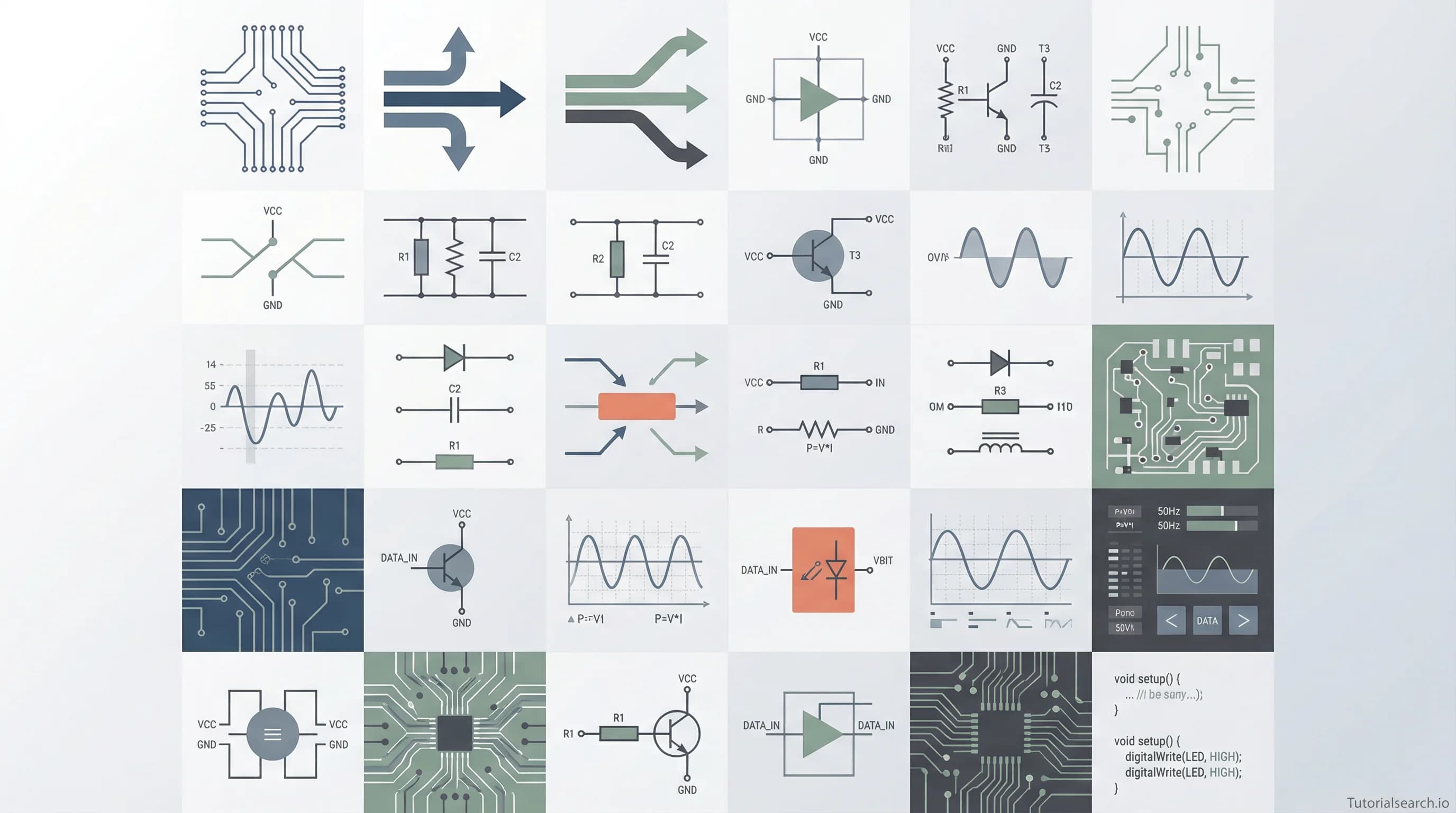
Electrical Engineering: How I'd Learn It If I Started Over
Electrical engineering spans circuits, power systems, solar, and beyond. Here are the courses, free MIT resources, YouTube channels, and books worth your time.
Hire the developers behind TutorialSearch.io
We built this site — full-stack web apps, AI integration & automation. Tell us what you need and we'll build yours.
Electrical engineering is everywhere — it's in the chip inside your phone, the solar panel on your roof, and the transformer humming outside your window. Yet most people who want to learn it have no idea where to start.
The field covers a lot of ground: circuit design, power systems, signal processing, control theory, electronics, and more. That breadth is what makes it so valuable — and what makes it so easy to spin in circles when you're starting out.
Here's how I'd approach it if I were starting from scratch today, including the courses, free tools, YouTube channels, and books I'd actually use.
Key Takeaways
- Electrical engineering covers circuits, power, signals, and electronics — start with one area before branching out.
- The best free beginner resource is Khan Academy's electrical engineering track, which covers core concepts without requiring a textbook.
- Paid courses like Electrical Engineering - Understanding Alternating Current make abstract AC theory practical and accessible.
- MIT OpenCourseWare offers a full university-level electrical engineering curriculum at no cost.
- The field's job market spans power, telecoms, electronics, and renewables — your specialization shapes your career path.
In This Article
- Where Electrical Engineering Actually Begins
- Electrical Engineering Courses Worth Your Time
- The Electrical Engineering YouTube Channels I Keep Watching
- Free Electrical Engineering Resources That Don't Waste Your Time
- Electrical Engineering GitHub Repos Worth Bookmarking
- Electrical Engineering Books for When You Want to Go Deeper
- The Electrical Engineering Communities Where Real Learning Happens
- Related Skills Worth Exploring
- Frequently Asked Questions About Electrical Engineering
Where Electrical Engineering Actually Begins
Most people assume they need calculus mastered before touching any electrical content. That's not quite right.
Yes, math matters. Differential equations, linear algebra, and complex numbers all come up. But the better approach is to learn the math alongside the engineering concepts, not before them. When you see why you need a differential equation to model a capacitor's behavior, it sticks in a way that abstract math drills never do.
The real prerequisite is curiosity and some basic algebra. Physics helps too — especially mechanics and electrostatics. If you've already covered physics fundamentals, you're in good shape to start.
One thing worth clearing up upfront: electrical engineering is not the same as being an electrician. Electricians wire buildings. Electrical engineers design the systems, components, and devices that power those buildings. The overlap is in understanding how electricity behaves — but the depth and career paths are very different.
The biggest beginner mistake is trying to study everything at once. The field branches fast into power electronics, digital systems, RF and wireless, control theory, and embedded systems. Pick one branch as your focus early. Everything else connects once you have a foundation.
Electrical Engineering Courses Worth Your Time
This is where most beginners get overwhelmed. There's no shortage of options — but a lot of them aren't designed for someone starting from zero.
Here's how I'd sequence them, from foundational to specialized.
Starting With the Fundamentals
1. Basic Electrical Engineering (Udemy)
Instructor: Edoreal Learning Solutions | Rating: 4.1 | 3,200+ students | Beginner
This is a solid first course if you need fundamentals in a structured format. It covers DC circuits, Ohm's Law, Kirchhoff's Laws, and basic AC theory. The pacing is beginner-friendly without being condescending. Good starting point before you commit to a specialization.
2. Electrical Engineering - Understanding Alternating Current (Udemy) [Editors' Choice]
Instructor: John Kelly | Rating: 4.7 | Beginner
AC theory is the part of electrical engineering that most beginners find genuinely confusing — phasors, impedance, power factor — and John Kelly explains it clearly using real-world examples rather than abstract formulas. The 4.7 rating is well-earned. If you only take one beginner course, make it this one. It demystifies something that trips up a lot of new learners.
3. BEEE - Basic Electronics and Electrical Engineering (Udemy)
Rating: 4.4 | 410 students | Beginner
Covers both electrical and electronics fundamentals together. Good choice if you want to understand how passive components — resistors, capacitors, inductors — behave before moving to active devices like transistors. The dual coverage makes it useful for people heading toward embedded systems or circuit design.
Pick Your Path: Intermediate Options
Once you're past the basics, your direction shapes which courses matter. Here's a quick decision table:
| If you want to focus on… | Try this course |
|---|---|
| Power systems & grid infrastructure | Ultimate Electricity Generation, HV, and Substations Bundle (4.5 ⭐, 4,800+ students) |
| Power electronics & inverters | Electrical Engineering: Power Electronics Masterclass (4.1 ⭐, intermediate) |
| Industry simulation software | Electrical Engineering Simulations with Etap (4.4 ⭐, practical) |
| Renewable energy systems | Clean Technology Fundamentals: Distributed Generation (4.2 ⭐, 16,600+ students) |
Electrical Engineering: Power Electronics Masterclass by Ricardo Romero, PE digs into converters, inverters, and motor drives. It assumes you already understand basic circuits — don't jump into this one first. The instructor is a licensed Professional Engineer, which gives the content more real-world grounding than most lecture-style courses.
Electrical Engineering Simulations with Etap by Hossein Tootoonchy is worth mentioning separately. ETAP is the industry-standard software for power system analysis. If you're heading toward industrial or utility work, knowing ETAP shows up on job listings regularly. This course is one of the few that actually teaches the tool in depth, not just the underlying theory.
Clean Technology Fundamentals: Distributed Generation [Editors' Choice]
Rating: 4.2 | 16,600+ students
This is the most-enrolled course in this roundup and for good reason. Distributed generation — solar, wind, and microgrids — is where electrical engineering meets the energy transition. The course covers the fundamentals without requiring deep prior knowledge. If you're interested in where electrical engineering meets sustainability, start here before going deeper into energy systems.
Solar deep-dive: Solar Photovoltaic Technology Basics (4.7 rating, 4,365 students) is the better choice if you want to go technical on solar specifically. Highly rated and more focused than the distributed generation course.
One piece of honest advice: skip the 50+ hour "complete electrical engineering" mega-courses as a starting point. They look comprehensive but they burn people out before they build momentum. Take targeted 5–10 hour courses on specific topics first, get some wins, then go deeper. You can browse all 196+ courses on the electrical engineering topic page to find what fits your direction.
The Electrical Engineering YouTube Channels I Keep Watching
YouTube is underrated for EE learning. Some of the best content isn't on Udemy — it's free, and it's genuinely good.
The Engineering Mindset — The animations here are exceptional. For concepts like transformers, three-phase power, and electrical distribution systems, visual explanations beat static textbook diagrams every time. Start with their electrical fundamentals playlist.
ElectroBOOM [Editors' Choice] — Mehdi Sadaghdar is an actual electrical engineer who uses humor and occasional self-inflicted shocks to demonstrate real electrical concepts. Don't let the comedy fool you — the physics explanations are accurate and the demonstrations are memorable. Over 7.8 million subscribers, and the comments section is full of engineers validating his content.
Neso Academy — Structured, academic playlists covering signals and systems, digital electronics, and engineering mathematics. If you need university-style content without the university price tag, this channel is one of the best free options available.
EEVblog — Dave Jones has been making electronics content for over a decade. The oscilloscope tutorials and equipment teardowns are particularly good if you're heading toward hardware work and test equipment.
GreatScott! — Practical DIY electronics projects with clear breakdowns of the circuit principles behind each build. Better for applied learners than theory-first types. If you want to understand why a circuit works while you're building it, this channel is worth your time.
Free Electrical Engineering Resources That Don't Waste Your Time
Hire the developers behind TutorialSearch.io
We built this site — full-stack web apps, AI integration & automation. Tell us what you need and we'll build yours.
A lot of "free resources" lists pad out with low-quality filler. These are the ones worth your time.
Khan Academy - Electrical Engineering [Editors' Choice]
Khan Academy's EE section covers circuit analysis, amplifiers, signals, and digital logic. It's not comprehensive enough to replace a degree, but for building foundational understanding, it's exceptional. The interactive circuit simulators make abstract concepts click. Completely free, no signup required.
MIT OpenCourseWare - Circuits and Electronics (6.002)
This is a full MIT undergraduate course — lecture videos, problem sets, exams, and all. MIT 6.002 is often cited as one of the best introductory EE courses ever recorded. It's not easy, but it's the real thing. If Khan Academy feels too surface-level and you want university depth, start here. Also check MIT's full EE course catalog for more options once you have a foundation.
All About Circuits - Free Textbook
A multi-volume free textbook covering DC circuits, AC circuits, semiconductors, digital circuits, and more. Written for engineers and serious hobbyists. The companion video lectures are also worth bookmarking.
One of the most underrated free learning sites for electrical engineering. Covers a huge range of topics — from basic circuit laws to power systems, transformers, and machines — written in plain English. The depth here is surprisingly good for a free site.
Particularly strong on logic gates, semiconductor devices, and switching circuits. Useful for the electronics side of EE if you're heading toward embedded systems or digital design.
Coursera - Electrical Engineering Courses
Coursera offers courses from Georgia Tech, Duke, and other universities. Many are free to audit (certificates require payment). Worth exploring if you want more structured learning with university branding behind it.
For the physics underpinning all of this, the overlap between EE and physics concepts runs deep — especially for electromagnetics and semiconductor behavior. Worth exploring in parallel.
Electrical Engineering GitHub Repos Worth Bookmarking
Not everyone checks GitHub for learning materials, but for EE it's genuinely useful.
awesome-electronic-engineering — A curated list of electronic engineering resources: tools, simulators, courses, and reference materials. Well-maintained and organized by topic area. Good overview of the ecosystem.
OSEE: Open-Source EE Curriculum — A structured self-study curriculum for electrical engineering, inspired by OSSU (the open-source CS degree). If you want a roadmap rather than random resources, this gives you a sequence to follow from fundamentals to advanced topics.
awesome-electronics (Kitspace) — More focused on practical electronics: PCB design tools, simulation software, component databases. Better for applied engineers and hardware builders than pure theorists.
Star these before you forget. GitHub learning repos get updated regularly, which means they stay current in ways that static course content often doesn't.
Electrical Engineering Books for When You Want to Go Deeper
Electrical Engineering 101 by Darren Ashby — The best starting point for complete beginners. Covers the breadth of electrical engineering — circuits, power, electromagnetics — without overwhelming detail. Read this before committing to a specialization.
Practical Electronics for Inventors by Paul Scherz & Simon Monk — Covers components, circuits, microcontrollers, and sensors in a hands-on way. It's a heavy book but comprehensive. The go-to reference for people building real things, not just studying theory.
The Art of Electronics by Horowitz & Hill — The definitive reference for analog and digital circuit design. Not a beginner book. But once you're past fundamentals, this one belongs on your shelf. It's the book electrical engineers reference throughout their careers.
Open Textbook Library - Electrical Engineering — Free, open-access textbooks covering circuits, electromagnetism, and signal analysis. A good alternative if you want academic rigor without textbook prices.
The physics connection runs deep here too. The link between electrical engineering and materials science is especially relevant for semiconductors — every transistor and diode is a materials science problem at its core.
The Electrical Engineering Communities Where Real Learning Happens
Learning in isolation only gets you so far. These communities help with the gaps, especially when you're stuck on a concept and need a human explanation.
Electrical Engineering Discord — 23,000+ members. Active discussions on circuits, power systems, embedded systems, and career questions. The homework-help channels are genuinely useful for working through problems you're stuck on.
r/AskElectronics and r/ElectricalEngineering — Reddit communities for questions, project sharing, and career advice. r/AskElectronics skews more practical and hands-on. r/ElectricalEngineering covers broader topics including industry, research, and academia.
IEEE Student Communities — If you're pursuing electrical engineering formally or professionally, IEEE membership opens access to publications, technical events, and networking that's hard to find elsewhere. Worth the student membership fee if you're serious about the field.
Related Skills Worth Exploring
Electrical engineering rarely exists in isolation. These fields connect closely depending on your direction:
- Energy Systems — Power generation, storage, and distribution. The natural next step for anyone heading into renewable energy or utility work.
- Physics Fundamentals — The math and physics behind electromagnetic fields and circuit behavior. A strong physics foundation makes advanced EE topics significantly easier.
- Structural Analysis — Relevant for electrical infrastructure, substations, and power plant design.
- Materials Science — Semiconductors, conductors, and insulators are all materials science problems before they're electrical ones.
- Physics Concepts — Bridges the gap between electrical engineering and applied physics.
- Environmental Science — As electrical engineering intersects more deeply with renewables, environmental impact assessment becomes increasingly relevant.
Frequently Asked Questions About Electrical Engineering
How long does it take to learn Electrical Engineering?
A formal degree takes four years. Self-taught fundamentals — enough to understand circuits, basic power systems, and core theory — take around 6–12 months of consistent study at roughly 10 hours per week. Reaching job-ready proficiency in a specialty like power electronics or embedded systems typically takes 1–2 years of focused work.
Do I need calculus to learn Electrical Engineering?
Yes, eventually. Calculus shows up in circuit transients, signal analysis, and electromagnetics. But you can start with algebra and basic physics and pick up the calculus alongside the engineering content as you need it. The mistake is waiting until your math feels "ready" — it never does. Start anyway, and let the engineering give the math context.
Can I get a job with Electrical Engineering skills?
Absolutely. Electrical engineering careers span power generation, telecom infrastructure, electronics design, automotive systems (especially EVs), aerospace, and renewable energy. The Bureau of Labor Statistics lists electrical and electronics engineers at median salaries well above the national average, and demand is growing in clean energy and semiconductor sectors specifically.
What scientific principles form the basis of Electrical Engineering?
Electromagnetism, circuit theory, and semiconductor physics are the three core foundations. Electromagnetism explains how current and voltage interact with fields. Circuit theory gives you the tools to analyze and design networks of components. Semiconductor physics underpins every transistor, diode, and chip ever made. All three are worth studying at least to an intermediate level.
Is Electrical Engineering a good alternative to Computer Engineering?
They overlap more than most people expect. Electrical engineering goes deeper into analog hardware, power systems, and signal processing. Computer engineering leans toward digital design, computer architecture, and the software-hardware interface. The deciding factor is usually whether you want to work closer to physical hardware and power systems (EE) or computing systems and embedded software (CE). Both are strong career paths.
The clearest path through electrical engineering is to start narrow, build real understanding in one area, and then expand. Pick one direction — power systems, electronics, renewable energy — and go deep before branching out. Every resource above gives you a way to do that, mostly for free.
Browse the full electrical engineering course catalog to find your next step.