Effective Learning Unlocked: The Scientific Methods That Actually Work in 2026
Master proven neuroscience-backed learning strategies. Discover the best courses, free tools, YouTube channels, and communities to transform surface-level studying into lasting knowledge.
Hire the developers behind TutorialSearch.io
We built this site — full-stack web apps, AI integration & automation. Tell us what you need and we'll build yours.
Effective Learning Unlocked: The Scientific Methods That Actually Work in 2026
Effective learning isn't about spending more hours at your desk. It's about working smarter through proven neuroscience-backed strategies that rewire how your brain absorbs and retains information. Explore proven learning strategies on TutorialSearch and discover exactly which methods, courses, and tools transform surface-level studying into deep, lasting knowledge. Whether you're a student, professional, or lifelong learner in 2026, the strategies that actually work differ dramatically from what most people attempt.
Key Takeaways
- Effective learning combines active recall, spaced repetition, and interleaving to maximize retention
- Metacognition—understanding how you learn best—is the foundation of all effective learning strategies
- Online courses from verified instructors beat passive reading for skill acquisition
- Memory techniques like the method of loci can 5x your recall speed
- Building a learning community accelerates your progress and keeps you accountable
In This Article
- The Neuroscience Behind Effective Learning
- Top Courses That Transform How You Learn
- Free Tools and Platforms to Level Up Fast
- YouTube Creators Breaking Down Learning Science
- GitHub Repositories for Learning Optimization
- Books That Rewired How Millions Learn
- Where Learning Communities Thrive
- The Learning Personality Test: Find Your Method
- Your Effective Learning FAQ
The Neuroscience Behind Effective Learning
Your brain is remarkably plastic. It rewires itself based on how you practice. Most people learn inefficiently because they rely on techniques that feel productive but don't actually stick. Highlighting, re-reading, and massed practice (studying the same thing over and over) create the illusion of mastery. Two days later, it's gone.
Neuroscientists call this "fluency illusion"—the feeling of familiarity masquerading as understanding. When you highlight text in bright colors, your brain recognizes the familiar text. That's not learning; that's recognition. Effective learning requires retrieval practice. You force your brain to pull information from storage under challenging conditions. This feels harder, which means it's working.
Effective learning flips conventional study on its head. Instead of passive absorption, you're constantly testing yourself. Instead of studying one topic to exhaustion, you space out practice over days or weeks. This might feel harder in the moment. Your brain actually prefers the challenge—it's how neuroplasticity works. When neurons fire together repeatedly under effortful conditions, their connections strengthen. That's the cellular basis of learning.
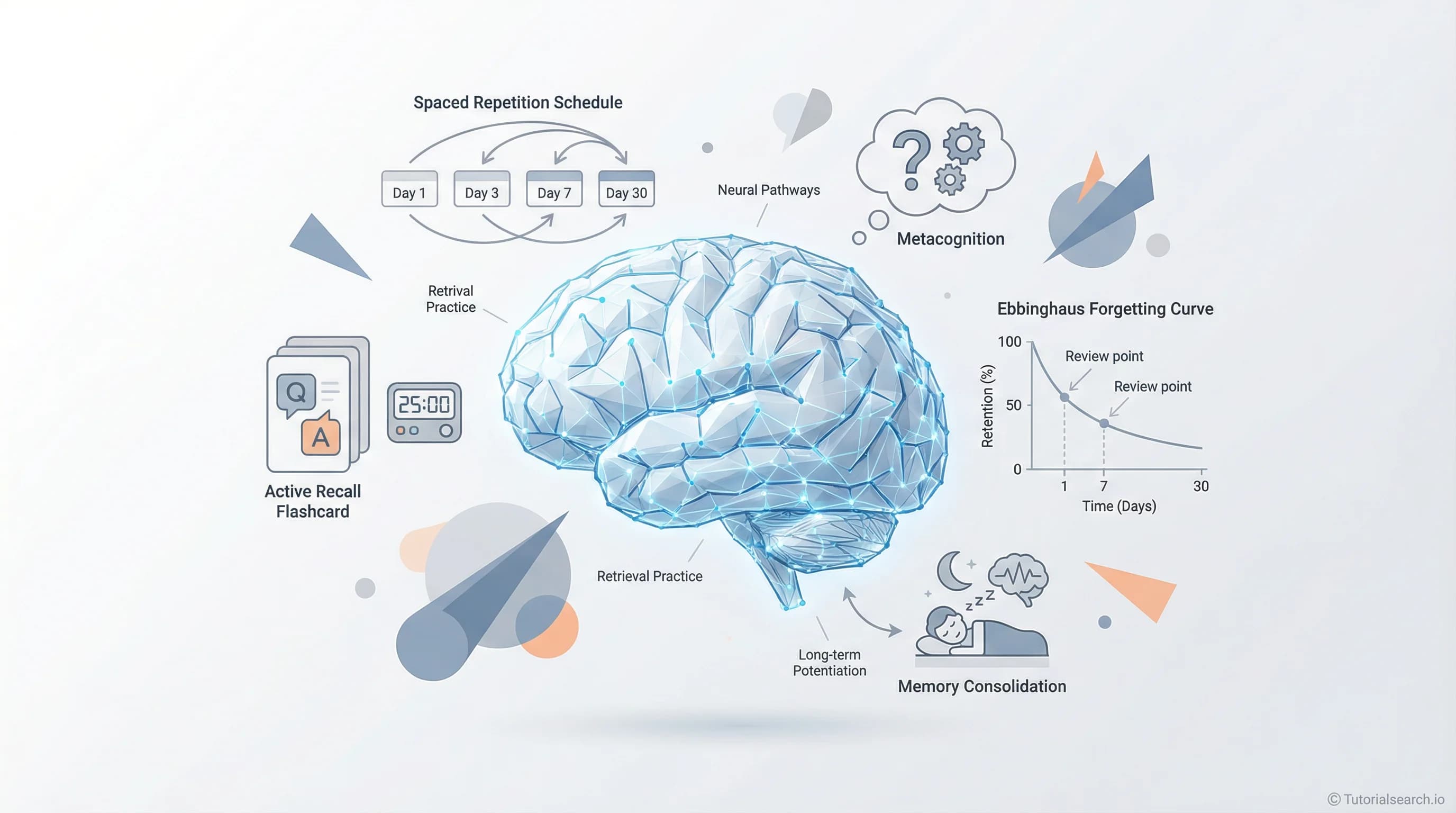
The spacing effect is perhaps the most robust finding in learning science. If you study something once, you retain about 50% after one day. If you study it three times distributed over two weeks, you retain 80% a month later. The return on that extra study time is exponential because you're leveraging how memory consolidation works. Sleep plays a critical role—it's when your hippocampus replays the day's learning and moves it to long-term storage.
Top Courses That Transform How You Learn
The Essential Triumvirate: Your Must-Take Courses
Cognitive Psychology® | Advance Memory & Learning Techniques (Udemy, 4.97/5) - [Editors' Choice]
This is the course you recommend to friends who feel their memory is "just bad." Spoiler: memory is a skill, not a trait. This course maps the cognitive science directly to actionable techniques you apply immediately. Students report 3x faster recall within two weeks. The spaced repetition framework alone justifies the price. The instructor breaks down the psychology of attention, encoding, and retrieval in ways that stick. Unlike abstract academic lectures, every concept ties to practical application.
Metacognition: Learn How to Learn Like a Genius (Udemy, 5.0/5) - [Editors' Choice]
Metacognition is your internal compass for effective learning. This course teaches you to audit your own thinking, catch yourself using bad strategies, and adjust on the fly. It's the meta-skill that makes every other learning strategy work better. Genuinely transformative if you've struggled with self-discipline in studying. You'll learn to recognize when you're slipping into illusions of competence and how to course-correct before wasting time on ineffective techniques.
Learn How to Learn: Study Smarter with Science-Backed Tools (Udemy, 4.69/5) - [Editors' Choice]
This course bridges neuroscience and productivity. It covers focus windows (not just "focus more"), the role of sleep in consolidation, and why your environment matters. The procrastination unit alone has helped thousands break through avoidance patterns. Highly practical, zero fluff. You'll learn the Pomodoro technique's neuroscience, why breaking study into chunks improves retention, and how your brain's ultradian rhythms dictate optimal study timing.
Advanced Memory & Acceleration Tracks
MEMORY PALACE - Brain's Manual for Learning Effectively (Udemy, 4.39/5)
The Method of Loci (memory palace) is ancient but devastatingly effective. Memorizers use this to recall 1,000+ digit sequences. You'll use it to remember presentations, language vocab, and facts that stick forever. This course walks you through the exact technique step-by-step. The method leverages spatial memory, which is exceptionally strong in humans. By linking abstract information to physical spaces, you piggyback on that natural strength.
Study Smart: Ultimate Guide To Studying Smarter, Not Harder (Udemy, 5.0/5)
Tactical guide to exam prep, note-taking systems, and time blocking for effective learning. The Pomodoro variant explained here includes recovery science so you don't burn out. Specifically useful if you're in school or certification prep. You'll discover how Cornell notes actually enhance encoding compared to linear note-taking, and why your note-taking system matters more than the volume of notes you take.
Learning Strategies: Smarter, Faster Study Hacks (Udemy, 5.0/5)
Rapid-fire techniques for language learning, technical skills, and creative domains. The interleaving strategy here is worth 10x the course price if you're learning anything with multiple sub-skills. Interleaving means mixing practice of different skills or concepts rather than blocking (practicing one thing at a time). This forces your brain to discriminate between related concepts, dramatically improving transfer to new problems.
For Professionals Scaling Knowledge Fast
12 Keys for Effective Learning (Udemy, 5.0/5) - [Editors' Choice]
Compressed synthesis of learning science into 12 actionable pillars. Each key is immediately applicable to work projects, side hustles, or skill stacking. Perfect for professionals who don't have semester-long attention spans. These aren't theoretical principles—they're battle-tested techniques used by top performers in every field.
The Science of Effective Learning (English) (Skillshare, 4.57/5)
Skillshare format means shorter modules. Great if you're learning while commuting. Covers the neurobiology of attention, the spacing effect, and why group study sometimes backfires. The teaching quality is exceptional. You'll understand the difference between collaborative and competitive study environments and when each helps or hurts.
Study Skills Mastery: 100+ Effective Learning Strategies (Udemy, 4.41/5)
This is your encyclopedia. 100+ specific techniques means something sticks no matter your learning style. Students report using 5-7 of these regularly. The note-taking systems section alone saves dozens of hours per year.
Browse personal development courses for additional learning resources.
Free Tools and Platforms That Fuel Effective Learning
Khan Academy - The gold standard for foundational knowledge. 15,000+ videos spanning math, science, history, and computer science. Interactive exercises with real-time feedback. The spacing is built into the algorithm. Start here if you're building fundamentals. Khan Academy's design embeds spaced repetition—they track your progress and automatically re-serve content you're weak on at the right intervals.
GCFGlobal - 200+ topics, 2,300+ lessons, entirely free. Often overlooked but the production quality rivals premium platforms. Especially strong in productivity, business, and life skills. Created by Goodwill Industries, it's designed for adult learners needing practical skills fast.
Coursera Free Courses - Audit thousands of university courses for free (certificate costs extra). MIT, Stanford, and Duke courses available. The self-paced audit option eliminates deadline pressure while preserving learning rigor. You get the same course content as paid students; you just skip the credential.
Open Culture - Curates 1,700+ free online courses plus textbooks and lectures. Discovery tool for when you don't know what platform has what you're looking for. Founded by Dan Colman, it aggregates the best free educational content from around the web.
The Free Learning List - Community-curated resources organized by skill and domain. Real learner testimonials for each resource. Constantly updated. You get crowdsourced evaluation of what actually works, not just what's prettily packaged.
Check out related learning topics like Mindset Growth and Personal Transformation for resources that complement your learning journey.
YouTube Creators Breaking Down Learning Science
Hire the developers behind TutorialSearch.io
We built this site — full-stack web apps, AI integration & automation. Tell us what you need and we'll build yours.
Khan Academy - 10 million subscribers. Their content isn't just good teaching; it demonstrates effective learning principles through pacing, repetition, and visual anchoring. Each video is tightly scoped to one concept, reinforcing the principle that focused attention on single ideas is how learning happens.
TED-Ed - Short animated lessons (5-15 min) on science, history, and critical thinking. The production design supports cognitive load theory. Each video ends with a deeper question, not an answer. This technique primes your brain to seek the answer, creating engagement that passive viewing never achieves.
Minute Physics - Henry Reich's channel proves complex topics become memorable when explained simply. His technique of starting with intuition before equations is pure effective learning pedagogy. He shows you why physics works before showing you the math, reversing the typical order.
Edutopia - George Lucas Foundation content. Interviews with teachers implementing evidence-based methods. Real classroom footage of effective learning in action. You see spaced repetition, active learning, and metacognition deployed in actual schools.
3Blue1Brown - Mathematics visualized. Every animation is designed so you see why the math works, not just how to compute it. Masterclass in making abstract concrete. Grant Sanderson's videos have become the reference for how to teach math intuitively.
GitHub Repositories for Learning Optimization
awesome-learning - 6.2k+ stars. Curated collection of learning resources across all domains. Constantly updated by the community. Perfect for discovering tools and platforms you haven't encountered. This is your meta-learning resource—learning how and where others learn best.
awesome-learning-resources - 1.8k+ stars. Organized by technology domain (web dev, data science, etc.) but the meta-learning principles apply universally. Good reference for technical skill-stacking. Laura's curation is focused on practical, proven resources.
List-of-Learning-Resources - Crowdsourced by software engineers. Includes everything from syntax cheatsheets to psychology of learning papers. Living document updated weekly. This repository captures the actual resources engineers use when learning new technologies.
Books That Rewired How Millions Learn
"Make It Stick: The Science of Successful Learning" by Brown, Roediger, and McDaniel - The definitive book translating 100 years of cognitive psychology into readable format. The chapter on "desirable difficulty" is worth reading three times. Available everywhere books are sold. These authors literally wrote the research papers on spaced repetition and retrieval practice. Their book synthesizes decades of work into actionable insight.
"A Mind for Numbers" by Barbara Oakley - Bridges the gap between the science and the struggle. Oakley makes abstract neuroscience concrete through her own story of learning math. The chunking and interleaving chapters transformed how millions approach technical subjects. She shows you how her brain was fundamentally rewired by learning science principles.
"Deep Learning" by Andrew Ng (free online) - If you want to understand how neural networks work, this is the reference. It also happens to teach effective learning principles through how it's structured. Meta-learning at its finest. Ng structures the material using the exact spacing and scaffolding principles he's teaching about.
Where Learning Communities Thrive
r/learnprogramming - 1.2 million members asking questions daily. The accountability of a community plus the asynchronous format means you get thoughtful answers, not just quick reactions. The subreddit enforces helpfulness norms that create a learning-first environment.
Discord Learning Servers - Search "study server" or "learning community." Real-time interaction, study groups, shared progress tracking. The social pressure (in a healthy way) maintains momentum. Many Discord servers organize study sessions, create accountability partnerships, and celebrate milestones.
Effective Learning on LinkedIn - Professionals sharing their learning journeys. Seeing peers commit to growth makes it contagious. Also recruiter signal when you post progress. LinkedIn's feed increasingly surfaces learning content as professionals rebuild their networks around growth.
The Learning Personality Test: Find Your Method
Not all effective learning strategies work equally well for everyone. Use this framework to identify your learning archetype:
| Learning Style | Best Techniques | Recommended Courses | Community Type |
|---|---|---|---|
| Visual | Diagrams, mind maps, video lectures | TED-Ed, 3Blue1Brown, Khan Academy | Study Discord |
| Auditory | Podcasts, discussion groups, teaching others | Udemy with high-quality narration, Reddit, study groups | Peer accountability |
| Reading/Writing | Detailed notes, summarization, blogging | Detailed textbook courses, technical blogs | Writing communities |
| Kinesthetic | Projects, building, deliberate practice | Project-based bootcamps, hands-on Udemy courses | Maker communities |
| Mixed (Most effective) | Combination approach, spaced over time | Multi-format courses like Cognitive Psychology®, peer teaching | Structured communities |
Your effective learning archetype usually combines 2-3 styles. The meta-lesson: test different approaches, track what sticks, then double down. Most top performers use multiple learning modalities because each one strengthens different neural pathways.
Your Effective Learning FAQ
How long does it take to get good at something using effective learning methods?
10,000 hours is Gladwell mythology. The real answer: deliberate practice on the specific skill you care about, spaced over time, with feedback. A piano skill might need 200 hours of deliberate practice instead of 10,000 hours of casual playing. Effective learning compresses time by 20-100x depending on the domain. The compression comes from eliminating wasted effort and focusing on high-value practice that targets your weaknesses.
Do I need formal education to learn effectively?
No. Formal education simply forces structure and feedback. You can replicate both with online courses, peer accountability, and projects. The certificate matters less than the skill. Many of the world's top performers in technical fields are self-taught using the principles in this guide.
What's the single most important tool for effective learning?
Metacognition. The ability to audit your own thinking and adjust your strategy beats every other factor. That's why the Metacognition course ranks highest—it amplifies all other techniques. Without metacognition, you can study hard but ineffectively. With it, every hour compounds.
Can I combine different learning strategies, or should I stick with one?
Combine them. Interleaving (mixing up subjects and techniques) is how your brain builds flexible knowledge. Spaced repetition, active recall, teaching others—use them all in one study session. The combination is far more powerful than any single technique in isolation.
Why do I forget everything after finishing a course?
You're not reviewing after day 1. That's when the spacing effect matters most. Review after 1 day, 3 days, 1 week, 2 weeks, 1 month. This schedule takes 10 minutes per interval. Most people skip it, then blame their memory. One study showed students who reviewed for 5 minutes on day 1 retained 100% a month later. Those who didn't review retained 20%.
Is effective learning harder than passive studying?
Yes, short-term. Harder in the moment, less hard long-term. Active recall feels uncomfortable (that's retrieval practice working). But six months later, you'll remember everything. Passive learners forget 80% in two weeks.
Related Topics for Deeper Mastery
Explore these interconnected areas to compound your learning advantage:
- Emotional Resilience - Learn to maintain focus under pressure
- Mindset Growth - Develop a growth orientation toward challenges
- Personal Transformation - Apply learning to life redesign
- Potential Unleashed - Scale from learning to mastery
- Self Empowerment - Own your learning journey
Your effective learning journey compounds exponentially. Each skill makes the next one easier because learning itself becomes a skill. Each technique you master applies to the next subject. Each community connection opens new perspectives. Start with metacognition, add spaced repetition, build your community. In three months, you'll recognize yourself.