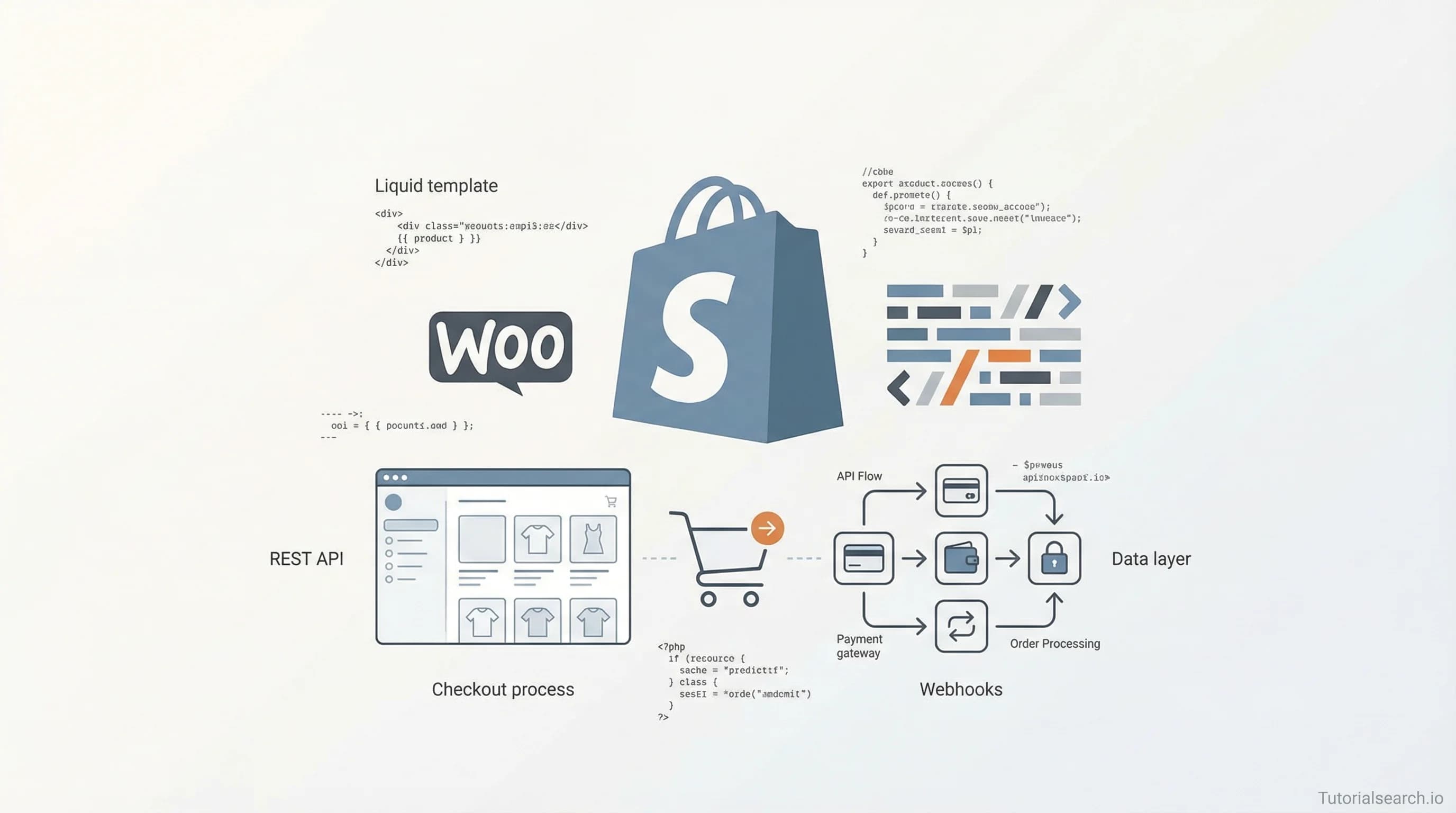
Ecommerce Development Courses I'd Recommend to a Friend
Ecommerce development is one of the most in-demand web skills you can learn. This guide covers the best courses, free resources, GitHub repos, and communities for building real online stores.
Need a web app built? Hire the team behind TutorialSearch.io
We ship fast, production-grade full-stack apps (Next.js, React, edge infra) — the same stack that powers this site.
Ecommerce development is one of the most in-demand web skills you can learn — and one of the easiest to approach in the wrong order.
The first store I tried to build had everything wrong. Checkout broken on mobile. Product images stretched and blurry. A payment form a client rejected because it looked sketchy. All because I picked a platform theme before understanding how the pieces fit together.
If you're building client stores or launching your own online business, here are the courses and resources I'd actually point a friend toward. Practical picks, honest opinions, no fluff.
Key Takeaways
- Ecommerce development covers front-end, back-end, payment integration, and product logic — it's broader than standard web development.
- The best ecommerce development courses build a complete, working store from scratch using real code.
- WooCommerce and Shopify dominate real-world projects, but core web skills transfer across platforms — platform-specific skills don't.
- Free resources from WooCommerce docs, GitHub repos, and official platform guides can take you surprisingly far before paying for a course.
- Joining an ecommerce development community cuts your learning time and surfaces client opportunities you wouldn't find alone.
In This Article
- The Ecommerce Development Courses I'd Actually Pick
- Ecommerce Development by Platform: WooCommerce, Shopify & More
- Free Ecommerce Development Resources Worth Bookmarking
- Ecommerce Development YouTube Channels That Actually Teach
- The Ecommerce Development GitHub Repos Worth Starring
- Ecommerce Development Books Worth Your Time
- Ecommerce Development Communities Where People Actually Help
- Related Ecommerce Development Skills Worth Exploring
- Frequently Asked Questions About Ecommerce Development
The Ecommerce Development Courses I'd Actually Pick
There are hundreds of ecommerce courses online. Most of them teach you to click around a Shopify admin. The ones worth your time make you write actual code and ship something you can show a client.
Here's my honest shortlist. You can also browse all 164+ courses on the ecommerce development topic page at TutorialSearch to see ratings and student counts at a glance.
1. Create an eCommerce Website Using Laravel (PHP & MySQL) [Editors' Choice]
Create an eCommerce Website Using Laravel by ABDUL VALI KHAN is the most enrolled ecommerce course in this list — over 124,000 students. That number says something real.
You build the whole thing from scratch: product catalog, user authentication, shopping cart, order management, and payment integration using PHP and MySQL. Laravel is a mature, battle-tested framework that many agencies use for custom store builds.
My honest note: Laravel isn't the most fashionable choice in 2026. If a client specifically wants a React-based headless storefront, you'll need to supplement this. But as a foundation that teaches you how ecommerce systems actually work under the hood? Hard to beat at this scale of social proof.
2. Java Spring Boot: Professional eCommerce Project Masterclass [Editors' Choice]
Java Spring Boot Professional eCommerce Masterclass by Faisal Memon (EmbarkX) has 18,500 students and a 4.55 rating. This one is not for beginners.
What makes it valuable is the target audience: Spring Boot is what large enterprises actually use for their ecommerce backends. If you want to work at a company like a major retail chain or a large marketplace — rather than doing freelance store builds — this is the framework you'll encounter. The course builds order processing, inventory management, and REST APIs to a standard that a real team would recognize.
3. Build Complete PHP MySQL Food Ordering Ecommerce Store
Build Complete PHP MySQL Food Ordering Ecommerce Store by Web Coding has 36,000+ students. The food ordering angle isn't a gimmick — it forces you to solve real ecommerce problems that a generic "build a product catalog" course skips.
Multiple user roles. Real-time order status updates. Category filtering. Time-sensitive inventory. These are the messy, practical parts of ecommerce that trip up developers who only learned from simple examples. This course handles all of it.
4. PHP for Beginners: How to Build an Ecommerce Store
PHP for Beginners: How to Build an Ecommerce Store by Edwin Diaz is the entry point if you're not yet comfortable with server-side development. It has 14,000 students and teaches PHP from scratch before adding ecommerce functionality on top.
PHP powers WooCommerce and Magento. Despite what some developers will tell you, it's not a dead language — it's just unglamorous. If your goal is agency freelance work building WooCommerce sites, PHP is the practical path.
5. Next.js React Ultimate Ecommerce Development
Next.js React Ultimate Ecommerce Development by Ryan Dhungel is the modern stack pick. If you're already comfortable with React, this bridges the gap to production ecommerce. It covers server-side rendering (SSR) — critical for SEO on product pages — and walks through a complete payment integration flow.
Next.js headless storefronts are increasingly what agencies charge premium rates for. If you want to position yourself in that niche, this is where to start.
6. Laravel - Restaurant and Food Ordering Ecommerce
Laravel Restaurant and Food Ordering Ecommerce by Web Solution US is worth mentioning alongside the PHP food ordering course above. This one uses Laravel (a PHP framework) rather than raw PHP, which gives you the experience of working with a structured codebase — the way professional teams actually build things. Over 10,000 students and consistently solid ratings.
Ecommerce Development by Platform: WooCommerce, Shopify & More
Here's an opinion that will save you time: pick one platform and go deep before touching another.
Everyone says "learn WooCommerce and Shopify." But WooCommerce is PHP, hooks, and filters. Shopify is Liquid templates and GraphQL. They share almost no overlap technically. A developer who tries to learn both at once ends up shallow at both.
Pick one. Get confident. Then branch out.
WooCommerce (WordPress)
WooCommerce powers roughly 39% of all online stores. That market share exists because it's free, it's flexible, and it runs on WordPress — which powers about a third of the web. Agencies that build ecommerce sites almost always have WooCommerce projects in the queue.
Practical eCommerce Development with WordPress & WooCommerce by Alexandr Sochirca is the highest-rated course in this roundup at 4.73. It covers custom theme development, plugin customization, performance optimization, and the WooCommerce REST API — the specific skills clients actually pay for.
The official WooCommerce developer documentation is also excellent and completely free. Hooks, filters, REST API endpoints, payment gateway integration — it's all documented. Most blog posts about WooCommerce development are just reformatted versions of these docs. Go to the source.
Beginner To Master: Complete WordPress WooCommerce Store by Kazi Ariyan is a solid companion if you're newer to WordPress itself. It takes a slower pace and covers the CMS foundation before layering on store functionality.
Shopify (Custom Development)
Shopify owns a massive slice of the SaaS ecommerce market. Most "Shopify courses" teach you to use the admin dashboard — that's not development. Real Shopify development means Liquid templates, the Storefront API, and (increasingly) custom React frontends.
React + Shopify (Headless CMS): Build a Custom Storefront by Working With Shopify covers the Storefront API, GraphQL queries, and custom React frontends. It's rated lower (3.97) than other courses here, but it covers a skill set that almost no other course touches. When a client asks for a Shopify headless storefront — and they will — this is your starting reference.
Pair it with the official Shopify developer documentation and the Storefront API reference.
A Quick Stack Comparison
| Stack | Best For | Learning Curve | Market Demand |
|---|---|---|---|
| WooCommerce (PHP) | Freelancers, agencies | Moderate | Very high |
| Shopify (Liquid/GraphQL) | SaaS + client projects | Moderate | High |
| Laravel / PHP custom | Complex custom builds | High | High |
| Next.js + headless | Modern storefronts | High | Growing fast |
| Spring Boot (Java) | Enterprise backends | Very high | Enterprise niche |
If you're interested in the broader web development landscape, ecommerce sits in the middle of the market — not as niche as embedded systems, not as commoditized as basic static sites.
Free Ecommerce Development Resources Worth Bookmarking
You don't need to spend money to get started with ecommerce development. These free resources are genuinely useful.
WooCommerce Developer Documentation (developer.woocommerce.com) [Editors' Choice]
The free official WooCommerce developer docs are where experienced WooCommerce developers actually spend their time. Plugin development guides, action hooks reference, REST API documentation, payment gateway integration — it's all here, well-maintained and searchable. Before you pay for any WooCommerce course, spend an afternoon with these docs. If they make sense, you might not need the course.
Adobe Commerce / Magento Developer Documentation (developer.adobe.com/commerce)
Magento is what large retailers use when WooCommerce isn't enough. The docs are dense and reflect that complexity. But if you're targeting enterprise ecommerce work, this is the reference you'll bookmark.
BigCommerce Ecommerce Development Guide (bigcommerce.com)
An excellent free overview of the full development lifecycle — from architecture decisions to performance optimization to deployment. Good for understanding how professional development teams think about building a store, not just the code itself.
Free Udemy: Build An eCommerce Website (udemy.com)
Zero cost and beginner-friendly. Not the deepest course, but a good first pass before committing to a paid option. Use it as a sanity check — make sure the concepts click before spending money.
Webflow Ecommerce University (university.webflow.com)
Webflow isn't the right tool for every store, but knowing it makes you more versatile as a developer. The free Webflow University ecommerce course covers the complete setup. Clients who use Webflow for their marketing site will often want the store on the same platform.
SynergyTop Ecommerce Development Roadmap (synergytop.com)
A detailed written guide to how professional development teams plan and execute ecommerce builds. Worth reading before you quote your first ecommerce project.
Ecommerce Development YouTube Channels That Actually Teach
Need a web app built? Hire the team behind TutorialSearch.io
We ship fast, production-grade full-stack apps (Next.js, React, edge infra) — the same stack that powers this site.
Most YouTube ecommerce content is about running a store, not building one. These channels lean toward the developer side.
Traversy Media (YouTube)
Brad Traversy's project walkthroughs are the closest thing YouTube has to structured ecommerce courses. Search "Traversy ecommerce" and you'll find complete builds using React, Next.js, and the MERN stack — all free, all explained clearly. He doesn't just show you what to type; he explains what the code is doing and why.
Fireship (YouTube)
Fireship's short explainers are a fast way to understand concepts before diving into a full course. His coverage of Stripe integration, GraphQL, and serverless functions fills in the gaps that most ecommerce courses skip. When you hit a concept you don't recognize mid-course, search Fireship first.
Kevin Powell (YouTube)
Kevin's channel focuses on CSS — which sounds boring until you realize that CSS is where most junior ecommerce developers fall apart. Product grids that break on mobile. Checkout forms that don't fit smaller screens. Cart UI that looks fine on desktop and terrible everywhere else. Kevin's tutorials on layouts and responsive design will save you hours of debugging.
Practical eCommerce (practicalecommerce.com)
More business-oriented than technical, but valuable for context. Understanding what drives client decisions — conversion rates, cart abandonment, mobile performance — makes you a better developer. You'll write better code when you understand what actually matters to the person paying for it.
For a broader directory of ecommerce-focused YouTube channels, this guide from Do Dropshipping covers the technical and business sides together.
The Ecommerce Development GitHub Repos Worth Starring
Open source ecommerce projects are some of the best learning material available. Reading real production code — even if you don't contribute — teaches you patterns that tutorials skip.
awesome-ecommerce by jluterek (github.com/jluterek/awesome-ecommerce)
A curated list of libraries, tools, platforms, and resources focused on ecommerce development. Categories cover payment gateways, open source platforms, analytics integrations, and more. Well-maintained and a good reference when you're evaluating libraries for a project.
awesome-e-commerce by ad-si (github.com/ad-si/awesome-e-commerce)
A broader collection of open source ecommerce platforms. Useful if you're choosing a tech stack for a new custom build or want to see how different teams have solved similar problems at scale.
GitHub e-commerce topic page (github.com/topics/e-commerce)
The GitHub topic page shows the most-starred open source storefront projects right now. Browsing it gives you a feel for what the community is actually building and which approaches are gaining momentum.
frutik/awesome-search (github.com/frutik/awesome-search)
Ecommerce search is its own specialty. Product filtering, ranking, autocomplete, and fuzzy matching have to work well or customers drop off before they buy. This repo covers the ecommerce search problem in depth.
If you're building your skills toward full stack development, contributing to an open source ecommerce project is one of the fastest ways to get practical experience that shows up on a portfolio.
Ecommerce Development Books Worth Your Time
Most ecommerce books focus on running a store, not building one. The technical reading list is genuinely short. Here's what's worth your time.
"E-Commerce 2026" by Laudon & Traver
The standard academic textbook for understanding ecommerce systems at a systems level — business models, security architecture, payment processing infrastructure, and technology decisions. Dense, but comprehensive. Good if you want to understand the full picture before specializing.
"WooCommerce Cookbook"
A practical, recipe-style reference for WooCommerce development. The format — problem, solution, code — makes it faster to consult than docs when you're stuck mid-project. Not available free, but the focused structure makes it worth the cost if you're doing consistent WooCommerce work.
Shopify's Ecommerce Books List (shopify.com)
Shopify maintains an updated list of recommended ecommerce books covering business strategy, UX, and technical architecture. Most skew toward the business side, but several cover conversion design and platform-specific development in useful depth.
Cloudways Ecommerce Books Roundup (cloudways.com)
More technically oriented than Shopify's list. Worth checking for specific focus areas like performance optimization or security.
Ecommerce Development Communities Where People Actually Help
Learning ecommerce development in isolation is slower than it needs to be. These communities have experienced developers who answer real questions.
r/ecommerce (Reddit)
A mix of store owners and developers. The conversations are practical — real problems, real clients, real edge cases. Reading through threads shows you what clients actually ask for, which shapes what you should prioritize learning. The web development section on TutorialSearch pairs well with things you find in these threads.
WooCommerce Community Forums (wordpress.org)
Official, searchable, and enormous. If you're developing on WooCommerce, the answer to your specific problem has almost certainly already been posted here. Search before you ask.
Shopify Partners Community
Specifically for developers and agencies building on Shopify. The level of technical conversation is noticeably higher than generic ecommerce forums. Worth joining if you're targeting Shopify client work.
Ecommerce Discord Servers (whop.com)
There are now dozens of active ecommerce Discord communities. Some focus on dropshipping and business, but developer-specific servers for WooCommerce, Shopify, and headless builds do exist. This roundup from Whop is a reasonable starting point for finding the right one.
Related Ecommerce Development Skills Worth Exploring
Ecommerce development doesn't exist in isolation. These skills directly complement it:
- Full Stack Development — Most ecommerce projects require solid skills on both front and back end. Ecommerce work is a natural landing zone for full stack developers.
- Front-End Development — Checkout flows, product grids, and cart UI are where conversion rates are won or lost. Strong front-end skills directly impact the business results your clients see.
- WordPress Development — WooCommerce is built on WordPress. If you're going the WooCommerce route, WordPress development skills aren't optional.
- Front-End Frameworks — Headless storefronts increasingly use React, Vue, or Svelte. Knowing a front-end framework opens up the higher-paying tier of ecommerce projects.
- Web Applications — At their core, ecommerce stores are complex web applications. Strong web app fundamentals make every ecommerce build cleaner.
- Website Development — General web development skills form the foundation everything else builds on.
- Web Site Creation — If you're just getting started with web development before specializing in ecommerce, this is worth exploring.
You can also search for ecommerce tutorials across all platforms on TutorialSearch, or filter by skill level and price.
Frequently Asked Questions About Ecommerce Development
How long does it take to learn ecommerce development?
Most developers reach a working skill level in 3–6 months with consistent practice. The timeline depends heavily on your existing web development experience. Someone who already knows PHP or JavaScript will move faster than someone starting from zero.
Do I need to know HTML and CSS before starting ecommerce development?
Yes — and JavaScript helps a lot too. Ecommerce development builds directly on general web skills. If you're starting from scratch, invest time in front-end development fundamentals before jumping into platform-specific courses.
Can I get a job with ecommerce development skills?
The job market is consistently strong. Agencies that build client stores are always hiring, and in-house ecommerce teams at retail companies need developers who understand both the technical and business sides. WooCommerce and Shopify skills are especially in demand for freelance and agency work. Spring Boot and enterprise ecommerce skills open doors at larger companies.
What platforms are best for ecommerce development?
WooCommerce and Shopify cover the majority of real-world projects. WooCommerce is better for complex, highly customized stores. Shopify is faster to deploy and easier to hand off to non-technical clients. Magento (Adobe Commerce) is the choice for large enterprise projects. Headless setups using Next.js are gaining market share for teams that want full control over the frontend.
How does ecommerce development differ from regular web development?
Standard web development builds pages, apps, and user interfaces. Ecommerce development adds shopping cart logic, payment processing, product and inventory management, order fulfillment, and conversion optimization. That additional complexity means ecommerce developers typically command higher rates than generalist web developers.
What is the role of APIs in ecommerce development?
APIs (Application Programming Interfaces) let your store connect to outside services — payment processors like Stripe or PayPal, shipping carriers, marketing platforms, and inventory systems. Almost every professional ecommerce build uses multiple APIs. Understanding REST APIs and, increasingly, GraphQL is a core ecommerce development skill.
Ecommerce development is a practical investment in a skill set that businesses will always need. Online stores aren't going away, and developers who can build and customize them — rather than just configure dashboards — will stay in demand. Pick one solid course, build something real, and layer in platform knowledge from there. The learning compounds quickly once you have that first working store under your belt.