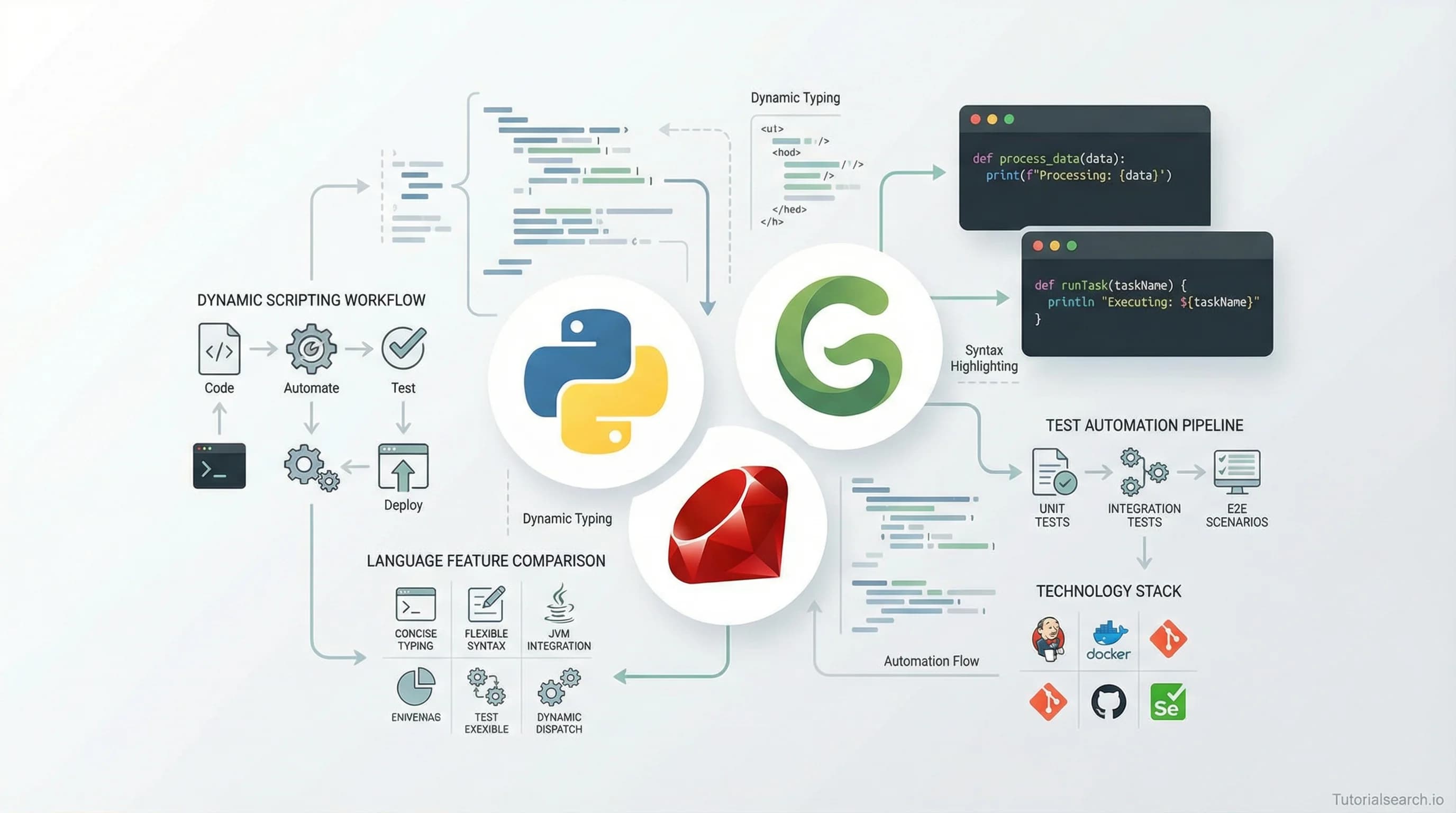
Master Dynamic Languages: From Groovy Automation to Production Systems
Learn why dynamic languages like Groovy power automation and testing at scale. Discover practical strategies for production use, real team experiences, and when dynamic beats static.
Need a web app built? Hire the team behind TutorialSearch.io
We ship fast, production-grade full-stack apps (Next.js, React, edge infra) — the same stack that powers this site.
Dynamic languages shape how we build software today. Whether you're automating tests, scripting deployments, or prototyping quickly, languages like Groovy, Python, Ruby, and JavaScript give you power without ceremony.
But what makes them "dynamic"? And when should you actually use them instead of static alternatives? This guide cuts through the hype and gives you a realistic roadmap for mastering dynamic languages from concept to production code.
Key Takeaways
- Dynamic languages check types at runtime, enabling rapid development and flexibility
- Groovy brings dynamic power to Java's ecosystem for testing and scripting
- The "dynamic vs. static" debate misses the point—use the right tool for each job
- Performance and maintainability aren't guaranteed sacrifices; it's about discipline
- Real mastery means understanding when dynamism helps and when it hurts
In This Article
- Runtime Type Flexibility: Freedom and Consequences
- Groovy: The Bridge Between Java and Simplicity
- Dynamic Languages Transforming Test Automation
- Building Confidence in Dynamically Typed Code
- The Scripting and Automation Advantage
- When to Choose Dynamic Over Static
- Common Mistakes Dynamic Language Learners Make
- Community Standards and Best Practices
- FAQ
- Related Learning Topics
Understanding Runtime Type Flexibility: What "Dynamic" Actually Means
When we talk about dynamic languages, we're talking about type checking. Most programming happens in two paradigms: compile-time (static) and runtime (dynamic).
Static languages like Java and C# demand you declare variable types upfront. The compiler checks everything before your code runs. If you try to add a number to text, you get a compilation error—problem solved before deployment.
Dynamic languages defer this checking until your code executes. Variables accept any value. You can reassign the same variable to hold an integer, then a string, then an object. The language figures it out as code runs.
This flexibility creates two distinct advantages. First, you write less boilerplate. No verbose type declarations cluttering every function signature. Second, you iterate faster. You write code, run tests, change behavior—all without compilation delays.
But this freedom demands discipline. Runtime errors hide until code paths execute. A type mismatch stays undetected until a user hits that code branch. That's where testing and careful design become critical.
The best dynamic languages intentionally balance flexibility with clarity. They give you enough structure to build reliable systems while keeping syntax lean.
Groovy: The Bridge Between Java and Simplicity
Apache Groovy occupies a unique space. It's a dynamic language that runs on the Java Virtual Machine (JVM), meaning it integrates seamlessly with existing Java code and libraries.
For Java developers, this is powerful. You keep your investment in the Java ecosystem while gaining dynamic language benefits. You write less code. You express ideas more concisely. You automate testing without heavyweight syntax.
Consider a simple example. Java requires explicit type declarations:
List<String> names = new ArrayList<>();
names.add("Alice");
Groovy accomplishes the same with less friction:
def names = ["Alice"]
The def keyword tells Groovy to infer the type. You get type safety when it matters and flexibility when you need to move fast.
Groovy's real strength emerges in scripting and testing. The Complete Apache Groovy Developer Course by Dan Vega covers this comprehensively. With almost 14 hours of content, it takes you from basics through metaprogramming—the ability to write code that modifies itself at runtime. [Editors' Choice]: This course earns top recognition because it balances practical examples with deep language understanding, making it ideal whether you're automating tests or building DSLs (Domain-Specific Languages).
Official Groovy documentation provides the authoritative reference. The single-page documentation guide covers everything from basics through advanced metaprogramming and testing frameworks.
Dynamic Languages Transforming Test Automation
Where dynamic languages truly shine is test automation. Writing tests demands clarity above all. The code should express intent, not compiler rules.
Spock is a Groovy-based testing framework that revolutionizes how teams write tests. Instead of traditional JUnit structure, Spock uses a specification DSL (domain-specific language) that reads almost like documentation.
Notice how specification-driven testing tells a story. Given some setup, when we perform an action, then we verify an outcome. New team members understand the test logic without expertise in testing frameworks.
REST Assured. API test automation for beginners by Dmitry Shyshkin demonstrates how dynamic approaches simplify complex testing scenarios. [Editors' Choice]: This course teaches API testing for beginners with 4.5+ rating and 8,000+ students, emphasizing readable test code over boilerplate.
The Groovy testing guide from Apache covers Spock, JUnit integration, and modern testing practices. Free and comprehensive.
Building Confidence in Dynamically Typed Code
The biggest concern engineers voice about dynamic languages is correctness. Without compile-time type checking, how do you prevent bugs?
The answer: discipline and testing. A single practice separates weak dynamic codebases from robust ones: comprehensive test coverage.
In static languages, the compiler is your first safety net. In dynamic languages, tests become that safety net. This isn't weakness—it's different. Many teams using dynamic languages actually write more tests because tests are their primary defense.
Tools amplify this. Python's type hints and Groovy's optional type declarations let you specify types where it matters without mandating them everywhere. You get the strictness you need and flexibility where you want it.
Best practice: start with dynamic typing. If a section of code gets complex or error-prone, add type hints or move to a static language for that component. The hybrid approach works.
Consider Dynamic C# 7 Fundamentals by Jason Roberts, which explores dynamic features within a statically-typed language. This reveals how modern languages blur the static/dynamic boundary. [Editors' Choice]: Roberts' course shows that the strict dichotomy between static and dynamic is outdated.
The Scripting and Automation Advantage
Automation is where dynamic languages dominate. DevOps teams, build engineers, and QA specialists choose dynamic languages because they cut development time dramatically.
Groovy powers two major automation platforms: Jenkins (the industry standard CI/CD server) and Gradle (the build automation tool used by millions of Android developers). These aren't academic choices—they're production systems managing mission-critical deployments.
Why Groovy for these tools? Because writing build logic or pipeline configuration in verbose static syntax would be torture. Groovy lets engineers express complex automation intent concisely.
Groovy Step by Step for Beginners teaches this practical automation approach. Coverage includes installation, IDE setup, file I/O, and object-oriented programming—all essentials for real automation work.
Free resource: TutorialsPoint's Groovy tutorial covers basics through object-oriented programming without requiring purchase.
When to Choose Dynamic Over Static
The choice between dynamic and static languages isn't about technical purity—it's pragmatism.
Choose dynamic languages when:
- You're prototyping and exploring solutions
- Time to deployment matters more than runtime milliseconds
- Your team values readability over compile-time guarantees
- You're building automation, scripts, or configuration logic
- The codebase is small or medium-sized with solid testing
- You need rapid iteration on APIs or data processing
Choose static languages when:
- You're building systems requiring proven correctness
- Type safety prevents entire categories of bugs
- Your codebase spans millions of lines maintained by large teams
- Performance is critical and optimization matters
- You want compile-time catches for problems
The reality: most successful systems use both. You might use Python for data pipelines and Go for the serving layer. Java backends with Groovy test automation. JavaScript frontends with TypeScript for type safety.
Modern Languages explores this ecosystem. The best engineers master multiple approaches and choose deliberately.
Common Mistakes Dynamic Language Learners Make
Need a web app built? Hire the team behind TutorialSearch.io
We ship fast, production-grade full-stack apps (Next.js, React, edge infra) — the same stack that powers this site.
Having coached teams through dynamic language adoption, I've seen predictable patterns that derail projects.
Mistake One: Skipping Testing. Static language developers sometimes assume dynamic languages need fewer tests. Wrong. Tests become your compiler. Weak testing turns dynamic's flexibility into liability.
Mistake Two: Ignoring Type Hints. When your language offers optional typing (Python's type hints, Groovy's type declarations), using them isn't surrender. They're powerful tools. Use them in critical sections.
Mistake Three: Assuming Performance Equals Slowness. Dynamic languages are slower than optimized static code. But modern JVMs and runtimes are sophisticated. Groovy runs at near-Java speeds on the JVM. Python with PyPy gets competitive with statically-compiled code. The real cost is usually design, not dynamism.
Mistake Four: Letting Code Get Too Clever. Dynamic languages enable metaprogramming and clever tricks. Just because you can write magical code doesn't mean you should. The best dynamic code is readable dynamic code. Choose clarity.
Mistake Five: Not Learning the Ecosystem. Each dynamic language comes with conventions and libraries that solve common problems. Ignoring them means reinventing constantly. Learn the idioms.
Real anecdote: I once reviewed a large Groovy codebase with exactly three tests covering hundreds of methods. The developers loved dynamic flexibility. But without testing discipline, they had no confidence in changes. Adding comprehensive tests transformed the project.
Community Standards and Best Practices
Successful dynamic language teams establish standards early.
Naming conventions matter more. With runtime typing, clear names act as implicit documentation. A method named processUserInput() should validate and return user input. Names encode type information your language won't enforce.
Documentation is non-negotiable. Since the compiler won't infer everything, write clear docstrings. Explain what types methods expect and return. Many dynamic languages have documentation generation tools (Groovy has GroovyDoc).
Testing is your contract. Tests document expected behavior better than any spec. When tests are comprehensive, future developers understand the system's guarantees.
Use linters and static analysis. Tools like SonarQube analyze dynamic code for patterns suggesting bugs. They're not compilers, but they catch surprising issues.
Version pinning prevents surprises. Dynamic languages don't enforce compatibility. If you depend on a library that updates and changes behavior, your code breaks. Pin versions explicitly.
Dynamic Languages in Real Data Work
Data processing is where dynamic languages shine. Python dominates machine learning and data science because dynamism accelerates experimentation.
Data Science with Julia (Part I) by Dr. İlker Arslan introduces Julia, a language specifically designed for dynamic numerical computing. [Editors' Choice]: Julia is a modern dynamic language built from the ground up for performance-critical data work. This course bridges the gap between traditional dynamic languages and high-performance computing.
Programming with Julia also by Dr. Arslan covers fundamentals with 5,000+ students. Julia represents the evolution of dynamic language thinking—strict JIT compilation paired with dynamic syntax.
The broader lesson: dynamic languages in data science aren't slower despite their reputation. Modern implementations use just-in-time (JIT) compilation to optimize hot code paths at runtime. Performance becomes comparable to static languages while retaining dynamic flexibility.
Contrarian Take: Dynamic Languages Aren't Just for Startups
There's a narrative that dynamic languages are for prototypes and scrappy startups while enterprise systems demand static languages. This is outdated.
Netflix runs massive Python systems. Dropbox uses Python at scale. Twitter, despite rewriting in Scala, runs enormous Ruby infrastructure. Airbnb built a billion-dollar business on dynamic languages.
The difference isn't the language—it's discipline. Successful organizations using dynamic languages maintain:
- Rigorous testing practices
- Strong type annotations where needed
- Clear architectural boundaries
- Performance monitoring from day one
- Documentation standards
- Code review discipline
These practices work equally well for static languages. The real separator between chaos and order is engineering discipline, not language choice.
Comparison Table: Dynamic vs. Static Trade-offs
| Aspect | Dynamic | Static |
|---|---|---|
| Development Speed | Fast, less boilerplate | Slower, more structure |
| Type Safety | Runtime errors possible | Compile-time guarantees |
| Flexibility | High, easy refactoring | Less flexible, requires planning |
| Performance | Good with JIT, varies | Generally faster |
| Learning Curve | Gentler for beginners | Steeper, but pays off |
| Scaling Systems | Needs discipline | Aided by type system |
| Testing Burden | Higher coverage needed | Lower coverage sufficient |
The choice isn't absolute. Many projects benefit from hybrid approaches.
Essential Free Resources for Dynamic Languages
Beyond paid courses, free resources abound.
Apache Groovy official documentation provides single-page references for all language features.
Baeldung's Groovy guides offer practical tutorials on common tasks.
Derek Banas' YouTube tutorial teaches Groovy fundamentals through video.
Guru99's Groovy tutorial covers scripting basics for beginners.
GitHub's awesome-programming-languages list curates dynamic languages worth learning.
Crafting Interpreters is a free, complete book on implementing scripting languages.
YouTube Channels and Learning Playlists
Class Central's Groovy courses aggregates free and paid Groovy learning resources.
Greach conference (Groovy community conference) publishes talks on YouTube covering advanced topics.
Dan Vega's content (creator of the popular Groovy course) offers free blog posts and videos.
Books for Deeper Understanding
Structure and Interpretation of Computer Programs (SICP) by Abelson, Sussman, and Sussman remains the canonical text on language design using a Lisp-like dynamic language.
Essentials of Programming Languages by Friedman, Wand, and Haynes teaches language concepts through building interpreters.
Types and Programming Languages by Benjamin C. Pierce explores the type system theory underlying both dynamic and static languages.
Crafting Interpreters by Robert Nystrom (free online) shows how modern languages implement dynamic behavior.
FAQ
Q: Are dynamic languages slower than static languages?
A: Not inherently. Modern JVMs and runtimes use just-in-time compilation to optimize dynamic code. Groovy runs at near-Java speeds. Python with PyPy approaches compiled performance. The difference is usually negligible for most workloads.
Q: Can I use dynamic languages in production systems?
A: Absolutely. Netflix, Dropbox, GitHub, and thousands of major systems run on dynamic languages. The requirement is discipline: comprehensive testing, monitoring, and clear architecture.
Q: Should I learn a dynamic language or static language first?
A: Both have merit. Static languages teach you type discipline from the start. Dynamic languages let you focus on logic without type ceremony. Most developers benefit from learning both perspectives.
Q: How do I catch bugs in dynamic languages without compile-time checks?
A: Testing is primary. Use linters and static analysis tools as secondary checks. Add type hints in critical sections. Many teams find that comprehensive testing actually prevents more bugs than type systems.
Q: Is Groovy only for testing?
A: No. Groovy excels at testing and scripting, but it's also used for web applications, build automation (Gradle), and continuous integration (Jenkins). It's a general-purpose dynamic language.
Q: Can I mix dynamic and static code?
A: Yes. Groovy runs on the JVM alongside Java. Python integrates with C extensions. You can use each where it fits best.
Q: How do I transition from static to dynamic language development?
A: Embrace testing as your safety net. Learn the language's idioms and conventions. Start with small projects. Gradually build confidence in dynamic patterns.
Related Learning Topics
Explore these related areas to deepen your understanding:
- Modern Languages — Discover languages built on dynamic principles
- Python Basics — Master the most popular dynamic language
- JavaScript Development — Learn the dynamic language powering the web
- Programming Fundamentals — Solidify core concepts across all languages
- Automation Development — Master scripting for DevOps and CI/CD
Dynamic languages aren't a phase. They're a proven approach used by companies at every scale. Master them with the discipline they deserve.