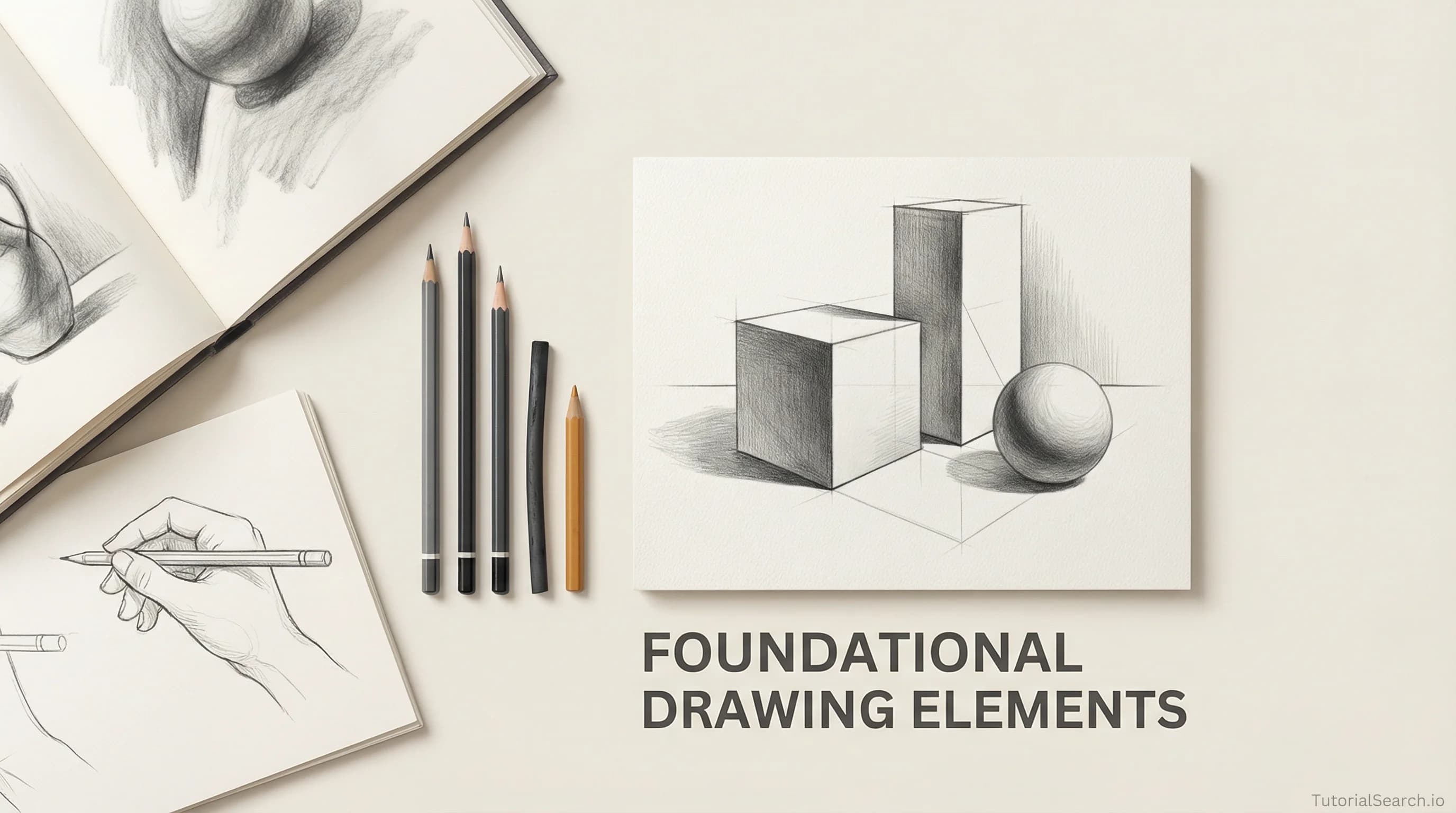
Drawing Fundamentals: Master the Core Skills Every Artist Needs
Master the five core pillars of drawing fundamentals—observation, line quality, form, value, and composition. Learn how consistent practice transforms anyone into a skilled artist, with practical exercises and a 30-day learning plan.
Hire the developers behind TutorialSearch.io
We built this site — full-stack web apps, AI integration & automation. Tell us what you need and we'll build yours.
Building foundational drawing skills is one of the most rewarding journeys an artist can take. Whether you're picking up a pencil for the first time or returning after years away, drawing fundamentals form the bedrock that makes every other artistic pursuit possible. The good news? These core skills are learned, not inherited. I first discovered this the hard way during an art class in my twenties. I'd convinced myself I couldn't draw—that talent determined everything. After a patient instructor showed me I could improve through deliberate practice, I spent the next three months focused entirely on fundamentals. By week four, my family couldn't believe the transformation. That experience changed how I think about learning entirely.\n\nDrawing fundamentals aren't about talent. They're about developing your ability to see clearly, translate what you observe onto paper, and communicate visually. When you understand line quality, form, value, and composition, you stop struggling with "why doesn't this look right?" and start building confidence with each sketch.\n\n> Key Takeaways\n> - Drawing fundamentals encompass observation, line work, form, value, and composition—core skills that unlock all artistic styles\n> - Mastering these core principles takes consistent practice over weeks and months, not inherent talent\n> - Start with observation exercises and basic shapes before moving to complex subjects\n> - Value and shading transform flat drawings into three-dimensional compositions\n> - Your unique drawing style emerges naturally once fundamentals are solid\n\n## Table of Contents\n1. The Five Core Pillars of Drawing Fundamentals\n2. Observation: Learning to See Like an Artist\n3. Line Quality: The Foundation of Confident Sketching\n4. Form and Value: Creating Three-Dimensional Drawings\n5. Composition and Balance: Arranging Your Visual Ideas\n6. From Theory to Practice: Your First 30 Days\n7. Common Mistakes Beginners Make (And How to Avoid Them)\n8. The Role of Perspective in Drawing Fundamentals\n9. Choosing the Right Materials\n10. Building Your Consistent Practice Routine\n11. Top Courses for Structured Learning\n12. FAQ\n13. Related Topics\n\n## The Five Core Pillars of Drawing Fundamentals {#five-core-pillars}\n\n[Editors' Choice] Drawing fundamentals rest on five interconnected skills that work together to create compelling artwork. Think of them as the foundation of a house—without solid ground, the walls won't stand.\n\nObservation teaches you to really see. Most people look, but artists observe. You analyze how light falls, how shadows sit underneath forms, and how proportions relate to each other. Observation isn't passive; it's active analysis. The famous artist Betty Edwards dedicated an entire methodology to training the observational eye, understanding that most people who claim they can't draw simply haven't trained their observation skills.\n\nLine quality is about control and intention. A confident line drawn with awareness creates a different feeling than a tentative, shaky line. Professional artists make their lines count—each one serves a purpose, whether suggesting form, creating texture, or defining edges. This skill separates amateur work from professional work more than most people realize.\n\nForm is understanding that objects in the real world are three-dimensional. On your paper, you're creating the illusion of depth using techniques like overlapping, size changes, and perspective. This isn't magic; it's systematic representation. Every object has mass, structure, and volume—learning to represent these qualities is form mastery.\n\nValue refers to how light or dark something is. Beginners often skip this crucial skill, but value is what makes drawings pop off the page. The contrast between light and shadow creates visual interest and three-dimensionality. Without value, even perfectly drawn objects feel flat and lifeless.\n\nComposition is the arrangement of elements. Where do you place your subject? What draws the viewer's eye first? Composition is the choreography of your drawing—it guides the viewer through your work intentionally. Great drawing fundamentals combined with weak composition creates missed opportunities for visual impact.\n\n## Observation: Learning to See Like an Artist {#observation-seeing}\n\nHere's something most drawing tutorials skip: observation is harder than execution. You can learn to draw a line. Learning to see what's actually in front of you? That takes practice.\n\nWhen you look at a hand, you don't see five fingers and a palm. You see interconnected forms with varying lighting, overlapping planes, and relationships in space. The ability to break down what you see into these components is observation. This distinction between looking and observing separates beginners from professionals more than almost anything else.\n\n[Editors' Choice] A famous exercise from art schools worldwide is blind contour drawing. Without looking at your paper, you draw the outline of an object while watching it continuously. This disconnects your "I know what a hand looks like" brain from your "what am I actually seeing" eyes. The results are usually messy and weird. That's the point. You're training your observation muscle. Most artists who practice this exercise report that their drawings become noticeably more accurate within days.\n\nAnother essential exercise involves drawing from observation for just 10-15 minutes daily. Set a timer, pick an object, and draw it without pressure to create finished artwork. The object is observation, not perfection. Over weeks, you'll notice your drawings become more accurate simply because you're training your eye. This daily observation practice, if done consistently, produces results faster than occasional long drawing sessions.\n\nProfessional artists spend years developing observation skills. This isn't a beginner shortcut—it's a career-long practice. The difference between amateur and professional work often comes down to observation accuracy. Even after decades, professional artists continue to refine their observational abilities, understanding that perception can always deepen.\n\n## Line Quality: The Foundation of Confident Sketching {#line-quality-foundation}\n\nYour line tells a story about your confidence. A timid, barely-there line communicates uncertainty. A confident line, even if slightly imperfect, communicates control. This psychological dimension of mark-making matters far more than technical perfection in early drawings.\n\nImproving line quality starts with understanding speed and pressure. A slow, hesitant line wavers. A line drawn with confident speed flows naturally. This seems backwards—shouldn't careful lines be better? Actually, your hand knows what to do when you commit. Dancers move more gracefully with commitment. Musicians play with more musicality when confident. Likewise, artists draw cleaner lines when decisive.\n\nTry this exercise: draw a line across a page as confidently and smoothly as possible in one motion. Now draw the same line slowly and carefully. Compare them. The fast line is usually cleaner. Speed plus intention equals quality lines. This counterintuitive discovery often surprises beginners, but it's one of the most practical insights in drawing fundamentals.\n\nPressure control matters too. Some lines should be lighter (construction lines, soft edges) and others darker (final outlines, emphasized edges). Beginners often press equally hard with every line, creating flat, uninformative drawings. Professional artists vary pressure deliberately, using line weight to suggest form, create hierarchy, and guide the viewer's eye.\n\nA technique called "ghosting" helps train line confidence. Before committing to a visible line, lightly sketch it multiple times. This trains your hand to know where it's going, so when you draw the final line, it's confident and clean. Professional concept artists use this technique consistently, understanding that confident lines communicate professionalism and control.\n\n## Form and Value: Creating Three-Dimensional Drawings {#form-value-3d}\n\nForm and value are the dynamic duo of three-dimensional representation. Form is the structure; value is the lighting that reveals it. Understanding both transforms flat sketches into dynamic, dimensional artwork.\n\nWhen you understand form, you understand that objects aren't flat. A sphere isn't just a circle—it's a three-dimensional ball with a consistent light source revealing its roundness. A head isn't a flat oval—it's a complex form with multiple planes that angle toward or away from light. This fundamental shift in thinking changes everything about how you approach drawing.\n\nValue brings form to life. Without value, even perfectly proportioned drawings look flat and lifeless. With value, they jump off the page. This is why many illustration fundamentals courses emphasize value studies before moving to color—the underlying structure of light and shadow determines visual impact regardless of color choices.\n\nThe fundamental principle: light creates value contrast. Where light hits the form, you get light values. Where light is blocked, you get shadow. The transition between light and shadow reveals the form's structure. This principle applies universally—whether drawing faces, landscapes, or still lifes.\n\nA simple exercise demonstrates this power: draw a sphere using only outline (no shading). It's a circle. Now add subtle shading that suggests roundness. The same circle becomes an actual sphere. That transformation is value at work. Try this with cubes, cylinders, and more complex objects. Each time, shading transforms flat shapes into three-dimensional forms.\n\nProfessional artists understand light direction before they start. Where is the light coming from? This determines everything about value placement. Inconsistent lighting creates confusion. Consistent lighting creates clarity. Many professionals establish their light source explicitly before beginning, treating it as a foundational decision that affects everything downstream.\n\n[Editors' Choice] Begin value studies by working in grayscale. Take a photo, set up an object, or reference artwork from your favorite illustration courses. Don't worry about accuracy; focus on the range of values from lightest light to darkest dark. Practice squinting—when you squint at a subject, details fade and values clarify. This helps you see the big value shapes before details distract you. This single practice accelerates understanding of value structure more than hours of technical explanation.\n\n## Composition and Balance: Arranging Your Visual Ideas {#composition-balance}\n\nComposition is planning before you mark the paper. It's the difference between sketches that feel balanced and sketches that feel chaotic or boring. Many beginning artists treat composition as an afterthought, then wonder why their drawings don't capture attention.\n\nBasic composition principles include the rule of thirds, balance (symmetrical and asymmetrical), and focal points. The rule of thirds divides your paper into nine sections, and interesting compositions often place important elements on the intersecting lines rather than dead center. This isn't magical—it's about natural eye movement and how human brains process visual information.\n\nBut composition goes deeper than rules. It's about intention. Where do you want the viewer's eye to go first? What path do you want them to follow? Are you creating rhythm, tension, harmony? Rules provide starting points; intention creates art. The best compositions feel inevitable, as though the artist had no choice but to arrange elements exactly as they did.\n\nAsymmetrical balance feels more dynamic than symmetrical balance. Three objects feel more interesting than two or four. Odd numbers work because our brains find them more pleasing (this isn't a magic rule—it's about perception). Understanding why these principles work helps you apply them intentionally rather than memorizing rules mechanically.\n\nA practical exercise: collect images you love. Don't analyze why you love them yet. After collecting 10-15 images, analyze their compositions. Where are focal points? How are elements balanced? What draws your eye? Patterns emerge. Absorbing good composition naturally improves your intuition. Many professional illustrators report that this passive compositional training accelerates their instinctive understanding.\n\n## From Theory to Practice: Your First 30 Days {#practice-30-days}\n\nUnderstanding fundamentals is great. Applying them daily transforms your drawing. Theory without practice is philosophy; practice without theory is mechanical repetition. The magic happens when both combine.\n\nWeek 1 focuses on observation and line quality. Each day, spend 15 minutes on blind contour drawing, 10 minutes on confident line exercises, and 10 minutes observing something simple (an apple, a cup, a hand). Nothing needs to be beautiful—the goal is consistency and observation development. Track what you observe: how does the light fall? Where are the darkest darks? How do edges vary?\n\nWeek 2 introduces form and basic shapes. Draw spheres, cubes, and cylinders with shading. Understand how light reveals form. Add simple value to your daily observations from week 1. Still 35 minutes daily. Consistency beats intensity. By the end of week two, your sphere drawings should show clear progression from early attempts to more dimensional forms.\n\nWeek 3 combines everything. Draw simple still lifes using observation, line quality, form, and value. Take a cup, an apple, and a cloth. Spend 30 minutes on one drawing emphasizing all five fundamentals. This integration week builds neural connections between separate skills. Your drawings at week three often show dramatic improvement compared to week one.\n\nWeek 4 introduces composition. Draw the same still life from different viewpoints. Crop tightly, zoom out, shift elements. Spend time planning composition before drawing. By week's end, you'll notice clear improvement in accuracy, confidence, and visual communication. Many artists report that their week-four drawings feel like genuine artwork, not just exercises.\n\nThis 30-day journey isn't about finishing masterpieces. It's about building neural pathways. Your brain and hand are learning to communicate. Consistency matters far more than session length. Some artists find that shorter, more frequent sessions build skills faster than occasional longer sessions. Find what works for your schedule and stick with it.\n\n## Common Mistakes Beginners Make (And How to Avoid Them) {#common-mistakes}\n\nSkipping observation for imagination. New artists often draw from memory or convention. "I know what a hand looks like" leads to generic, inaccurate hands. Instead, observe. Reference. Draw from life. Your unique observation creates unique accuracy. This mistake accounts for more failed drawings than almost any technical deficiency.\n\nNeglecting value. Many beginners spend weeks on outline work without value. Then they add value as an afterthought. Integrate value from the start. Understand that value conveys form, depth, and visual interest. Starting with value planning rather than adding it later creates dramatically better results.\n\nInconsistent light direction. Your light source determines everything about value placement. Decide your light direction immediately. Never let it shift midway through a drawing—this creates visual confusion. Even professional artists establish this before starting, understanding that confusion about light destroys the illusion of three-dimensionality.\n\nAvoiding gesture and movement. Still life teaches form, but gesture drawing teaches life. A figure drawn with accurate proportions but no sense of movement feels stiff. Study gesture alongside fundamentals. Spend time on fast, loose gesture drawings (30 seconds to 5 minutes). Gesture work balances technical precision with expressive freedom.\n\nWaiting for perfection before moving forward. Fundamentals develop through repetition, not refinement. A hundred 10-minute sketches teach more than five hours spent perfecting one drawing. The quantity-to-quality ratio in learning art is inverted compared to many other skills. More drawings beat longer sessions consistently.\n\nPerfectionism strangling daily practice. The biggest mistake beginners make is stopping when drawings don't match their vision. Your vision improves with practice. Early drawings won't be masterpieces—that's normal. Press forward. Every skipped day resets momentum. Every completed sketch, no matter how imperfect, builds skill.\n\n## The Role of Perspective in Drawing Fundamentals {#perspective-role}\n\nPerspective is the technical skill that transforms flat objects into dimensional space. It's systematic, learnable, and essential. Many artists initially fear perspective, but it's actually one of the most logical drawing fundamentals once you understand the underlying principles.\n\nOne-point perspective occurs when parallel lines converge to a single vanishing point. Two-point perspective uses two vanishing points. Three-point perspective adds vertical vanishing points. These aren't random rules—they mirror how human vision works. Understanding the mathematics behind perspective helps it feel less arbitrary and more inevitable.\n\nUnderstanding perspective isn't about memorizing rules. It's about understanding how objects recede into space. A road stretches to the horizon. Telephone poles get smaller as they recede. Parallel lines appear to converge. This is perspective. When you grasp the underlying logic, applying it becomes intuitive rather than formulaic.\n\nStart simple. Draw a cube in one-point perspective. Then two-point. Then place multiple objects in perspective space. Once you grasp the concept, perspective becomes intuitive. Many artists report that after practicing basic perspective shapes for a week, they instinctively place objects in correct spatial relationships without consciously thinking about vanishing points.\n\nPerspective works alongside observation. When you observe accurately, perspective often emerges naturally. When you add perspective understanding, your observation becomes more systematic and accurate. The best drawings combine observation accuracy with perspective knowledge, creating both convincing and believable artwork.\n\n## Choosing the Right Materials {#choosing-materials}\n\nBeginners often overthink materials, believing expensive supplies unlock better drawing. Actually, constraint often improves learning. Limited tools force focused practice. Many professional artists began with basic supplies and developed fundamentals before upgrading materials.\n\nStart with graphite pencils (HB or 2B), quality eraser, and regular paper. That's it. Most fundamentals are developed with these simple tools. Fancy colored pencils or markers aren't necessary yet. This simplicity forces focus on fundamental skills rather than material exploration.\n\nAs you develop, explore:\n\n- Pencil range: HB (medium), 2B, 4B, 6B (darker), 2H (lighter) for value variety\n- Paper quality: Heavier paper (140gsm+) accepts erasing better, stays cleaner\n- Erasers: Kneaded erasers are gentler; hardness erasers are more aggressive\n- Blending tools: Blending stumps and tortillons help smooth value transitions\n- Fixative spray: Protects finished graphite drawings from smudging\n\nMany professional artists developed fundamentals with basic supplies. Expensive materials don't accelerate learning. Consistent practice does. This is perhaps the most important insight: materials matter far less than practice consistency.\n\n## Building Your Consistent Practice Routine {#practice-routine}\n\n[Editors' Choice] Consistency beats intensity. A 20-minute daily practice habit builds skills faster than weekend art marathons. This counterintuitive principle applies to drawing more than most skills. Small, regular practice creates stronger neural adaptations than occasional intense sessions.\n\nSet a specific time. Morning sketches often feel fresher. Evening sessions work if consistency matters more than timing. Pick a time and commit. Many successful artists treat drawing time like exercise—a non-negotiable appointment with themselves rather than something to do when convenient.\n\nTrack progress. Date your sketches. After four weeks, look at week one versus week four. The improvement is tangible. This feedback loop maintains motivation. Visual evidence of progress is one of the strongest motivators for continuing practice.\n\nCombine focused skill work with free drawing. Spend 60% of your time on specific fundamentals (observation, value, perspective). Spend 40% on subjects you love drawing. This balance prevents burnout while building skills. Too much skill work feels like homework. Too much free drawing plateaus learning.\n\nJoin communities. r/learnart, local art groups, or online forums provide encouragement and feedback. Seeing others' progress motivates your own consistency. Community connection transforms isolated practice into shared journey. Many artists credit community support with maintaining consistency through difficult learning phases.\n\nRemember that plateaus are normal. You'll improve rapidly, then plateau for weeks or months, then suddenly leap forward. Plateaus mean your brain is integrating skills. Don't panic—keep drawing. This understanding prevents discouragement during inevitable slow periods when daily practice feels unproductive.\n\n## Top Courses for Structured Learning {#top-courses}\n\nFor structured guidance, several courses stand out. The Fundamentals of Drawing course series on major platforms breaks complex concepts into manageable lessons. [Editors' Choice] These courses often include video demonstrations showing instructors drawing in real-time—watching someone practice fundamentals is remarkably instructive, letting you absorb techniques through observation without explicit explanation.\n\nEthan Nguyen's Drawing Fundamentals Series on Udemy includes focused courses on sketching basics, perspective, and shading. Each course in the series builds on previous concepts, creating a structured learning path. The Skillshare versions offer similar content with community feedback features.\n\nHead Drawing Fundamentals courses teach a specific skill—accurate head drawing—using fundamental principles. Heads are complex forms, so mastering them requires integrated knowledge of observation, form, and value. Courses focused on heads often accelerate understanding of how fundamentals apply to specific challenges.\n\nBeyond course-based learning, resources like Draw a Box offer free, structured fundamentals training. Drawabox provides lessons on lines, ellipses, perspective, and form, with optional community feedback. Many professional artists credit structured fundamentals training with dramatically accelerating their progress beyond what random practice achieved.\n\n## FAQ {#faq}\n\nWhat are the core Drawing Fundamentals skills?\n\nThe core skills are observation, line quality, form, value, and composition. Observation teaches you to see accurately. Line quality gives your drawings confidence. Form creates three-dimensionality. Value reveals form through light and shadow. Composition arranges elements intentionally. These five skills work together—master them, and you can draw anything. Each skill strengthens the others, creating a synergistic system where improvement in one area cascades to improve overall drawing ability. Interested in formal education? Consider exploring illustration techniques courses that dive deeper into applying these fundamentals.\n\nWhy are Drawing Fundamentals important for illustration?\n\nIllustration without fundamentals feels amateurish and unclear. Strong fundamentals let you execute your ideas visually. You communicate clearly because your observation is accurate, your forms read as three-dimensional, and your composition guides the viewer. Illustration is visual communication—fundamentals are your vocabulary. Professional illustrators spend years refining fundamentals because weak fundamentals undermine every finished piece. See how other artists apply fundamentals through watercolor illustration or mixed media art approaches.\n\nWhat skills are prerequisites for Drawing Fundamentals?\n\nNo prerequisites exist. You don't need artistic talent, fine motor control, or previous experience. You need enthusiasm and consistency. Your brain and hand will develop necessary skills through practice. Start today. Literally anyone with a pencil and paper can begin drawing fundamentals. Age, background, and perceived talent matter far less than showing up daily. Many professional artists report having no interest in art as children, only discovering passion years later.\n\nHow do Drawing Fundamentals aid in digital art?\n\nFundamentals are identical in digital and traditional art. Observation works the same way. Form reads the same. Value functions identically. Digital tools don't change core principles—they're just different delivery systems. Artists who understand fundamentals transition seamlessly between pencil and tablet because the underlying thinking is identical. Photoshop techniques and digital illustration both depend entirely on strong foundational understanding.\n\nWhat is the difference between Drawing Fundamentals and sketching?\n\nSketching is quick, exploratory, and loose. Fundamentals are deliberate, systematic, and foundational. You sketch to explore ideas. You practice fundamentals to develop skills. Both matter. Fundamentals give sketching accuracy and purpose. Many artists find that strengthening fundamentals paradoxically makes sketching faster—you know what you're doing, so marks become more efficient.\n\nHow long does it take to master Drawing Fundamentals?\n\nThis question has no simple answer. Basic competency takes weeks of consistent daily practice. Professional-level fundamentals take years. But here's what matters: noticeable improvement happens in 30 days of consistent practice. After three months, your accuracy will transform your own perception of progress. Keep practicing and your fundamentals deepen continuously. Even professional artists with decades of experience discover new insights about fundamentals regularly.\n\n## Related Topics\n\nExplore connected areas of visual art to deepen your artistic practice:\n\n- Illustration Techniques — Apply fundamentals to create finished illustrations\n- Watercolor Illustration — Combine drawing fundamentals with color and watercolor techniques\n- Mixed Media Art — Integrate drawing with other materials and methods\n- Photoshop Techniques — Apply drawing principles in digital environments\n- Creative Expression — Develop your unique voice through fundamental skills