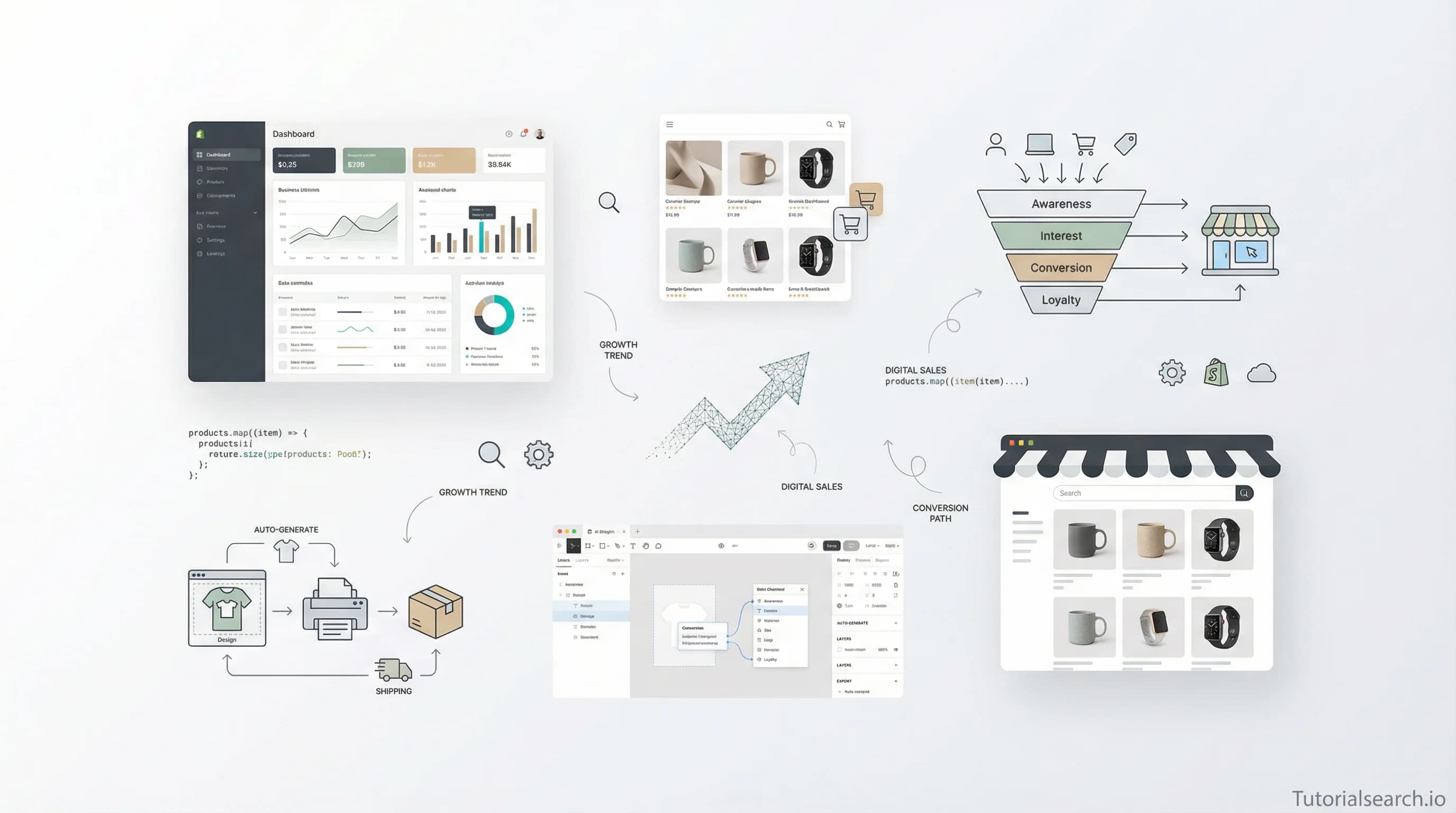
Digital Commerce 101: Master Print-On-Demand, AI Design, and Multi-Channel Selling in 2026
Master digital commerce and print-on-demand in 2026. Discover the best courses, free resources, YouTube tutorials, GitHub tools, books, and communities to launch a profitable online store.
Hire the developers behind TutorialSearch.io
We built this site — full-stack web apps, AI integration & automation. Tell us what you need and we'll build yours.
Digital commerce is reshaping how entrepreneurs build profitable online businesses in 2026. Whether you're interested in print-on-demand, dropshipping, or launching a full-scale e-commerce operation, the barriers to entry have never been lower. AI is handling design work, automation platforms are managing customer service, and integrated marketplaces let you reach millions without building from scratch.
The difference between success and failure in digital commerce often comes down to knowledge. You need to understand niche selection, platform optimization, conversion psychology, and the tech stack that powers modern online stores. That's why we've assembled this definitive guide—combining hand-picked courses, free resources, YouTube tutorials, GitHub repositories, books, and community resources to accelerate your learning in 2026.
Key Takeaways
- Start digital commerce with $0-30 depending on your platform choice (Redbubble costs nothing; Shopify requires monthly fees)
- Print-on-demand remains viable but requires strong design skills and proven marketing strategy to stand out
- AI design tools and automation platforms are no longer optional—they're competitive advantages that separate successful sellers from the rest
- Multi-channel selling (Etsy + Shopify + Amazon) reduces platform dependency and maximizes revenue potential
- Community support and peer mentorship accelerate your growth trajectory by 6-12 months compared to solo learning
In This Article
- Getting Started: Core Concepts and Platforms
- Mastering Print-On-Demand for Digital Commerce
- AI-Powered Design: The Competitive Edge
- Curated Courses for Every Skill Level
- YouTube Channels and Video Tutorials
- Free Resources and Official Guides
- GitHub Repositories and Technical Resources
- Essential Books for Digital Commerce
- Communities Where Winners Learn
- Platform Comparison Guide
- FAQ: Your Digital Commerce Questions Answered
- Related Topics to Expand Your Knowledge
Getting Started: Core Concepts and Platforms
Digital commerce operates fundamentally differently from traditional retail. You're not holding inventory, managing warehouses, or handling shipping logistics. Instead, you're orchestrating a network of suppliers, platforms, and customer touchpoints. When someone buys from your store, your supplier (print-on-demand provider, dropshipper, or manufacturer) handles the rest.
This model shifts your focus from operations to optimization. You're competing on design, marketing, customer experience, and strategic positioning. The businesses winning in 2026 aren't the ones with the cheapest products—they're the ones solving real problems for specific niches.
Shopify's Print-on-Demand guide walks you through the complete lifecycle. A customer uploads artwork, syncs it to their store, and customers pay at checkout. The supplier prints and ships directly while you pocket the margin. The global print-on-demand market reached $11 billion in 2025 and continues growing at 23.6% annually, proving the model's durability. This growth isn't an accident—it reflects genuine market demand for customized products and low-barrier entrepreneurship.
Mastering Print-On-Demand for Digital Commerce
Print-on-demand isn't a passive income strategy anymore. In 2026, successful POD entrepreneurs treat it like a legitimate business with rigorous niche selection, iterative design testing, and sophisticated marketing. They're using tools like Printify to automate what used to require freelance designers and manual workflow.
Printful remains the gold standard for POD quality—they own production facilities in North America and Europe, reducing shipping times and quality issues that plague cheap providers. But Printful costs more. Printify gives you access to multiple manufacturers at lower price points, perfect for testing products before committing to Printful's premium fees.
Your real advantage in POD comes from niche specificity. Broad niches like "funny t-shirts" are oversaturated. Winning niches are specific: "Etsy sellers who struggle with tax compliance" or "CrossFit coaches looking for branded merch." You design products that solve their problem, and they buy because they see themselves in your offering. That's not luck—it's positioning.
Here's something that surprised me early on: the most profitable POD stores aren't operated by designers. They're run by marketer-entrepreneurs who understand customer psychology, run disciplined ad experiments, and relentlessly optimize for profitability rather than aesthetics. A mediocre design marketed to the right audience outsells a beautiful design marketed broadly every single time.
AI-Powered Design: The Competitive Edge
This is where 2026 fundamentally differs from 2023. Three years ago, you needed design skills or freelance budget. Now, tools like Leonardo and Midjourney show you how to generate design concepts in seconds using AI image generators. Your job shifts from "create the design" to "direct the AI toward your vision."
Here's what separates professionals from hobbyists: they iterate rapidly. They generate 50 design variations in an afternoon, test them with small ad budgets, and double down on what converts. They layer AI tools (image generation, text layout automation, background removal) into workflows that produce 100+ designs weekly with minimal manual effort.
The best players aren't avoiding AI—they're building workflows around it. They use Making Money with Artificial Intelligence Images Generator courses to learn exactly which AI tools pair well together, how to prompt effectively, and where AI-generated designs still fail (you need to catch these before customers see them).
The contrarian take: not all AI-generated designs are bad, but most are undifferentiated. Winners use AI to produce volume quickly, then manually refine top performers. It's a hybrid workflow—leaning on AI for ideation and iteration, then human judgment for refinement.
Curated Courses for Every Skill Level
Beginner Friendly
Build a Shopify Print on Demand Business from Scratch (Editors' Choice)
Adam Reed teaches the complete POD workflow from platform setup to first sales. This course prioritizes action over theory—you'll build a real store by the end. 4.4 rating with nearly 5,000 students. Ideal if you've never touched e-commerce before.
Print on Demand Business for Creatives: The Ultimate Guide (Editors' Choice)
Comprehensive 50+ hour curriculum covering design principles, marketplace optimization for Etsy/Amazon/Shopify, and scaling strategies. Best for creative professionals transitioning to entrepreneurship.
Intermediate & Advanced
Shopify Masterclass: Build A Store That Converts (Editors' Choice)
Jason Gandy focuses on conversion optimization—not just building a store, but one that actually sells. Covers funnel design, psychological pricing, and traffic generation. 4.4 rating.
E-Commerce and POD Future with Automation Secrets
Moves beyond basic POD into enterprise-level automation. Learn dynamic pricing, real-time dashboards, automated customer service, and ethical scaling strategies. Essential for anyone planning to do $50k+/month in revenue.
Leonardo AI MasterClass (Better Than Midjourney)
Deep dive into professional-grade AI design. Learn why Leonardo outperforms Midjourney for commercial work and how to build repeatable design systems that scale.
Specialized Skills
Building & Designing E-Commerce Store with WooCommerce
If Shopify feels limiting, WooCommerce offers more customization. This course teaches advanced technical implementations.
E-commerce & Marketing Success with Odoo Certification
Odoo is enterprise software making inroads with serious online sellers. Learn supply chain integration, accounting automation, and multi-channel management.
YouTube Channels and Video Tutorials
Video learning fits how entrepreneurs actually work—you watch tutorials while designing, testing, or analyzing your own store. These channels publish weekly content on digital commerce and e-commerce strategies.
Shopify Official YouTube Channel
Where Shopify announces features and shares tutorials. Subscribe to stay ahead of platform changes that might affect your store structure.
HubSpot Academy on YouTube
Over 400 videos on digital marketing strategy—traffic generation, email sequences, conversion optimization, and customer retention. Especially valuable for understanding the psychology behind why customers buy.
WsCube Tech Shopify Tutorials
Beginner-friendly step-by-step walkthroughs. Watch in order if you're brand new to Shopify.
Santrel Media
Focuses on store design, product selection, and marketing strategies specifically for dropshipping and POD. Watch their "30 days to $1000" series.
Gary Vaynerchuk - GaryVee Video Experience
Not platform-specific, but Gary's content on personal branding, social media marketing, and scaling philosophy is required viewing. His framework for understanding where attention flows online is worth more than most paid courses.
Browse the complete list of e-commerce YouTubers. You'll find 100+ channels covering everything from niche selection to advanced Facebook ad strategy.
Free Resources and Official Guides
Hire the developers behind TutorialSearch.io
We built this site — full-stack web apps, AI integration & automation. Tell us what you need and we'll build yours.
Shopify's Print-on-Demand Resource Center
Official guide explaining POD mechanics, startup costs ($0-30), and platform recommendations. Bookmark this—it's updated quarterly with market data.
Printify's Complete 2026 Guide
Comprehensive documentation explaining their multi-supplier approach, cost structures, and integration options. The best free POD education available.
Podbase Print-on-Demand Beginner's Guide
Covers niche selection, product differentiation, and marketing strategies. Free checklist included.
Everbee's 2026 Print-on-Demand Analysis
Market research and platform comparisons. Cost breakdowns for Printful vs. Printify vs. Gelato show exactly what you'll spend monthly.
Printram's E-Commerce Roadmap
Strategic perspective on why 2026 is optimal timing for new POD businesses, with market tailwinds analysis.
Class Central Courses Directory
Aggregated directory of free and paid courses. Filter by platform, instructor reputation, and student reviews.
Printram on POD Business Models
Deep dives into POD business strategy, supplier comparisons, and profitability frameworks.
Michael Essek POD Guides
Reviews of 11+ POD platforms with pros, cons, and when to use each one.
GitHub Repositories and Technical Resources
If you're building a custom e-commerce platform or want to understand the technical architecture powering digital commerce, these repositories provide solid foundations.
ad-si/awesome-e-commerce
Curated list of e-commerce tools, libraries, and resources. Covers payment processing, inventory management, and fulfillment integrations.
jluterek/awesome-ecommerce
Comprehensive collection of software, libraries, and training focused on e-commerce. Updated regularly with new tools.
astrotars/awesome-ecommerce-stack
Popular marketing tools and add-ons used by 10,000+ top e-commerce stores. Research what winners are actually using.
Explore the broader e-commerce topic on GitHub for cutting-edge projects and open-source solutions that power serious operations.
Essential Books for Digital Commerce
"Dotcom Secrets" by Russell Brunson
The definitive guide to sales funnels for online business. Brunson's framework applies whether you're selling print-on-demand t-shirts or digital courses.
"E-Commerce Evolved" by Tanner Larsson
Strategy-focused rather than tactical. Covers niche selection, positioning, customer psychology, and scaling.
"Building a StoryBrand" by Donald Miller
Your brand narrative matters more than product features. Miller's framework transforms how you communicate with potential customers.
"Atomic Habits" by James Clear
Not specifically about e-commerce, but the most practical book ever written on building systems that compound over time.
"Don't Make Me Think" by Steve Krug
Web design and UX fundamentals. Your store's conversion rate depends on invisible usability factors this book teaches you to spot.
Communities Where Winners Learn
GrindCommerce Discord
Active community with 24,859 members discussing dropshipping, e-commerce, and product research. Daily discussions on supplier vetting and market trends.
E-Commerce Mentoring Discord
Structured education with 16,000+ members. Get access to beginner guides, advanced masterminds, and direct feedback on your business.
Commerce Community Discord
14,771 members offering free voice and text channels. Network with other entrepreneurs and share strategies in real-time.
Reseller World Discord
For product flipping and reselling. Access vendor connections, advanced research tips, and system discussions.
Reddit: r/ecommerce
Largest e-commerce community on Reddit. Discussions range from technical questions to market analysis. Sort by "top this month" to find relevant conversations.
DISBOARD E-Commerce Servers
Directory of Discord communities focused on e-commerce and digital business.
Platform Comparison Guide
This table shows the tradeoffs between leading digital commerce platforms. Each has advantages depending on your skill level, budget, and business model.
| Platform | Starting Cost | Best For | Pros | Cons |
|---|---|---|---|---|
| Shopify | $29-299/month | Full control, brand building | Powerful, integrations, reliability | Monthly fees, steeper learning curve |
| Etsy | $0 upfront | Print-on-demand, vintage, handmade | Built-in traffic, simple interface | Limited branding, higher fees (6.5%) |
| Redbubble | $0 | Design-first sellers, passive income | Completely free, global marketplace | No branding, platform controls pricing |
| Amazon Merch | $0 (after approval) | Print-on-demand, passive | Huge traffic, no inventory | Approval takes months, limited customization |
| WooCommerce | $100+/year | Technical sellers, customization | Open-source, no transaction fees | Requires hosting knowledge, setup complexity |
Pro tip: Use Printify or Printful to sync one product across 5-6 sales channels simultaneously. Test where it sells best, then invest deeper into that platform's marketing. This hedging strategy reduces platform risk significantly.
FAQ: Your Digital Commerce Questions Answered
What's the realistic income potential in digital commerce?
Print-on-demand sellers report $500-2000/month as achievable with 6 months of consistent effort. Top 5% earn $10k-50k+/month. The difference isn't luck—it's systematic marketing testing, niche validation, and willingness to iterate on designs that don't convert. Learn comprehensive digital commerce strategies by exploring understand how strategic positioning drives success.
Should I start with print-on-demand or dropshipping?
POD is better for creatives because your design drives sales. Dropshipping is better if you're a marketer who doesn't create—you source products and drive traffic. Both require strong marketing; neither guarantees passive income. POD has lower complexity, so it's ideal for first-time entrepreneurs launching ventures with lower overhead.
How long before my store makes its first sale?
Expect 2-8 weeks if you're marketing actively. Most beginners wait passively and see nothing for months. The sellers making sales are running Facebook ads ($10/day), creating TikTok content consistently, and optimizing listings for search. You need at least 50-100 listings tested before patterns emerge.
Can I succeed if I'm not a designer?
Absolutely. AI design tools eliminate the design barrier. Your competitive advantage shifts to niche selection, marketing psychology, and testing velocity. You can generate 50 designs weekly—something that required expensive freelancers in 2023.
What's the biggest mistake beginners make?
Broad targeting. Selling "funny t-shirts to everyone" means competing with established brands on price. Winning sellers identify micro-niches where they can be the obvious choice. Example: "Software engineers who use Linux" beats "people who like tech." Specificity converts.
Should I build my own Shopify store or sell on Etsy/Amazon?
Etsy gives you traffic immediately but limits branding. Shopify gives you control but requires marketing skills. Most successful sellers start on Etsy or Redbubble (zero cost), test profitability, then move successful products to Shopify for higher margins. This testing-then-scaling approach reduces financial risk.
How do I avoid supplier quality issues?
Use Printful (premium but reliable) for initial testing. They own production, so quality is consistent. Once you prove demand, consider Printify's multiple suppliers for lower costs. Always order samples before launching products live. One quality disaster destroys reputation irreversibly.
Related Topics to Expand Your Knowledge
Deepen your understanding by exploring these connected areas:
- Online Ventures - Explore diverse online business models beyond digital commerce
- Business Launch - Master the foundational steps for any online business
- Entrepreneurship Skills - Develop the mindset and skills every founder needs
- Online Business - Understand the broader online business ecosystem
- Dropshipping Business - A specific model within digital commerce worth dedicated study
The 2026 Advantage: Why Now Matters
Digital commerce in 2026 operates under fundamentally different conditions than 2020 or 2023. Saturation hit certain niches hard—generic t-shirt designs, basic mugs, and broad product categories now require significantly more marketing spend to convert. But this creates opportunity for sophisticated sellers.
Winners in 2026 aren't fighting saturation. They're solving specific problems for defined audiences using AI design, intelligent automation, and multi-platform strategies. The technical barriers have collapsed entirely. Anyone with a laptop and internet access can set up a store on Shopify or Etsy in minutes. The only barrier now is knowledge—understanding what actually converts, who actually buys, and how to reach them profitably.
This is why community matters so much. The sellers earning $10k+/month aren't hoarding secrets. They're sharing frameworks in Discord servers, publishing detailed guides on Medium, and teaching courses on YouTube. The information density available to beginners is unprecedented.