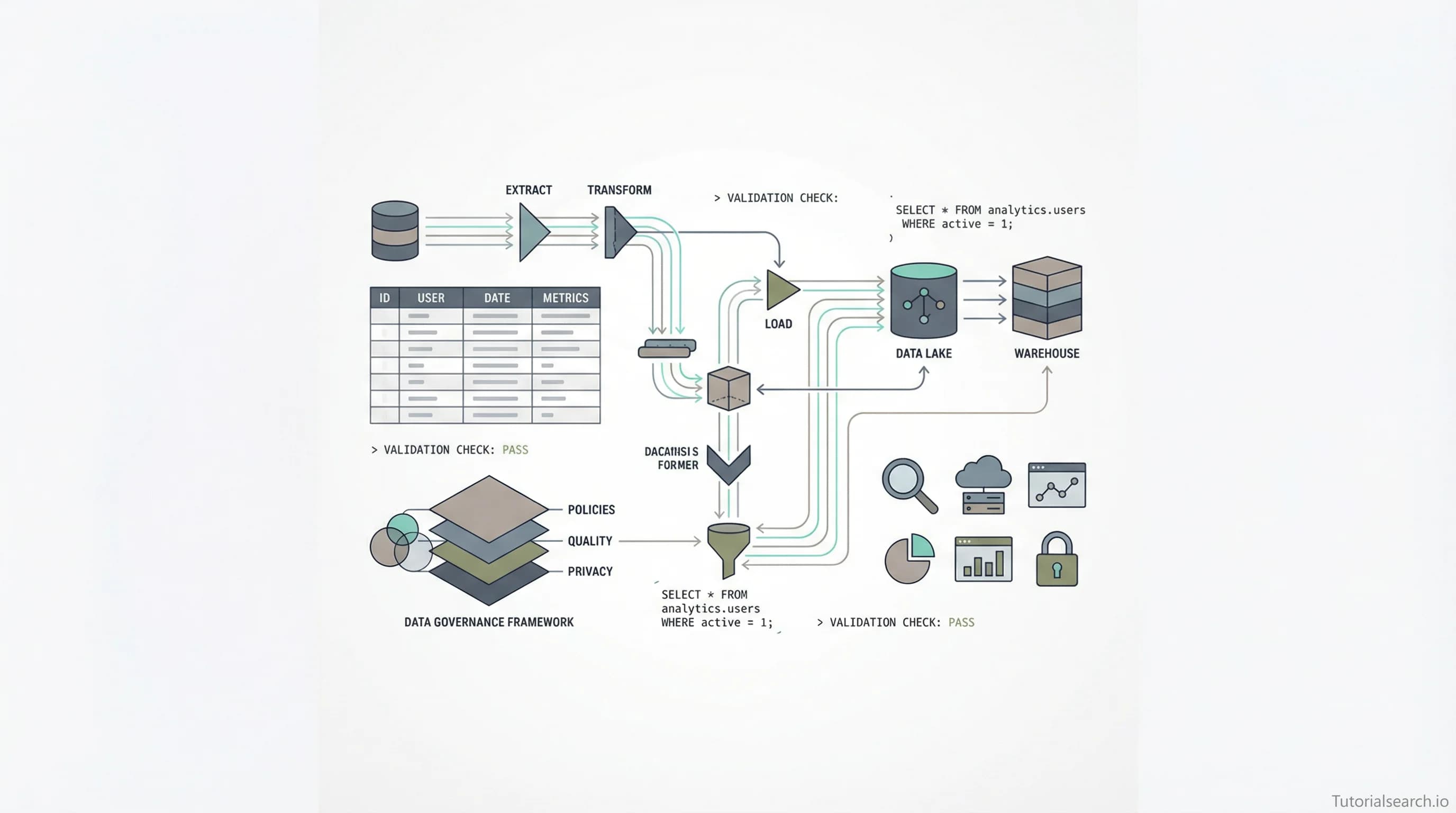
Data Management Toolkit: Essential Practices for Modern Data Teams
Master data management with proven frameworks, ETL tools, and governance practices. Learn from real implementations and build your data strategy for 2026.
Want AI in your product? Hire the team behind TutorialSearch.io
LLM features, RAG, agents and automation wired into a real product — built by the devs who shipped this site.
Most organizations spend 30% of their time fixing data problems that proper data management could have prevented entirely. If you're drowning in inconsistent spreadsheets, broken pipelines, or regulatory compliance nightmares, you're not alone. This comprehensive guide cuts through the noise and gives you the exact toolkit modern data teams use to transform chaos into confidence.
Data management is the organizational practice of collecting, organizing, architecting, governing, processing and maintaining data securely and effectively so it can be used for business analytics and decision-making. It's not a one-time project—it's a living system that requires the right tools, processes, and culture to sustain.
Key Takeaways
- Data quality standards protect your insights by ensuring accuracy, completeness, and consistency across all systems
- Governance frameworks like DAMA-DMBOK provide proven structures that reduce compliance risk by 37%
- ETL and integration tools vary dramatically in purpose: Apache NiFi excels at real-time streaming while Talend dominates enterprise batch processing
- Data monitoring and observability catch problems before they corrupt dashboards or decision-making
- Role clarity (data stewards, owners, governance committees) makes the difference between data initiatives that stick and those that stall
- Platform-specific tools like dbt and Great Expectations shift data validation from manual labor to repeatable automation
Table of Contents
- The Foundation: Data Quality Standards
- Governance Without Gridlock: DAMA-DMBOK Framework
- Moving Data Reliably: ETL Tools and Architecture Patterns
- Catching Problems Before They Spread: Data Quality Assurance
- Building the Right Team Structure
- Technology Stack: Tools That Actually Work Together
- Migration Strategies for Legacy Systems
- Real-World Implementation Challenges
- FAQ: Data Management Questions Answered
The Foundation: Data Quality Standards
Your entire data operation crumbles if data entering the system is garbage. I watched a fintech startup lose $2M in a single day because one upstream system was recording transactions in cents while another recorded them in dollars. By the time anyone noticed the discrepancy, thousands of incorrect transfers had cascaded through their system. That's an extreme example, but the same class of problem happens in every organization that skips data quality.
Data quality standards establish measurable metrics that prevent this disaster. These standards sit at three levels.
Accuracy means data correctly represents what happened in the real world. A customer's email stored as "[email protected]" instead of "[email protected]" breaks communications. A transaction marked as $1,000 when it was actually $10,000 corrupts financial reporting. Accuracy testing catches these before they propagate downstream. You write tests that validate data against known reference sources or business rules. If a date field should never be in the future, that's a rule. If a customer ID must exist in your customer master, that's a rule.
Completeness ensures all necessary data fields are present. Missing email addresses mean you can't contact users. Missing product categories break classification systems. Completeness metrics answer: what percentage of records have values for every required field? Many organizations discover that "required" fields are empty in 5-15% of records—a silent killer of downstream processes. I once found a dataset where 12% of order amounts were null. The "required" field validation simply wasn't being enforced at the application layer.
Consistency means data formatted uniformly across systems. One database calls the data type "text," another calls it "varchar." One team abbreviates states as "CA," another spells them "California." One system stores phone numbers as "(555) 123-4567," another as "5551234567." Consistency enforcement during ingestion prevents these variations from entrenching themselves in your data lake. Without it, reports show conflicting numbers for what should be identical metrics.
[Editors' Choice] Great Expectations takes this automation to the modern era. Instead of writing SQL queries to test data, you define expectations in Python: "This field should have no nulls," "This value should be between 0 and 100," "These records should pass this regex pattern." Great Expectations ships with 300+ pre-built expectations covering the scenarios that break 80% of data pipelines. Tests run automatically as part of your pipeline, failing fast rather than silently corrupting downstream analytics.
The best data quality practice I've seen? Make quality tests visible. Display your pass/fail metrics on dashboards. When a new ETL job runs dirty data and the entire team sees a red quality indicator, suddenly everyone cares about the root cause. The transparency itself becomes a cultural force.
Governance Without Gridlock: DAMA-DMBOK Framework
Many organizations treat data governance like security compliance—a checkbox exercise where governance happens to someone else's data. That approach fails spectacularly. DAMA-DMBOK (Data Management Body of Knowledge) flips this around. It's not governance theater; it's a practical framework that 80% of Forbes Global 2000 companies use to reduce audit risk and align data with business strategy.
DAMA-DMBOK defines 11 functional knowledge areas:
- Data Architecture - The blueprint for how data flows and connects
- Data Modeling & Design - Logical and physical database design
- Storage & Operations - Infrastructure and database management
- Data Security - Access controls and encryption
- Data Quality Management - Standards and monitoring
- Master Data Management (MDM) - Single sources of truth
- Data Warehousing & Analytics - Business intelligence infrastructure
- Metadata Management - Cataloging and discoverability
- Data Governance - Policies and oversight
- Reference Data Management - Standard codes and classifications
- Data Integration - ETL and APIs
This framework works because it separates concerns. Data architects own architecture. Data stewards own quality policies. Data owners own specific datasets. A governance committee oversees conflicts. When someone asks "whose job is it to ensure data accuracy?" the answer is clear: the data steward, with accountability to the data owner.
GDPR compliance specifically benefits from DAMA structure. Instead of a mad scramble when regulators ask "where is customer data stored?" you have lineage tracking, classification rules, and retention policies baked into your workflow. DAMA links compliance obligations to repeatable practices like access control, data classification, and lifecycle management. Organizations using this approach cut incident response time and prevent expensive last-minute firefighting.
The framework is especially valuable in regulated industries. Healthcare organizations must track patient data provenance for HIPAA compliance. Financial institutions must audit data access for SOX compliance. DAMA provides the vocabulary and structure to satisfy these requirements systematically rather than through panicked documentation sprints.
[Editors' Choice] Atlan has emerged as the modern implementation toolkit for DAMA principles. Their data catalog and governance platform provides data catalog, lineage visualization, policy management, and team workflows—essentially automating the human-side governance that DAMA describes.
The critical insight: governance only sticks when people understand their role and have tools to do it. A 30-page governance policy document that lives in email becomes a speed bump. Embedded governance—automatic quality checks, clear data ownership, searchable catalogs—becomes invisible because it works. Teams adopt it without feeling like they're following rules.
Moving Data Reliably: ETL Tools and Architecture Patterns
ETL stands for Extract (get data from source systems), Transform (change its structure to match your target), Load (deliver it to the destination). The category has fragmented dramatically because "moving data" means different things to different organizations.
Real-time streaming data from IoT sensors demands sub-second latency. Traditional batch warehouses tolerate hourly or daily delays. Some transformations are complex business logic; others are simple field mappings. Trying to force everything through a single ETL tool is like insisting a hammer is the right tool for every job.
Apache NiFi dominates real-time, flow-based data integration. Its visual flow interface lets you drag components without writing code. Data lineage tracking shows exactly where each record came from and where it's going—invaluable for debugging. It handles routing and transformation in real-time without the latency of batch ETL. If your use case involves event streams (user activity, sensor data, API events), NiFi's architecture of guaranteed delivery and backpressure handling prevents data loss when downstream systems slow down. One contrarian opinion: many teams buy expensive enterprise ETL when NiFi would solve their problem more elegantly and cheaply.
Talend (now under Qlik ownership) owns the enterprise batch ETL space. It includes 1000+ pre-built connectors to source systems, visual drag-and-drop job design, and deep metadata management for governance. Talend excels at orchestrating complex transformations where you need to coordinate multiple data sources, apply business rules, and manage data quality in a single enterprise platform. Its sweet spot: companies with complex regulatory requirements and existing Talend investments.
A crucial 2026 update: Talend Open Studio reached end-of-life on January 31, 2026. Teams using the open-source version must plan migrations to either the commercial Talend platform or open alternatives like Apache NiFi, Airflow, or dbt. This is a real transition point for many organizations.
[Editors' Choice] dbt (data build tool) has revolutionized the transformation layer. Instead of proprietary ETL tools managing transformations, dbt lets you write SQL or Python—whatever your data warehouse supports natively. dbt handles dependency management, testing, and documentation. Combined with tools like Fivetran for extraction, dbt gives smaller teams enterprise transformation capabilities without the expense or complexity of traditional ETL suites. The learning curve is surprisingly gentle if your team knows SQL.
Most modern stacks combine tools: Fivetran or Stitch for extraction → cloud data warehouse (Snowflake, BigQuery, Redshift) for storage → dbt for transformation → BI tools for analysis. This modular approach costs less than monolithic ETL and feels more natural to teams already comfortable with SQL.
Catching Problems Before They Spread: Data Quality Assurance
Validation tools check "does this data meet standards right now?" Observability tools watch "is data behaving as expected over time?" Both matter. Many organizations skip observability because validation seems sufficient. Then they experience the nightmare where data slowly drifts out of tolerance and nobody notices until stakeholders are making decisions based on corrupted insights.
Data validation frameworks define rules once and apply them everywhere:
- Great Expectations (Python, visual) - Build expectations once, reuse across pipelines
- dbt tests - SQL-based validation integrated with your transformation layer
- QuerySurge - Automated comparison between source and target datasets
- Soda - Open-source, Python-based data quality scanning
Pick based on your team's language comfort. SQL shops gravitate to dbt. Python-first organizations choose Great Expectations or Soda. The framework choice matters less than consistent adoption.
Data observability platforms like Monte Carlo and SYNQ monitor production data continuously. They learn baseline behavior ("this field usually has values between 100-1,000") and alert when anomalies appear ("today it's -50,000 for 30% of records"). This catches problems proactively instead of reactively discovering them when business users complain about weird numbers in dashboards.
The honest truth: many organizations build data pipelines without quality checks, assuming "we'll monitor manually." That works until you have 50 pipelines. Monitoring manually at that scale becomes career-ending firefighting. Shift left to automated validation early, when adoption is easy.
Building the Right Team Structure
Want AI in your product? Hire the team behind TutorialSearch.io
LLM features, RAG, agents and automation wired into a real product — built by the devs who shipped this site.
Data management fails without clear accountability. This is where most organizations stumble. I've seen teams where everyone's responsible for data quality, which means nobody is. Data quality then becomes the responsibility of whoever gets blamed hardest when things break.
A data steward owns data quality for specific domains (sales data, customer data, product data). They answer "what does this field mean?" and "why is it inconsistent?" They don't implement fixes themselves; they identify problems and coordinate solutions.
A data owner (usually a business leader like VP of Sales or VP of Finance) has accountability for the accuracy and accessibility of data in their domain. They approve policies, fund improvements, and ensure the data serves business needs.
A data governance committee (typically 5-8 people including IT, business, and compliance) resolves conflicts and prioritizes investments. When the sales team and finance team disagree about how to define "customer," the committee decides.
A data architect designs the overall infrastructure and data flows. They evaluate tool choices (do we build or buy?), design schemas, and solve integration challenges.
A data engineer implements the technical infrastructure. They build and maintain pipelines, troubleshoot failures, and optimize performance.
The mistake: trying to do this with one "data steward" person while everyone else pursues their normal job. Data governance is not a part-time responsibility; it requires dedicated focus and organizational weight. I've seen this fail repeatedly when companies try to assign data governance as an extra responsibility.
Technology Stack: Tools That Actually Work Together
Your tool selection depends on your context: company size, existing infrastructure, team skills, and data volume. There's no universal right answer, but patterns emerge.
For startups (<20 people):
- Extraction: Fivetran (cloud-native, minimal ops)
- Warehouse: BigQuery or Snowflake (serverless, minimal maintenance)
- Transformation: dbt (SQL-based, version-controlled)
- BI: Metabase or Looker (intuitive, moderate cost)
- Governance: Lightweight (focus on documentation and access control)
This stack minimizes ops overhead while scaling naturally. You'll spend zero time on infrastructure and maximum time on analytics.
For mid-market companies (100-1000 people):
- Extraction: Fivetran or custom Apache Airflow DAGs for complex sources
- Warehouse: Snowflake or BigQuery (handle complexity and scale)
- Transformation: dbt with Airflow for orchestration
- Data Catalog: Atlan or DataHub for governance and discovery
- Quality: dbt tests plus Monte Carlo for observability
- BI: Looker or Mode Analytics (self-service analytics capability)
This adds governance infrastructure without overwhelming operations. You're building repeatable systems at this scale.
For enterprises (>1000 people):
- Extraction: Mix of Talend (for regulated, complex sources) and Fivetran (for modern SaaS)
- Warehouse: Snowflake or custom Teradata/Oracle (if legacy-locked)
- Transformation: dbt for modern stacks; custom ETL for legacy
- Data Catalog: Atlan or Collibra (enterprise features, audit trails)
- Quality: Soda + QuerySurge (comprehensive validation)
- Governance: DAMA-aligned with dedicated roles
- BI: Tableau or Power BI (deeply embedded, extensive customization)
Enterprises must balance legacy systems with modern stacks—a multi-year transition typically. You'll need to support both simultaneously during the transition period.
The common theme across all: modular tools that do one job well beat monolithic suites. A monolithic platform locks you in. Modular tools let you upgrade components independently.
Migration Strategies for Legacy Systems
Your data warehouse probably evolved organically over 10 years. It works, but it's inefficient, undocumented, and nobody wants to touch it. Migrating to modern practices doesn't require ripping and replacing overnight. I've seen organizations that tried that approach and spent 18 months and 5x budget just to end up with less functionality than before.
Phase 1 (Months 1-3): Understand & Document
Audit existing systems. Map data flows. Document what data exists and where it lives. Use tools like Apache Atlas or open-source alternatives to create a baseline inventory. This sounds boring but prevents disasters. You can't plan a migration if you don't know what you're migrating.
Phase 2 (Months 3-6): New Projects on Modern Stack
All new initiatives use modern tools (cloud warehouse + dbt). Don't try to migrate legacy systems yet. Let the new stack prove itself while legacy systems continue unchanged. This builds confidence in the new approach.
Phase 3 (Months 6-12): Parallel Runs
Run modern and legacy systems in parallel. Execute the same business logic in both. Validate that results match. This is slow and expensive but builds confidence. When discrepancies appear (and they will), you identify and fix the root causes before cutover.
Phase 4 (Months 12+): Cutover by Function
Once parallel runs validate correctness, migrate one business function at a time. Sales analytics moves to the modern stack. Legacy system becomes read-only. Finance analytics moves next. This spreads risk and lets the team learn incrementally.
Organizations that try to migrate everything at once inevitably face 18-month projects, 300% budget overruns, and business teams running their own shadow IT because they can't wait. Avoid this by accepting that migration is a multi-year journey.
Real-World Implementation Challenges
Every data management implementation encounters these obstacles:
Organizational silos prevent shared data ownership. Sales owns customer data. Finance owns transaction data. Neither wants to share because sharing means losing control. Solution: explicit governance decisions and executive sponsorship that data is a shared asset. Without executive backing, silos always win.
Legacy technical debt limits tool choices. You can't migrate to Snowflake if your entire business logic lives in Oracle-specific PL/SQL. Solution: identify which legacy systems must be maintained vs. replaced, and plan gradual migration. Accept that some legacy code will outlive your career.
Skill gaps in your team. Your senior DBA knows Oracle but has never touched modern cloud data platforms. Solution: invest in training, hire complementary skills, and plan realistic timelines for knowledge transfer. Don't assume existing expertise transfers automatically.
Competing priorities from business stakeholders who want dashboards yesterday. Data quality improvements feel slow and invisible. Solution: quantify the cost of poor data quality (this mistake costs $X per month) to justify the investment. Measure and communicate the value delivered.
Tool proliferation where every team chooses different tools. One team uses Segment for event pipelines, another uses custom Kafka. Solution: establish standards without eliminating flexibility—allow exceptions with documented justification. Perfect is the enemy of good.
The teams that succeed treat data management as continuous process improvement, not a one-time project. They measure success by data quality metrics and governance adoption, not by tool count.
FAQ: Data Management Questions Answered
Q: What are the key steps in Data Management?
Data Management involves data collection from source systems, storage in warehouses or data lakes, cleaning to remove errors and inconsistencies, and analysis to extract business value. Effective practices include establishing quality standards, defining clear ownership, documenting data definitions, implementing security controls, and monitoring data health continuously. These steps ensure data reliability and accessibility for informed decision-making.
Q: Why is Data Management important for data scientists?
Data Management ensures data scientists have access to accurate, reliable, and well-organized data. Poor data management forces data scientists to spend 80% of time on data cleaning instead of modeling. Effective Data Management streamlines workflows, reduces errors, enables faster model development, and ultimately improves the quality of data-driven insights and predictions.
Q: How does Data Management relate to data governance?
Data Management and Data Governance are interconnected, with Governance defining policies and standards for data usage and quality, while Management implements those policies through processes and tools. Think of governance as "what we should do" and management as "how we actually do it." Strong Data Management supports effective Data Governance by providing automated enforcement of rules through technology.
Q: What are common Data Management tools used in data science?
Common Data Management tools include databases (PostgreSQL, MySQL), cloud warehouses (Snowflake, BigQuery), ETL platforms (Talend, Apache NiFi), data catalogs (Atlan, DataHub), and validation frameworks (Great Expectations, dbt). These tools facilitate data storage, transformation, discovery, and quality assurance, enabling data scientists to efficiently work with large datasets.
Q: What skills are essential for Data Management professionals?
Essential skills include SQL and database design, understanding data modeling concepts, data quality and testing methodologies, familiarity with ETL/ELT tools, and knowledge of governance frameworks like DAMA. Beyond technical skills, strong analytical thinking, communication skills for explaining data concepts to non-technical stakeholders, and project management abilities are vital for success.
Q: How can small teams implement Data Management without huge budgets?
Start with free and open-source tools: PostgreSQL or MySQL for databases, Apache NiFi or Airflow for orchestration, dbt for transformation, Great Expectations for quality testing, and open-source catalogs like DataHub. Focus investments on people (dedicated stewardship) and processes (clear documentation) rather than expensive enterprise platforms. Modern open-source tools are enterprise-capable when applied thoughtfully.
Related Topics
Dive deeper into related data science areas:
- Data Visualization Techniques - Transform managed data into actionable visual insights
- Data Science Skills Foundation - Build the analytical mindset that data management supports
- Power BI Analysis Methods - Connect managed data to business intelligence reporting
- Data Engineering Fundamentals - Understand the infrastructure that supports data management
- Business Analytics Applications - Apply data management principles to business decision-making
Ready to modernize your data infrastructure? Start small: pick one data quality framework, establish clear ownership for your highest-impact dataset, and measure improvement. The teams that win are those that treat data management as continuous practice, not a destination. Your future self—and your business users—will thank you when dashboards finally show reliable insights.