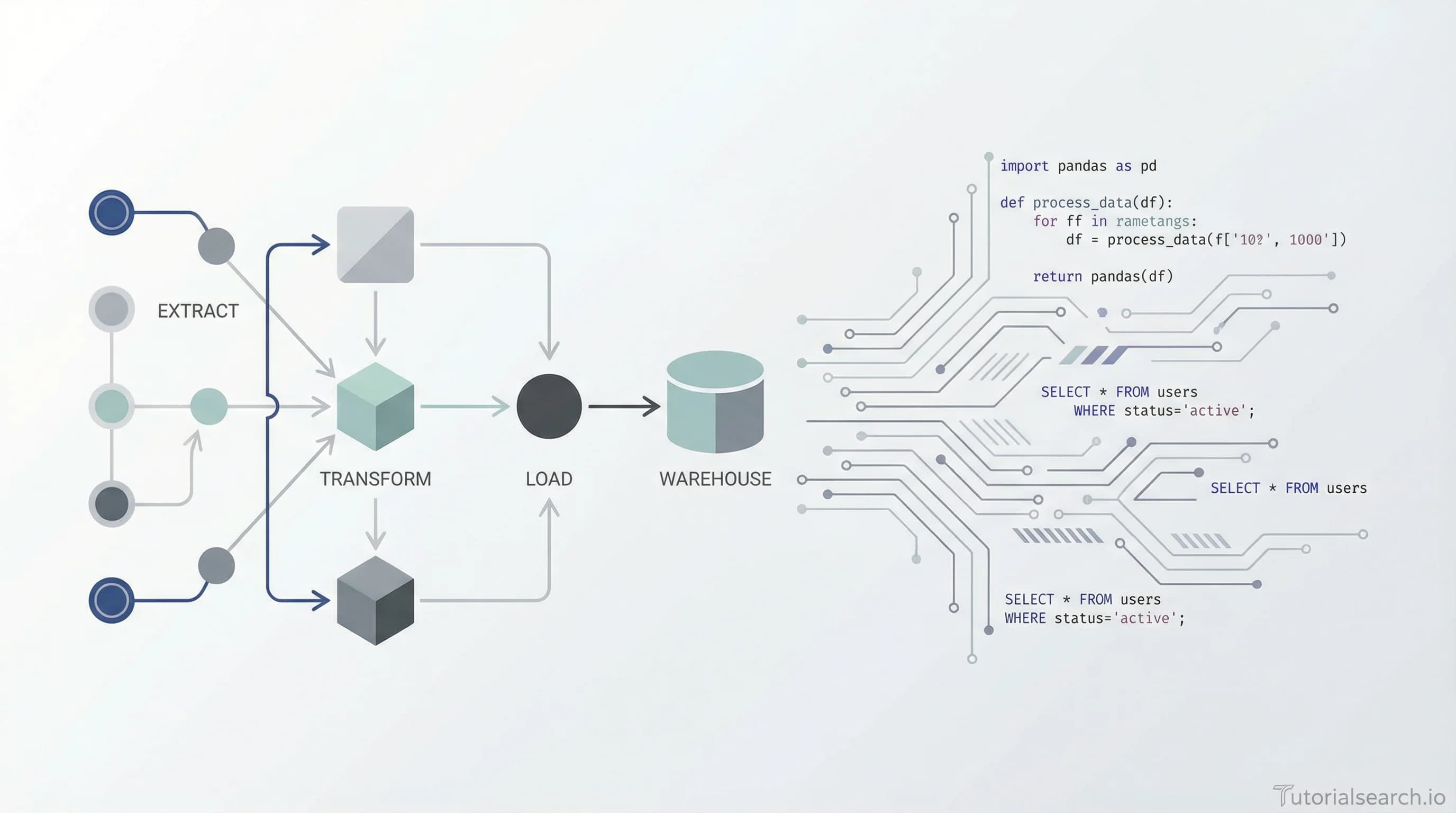
Data Engineering in 2026: The Path I'd Take From Scratch
Learn data engineering from scratch with the best courses, free resources, YouTube channels, and communities to build real pipeline skills in 2026.
Want AI in your product? Hire the team behind TutorialSearch.io
LLM features, RAG, agents and automation wired into a real product — built by the devs who shipped this site.
Data engineering is one of the most in-demand technical skills of 2026, building the pipelines that power AI, analytics, and data-driven products across every industry. Yet most learning guides treat it like a topic to survey rather than a craft to develop — they hand you a 40-item tool list and leave you to figure out the sequence on your own.
This post takes a more opinionated approach. If I were starting from zero today, here's exactly how I'd do it: the courses I'd prioritize, the free resources worth using, the communities where real data engineers actually talk, and the books that build lasting mental models. If you want to browse the full catalogue, the data engineering courses on TutorialSearch cover over 100 options — but this guide tells you which ones are worth your time and in what order.
One thing worth knowing upfront: data engineering isn't a single skill, it's a layered stack. SQL and Python come first, then you understand how pipelines and transformations work, then you layer in orchestration and cloud infrastructure. Each layer makes the next one click faster — so the sequence matters more than most people realize.
Key Takeaways
- Data engineering skills in Python, SQL, and pipeline orchestration are among the highest-demand technical roles of 2026
- The best data engineering courses combine structured teaching with real project work on tools like Spark, Kafka, and dbt
- Free resources like the Data Engineering Zoomcamp deliver production-grade foundations at zero cost
- Data engineering is the infrastructure layer that enables AI and ML — making it one of the most future-proof specializations in tech
In This Article
- The Data Engineering Courses Worth Your Time
- Free Data Engineering Resources That Actually Deliver
- Data Engineering YouTube Channels Worth Subscribing To
- GitHub Repos Every Data Engineer Should Star
- The Data Engineering Books Serious Learners Actually Finish
- Where Data Engineers Actually Talk to Each Other
- Beginner vs. Advanced: Two Paths Through Data Engineering
- Related Data Engineering Skills Worth Exploring
- FAQ
The Data Engineering Courses Worth Your Time
Here's the honest truth about most beginner data engineering courses: they spend too long on concepts and not enough time on the tools you'll actually use on the job. The best ones do the opposite — they get you working with real pipelines and real infrastructure early, leaving theory as commentary rather than the main event.
Data Engineering for Beginners: Learn SQL, Python & Spark (Udemy) — [Editors' Choice]
With over 100,000 students and a 4.3 rating, this is the most popular data engineering course online, and it earns that standing. Instructor Durga Viswanatha Raju Gadiraju covers SQL, Python, and Spark in a structured sequence that mirrors how real data engineering work actually flows — you don't just learn what these tools are, you learn how they fit together. This is the course I'd start with if you're coming from scratch.
The Spark content alone justifies the price. Most beginner courses treat Spark as an advanced topic for later; this one introduces it early and gives it proper depth. By the end, you've built a genuine pipeline — not a toy demo, but something that reflects real-world architecture decisions.
Data Engineering 101: The Beginner's Guide (Udemy) — [Editors' Choice]
The highest-rated data engineering course in this list at 4.6 stars. Instructor Seungchan Lee has a real gift for making abstract distinctions — data lakes vs. data warehouses, batch vs. streaming, ingestion vs. transformation — feel concrete and applicable rather than academic. It's shorter than most alternatives, which makes it ideal if you want a clear orientation before committing to a longer program.
What I appreciate most is that it doesn't try to teach you every tool. It teaches you how to think like a data engineer — which turns out to be the harder skill to develop.
Data Engineering using Databricks on AWS and Azure (Udemy) — [Editors' Choice]
Databricks is everywhere in enterprise data engineering right now. Knowing Databricks on both AWS and Azure is a genuine differentiator in the job market. This course — another from Durga Gadiraju, who clearly knows this space deeply — covers Delta Lake, Lakehouse architecture, and end-to-end pipeline design on real cloud infrastructure. Rated 4.5 with nearly 19,000 students. This is the cloud-focused pick for anyone targeting enterprise roles.
Data Engineering using AWS Data Analytics (Udemy)
AWS remains the dominant cloud platform for data engineering teams. This course gives solid coverage of S3, Glue, Redshift, and the broader AWS analytics stack. It's best taken after you have Python and SQL under your belt — treat it as a second-stage course once the foundations are solid.
Data Engineering Master Course: Spark/Hadoop/Kafka/MongoDB (Udemy)
If you want one course that covers the big data ecosystem in breadth — Spark, Hadoop, Kafka, and MongoDB together — this is the one. At 4.4 stars and 17,000 students, it's a proven path. Better as a second or third course than a first: the breadth is the point, and you'll get more out of it once you know what pain each tool is solving.
Free Data Engineering Resources That Actually Deliver
Paid courses aren't the only path. Several free resources genuinely match what you'd find behind a paywall — you just need to know which ones are worth your time and which are glorified marketing pages in disguise.
Data Engineering Zoomcamp (DataTalksClub / GitHub) — [Editors' Choice]
This is the best free data engineering program available, full stop. The DataTalksClub Zoomcamp is a free 9-week course that teaches production-ready pipeline building using Docker, PostgreSQL, Terraform, GCP, BigQuery, dbt, Apache Spark, and Kafka. The GitHub repository has tens of thousands of stars because the content is genuinely excellent. The cohort model runs annually, but all materials are permanently available for independent study. If you're budget-conscious and serious, start here.
DataCamp: How to Learn Data Engineering (DataCamp)
One of the most clearly written "what to learn and in what order" resources available for free. DataCamp's guide lays out a realistic 8-12 month path to job-ready data engineering skills, names the specific tools worth prioritizing at each stage, and doesn't pad the timeline with fluff. You don't need to subscribe — the guide itself is free and genuinely useful for planning your learning sequence.
Dataquest: The Data Engineer Roadmap for Beginners (Dataquest)
Similar in spirit to the DataCamp guide but with more focus on early-stage learners who aren't yet sure if data engineering is the right direction. Good honest framing of prerequisites and what the day-to-day job actually looks like.
DataTalks.Club Free Courses List (DataTalks.Club)
A curated breakdown of 15+ free data engineering courses with notes on what each actually covers — much more useful than a generic "top courses" list because it's maintained by people who run data engineering education programs. Worth bookmarking for when the Zoomcamp isn't the right fit.
Microsoft Fabric Data Engineering Documentation (Microsoft Learn)
If you're targeting enterprise environments — especially those running Microsoft stacks — Fabric's documentation is authoritative and more readable than most official docs. Free, comprehensive, and current. Not a tutorial, but an essential reference once you're past the basics.
Databricks Data Engineering Documentation (Databricks)
Delta Lake, Lakeflow pipelines, and streaming architecture on AWS — all covered in Databricks' official engineering docs. They also offer self-paced intro videos with completion certificates at no cost. For anyone targeting Databricks roles specifically, this is the reference to bookmark.
Class Central: Data Engineering Courses (Class Central)
Class Central aggregates 1,700+ data engineering courses from every major platform, with student ratings and free audit options flagged clearly. Useful when you want to compare multiple options before committing to a program.
For a more structured path with project feedback and instructor support, the ETL and Big Data course on TutorialSearch covers similar ground with guided curriculum — a good option if you prefer video over self-directed reading.
Data Engineering YouTube Channels Worth Subscribing To
Video content is genuinely underrated for data engineering. Some of the most useful explanations of Kafka internals, Spark optimization, and pipeline architecture exist on YouTube — and they're free. The challenge is knowing which channels are worth your time.
Learn Data Engineering — Andreas Kretz (YouTube)
The most honest data engineering channel I've found. Kretz's whiteboard explainers on distributed systems and pipeline architectures are unusually clear — he makes the "why" obvious before getting into the "how." His roadmap series and the "what does a data engineer actually do" deep-dives are the best starting points. If you only subscribe to one channel here, make it this one.
Seattle Data Guy — Ben Rogojan (YouTube)
Ben's channel is practical in the best sense: less theory, more "here's what data engineers actually do at work." He covers Snowflake, dbt, Airflow, and BigQuery with a practitioner's perspective that most academic content misses. His data engineering interview prep videos are especially useful if you're job hunting soon.
EcZachLy — Zach Wilson (YouTube)
Zach Wilson built the DataExpert.io community and has strong content on data modeling, real-world pipeline challenges, and the data engineering career path. The signal-to-noise ratio is high — he doesn't pad content for runtime.
For structured video courses with completion tracking and certificates, use the data engineering search on TutorialSearch to find platform-hosted programs across Udemy, Pluralsight, and Skillshare.
GitHub Repos Every Data Engineer Should Star
Want AI in your product? Hire the team behind TutorialSearch.io
LLM features, RAG, agents and automation wired into a real product — built by the devs who shipped this site.
The data engineering GitHub ecosystem is genuinely rich. These repositories don't just give you reading lists — they show you the actual tool landscape and how practitioners think about the field.
DataTalksClub/data-engineering-zoomcamp — 30,000+ stars
The Zoomcamp repo doubles as one of the best free resources in this entire guide. The code, homework scaffolding, and capstone project materials are all here. Even without following a cohort, working through the materials at your own pace is a legitimate and effective path.
igorbarinov/awesome-data-engineering — Curated tooling overview
This "awesome list" covers databases, batch processing frameworks, streaming tools, and data validation libraries. It's the fastest way to orient yourself to the full landscape of data engineering tooling before committing to any particular stack — ideal for the "what even exists" question.
gunnarmorling/awesome-opensource-data-engineering — Open-source focused
More opinionated than the igorbarinov list — it focuses specifically on open-source tools and includes real context for stream processing, orchestration, testing, and monitoring. Better if you already know the basics and want to go deeper into specific problem domains.
adilkhash/Data-Engineering-HowTo — Learning pathway focused
A practical "how do I actually learn this from scratch" repository with curated resources and tool recommendations organized by skill level. Less about tools, more about the learning journey itself — which makes it complementary to the awesome lists above.
The Data Engineering Books Serious Learners Actually Finish
Most technical books get abandoned two chapters in. These don't — because they're organized around mental models, not tool documentation.
Fundamentals of Data Engineering by Joe Reis and Matt Housley (O'Reilly)
This is the first book I'd recommend to anyone serious about the field. Reis and Housley don't get distracted by specific tools — they explain the data engineering lifecycle, how data flows from source to consumption, and why architectural decisions matter at each stage. It reads less like a textbook and more like a long conversation with two experienced engineers who've made the mistakes so you don't have to. Start here.
Designing Data-Intensive Applications by Martin Kleppmann
Often shortened to "DDIA" by engineers who've read it, this book makes distributed systems concepts click. It explains replication, partitioning, consistency, and fault tolerance in a way that helps you understand why Kafka and Cassandra are designed the way they are — not just how to use them. Read it after the Reis/Housley book, once you understand the basics of pipelines and are ready to think seriously about scale.
Prefer video over books? The Python and SQL data engineering course on TutorialSearch covers similar foundational ground in a hands-on format with step-by-step guidance.
Where Data Engineers Actually Talk to Each Other
Community matters more in data engineering than in most fields. The tooling changes fast, and the engineers who keep up are almost always plugged into active communities where real practitioners share what's working.
r/dataengineering (Reddit)
The largest data engineering community online. Posts range from "which orchestration tool should I use for this" to deep architectural debates and candid career advice. The culture here skews toward practitioners helping practitioners — which is the kind of community that actually accelerates learning.
DataExpert.io Community Discord (Discord)
Zach Wilson's Discord community has nearly 30,000 members and is one of the most active real-time spaces for data engineers online. Dedicated channels for job boards, pipeline discussions, tool comparisons, and project feedback. If you want to connect with people actively building DE careers, this is the place.
Data Engineering Wiki Community Page (dataengineering.wiki)
A maintained list of additional communities — Slack workspaces, Discord servers, regional meetups, and forums — organized by the community itself. A useful jumping-off point if you want more than one community in your orbit.
Beginner vs. Advanced: Two Paths Through Data Engineering
Not sure where you fit in the skill spectrum? Here's a direct comparison of what each path looks like in practice.
| Beginner Path | Advanced Path | |
|---|---|---|
| Start with | SQL + Python fundamentals | Distributed systems design (DDIA book) |
| Core course | Data Engineering for Beginners (SQL/Python/Spark) | Data Engineering Master Course (Spark/Kafka) |
| Cloud focus | One platform — AWS or GCP | Multi-cloud + Databricks Lakehouse architecture |
| Orchestration | Learn Airflow basics, understand DAGs | Build production DAGs, run dbt in CI/CD |
| Free resource | Data Engineering Zoomcamp | Databricks self-paced certs + platform docs |
| Timeline | 3–6 months to first working pipeline | 6–12 months to senior-level readiness |
| Community | r/dataengineering (broad Q&A) | DataExpert.io Discord (advanced practitioners) |
The honest advice: most people should spend more time in the beginner path than they think they need. A solid foundation in SQL and Python makes every advanced topic faster to learn. For a detailed breakdown of what employers are actually hiring for at each level, Coursera's data engineering programs reflect the current market demand across both beginner and advanced skills.
Related Data Engineering Skills Worth Exploring
Data engineering doesn't exist in isolation. These adjacent skills compound your value and open up career paths that sit at the intersection of engineering and AI:
- Generative AI courses — Data engineers increasingly build the pipelines that feed LLM applications; understanding generative AI makes you a far more effective collaborator with AI product teams
- ML Fundamentals courses — Knowing how machine learning models consume data helps you build better feature pipelines and catch the data quality issues that silently break model performance
- AI Agents courses — Agent-based AI systems depend on reliable, low-latency data infrastructure — exactly the kind that data engineers build and maintain
- Applied AI courses — Understanding applied AI use cases helps you design data systems that serve actual business outcomes, not just technical specifications
FAQ
How long does it take to learn data engineering?
Most people reach a first-job level of competency in 6–12 months of consistent study. The timeline depends on your starting point — someone with SQL experience moves through beginner content quickly, while someone starting from scratch needs more time on fundamentals. Reaching senior-level skill takes 2–3 years of hands-on production experience on top of that.
Do I need a computer science degree to learn data engineering?
You don't. Many working data engineers come from adjacent fields — analytics, software development, or business intelligence. What matters far more than a degree is whether you can write clean Python, query a database effectively, and reason about data flow. The data engineering courses on TutorialSearch include programs specifically designed for learners without formal CS backgrounds.
Do I need to know Python before learning data engineering?
Some Python basics help, but expert-level Python isn't a prerequisite. Most beginner data engineering courses introduce or assume only foundational Python. The real skill to develop isn't Python mastery — it's comfort building, debugging, and iterating on pipelines, which comes from practice more than pre-study.
Can I get a job with data engineering skills?
Yes — and the job market is consistently strong. Data engineering roles rank among the highest-paying technical positions in tech, finance, healthcare, and retail. A solid portfolio of two or three real pipeline projects, combined with fluency in Python, SQL, and one cloud platform, is enough to land an entry-level role at most companies.
What tools are essential for data engineering in 2026?
The modern data engineering stack includes Python, SQL, one cloud platform (AWS, GCP, or Azure), an orchestration tool (Apache Airflow or Prefect), a transformation layer (dbt), and a data warehouse (Snowflake, BigQuery, or Redshift). You don't need fluency in all of these before you start — but building toward this stack puts you in strong shape for the current hiring market.
What is the difference between data engineering and data science?
Data engineering builds and maintains the infrastructure — pipelines, warehouses, and reliable data flows. Data science uses that infrastructure to extract insights and build predictive models. Data engineers make data science possible. The two roles overlap in practice, but data engineering skews toward software engineering and systems thinking, while data science skews toward statistics and modeling.