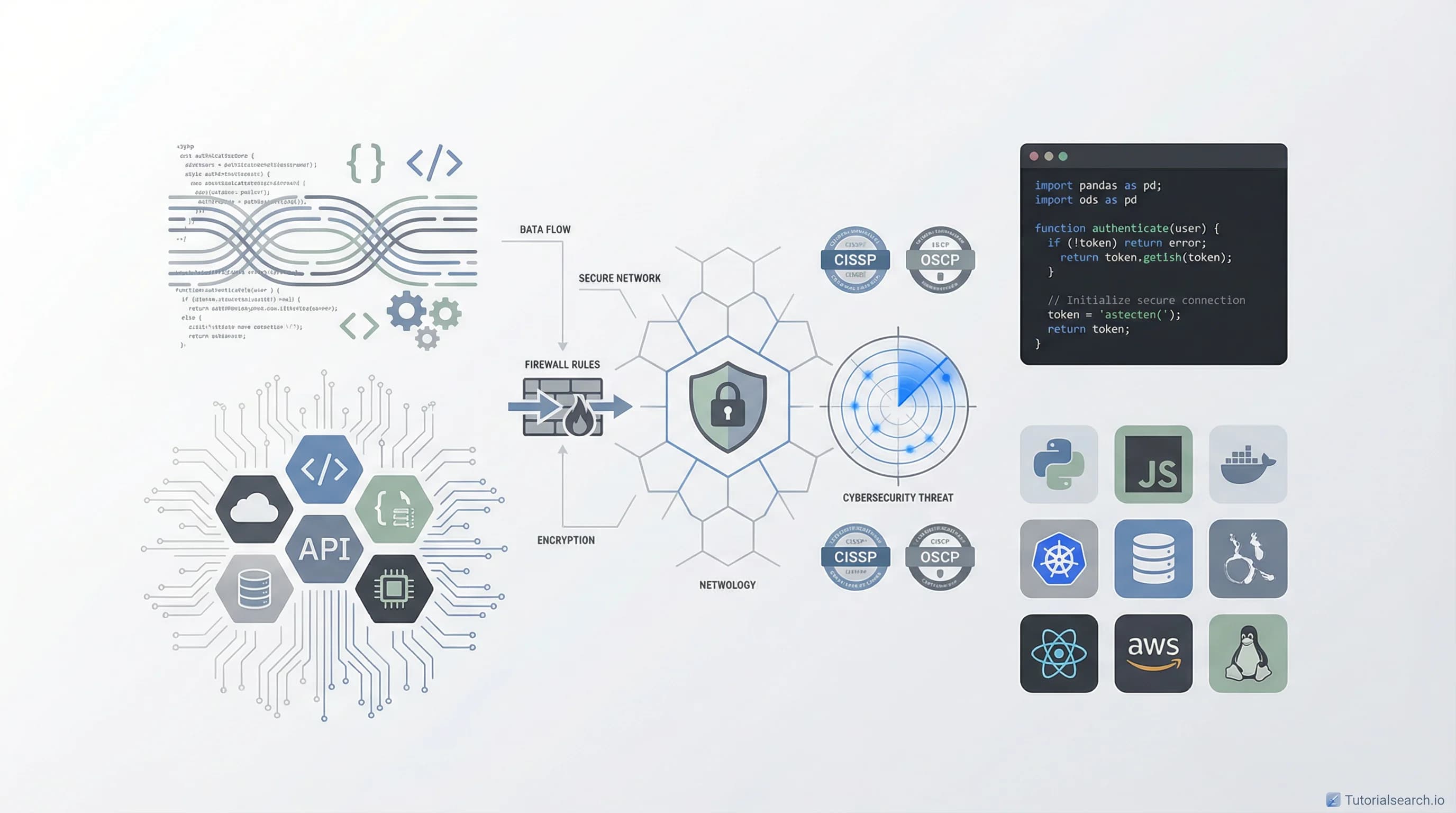
Cybersecurity Training From Zero to Job-Ready
Cybersecurity training is one of the most in-demand skills you can build right now. This guide covers the best courses, hands-on platforms, YouTube channels, GitHub repos, and books to take you from zero to job-ready.
Need a web app built? Hire the team behind TutorialSearch.io
We ship fast, production-grade full-stack apps (Next.js, React, edge infra) — the same stack that powers this site.
Cybersecurity training is one of the most in-demand skills you can build right now. Security Magazine reported that 41% of organizations struggle to find and retain qualified cybersecurity professionals in 2026. That gap isn't closing — and it means career doors are wide open for anyone serious about learning.
But the path is confusing. Certifications, bootcamps, hands-on labs, YouTube playlists — there's a lot of noise. This guide cuts through it. Below you'll find the best cybersecurity training courses, hands-on platforms, YouTube channels, GitHub repos, books, and communities to take you from zero to job-ready.
Key Takeaways
- Cybersecurity training covers everything from basic security concepts to advanced penetration testing and cloud defense.
- You don't need a computer science degree — many cybersecurity professionals are career changers from unrelated fields.
- Hands-on platforms like TryHackMe and Hack The Box are essential alongside course-based learning.
- CompTIA Security+ remains the most recognized entry-level certification for career changers in 2026.
- Free resources from CISA and GitHub repos can supplement paid cybersecurity training at every stage.
In This Article
- Where to Start Your Cybersecurity Training
- Cybersecurity Training Courses for Every Level
- Hands-On Cybersecurity Training That Goes Beyond Lectures
- Cybersecurity YouTube Channels That Actually Teach
- GitHub Repos Every Cybersecurity Learner Should Bookmark
- Cybersecurity Books Worth Reading
- The Cybersecurity Communities Where People Actually Help
- Related Cybersecurity Skills Worth Exploring
- Frequently Asked Questions About Cybersecurity Training
Where to Start Your Cybersecurity Training
Most beginners make the same mistake: they spend weeks deciding whether to start with networking, programming, or certifications — and end up doing none of it. Pick a lane and start moving.
If you have zero background in IT, here's the practical starting point: CompTIA Security+ is the industry's most recognized entry-level certification. It doesn't require programming experience, covers a wide range of foundational topics, and employers specifically list it in job postings. The exam covers threat detection, network security, cryptography, and identity management.
For hands-on learners who hate reading textbooks, TryHackMe is the better first step. It's a browser-based platform with guided "rooms" that walk you through security concepts interactively — you break things and fix them, rather than just watch slides.
Before you go deep into cybersecurity training, spend a week on basic networking: TCP/IP, how a firewall works, what DNS does. You don't need to be a network engineer, but these concepts come up constantly. Explore Network Security courses to build that foundation alongside your main curriculum.
One resource most beginners overlook: the CISA (Cybersecurity & Infrastructure Security Agency) offers free online training backed by the U.S. government. It covers cloud security, risk management, and malware analysis at no cost. Not flashy — but surprisingly thorough, and well-aligned with public sector and compliance roles.
Cybersecurity Training Courses for Every Level
There's an honest problem with paid cybersecurity courses: some go deep on theory without ever showing you how a real attack works. Others are hands-on but skip the context. The courses below hit the right balance.
For Beginners
Cybersecurity Training for New Hires by Brandy Coulsey (Udemy) — FREE · ★4.4 · 16,200+ students · [Editors' Choice]
This is the most student-friendly entry point available. It doesn't assume you know what a firewall is, and it uses real-world workplace scenarios rather than abstract diagrams. With over 16,000 students and a 4.4 rating, it's one of the highest-engagement free cybersecurity courses on Udemy. Ideal if you're starting from zero — or if you need to fulfill workplace compliance training and actually want to learn something.
- Who it's for: Complete beginners, new hires in corporate environments
- What it covers: Security awareness, threat basics, workplace security practices
- Why it stands out: 16K+ students don't lie — the approval rating and enrollment numbers together are a strong signal
Acronis CyberFit Cybersecurity Foundation by Ron Eo (Udemy) — FREE · ★4.6 · 3,690 students
Surprisingly polished for a free course. The Acronis Foundation material covers threat landscapes and managed service provider (MSP) security — useful if you're aiming for a career in IT services or corporate security. It's the highest-rated free course in this lineup.
Cybersecurity Essentials by Lee Mitchell (Udemy) — FREE · ★4.2
A good breadth-first survey of core cybersecurity concepts. Works well as a parallel resource while going through a more structured curriculum. Short enough to finish in a weekend — solid for confirming you've got the fundamentals down before moving on.
For Intermediate Learners
Cyber Security Awareness Training for Employees by Jeremiah Padayachee (Udemy) — Paid · ★4.5 · [Editors' Choice]
Don't be misled by the "awareness" framing — this is deeper than a typical compliance-checkbox course. Padayachee walks through social engineering, phishing simulations, and endpoint protection in a way that's genuinely engaging. Strong choice for IT professionals who need to train their teams, or for anyone who wants to understand the human side of security — which is, honestly, where most breaches actually start.
- Who it's for: Mid-level professionals, team leads, security-conscious employees
- Standout element: Covers the social engineering angle most technical courses skip entirely
Practice Exams for the CySA+ CS0-003 Certification by Roberto Herrera (Udemy) — Paid · ★4.3 · 5,556 students
CySA+ (CompTIA Cybersecurity Analyst) is the logical next certification after Security+. This course is exam-prep focused, and Herrera's practice questions run notably harder than the real exam — which is exactly what good prep looks like. Over 5,500 students have used it. If you're pursuing CySA+, the Security Certification resources on TutorialSearch.io offer 1,000+ additional courses in that category.
Ethical Hacking & Cybersecurity Training – Complete Course by Ahmad Hassan (Udemy) — Paid · ★4.2
This course bridges security fundamentals with hands-on attack techniques. It covers network scanning, exploitation basics, and web application vulnerabilities. Good preparation if your goal is eventually moving into penetration testing. Pairs well with an Ethical Hacking track for a complete picture — that category has 935 courses across all skill levels.
For Advancing Practitioners
Comprehensive Ethical Hacking and Cybersecurity Training by EDUCBA (Udemy) — Paid · ★4.0
Wide coverage — this feels more like a reference guide than a linear course. Best used selectively, picking modules relevant to your current role or certification target rather than going front to back. The EDUCBA production quality is solid.
Hands-On Cybersecurity Training That Goes Beyond Lectures
Everyone recommends stacking courses. But you won't get good at cybersecurity by watching videos alone. You need to practice in environments where you can actually break things.
TryHackMe is where most beginners should start for hands-on work. The free tier covers a solid chunk of content. Premium (~$14/month) unlocks structured learning paths built around certifications and job roles like SOC Analyst and Junior Penetration Tester. Each "room" gives you a browser-based Kali Linux instance — no local setup required, which removes a major early friction point.
Hack The Box Academy is the step up after you've spent 4-6 weeks on TryHackMe. It's harder, more realistic, and more respected in professional circles. Hack The Box was recognized as a leader in The Forrester Wave for Cybersecurity Skills & Training Platforms in Q1 2026. Unlike TryHackMe, it offers its own professional certifications — which serve as verifiable proof of hands-on skill, not just exam knowledge.
There's an important distinction worth making: TryHackMe is better for absolute beginners. If you've never opened a terminal, start there. If you're comfortable with Linux basics and want to actually hack machines, move to Hack The Box sooner than you think you need to.
SANS Institute is the gold standard for professional cybersecurity training — and the price tag reflects that. SANS courses run $4,000-$7,000+, and they're worth it for professionals who need employer-recognized credentials or work in high-stakes environments. For self-funded learners, SANS's free webcasts and their YouTube channel give you a taste of the instructors and content without the full investment.
The IBM 2026 Cybersecurity Guide is a free resource that most learners miss. It's not a course — it's a curated hub of explainers, tutorials, and podcasts on current threats and defenses. Good for understanding the threat landscape while going through structured training, and it's updated regularly by IBM's security research teams.
Cybersecurity YouTube Channels That Actually Teach
Need a web app built? Hire the team behind TutorialSearch.io
We ship fast, production-grade full-stack apps (Next.js, React, edge infra) — the same stack that powers this site.
There's no shortage of cybersecurity content on YouTube. Most of it is either too shallow or too narrowly focused on CTF (Capture the Flag) competitions to be practically useful. These channels are the exceptions.
The Cyber Mentor — [Editors' Choice]
Heath Adams built one of the best free resources for learning ethical hacking. His content on practical penetration testing is widely used by people preparing for OSCP (Offensive Security Certified Professional). What makes it stand out is how he teaches — like a practitioner, not a professor. Real tools, real methodology, actual attack chains. If you're going toward pentesting, start here.
-
NetworkChuck covers networking, Linux, and cybersecurity in a way that's surprisingly engaging to watch. His "Linux for Hackers" series is a good starting point if you're not yet confident with the command line. High energy, highly accessible — the kind of channel that gets beginners past the initial intimidation.
John Hammond — [Editors' Choice]
Hammond is known for CTF walkthroughs and malware analysis videos. His content skews toward intermediate-to-advanced, but beginners can learn a lot by following along. He explains the why behind what he's doing, not just the steps. His Discord community (free, welcoming) is worth joining alongside the channel.
-
Probably the most extensive free library of penetration testing tutorials on YouTube. HackerSploit covers Metasploit, Burp Suite, and vulnerability analysis in depth. Less polished than The Cyber Mentor, but the breadth is hard to match. Good for deep dives on specific tools once you have the fundamentals.
-
The official SANS channel has webcasts and conference talks that are genuinely worth watching if you're preparing for certifications or want an industry-level perspective. Fewer uploads than the others, but the signal-to-noise ratio is very high.
GitHub Repos Every Cybersecurity Learner Should Bookmark
The cybersecurity GitHub ecosystem is massive and surprisingly useful for self-directed learners. Four repos stand out from the rest:
90DaysOfCyberSecurity — A structured 90-day study plan covering Network+, Security+, Linux, Python, Traffic Analysis, AWS, and hands-on hacking. Daily tasks, real resource links, progressive difficulty. If you work best with external structure, this is the closest thing to a free boot camp in GitHub form.
awesome-cybersecurity-learning-resources — YouTube channels, GitHub repos, books, courses, labs, certifications — all in one actively maintained place. Good for when you want to go deeper on a specific area like cloud security, mobile security, or API security without starting from scratch.
Cybersecurity Mastery Roadmap — Step-by-step guide from beginner to expert, with curated resources and career guidance at each stage. Useful for understanding the skill progression before committing to a learning path.
roadmap.sh/cyber-security — Visual, interactive cybersecurity roadmap linked to relevant learning resources at each node. Keep it open as a reference while planning your curriculum. It's one of the cleaner "big picture" views of the field that exists anywhere.
Pair these with the Security Fundamentals courses on TutorialSearch.io — 527 courses covering the foundational layer that all the GitHub roadmaps assume you'll build first.
Cybersecurity Books Worth Reading
Most cybersecurity books fall into one of two traps: too shallow to be useful, or too advanced to be accessible. These four are the exceptions.
| Book | Best For | Approach |
|---|---|---|
| Cybersecurity Essentials – Charles J. Brooks | Beginners + Security+ prep | Textbook, exam-aligned |
| Cybersecurity for Dummies – Joseph Steinberg | Absolute beginners | Conversational, accessible |
| The Code Book – Simon Singh | Understanding why security matters | Narrative, historical |
| CompTIA Security+ SY0-701 Certification Guide | Exam preparation | Reference, 930+ practice Qs |
Cybersecurity Essentials by Charles J. Brooks is the strongest book for beginners who also want to prep for CompTIA Security+. The structure follows exam objectives closely, which means you're studying smart — not just broadly. It doubles as a study guide, which makes it one of the most efficient resources in print.
Cybersecurity for Dummies by Joseph Steinberg takes a different approach — less textbook, more conversation. It doesn't go deep on technical details, but it's the fastest way to build a solid mental model before you start technical training. Good for career changers who want context before diving into labs.
One book most recommended lists skip: The Code Book by Simon Singh. It's not a training manual — it's a history of cryptography told as a story. Read it alongside your technical training to understand why encryption and security protocols exist in the first place. It changes how you approach the technical content.
For those targeting InfoSec Certification paths — CISSP, CISM, and their counterparts — the CompTIA SY0-701 study guides are worth the investment. Over 930 practice questions and mock exams make them hard to beat for exam-focused prep.
The Cybersecurity Communities Where People Actually Help
Cybersecurity has a reputation for gatekeeping newcomers. These communities are the exceptions.
r/cybersecurity (Reddit) — Best for career questions, learning path advice, and staying current on industry news. The community is active and generally helpful to beginners who've done their homework before asking. Don't post "how do I start" without searching first — but genuinely specific questions get good answers.
r/netsec (Reddit) — More technical, more focused on research and threat intelligence. Good for understanding real vulnerabilities and staying current with what's actually happening in security. Better as you build fundamentals than at the very start.
TryHackMe Discord — If you're using TryHackMe, join their Discord. People are actively working through the same challenges and willing to share hints without giving away answers. It's one of the most beginner-friendly communities in the entire cybersecurity ecosystem.
NahamSec Discord — More experienced crowd, focused on bug bounty hunting and offensive security. Better suited once you've built some foundational skills — not the place for "what is a firewall" questions, but excellent for intermediate learners who want real feedback.
John Hammond Discord — Described by Hammond himself as "free cybersecurity education, without the fluff." CTFs, shared resources, active discussion. High signal, low noise.
If you're aiming for management or leadership roles, pairing community involvement with Security Management courses gives you the technical credibility and organizational context that senior roles require.
Related Cybersecurity Skills Worth Exploring
Cybersecurity training opens doors in multiple directions. These related skills pair naturally with it — and TutorialSearch.io has dedicated course collections for each:
- Security Certification — 1,063 courses covering CISSP, CEH, CompTIA Security+, and more. If certifications are your goal, this is the most direct route.
- Ethical Hacking — 935 courses covering penetration testing and offensive security. The natural technical extension of foundational cybersecurity training.
- Cloud Security — 982 courses. Cloud security is where most current job demand lives. AWS, Azure, and GCP security skills command premium salaries and have faster hiring pipelines.
- Network Security — 566 courses on firewalls, IDS/IPS (intrusion detection and prevention systems), and network-layer defense. The technical foundation that makes everything else click.
- Data Protection — 495 courses on GDPR, data governance, and privacy engineering. Increasingly valuable for compliance and legal tech roles.
- Security Fundamentals — 527 courses — the natural starting point before specializing in any direction.
- InfoSec Certification — 487 courses covering CISSP, CISM, and advanced professional certification prep.
You can browse all cybersecurity courses on TutorialSearch.io to explore every specialization track available.
Frequently Asked Questions About Cybersecurity Training
How long does cybersecurity training take?
It depends on your goal. For a foundational certification like CompTIA Security+, most people spend 3-6 months studying part-time. A skill set strong enough to land a junior SOC analyst role typically takes 12-18 months of focused learning, including hands-on lab practice. There's no shortcut, but consistent daily work on platforms like TryHackMe compounds fast. Browse cybersecurity training courses to map out a schedule that fits your timeline.
Do I need a computer science degree to start cybersecurity training?
No. Many working cybersecurity professionals came from unrelated fields — law enforcement, military, finance, even teaching. Certifications carry more weight than degrees in most hiring decisions, especially at the entry level. What matters is demonstrable skill, which is why hands-on lab experience matters as much as course completions.
Can cybersecurity training actually lead to a job?
Yes, and the demand is real. The talent gap sits at 41% of organizations struggling to fill roles in 2026. Entry-level SOC analyst (Security Operations Center analyst) positions are the most accessible first job, available at companies of every size. A combination of CompTIA Security+, hands-on practice from TryHackMe or Hack The Box, and a basic home lab portfolio is enough to get interviews. Explore the Security Certification track to map out exactly what credentials employers are looking for.
What is the best first certification for cybersecurity?
CompTIA Security+ (SY0-701) is the standard answer, and the standard holds up. Employers recognize it, it's vendor-neutral, and it covers enough ground to open multiple career paths. If you're coming from a networking background, CompTIA Network+ first makes sense. From there, InfoSec Certification courses on TutorialSearch.io help you plan your next move toward CISSP, CEH, or specialized certifications.
What skills does cybersecurity training actually cover?
Core cybersecurity training covers network security, threat detection, incident response, vulnerability management, secure coding, encryption (protecting data in transit and at rest), risk management, and compliance frameworks like NIST and ISO 27001. Advanced tracks add cloud security, penetration testing, and digital forensics. The Security Fundamentals track gives you the clearest map of the full landscape before you specialize.
The real barrier to cybersecurity training isn't access to resources — there's no shortage of those. It's commitment to consistent practice. Pick one course from this list, pair it with TryHackMe or Hack The Box, and log an hour a day. Six months from now, you'll have a skill set that 41% of organizations can't find.
Start with the cybersecurity training courses on TutorialSearch.io — 218 courses across every skill level and specialization, all in one place.