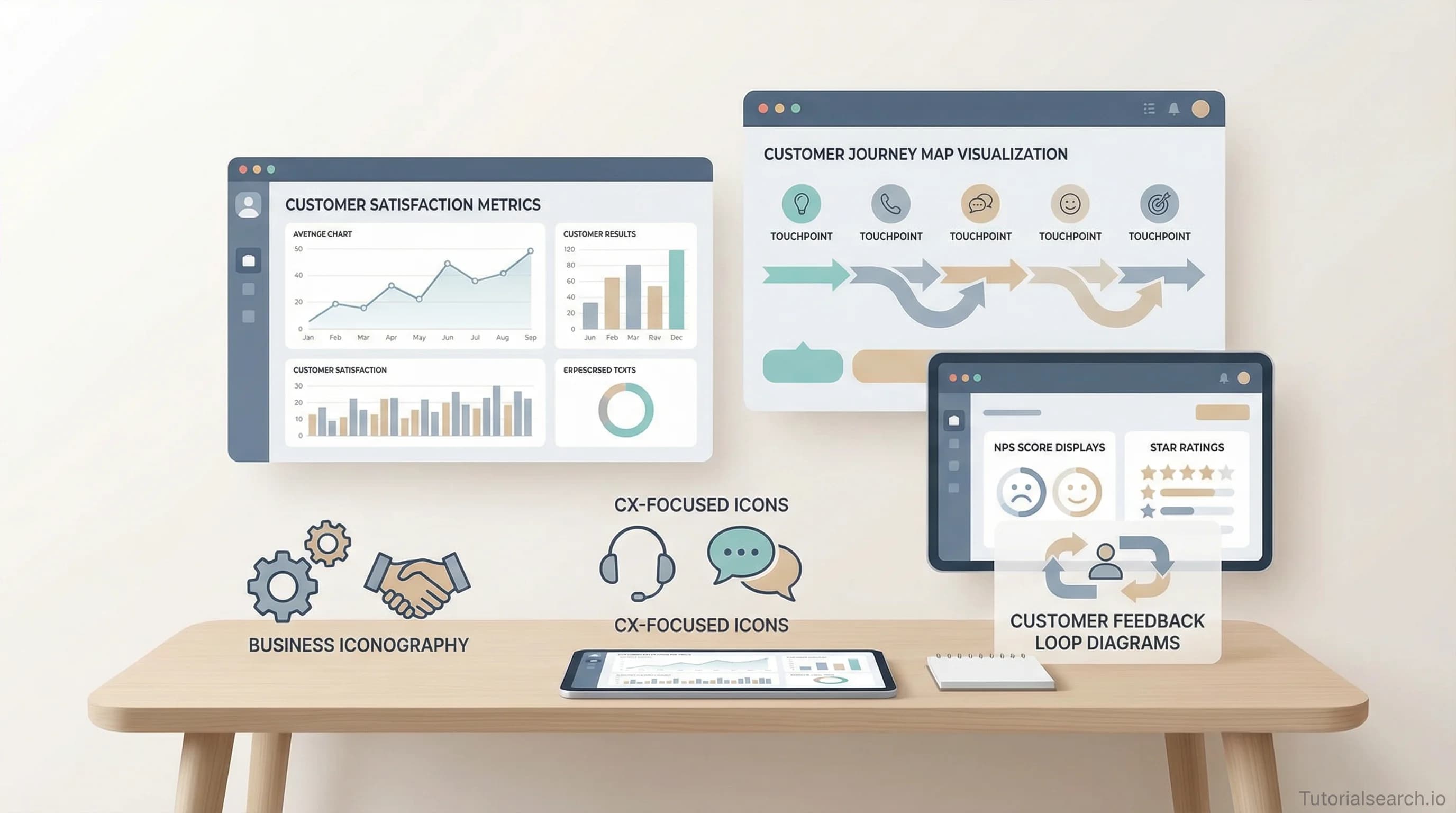
Customer Experience Courses Worth Your Time
Customer experience skills are in high demand across every industry. Here are the courses, free resources, YouTube channels, and books that get you there fastest.
Need a SaaS MVP shipped fast? Hire the TutorialSearch.io team
Auth, billing, dashboards and AI features — a launch-ready product built by the devs behind this site.
Customer experience failures often look like product problems — and that misdiagnosis is expensive.
Picture a software company that raised $20 million in Series A funding. The product was solid. The pricing was fair. But within six months, their churn rate had climbed to 35% — a number that made investors nervous and leadership scramble.
The culprit wasn't the product. It was every interaction around it. Slow onboarding. Generic emails. Support reps who followed scripts instead of listening. The company had a product problem that looked like a sales problem. It was actually a customer experience problem.
Customer experience (CX) is the sum of every touchpoint a customer has with your business — from the first ad they see to the support email they send two years later. Organizations that take this seriously are building a significant competitive advantage. The global CX management market was $22.35 billion in 2025. By 2034, it's projected to hit $84.22 billion — a 15.8% annual growth rate that makes most tech sectors look slow.
If you want to build real skills in this field, you'll find over 300 customer experience courses on TutorialSearch.io to get you started.
Key Takeaways
- Customer experience (CX) covers every interaction a customer has with your brand, from discovery to loyalty
- The CX management market will grow from $26 billion in 2026 to $84 billion by 2034 — demand for skilled practitioners is rising
- Free resources from HP LIFE, Great Learning, and Alison let you start without spending a dollar
- The best customer experience courses cover journey mapping, NPS measurement, and AI-powered personalization
- Reducing friction matters more than creating "wow moments" — this insight shapes how effective CX teams actually operate
In This Article
- The Customer Experience Skills That Set Professionals Apart
- The Customer Experience Courses I'd Recommend First
- Free Customer Experience Learning That Won't Waste Your Time
- Customer Experience YouTube Channels Worth Bookmarking
- Customer Experience GitHub Repos Worth Starring
- The Customer Experience Books That Changed How Practitioners Think
- Where Customer Experience Professionals Gather
- Related Customer Experience Skills Worth Exploring
- Frequently Asked Questions About Customer Experience
The Customer Experience Skills That Set Professionals Apart
CX isn't one skill. It's a cluster of connected abilities that work together.
The core ones: journey mapping (charting every step a customer takes with your brand), feedback measurement (using NPS, CSAT, and CES scores to quantify satisfaction), CRM proficiency (working with platforms like Salesforce or HubSpot), and data analysis (turning raw feedback into actionable patterns).
Beyond the basics, employers in 2026 want CX professionals who can work with AI tools. Chatbots, predictive analytics, and AI-personalization platforms are now table stakes in enterprise CX. If you understand how AI fits into the customer journey — and where it still falls short — you're ahead of most candidates.
One thing that surprises learners: CX and user experience (UX) are related but distinct. UX focuses on the design of products. CX covers the entire relationship — including sales, marketing, and support interactions that have nothing to do with product design. If you're interested in both, you might also want to explore business strategy courses, which often drive the organizational decisions that shape CX.
The Customer Experience Courses I'd Recommend First
There are over 300 customer experience courses available, but most learners don't need more than two or three. Here's what works.
1. Customer Experience Management - Foundation Course [Editors' Choice]
(Udemy — Sameer Narkar)
This is the course I'd send to someone starting completely from scratch. It holds a 4.6-star rating across nearly 10,000 students — which is unusually high for a foundation-level course. Narkar covers the core CX framework without overwhelming you: what CX is, how to measure it, and how organizations structure their CX function.
What stands out is that the course doesn't just define NPS and move on. It spends real time on how to act on the data — which is the part most introductory courses skip entirely. If you finish this one and nothing else, you'll have a working mental model of how professional CX operates. Check it out here.
- Customer satisfaction metrics (NPS, CSAT, CES)
- CX strategy and organizational structure
- Journey mapping fundamentals
- Practical case studies from real businesses
2. Customer Experience: Brand Promise & Customer Loyalty [Editors' Choice]
(Udemy — Expert Academy)
This is the highest-rated CX course in the catalog at 4.69 stars. The Expert Academy series is consistently well-produced, and this one focuses on the connection between brand promises and long-term customer loyalty.
The course argues, convincingly, that customers don't just want their problems solved. They want to feel that a company keeps its word. This isn't soft-skills territory — it translates directly into retention metrics and lifetime customer value. View the course.
3. Customer Experience (CX) in Industry 4.0 [Editors' Choice]
(Udemy — CipherDev Labs)
Industry 4.0 refers to the fourth industrial revolution — the era of digital transformation where AI, IoT (Internet of Things), and automation reshape how businesses operate. This course shows what that shift means for customer experience specifically.
At 4.52 stars and 17,605 students, it's one of the most popular CX courses available. The CipherDev Labs team covers how AI assistants, chatbots, and real-time analytics change the expectations customers now hold. If you're working in tech or at any digitally-forward company, this is required viewing. Check it out.
4. Customer Experience with Generative AI: Advanced CX with AI
(Udemy — Andrii Piatakha)
This one is for people who are already comfortable with CX basics and want to go deeper into AI applications. Piatakha covers journey mapping with AI tools, predictive analytics, and how generative AI (AI that creates content or responses) can personalize customer interactions at scale.
One honest note: this course is best if you already have six or more months of CX experience. The "advanced" label is accurate. Beginners will find it disorienting without a foundation first. View the course.
5. Customer Experience Management (CX): MASTERCLASS 2025
(Udemy — Manos Filippou)
Nearly 20,000 students have taken this masterclass. It's the widest-scope option here — covering everything from CX strategy to customer feedback systems to team management. The breadth is both its strength and its weakness.
It's good for people who need a broad foundation quickly. But if you want depth on one area, such as journey mapping or NPS analysis, you'll find this course thinner than a dedicated one. Browse the course.
Which course fits you? A quick decision guide:
| Your situation | Best pick |
|---|---|
| Complete beginner, want structure | Foundation Course (Sameer Narkar) |
| Already in CX, want to specialize | Brand Promise & Loyalty (Expert Academy) |
| Working in tech or digital transformation | CX in Industry 4.0 (CipherDev Labs) |
| Need the broadest overview fast | CX Masterclass (Manos Filippou) |
| AI-focused, already have CX experience | CX with Generative AI (Piatakha) |
The Expert Academy's Brand Purpose & Leadership course is also worth noting for those interested in the organizational leadership side of CX.
Free Customer Experience Learning That Won't Waste Your Time
The standard advice is to start with a paid course for structure. I'd push back on that — for CX specifically, free resources are unusually good.
Great Learning Academy — Demystifying Customer Experience
This is free, includes a certificate of completion, and covers CX fundamentals clearly. It's short enough to finish in an afternoon. Good for building vocabulary and frameworks before committing to a longer course.
HP LIFE — Improve Customer Experience for Business Success
HP LIFE's free CX course is aimed at small business owners and entrepreneurs. It focuses on the voice of the customer — how to collect it, interpret it, and act on it. Practical and jargon-free, it's one of the better free options for people who learn by doing.
Alison — Free Online Customer Experience Courses
Alison hosts several free CX courses, including "Introduction to Customer Service Excellence." The platform isn't flashy, but the content is solid and they provide free certificates upon completion. Good for learners who want a credential without the price tag.
Digital Marketing Institute — Free CX Micro Lessons
DMI offers sample lessons from their CX certification modules for free. If you're evaluating whether to invest in their full program, these previews give you a genuine taste of the content.
CMSWire — What Is Customer Experience: A Complete Guide
This isn't a course — it's a long-form guide that covers the discipline comprehensively. One stat worth bookmarking: the CX management market is expected to grow from $26.11 billion in 2026 to $84.22 billion by 2034. Useful context for anyone making an internal case for CX investment.
Shopify — The Ultimate Guide to Digital Customer Experience
A well-sourced guide on the state of online CX. The headline finding: 25% of brands saw their CX rankings fall in 2025, compared to just 7% that improved. Understanding where the industry is struggling helps you identify which skills are most in demand. Essential reading if you work in e-commerce.
You can also browse management skills courses — many include modules on customer-centric leadership that complement a dedicated CX program.
Customer Experience YouTube Channels Worth Bookmarking
Need a SaaS MVP shipped fast? Hire the TutorialSearch.io team
Auth, billing, dashboards and AI features — a launch-ready product built by the devs behind this site.
Blake Morgan — The Modern Customer Podcast Channel
Blake Morgan is one of the clearest thinkers on CX strategy working today. Her YouTube channel pairs with her podcast, and she regularly interviews CX leaders from major companies. The tone is strategic rather than academic. If you want to understand how CX decisions get made at the executive level, this is the place to spend time. Especially useful for business-side learners.
CSM Practice
This channel covers Customer Success and CX extensively, with 30+ playlists on topics including journey mapping, KPIs, retention, upsell strategy, and career paths in CX. It's one of the most comprehensive free YouTube resources for CX practitioners. The videos run longer than most — which is a good thing when you actually want to learn something.
Zendesk — Customer Service & Experience Videos
Zendesk's YouTube channel is more practical than strategic — it covers support workflows, agent training, and the operational tools you'd use day-to-day in a CX role. If you're moving into a position that involves managing support operations, these videos will save you significant onboarding time.
Qualtrics
Qualtrics focuses on measurement: NPS, CSAT, experience data, and what to do with it. Their 10 Must-Watch CX Videos list is a good place to start. If you're data-oriented, this channel speaks your language.
Customer Experience GitHub Repos Worth Starring
This is the go-to GitHub resource for CX and Customer Success professionals. It catalogs platforms (Gainsight, Totango), feedback tools (Wootric, AskNicely, SatisMeter), journey mapping tools (UXPressia, Smaply), and automation resources (Zapier, Workato). Bookmark this before you start evaluating any CX tech stack — it will save you hours of research.
mutedblues/Customer-Success-Management
A curated list of books, blogs, podcasts, software, and case studies focused on customer success management. Less about tools, more about the career and intellectual side of the discipline. The podcast and books sections alone are worth the visit — they surface resources you won't find by searching Coursera or Udemy.
These repos pair well with business improvement resources, where CX skills apply directly to operational change.
The Customer Experience Books That Changed How Practitioners Think
The Effortless Experience by Matthew Dixon, Nick Toman, and Rick DeLisi [Editors' Choice]
This book makes an uncomfortable argument: trying to delight customers doesn't build loyalty. Removing friction does.
Companies spend millions creating "wow moments" when what customers really want is to solve their problem quickly and move on. The research behind this is extensive, and the practical framework — reducing effort rather than maximizing delight — has changed how serious CX teams approach service design. This is the one book I'd recommend reading before anything else.
Outside In: The Power of Putting Customers at the Center of Your Business by Harley Manning and Kerry Bodine
Based on 14 years of Forrester Research, this book gives you a rigorous framework for diagnosing CX problems and building the internal case for investment. Less practical how-to, more strategic framework. Useful for people who need to influence CX priorities at their organization rather than just execute them.
The Experience Economy by Joseph Pine II and James Gilmore
The original book that defined "experience" as a distinct economic offering — separate from goods and services. Published in 1999 and updated since. Understanding this framework changes how you think about what businesses are actually selling. Worth reading before you touch anything tactical, just to shift your mental model.
Customer Experience 3.0 by John A. Goodman
Goodman focuses on the business case for CX — how to calculate ROI, reduce complaint volume, and use tools like CRM (customer relationship management) systems and social media monitoring to deliver seamless experiences. More practical than The Experience Economy, less philosophical. Good for people who need to quantify CX impact for leadership.
Where Customer Experience Professionals Gather
CXPA — Customer Experience Professionals Association
CXPA is the main professional body for CX practitioners. They offer the CCXP (Certified Customer Experience Professional) certification — the most widely recognized credential in the field. Preparing for the CCXP exam alone teaches you to think about CX systematically. Getting certified signals seriousness to employers and clients.
CustomerThink bills itself as "the world's largest online community dedicated to customer-centric business strategy." It publishes articles, research, and case studies from practitioners, and the community produces genuinely useful discussions. Good for staying current on industry trends without paying for a research subscription.
Aimed at subscription economy professionals, CHURN.FM interviews operators and CX leaders about retention strategy. The conversations are practical — real metrics, real decisions, honest outcomes. If you work in SaaS or any subscription business, put this in your podcast rotation.
Reddit — r/CustomerSuccess and r/CustomerExperience
Both subreddits are active and relatively high-signal. People ask real career questions, share salary data, and discuss tool evaluations openly. A good complement to more structured learning.
If you're interested in the people-management dimension of CX, people strategy courses alongside your CX learning will give you a more complete picture — CX rarely succeeds without strong internal alignment.
Related Customer Experience Skills Worth Exploring
Customer experience doesn't exist in isolation. These adjacent skills pair well with a CX foundation:
- Business Strategy — CX decisions at scale come from strategic frameworks. Understanding how companies set priorities helps you advocate for CX investment and make decisions that stick.
- Management Skills — Most CX roles eventually require managing teams or cross-functional influence. Management fundamentals make that transition smoother.
- Business Growth — Understanding growth models helps you connect CX improvements directly to revenue outcomes — which is how you get budget and buy-in.
- Business Processes — CX improvement often means redesigning workflows. Knowing how to map and optimize business processes is a natural complement to CX work.
- Quality Management — Quality frameworks like Six Sigma and ISO standards overlap significantly with CX methodology. If your organization uses these, understanding them deepens your CX work considerably.
Frequently Asked Questions About Customer Experience
How long does it take to learn Customer Experience?
You can build a solid foundation in four to eight weeks with a structured course and consistent practice. Reaching professional-level competency — where you can lead CX initiatives and interpret data confidently — typically takes six to twelve months of applied work. The foundation course by Sameer Narkar is a good benchmark: most learners finish it in three to five weeks at a steady pace.
Do I need a marketing or business background to learn Customer Experience?
No. CX draws from psychology, design, data analysis, and operations — it's deliberately multi-disciplinary. Some familiarity with how businesses work (customer lifecycles, basic metrics, revenue models) will help you move faster. If you're starting from scratch, pair your CX learning with a short business management course.
Can I get a job in Customer Experience without prior experience?
Yes, but you'll need to demonstrate the right mindset. Entry-level CX roles — customer success associate, support specialist, CX analyst — often hire candidates who show structured thinking and genuine interest in customer outcomes over pure credentials. A certification helps. A portfolio of real projects, even personal or freelance ones, helps more.
How does Customer Experience differ from Customer Service?
Customer service is reactive: it handles problems and requests after they arise. Customer experience is proactive: it designs the entire journey so fewer problems occur in the first place. Customer service is one touchpoint. Customer experience is the sum of all touchpoints. Most companies that struggle with CX have responsive support teams but have never thought holistically about the end-to-end journey.
What metrics matter most in Customer Experience?
The three most common: NPS (Net Promoter Score — measures likelihood to recommend), CSAT (Customer Satisfaction Score — measures satisfaction with a specific interaction), and CES (Customer Effort Score — measures how easy it was to complete a task). Research suggests CES is the most predictive of long-term loyalty, which is the central argument of The Effortless Experience. You can explore more customer experience courses and frameworks on TutorialSearch.io.
Your next move: if you're completely new to CX, start with the Foundation Course and the free HP LIFE resource in parallel. If you already have CX experience, the Brand Promise & Loyalty course or the Industry 4.0 course will take you further, faster.