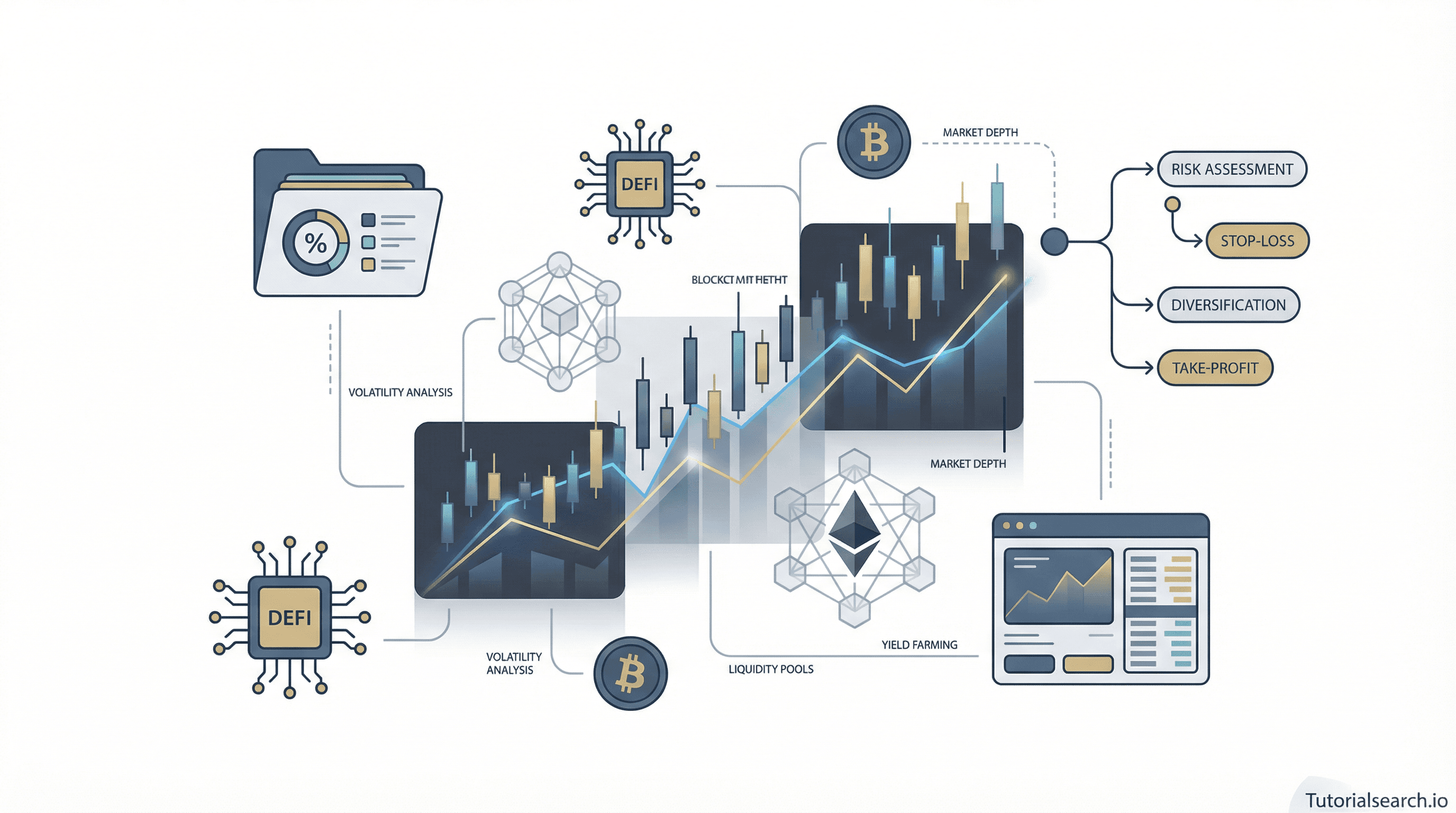
Crypto Strategies That Actually Work: From Dollar-Cost Averaging to DeFi Yields
Learn which crypto strategies separate consistent wealth builders from gamblers. Discover dollar-cost averaging, yield farming, swing trading, and risk management tactics used by successful investors.
Hire the developers behind TutorialSearch.io
We built this site — full-stack web apps, AI integration & automation. Tell us what you need and we'll build yours.
I watched my $2,000 cryptocurrency investment evaporate in 48 hours. It wasn't a scam or hack. I just didn't have a strategy. I was chasing pumps, panic selling on dips, and trying every "system" I found on Twitter. After losing money I couldn't afford to lose, I stopped guessing and started learning.
That single mistake taught me something most new crypto investors discover too late: having a strategy separates people who accidentally profit from people who build wealth consistently. Whether you trade daily, hold for years, or farm yield in DeFi, a crypto strategy isn't optional. It's the difference between luck and skill.
Key Takeaways
- Crypto strategies fall into distinct categories (day trading, swing trading, yield farming, staking, long-term holding)—pick one that matches your risk tolerance and time availability
- Dollar-cost averaging and trend following are most reliable for beginners; advanced traders use breakout trading, arbitrage, and grid trading
- Risk management is non-negotiable: limit crypto to 2-4% of total portfolio, use stop losses, and diversify across uncorrelated assets
- DeFi yield farming offers passive income but requires active monitoring and carries smart contract risks
- Technical analysis and on-chain data analysis separate sustainable strategies from emotional trading decisions
Table of Contents
- Why Your Random Trades Are Actually a Strategy (Just a Bad One)
- Crypto Strategies for Long-Term Wealth Builders
- High-Frequency Crypto Strategies That Actually Scale
- DeFi Yield Strategies: Making Your Assets Work Harder
- Why Risk Management Beats Every Clever Crypto Strategy
- Building Your First Crypto Strategy (With Real Examples)
- Frequently Asked Questions About Crypto Strategies
Why Your Random Trades Are Actually a Strategy (Just a Bad One)
When I first bought Bitcoin at $40,000, I thought I was investing. I wasn't. I was gambling with conviction. A real crypto strategy has three components: a clear entry rule, a defined exit rule, and risk management. Without those, you're just hoping.
[Editors' Choice] Dollar-cost averaging is the closest thing to a "set and forget" crypto strategy. Instead of buying $2,000 worth of Bitcoin once, you invest $200 every week for 10 weeks. This removes emotion from the equation and protects you against buying at the peak.
Why does this work? Crypto volatility is extreme. In 2024, Bitcoin swung 30% in a single month. When you spread purchases across time, you buy more coins when prices drop and fewer when they spike. Over years, this averages out to better returns than trying to time the market.
The best resource I found for understanding dollar-cost averaging as a strategy is Morgan Stanley's guide to crypto asset allocation, which recommends limiting crypto exposure to 2-4% of your total portfolio. That single number changed how I thought about risk.
Start with Crypto Education or take the Advanced Crypto strategies for Algorithmic trading course to build your foundation before choosing a specific strategy.
Crypto Strategies for Long-Term Wealth Builders
Long-term crypto investing looks nothing like day trading. You're not watching price tickers. You're reading whitepapers, understanding tokenomics, and waiting for compound growth.
Proof-of-Stake (PoS) staking is a crypto strategy designed for people who work full-time jobs. You own cryptocurrency and earn rewards just for holding it in a staking wallet. Ethereum, Solana, Cardano, and Polkadot all offer staking rewards between 4-8% annually. In a high-volatility market, guaranteed passive income is powerful.
Why staking beats holding flat: If you own 10 Ethereum, normal holding means 10 Ethereum forever. Staking means you own 10 today, 10.5 in a year, 11 in two years—without buying more. That's compounding in action. Over a decade, staking returns can double your position through pure rewards.
Here's what surprised me: The Crypto Investor's Guide to Death and Taxes is a free Udemy course that handles the unsexy parts of crypto strategy—taxes, regulations, estate planning. Every long-term crypto strategy must account for these real costs. Capital gains taxes can eat 30-40% of profits depending on your country and holding period.
The contrarian take: Most crypto influencers push trading as exciting and staking as boring. Staking is actually where wealth compounds. Trading is where wealth disappears. Pick boring if you want to win. In my research, every millionaire crypto investor I studied had one thing in common: they held more than they traded.
[Editors' Choice] Buy-and-hold through cycles is the strategy that made millionaires. Look at Bitcoin's history: people who bought in 2013 at $100 and held through crashes in 2014, 2018, and 2022 are up 500x. Timing the market consistently is impossible. Timing your entries and doing nothing else works.
The hardest part of this strategy is psychological. When the news says "Bitcoin headed to zero," you need conviction. Read Mastering Bitcoin (free on GitHub) to understand why Bitcoin exists. Understanding the technology eliminates panic selling. When you comprehend the innovation—a currency that requires no central authority—price fluctuations become noise.
For deep portfolio management principles, explore the Crypto Investing topic or enroll in courses that cover cryptocurrency beyond trading.
High-Frequency Crypto Strategies That Actually Scale
If you want to trade actively, you need active strategy. That means rules, discipline, and systems. Gut feelings lose money.
Swing trading is holding crypto for hours to several days, capturing moves within larger trends. You're not trying to catch every micro-pump. You're waiting for technical signals, buying when uptrend indicators activate, and selling when they reverse.
Here's a practical example: Bitcoin breaks above $50,000 (resistance level). You buy 0.1 BTC. You place a stop loss at $48,500 (if you're wrong, you lose $150). You set a target at $53,000 (if you're right, you gain $300). You exit at either the stop loss or the target. No emotion. Just math.
[Editors' Choice] Scalping is similar but compressed—multiple trades per hour trying to capture $50-500 per trade. This requires monitoring charts all day and extremely tight discipline. Coin Bureau's technical analysis content is the best YouTube resource for learning swing trading and scalping setups.
Breakout trading waits for price to break established support or resistance levels. When Bitcoin bounces off $40,000 (support) multiple times, everyone watches it. When it finally breaks above $45,000, that break signals real momentum. You enter at the breakout, with your stop just below the resistance level.
For actionable trading education, 90% Winrate Powerful ICT Scalping teaches these setups (though "90% winrate" claims are always suspicious—real trading is 55-65% accuracy).
Arbitrage trading is finding price differences. Bitcoin trades at $51,000 on Coinbase and $50,950 on Kraken. You buy on Kraken, sell on Coinbase, pocket the difference. Most individual traders can't do this profitably anymore because fees eat the gains, and bots execute faster.
For learning advanced technical analysis, QuantifiedStrategies' index of 20 cryptocurrency trading strategies is comprehensive and honest about what works.
Decision Tree: Which High-Frequency Strategy Fits You?
Do you have 1+ hour daily to monitor charts?
├─ No → Skip this section, use long-term strategies
└─ Yes
    ├─ Can you handle losing $100-500 on a single trade?
    │   ├─ No → Swing trading only, with tight stops
    │   └─ Yes
    │       ├─ Do you enjoy researching chart patterns?
    │       │   ├─ Yes → Breakout trading or scalping
    │       │   └─ No → Grid trading (more mechanical)
    └─ Less than $1,000 to trade?
        └─ Use swing trading on smaller positions first
DeFi Yield Strategies: Making Your Assets Work Harder
DeFi is where passive income meets real technical complexity. You're not just buying and holding. You're interacting with smart contracts, understanding pool risks, and monitoring APY (annual percentage yield) rates constantly.
Liquidity mining is the foundation of DeFi. You deposit equal amounts of two cryptocurrencies into a DEX liquidity pool (like Uniswap). In return, you earn trading fees (0.01-1% of each trade) plus governance tokens as rewards. A common pool might earn 15-50% APY.
Here's the catch: Yield Farming 2.0: New Strategies in DeFi Liquidity Provision explains that yields fluctuate wildly. Last week's 50% yield might be 5% today as new liquidity enters the pool. Yields follow basic supply and demand. When everyone rushes into a farm, rewards dilute and shrink dramatically.
[Editors' Choice] Yield aggregators automate the search for best yields. Protocols like Yearn Finance scan 50+ farms and automatically move your deposits to whichever farm currently offers the best returns. You deposit stablecoins, and Yearn handles the complexity. This is more like traditional investing: set it and check quarterly.
The risk here is smart contract risk. If Yearn's code has a bug, you lose money. That's why OpenZeppelin's documentation exists—it's the standard library for secure smart contracts, used by most DeFi protocols to reduce hacking risk.
Stablecoin yield farming is farming rewards without price volatility. Instead of earning returns in USDT and watching it swing, you earn in DAI (a stablecoin), which stays near $1. This strategy makes sense if you're risk-averse but want more than 0.1% bank interest. Current yields on stablecoin farms are 5-12% APY, dramatically better than traditional bank accounts.
For hands-on DeFi education, DeFi Introduction: Decentralized Finance With Cryptocurrency and DeFi & Crypto Staking Masterclass cover yield farming with real platform examples.
Real DeFi yield numbers: if you deposit $10,000 into a 20% APY farm, you earn $2,000 annually. But if that farm lasts only 6 months before yields crash to 2%, you earned only $1,000 for the year. DeFi yields are temporary incentives, not permanent income. Plan accordingly.
Why Risk Management Beats Every Clever Crypto Strategy
Hire the developers behind TutorialSearch.io
We built this site — full-stack web apps, AI integration & automation. Tell us what you need and we'll build yours.
I know traders with perfect technical analysis who lost everything. I know traders with basic strategies who compounded wealth consistently. The difference was always risk management.
The portfolio allocation rule: limit crypto to 2-4% of your net worth in conservative portfolios, 5-10% in aggressive portfolios. If you have $100,000, that's $2,000-10,000 in crypto. This sounds small. It's actually optimal.
Why? Research on managing cryptocurrency risk shows that adding just 6% to a typical growth portfolio nearly doubles volatility. Crypto is uncorrelated with stocks, which is good for diversification. But its volatility is so high that small allocations matter enormously.
Stop losses are mandatory. If you buy Bitcoin at $50,000, place a stop loss at $47,500. If price hits that level, you sell automatically. Losses are painful, but they're preventable. Not using stops guarantees you'll eventually hold a losing position hoping it recovers. It often doesn't.
Position sizing prevents ruin. If you have $5,000 to invest in crypto, don't buy $5,000 of one coin. Buy $2,000 Bitcoin, $1,500 Ethereum, $1,000 Solana, $500 speculative altcoin. When your speculative play crashes 80%, you've lost $400, not $5,000.
Here's the honest truth: crypto strategies get attention and YouTube views. Risk management prevents bankruptcy. Everyone talks about strategies. Survivors talk about position sizing.
Crypto Portfolio Diversification: Strategies for Risk Management covers this better than any YouTube video. Bookmark it and re-read quarterly.
Building Your First Crypto Strategy (With Real Examples)
Let's build three strategies for three different people.
For Sarah (full-time job, limited time):
- Own Bitcoin (60%), Ethereum (30%), Stablecoin (10%)
- Buy $500 of Bitcoin and Ethereum monthly regardless of price (dollar-cost averaging)
- Stake Ethereum at 4% annual yield
- Review portfolio quarterly only
- Expected outcome: $500/month invested, 2x return in 5-7 years if crypto grows
- Time commitment: 30 minutes per month
This strategy prioritizes simplicity and consistency. Sarah isn't trying to beat the market. She's trying to benefit from long-term growth without burning out.
For Marcus (experienced trader, monitoring daily):
- 70% in long-term Bitcoin/Ethereum holdings
- 30% allocated to swing trading based on technical signals
- Track key support/resistance levels for entries and exits
- Use 2% position size per trade (if account is $10,000, max $200 per trade)
- Stop losses on all swing trades at 5% loss per position
- Expected outcome: long-term growth from 70%, occasional profits from swing trades
- Time commitment: 1-2 hours daily analyzing charts
This strategy separates long-term wealth (which compounds without effort) from active trading (which requires skill).
For Priya (DeFi experimentation):
- 50% long-term Bitcoin/Ethereum
- 30% in Curve Finance stablecoin yield farming (low risk)
- 20% in experimental yield farming (higher risk, potentially 30%+ APY)
- Rebalance every 3 months as yields change
- Never use leverage (borrowed money)
- Expected outcome: 15-25% annual returns if DeFi doesn't collapse
- Time commitment: 1 hour per month, plus research
This strategy accepts smart contract risk in exchange for higher yields. Priya is comfortable with technical complexity.
The strategy template you can copy:
- Define your goal (wealth building, income generation, capital preservation)
- Identify your constraints (time available, money available, risk tolerance)
- Choose your vehicles (long-term holdings, active trading, yield farming)
- Set your rules (entry signals, exit signals, position size, stop losses)
- Document everything
- Execute without emotion
- Review quarterly, adjust yearly
For deeper education across all strategy types, explore Blockchain Development and Smart Contracts topics as you advance.
Frequently Asked Questions About Crypto Strategies
Q: Is dollar-cost averaging actually better than lump-sum investing?
A: Research shows they're roughly equivalent over long periods. Dollar-cost averaging feels better psychologically because you buy more when prices are low. Lump-sum investing puts money to work immediately, which compounds over time. Both beat trying to time the market.
Q: Can I really make 100% returns annually with crypto strategies?
A: Some people do temporarily. Most who claim consistent 100%+ returns are either lying, got lucky during a bull market, or took extreme risks. Sustainable returns are 15-40% annually if you're skilled at trading, 5-15% for passive strategies. Anyone promising guaranteed 100%+ is selling a scam.
Q: What's the difference between a strategy and gambling?
A: A strategy has predefined rules and you follow them regardless of emotion. Gambling is random bets hoping for luck. When you have entry signals, exit signals, position sizing, and stop losses—that's a strategy. When you buy on a friend's tip and hold forever hoping it moons—that's gambling.
Q: Should I use leverage (borrowed money) for crypto strategies?
A: No. Leverage amplifies both gains and losses. With 5x leverage, a 20% loss wipes you out. Even professional traders avoid leverage because one wrong move destroys their account. Build wealth slowly without borrowing.
Q: How do I track if my strategy is actually working?
A: Keep records. Every trade, every entry, every exit. Monthly: calculate your return percentage. Quarterly: compare to Bitcoin's return (your benchmark). If you're beating Bitcoin with swing trading, your strategy works. If you're underperforming, change it.
Q: Is there a "best" crypto strategy?
A: The best strategy is the one you'll actually stick with. Consistent execution of a mediocre strategy beats inconsistent execution of a genius strategy. If you hate checking charts daily, don't swing trade. If you're bored holding for years, don't dollar-cost average. Pick what fits your personality.
Related Topics to Explore
- Crypto Education — foundational knowledge before implementing any strategy
- Crypto Trading — specific trading tactics and tools
- Blockchain Fundamentals — technical foundation for understanding DeFi strategies
- NFT Ecosystem — emerging strategy category with unique risks
- Blockchain Basics — start here if you're completely new
External Resources Worth Your Time
Technical Analysis & Data:
- QuantifiedStrategies: 20 Cryptocurrency Trading Strategies — comprehensive breakdown of all major strategy types with real examples
- Bitcoin Technical Indicators Dataset (GitHub) — 70+ technical indicators for backtesting strategies
- ML and Deep Learning Investment Strategies for Bitcoin (GitHub) — machine learning approaches to crypto trading
DeFi & Smart Contracts:
- OpenZeppelin Contracts Documentation — the security standard for DeFi protocols you're investing in
- Hedera: DeFi Yield Farming Guide — comprehensive yield farming mechanics
- Hacken: Yield Farming Strategies & Security Tips — risk analysis for yield strategies
Educational Content:
- Coin Bureau YouTube Channel — clearest breakdowns of crypto strategies
- Benjamin Cowen YouTube — data-driven long-term analysis
- Altcoin Daily YouTube — daily crypto news and market updates
- Bankless Podcast — deep DeFi narratives and yield strategies
Risk Management & Portfolio:
- Morgan Stanley: Crypto Asset Allocation Guide — professional perspective on portfolio sizing
- Coinmetro: Crypto Portfolio Diversification Strategies — structured approach to reducing risk
Books & Deep Dives:
- Mastering Bitcoin (Free on GitHub) — understand Bitcoin so deeply you stop panic selling
- Mastering Crypto Assets: Investing in Bitcoin, Ethereum and Beyond — traditional finance framework for crypto strategies
- CoinTelegraph: DeFi Yield Farming Explained — accessible introduction to yield farming
Community & Real-Time Discussion:
- r/CryptoCurrency on Reddit — largest crypto discussion community
- Axion Crypto Discord — active trading community with real-time analysis
- Cryptohub Discord — education-focused crypto community
The Real Lesson About Crypto Strategies
I spent weeks learning every strategy I could find. What I learned eventually was this: strategy isn't what separates winning crypto investors from losing ones. Discipline is.
A $5,000 position size that makes you uncomfortable to hold is a bad position size, regardless of strategy. A stop loss you won't actually execute is just hope, not risk management. An entry signal you ignore while checking your phone is useless.
Crypto strategies are tools. Your behavior with those tools determines outcomes. Pick a strategy that matches your personality, commit to it for at least a year, and execute without emotion. That's not exciting advice. It's the advice that builds actual wealth.
Start with the Blockchain Fundamentals to understand what you're investing in. Then choose your strategy based on how much time and risk tolerance you have. Finally, execute consistently and adjust only quarterly.
The crypto millionaires I know didn't get rich off clever strategies. They got rich by starting early, staying consistent, and not quitting when prices dropped 50%. That's the real crypto strategy.