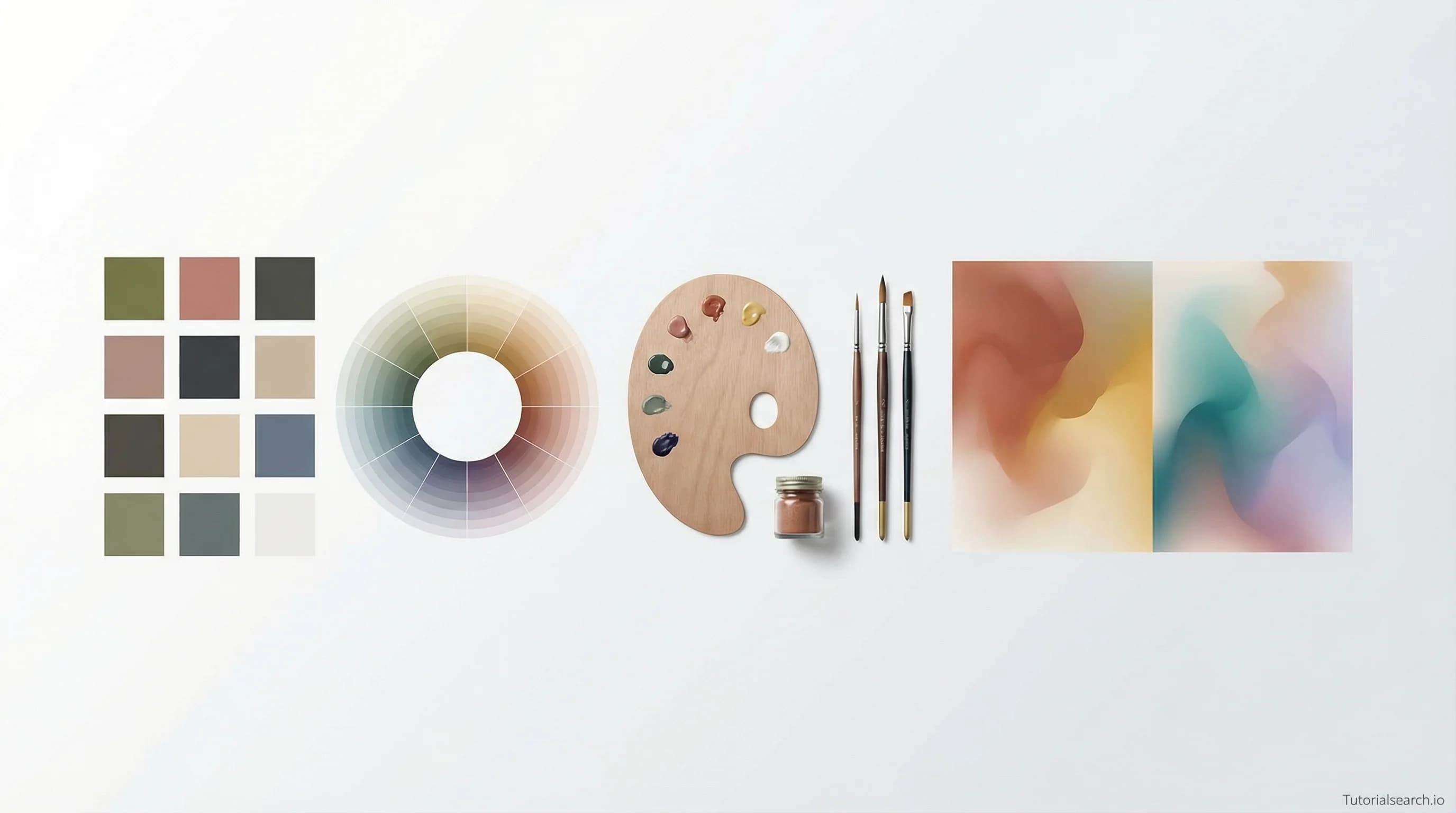
Color Theory for Artists: A Complete Resource Guide
Color theory for artists goes beyond the color wheel — here are the top courses, free tools, YouTube channels, and books that help color knowledge actually stick.
Hire the developers behind TutorialSearch.io
We built this site — full-stack web apps, AI integration & automation. Tell us what you need and we'll build yours.
Color theory for artists sounds deceptively simple, but applying it to real paintings is where most beginners get stuck. This guide brings together the best courses, free tools, YouTube channels, GitHub repos, and books to help that knowledge actually stick — whether you're just starting out or trying to move past muddy, lifeless palettes.
Here's what trips most people up: they memorize the color wheel, write down the rules for complementary and analogous colors, and then look at their work and wonder why it still feels off. The problem isn't the rules. It's that color theory isn't a checklist you apply — it's a way of seeing that takes time to train.
If you want to jump straight to courses, there are 186 color theory courses on TutorialSearch.io across every platform and skill level. But if you want to know which ones are worth your time — and what to use alongside them — keep reading.
Key Takeaways
- Color theory for artists means learning to see color relationships, not just memorizing rules
- The best color theory courses pair clear explanation with hands-on projects you actually finish
- Free tools like the Adobe Color wheel are genuinely useful for practicing harmony in real time
- "Interaction of Color" by Josef Albers is the most important color theory book ever written — and still taught in art schools today
- A structured course plus daily practice with real colors gets you further than reading alone
In This Article
- Color Theory Courses Worth Your Studio Time
- Free Color Theory Resources That Teach You to See
- Color Theory YouTube Channels Artists Actually Watch
- Color Theory GitHub Repos and Interactive Tools
- Color Theory Books That Belong in Your Studio
- Related Art Skills Worth Pairing With Color Theory
- Frequently Asked Questions About Color Theory
Color Theory Courses Worth Your Studio Time
The range of color theory courses online is enormous — from 30-minute Skillshare projects to multi-hour Udemy deep dives taught by PhDs. These are the ones that consistently deliver.
A quick platform note: Skillshare requires a subscription but offers project-based, shorter-form classes. Udemy is a one-time purchase per course and tends to go deeper on concepts. Both platforms have strong color theory options, and both have something the other doesn't.
1. Color Theory for Illustrators: A Fun Beginner's Guide to Creative Color [Editors' Choice]
Instructor: Brooke Glaser | Skillshare | ⭐ 4.62 | 23,400+ students | Paid
This is the course to recommend to a friend starting from scratch. The title isn't marketing fluff — Brooke Glaser genuinely keeps it engaging. She covers color harmonies, building palettes from photo references, and how to use color to lead a viewer's eye through an illustration.
What sets it apart from most introductory courses: you're not just watching diagrams. You're building and applying a color palette by the end of the first lesson. Theory and practice move together throughout.
Start with this course on TutorialSearch.io
2. Color Theory: Learn The Art and Science of Colors
Instructor: Talha Bhatti | Udemy | ⭐ 4.4 | 14,300+ students | Paid
Talha Bhatti takes a more academic approach than the Skillshare option above. If you want to understand the why behind every rule — the physics of light, the mechanics of how the eye perceives hue and saturation, why certain combinations create visual tension — this course goes there.
It's more lecture-heavy than the Brooke Glaser course, but many students find that the depth here makes earlier, lighter-touch courses finally make sense. The two courses work well together if you have the time.
View course on TutorialSearch.io
3. Color Theory (Emma Hitt Nichols, PhD) [Editors' Choice]
Instructor: Emma Hitt Nichols, PhD | Udemy | ⭐ 4.45 | 8,300+ students | FREE
A free course taught by a PhD-level instructor with near-perfect ratings. Dr. Nichols covers color temperature, value, saturation, color schemes, and the principles behind visual harmony — with academic rigor that stays accessible throughout.
The fact that it's free makes it an obvious first move. Download it, work through it, and then decide if you need a more advanced or more project-based follow-up.
4. Color Theory for Character Designers: Tips and Tricks [Editors' Choice]
Instructor: Ira Marcks | Skillshare | ⭐ 4.66 | 2,660+ students | Paid
This is the highest-rated color theory course in the list, and the narrower focus makes it more immediately useful for a specific audience: character designers working in animation, games, comics, or illustration.
Ira Marcks focuses on how color communicates personality and emotion. You learn to read why certain character palettes feel heroic, villainous, mysterious, or warm — and then you learn to build those effects deliberately. If that's your world, start here before anything else.
5. Color Theory for Creatives (Without the Theory and Just the Fun)
Instructor: Sandra Mejia | Skillshare | ⭐ 4.41 | 4,000+ students | Paid
The title is slightly tongue-in-cheek — there is theory here — but Sandra Mejia keeps the emphasis on intuition and creative play rather than rules. This is a great complement to a more structured course. When rules start feeling like constraints instead of tools, this one reminds you what color theory is actually for.
Also worth your attention
For designers specifically, Color Theory for Designers by Sarah Parkinson-Howe (Udemy, ⭐ 4.32) applies color principles to UI and visual communication — a different angle than the painting-focused courses above.
If you work in watercolor, Watercolor Magic: The Basics of Color Mixing and Color Harmony (Skillshare, ⭐ 4.38, 19,000+ students) applies color theory directly in a wet media context — one of the most practical approaches available for traditional painters.
There's also Painting with Gouache: Introduction to Color Theory (Skillshare, ⭐ 4.75) for those working with gouache — a medium where understanding opacity and color mixing directly shapes the outcome of every piece.
And if you genuinely want a free second option alongside Emma Hitt Nichols' course, the simply-titled Color theory by Mohd Arif on Udemy covers the basics at no cost, useful for a second perspective on the same foundational concepts.
Which course fits your situation? Here's a quick guide:
| Your situation | Best starting point |
|---|---|
| Complete beginner, want project-based learning | Brooke Glaser — Skillshare |
| Want to understand the science behind color | Talha Bhatti — Udemy |
| Budget is zero | Emma Hitt Nichols, PhD — Udemy (free) |
| Designing characters for games or animation | Ira Marcks — Skillshare |
| Feel overwhelmed by rules | Sandra Mejia — Skillshare |
| Working in watercolor specifically | Watercolor Magic — Skillshare |
Free Color Theory Resources That Teach You to See
Paid courses give you structure. But some of the best color theory education on the internet costs nothing — and some of these free resources are better than courses you'd pay for.
Color Matters: Basic Color Theory is one of the clearest written introductions you'll find. It covers the color wheel, harmony types, and how context changes color perception — all in plain language with strong visual examples. Bookmark it. You'll come back to it.
Sessions.edu: A Guide to Color Theory covers RGB and RYB color models, harmony principles, and how to apply color schemes in real work. Sessions is a professional design school, and the quality of their free content reflects that.
Adobe Color is the interactive tool worth keeping open while you study. You pick a base color, choose a harmony rule (complementary, triadic, split-complementary, analogous, and more), and the wheel shows you what fits. It also generates palette suggestions from uploaded photos — paste in a reference image and it extracts the dominant colors.
It's free, requires no Creative Cloud subscription, and nothing else comes close for practicing harmony rules in real time.
Sessions College Color Calculator pairs with the Sessions.edu guide. Enter a base color and it shows you complementary, analogous, and triadic options with visual swatches. Useful for understanding why harmony rules work — not just what they suggest.
Practical Color Theory for People Who Code (GitHub Pages) is technically aimed at developers, but its explanations of hue, saturation, and value relationships are some of the clearest available anywhere. If you've ever felt confused by HSV versus HSL versus RGB color spaces, this makes it click.
Draw Paint Academy: A Comprehensive Color Theory Guide is a long, detailed free article that goes well beyond the basics — covering color temperature, how to avoid muddy mixes, and how to read color in real-world scenes. Worth printing out and keeping in your studio.
Domestika's 10 Free Color Theory Tutorials collects free lessons from working artists and designers, plus a free downloadable color theory ebook. Good for picking up perspectives from different practitioners.
If you're building color theory skills in Procreate specifically, they pair directly with Procreate illustration courses — the understanding of hue, temperature, and harmony translates immediately into digital work.
Color Theory YouTube Channels Artists Actually Watch
Hire the developers behind TutorialSearch.io
We built this site — full-stack web apps, AI integration & automation. Tell us what you need and we'll build yours.
Video learning works well for color theory because you can watch an artist mix or apply colors in real time — something text and diagrams can't fully capture.
Proko (YouTube) has extensive coverage of color for representational artists. His videos go deep on color temperature, gamut masking (a technique for building cohesive limited palettes), and how to handle complex lighting situations. Best for intermediate artists who've already got the basics.
Marco Bucci runs one of the most analytically rigorous illustration channels on YouTube. His series on color and light — especially the videos on luminosity and atmospheric color — are frequently cited by working professionals. The production quality is high and the explanations are tight.
Aaron Rutten focuses on digital art but covers color theory in a way that crosses mediums. His explanations are clear and measured, and he builds up concepts from basics without losing more experienced viewers. A consistent, trustworthy reference.
DrawMixPaint takes a traditional painting perspective — specifically oil and acrylic — and explains how physical paint mixing differs from digital color models. If you've ever been confused about why your digital color choices don't translate cleanly to canvas, this channel addresses that gap directly.
One contrarian note: most beginners start their color theory YouTube journey by watching extremely long, comprehensive videos. The more effective approach is usually to watch short targeted videos on a single concept — value contrast, for example, or warm vs. cool temperature shifts — and then immediately practice that one thing. Passive color theory watching is a very slow path to actual color skill.
For finding video-based courses you can take at your own pace, search the color theory course library to filter by platform, level, and price.
Color Theory GitHub Repos and Interactive Tools
awesome-colour is a curated list maintained by the colour-science community on GitHub. It covers academic papers, Python libraries for color science, learning resources, and professional color space conversion tools. More technical than most artists need, but a thorough reference if you want to understand the science of color at depth.
Colorful (GitHub) curates color palette tools, gradient generators, and scheme builders — useful for finding new tools to experiment with and understanding what's available in the broader design community.
Practical Color Theory (tallys.github.io) is worth repeating here as both a learning resource and a demonstration of how color concepts can be taught interactively. Browse through the examples with your own colors to see harmony rules applied visually.
The Josef Albers interactive color app brings the exercises from "Interaction of Color" to life digitally — more on the book below. The interactive version lets you replicate Albers' classic color perception experiments on screen rather than with printed color chips.
Color theory skills also integrate naturally with illustration techniques — the two bodies of knowledge reinforce each other, and most intermediate illustration courses assume you're already developing color fundamentals alongside composition and drawing.
Color Theory Books That Belong in Your Studio
"Interaction of Color" by Josef Albers is the book that comes up in every serious color theory conversation, for good reason. First published in 1963 and still taught in art schools worldwide. Albers' central insight — that colors don't have fixed appearances, they shift based on what surrounds them — sounds obvious until you actually see it demonstrated. Then it changes how you look at everything.
The expanded pocket edition from Yale University Press is the most affordable entry point. The exercises are the point: read with swatches in hand, not passively.
"Color and Light: A Guide for the Realist Painter" by James Gurney [Editors' Choice] is probably the most practical color theory book for representational artists. Gurney works as a professional illustrator and has spent decades studying how light and color behave in real scenes — his website jamesgurney.com has extensive free content as well.
The book covers gamut masking (building harmonious limited palettes by restricting your color range), color temperature in light and shadow, and how to paint convincing light sources. It's the book professional illustrators recommend most often when asked what to read. If you're working in watercolor illustration, the chapter on color temperature in wet media specifically is worth the purchase price alone.
"Color: A Workshop for Artists and Designers" by David Hornung takes a semester-length curriculum approach, with exercises structured around understanding each concept through practice. If you want a self-directed study path with built-in projects, this book provides one.
"Color Mixing the Van Wyk Way" (Patti Mollica's adaptation) approaches color theory from the perspective of what's actually in your paint tubes — a grounded, practical angle that's very different from digital-first resources and from academic color science. Useful for traditional painters who want to mix more accurately.
"Muddy Colors" blog (muddycolors.com) runs an ongoing "How to Color Theory" series written by working professional illustrators. It's not a book, but the depth and quality matches one. Free, and updated regularly.
Related Art Skills Worth Pairing With Color Theory
Color theory doesn't exist in isolation. These skills extend and deepen what you learn:
Illustration Techniques — Color knowledge is most useful when your drawing and composition skills support it. 1,300+ courses here cover everything from line work to shading to figure drawing.
Watercolor Illustration — Watercolor is one of the best mediums for learning color mixing by feel. The transparency of the medium makes color interactions visible in ways that opaque media often hide.
Mixed Media Art — Working across multiple mediums forces you to think about how different pigments, surfaces, and textures interact — color theory becomes very tangible, very fast.
Photoshop Techniques — Adjusting color in Photoshop (curves, color balance, hue/saturation layers) becomes far more deliberate and effective once you understand what you're aiming for.
Watercolor Techniques — The wet-on-wet and wet-on-dry techniques in watercolor are a physical demonstration of how pigments mix and spread — color theory in action.
Creative Expression — Color is one of the most powerful emotional tools in art. These courses build on color fundamentals with more freeform, expressive creative work.
Procreate Illustration — Digital painting in Procreate lets you experiment with color faster than traditional media, making it a great companion for building color intuition quickly.
Beginner Art — If you're new to art altogether, starting here builds the foundational skills that make color theory easier to absorb and apply.
Frequently Asked Questions About Color Theory
How long does it take to learn color theory?
The fundamentals — color wheel, harmony types, temperature, value — take a few weeks to understand. Applying them with confidence in your work takes months of consistent practice. Most artists feel they've internalized the basics after a structured course (4–8 hours of content) plus 1–2 months of regular painting or illustration work alongside it.
Do I need drawing skills before studying color theory?
No — color theory is its own discipline you can learn independently. That said, you'll get more practical use out of it once you have basic compositional skills to work with. If you're starting from scratch, beginner art courses and color theory can be learned in parallel without issue.
Can I learn color theory without traditional painting experience?
Yes. Color theory applies equally to digital art, graphic design, photography, and interior design. Many of the strongest free resources — including the Adobe Color wheel — are entirely digital. You don't need paint tubes to understand how harmonies work.
Is color theory different for digital art versus traditional painting?
The core principles are the same, but the mechanics differ. Traditional painting uses subtractive color mixing — mixing physical pigments absorbs light wavelengths. Digital art uses additive mixing — combining RGB light values. Harmony, temperature, and contrast rules apply the same way in both contexts, but the process of mixing "to" a color works differently. Many color theory courses for illustrators cover both approaches — check the course description before buying to see which medium it emphasizes.
What's the best single free resource to start with?
The free "Color Theory" course by Emma Hitt Nichols, PhD on Udemy is the strongest single starting point if you want structured video learning. If you prefer written references, Sessions.edu's guide to color theory and the Color Matters introductory article are both excellent and free. Pair either with regular practice using the Adobe Color interactive tool.
Color theory is one of those skills where the more you learn, the more you start to see. A painting you've walked past a hundred times reveals its palette choices. You notice how a film uses warm and cool contrast to create tension in a scene. You see why a brand's logo color feels trustworthy or aggressive.
Start with the free course. Build a practice palette with the Adobe Color tool. Keep your sketchbook open. That combination gets you further than reading alone ever will.