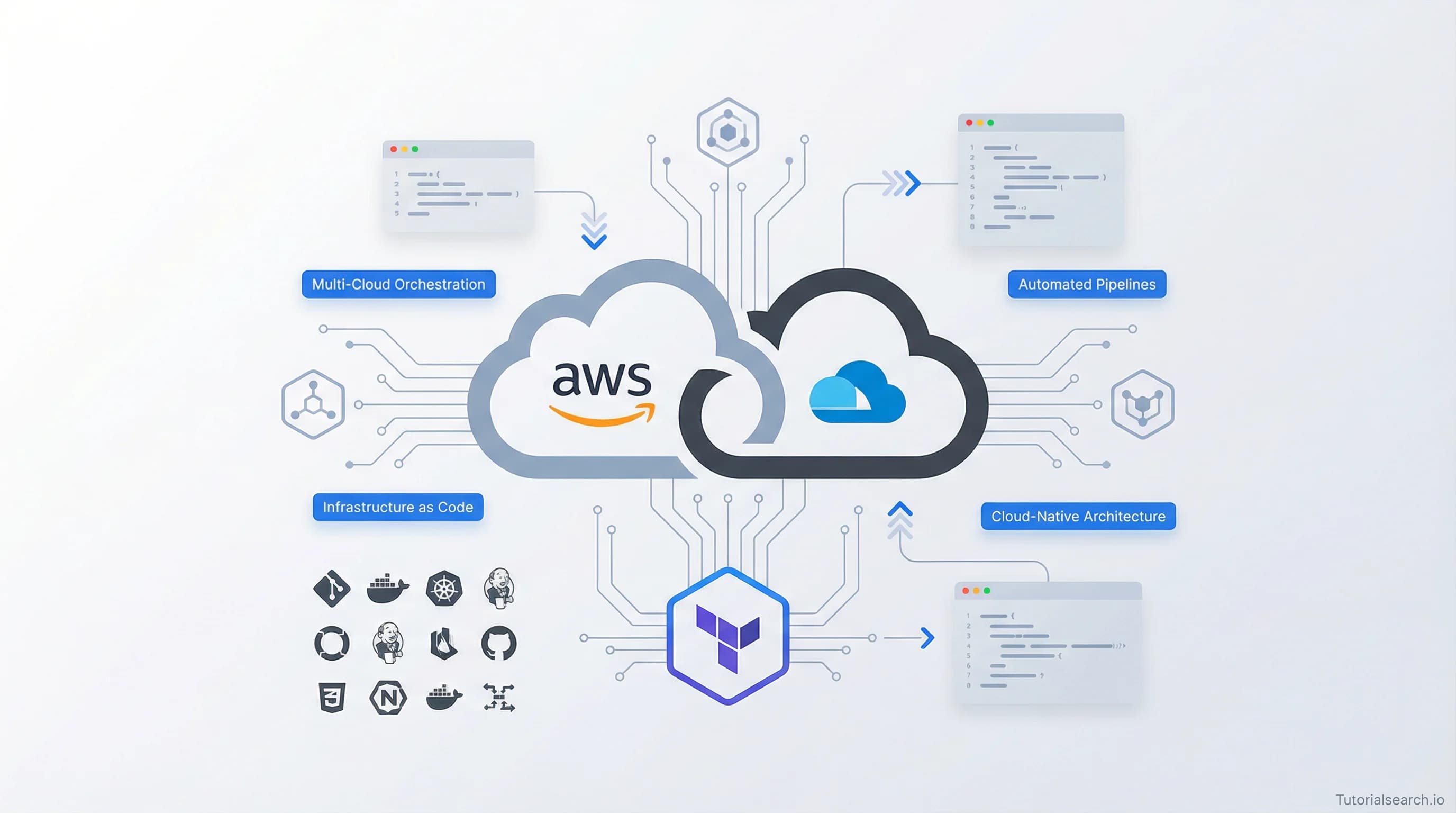
Cloud Management: From Manual Chaos to Orchestrated Automation
Master cloud management across AWS, Azure, and GCP. Learn Infrastructure as Code, cost optimization, and automation strategies that separate well-run operations from chaotic deployments.
Need a web app built? Hire the team behind TutorialSearch.io
We ship fast, production-grade full-stack apps (Next.js, React, edge infra) — the same stack that powers this site.
Cloud management has become the invisible backbone of modern enterprise operations. Every time you launch an application, scale a service, or monitor system performance, cloud management infrastructure is working behind the scenes. Yet many teams treat it as an afterthought until costs spiral out of control or a misconfigured resource becomes a security vulnerability.
Here's what's changed: cloud management isn't just about keeping systems running anymore. It's about orchestrating resources across multiple platforms, optimizing spending in real-time, and maintaining compliance at scale. The teams winning in 2026 aren't the ones with the most resources. They're the ones with the best systems to control those resources.
Key Takeaways
- Cloud management spans provisioning, monitoring, and optimization across AWS, Azure, and GCP platforms
- Infrastructure as Code (IaC) tools like Terraform eliminate manual configuration errors and save thousands in wasted resources
- Real-time cost monitoring with automated alerts prevents surprise bills and keeps teams within budget
- Multi-cloud management platforms provide unified visibility across hybrid environments
In This Article
- What Cloud Management Actually Looks Like
- The Infrastructure as Code Revolution
- Monitoring, Logging, and Observability
- The Hidden Cost of Cloud Sprawl
- Platform-Specific Management Approaches
- Automation: From Manual to Self-Healing
- Security and Governance in Cloud Environments
- Real-World Implementation: A Case Study
- Frequently Asked Questions
What Cloud Management Actually Looks Like
Cloud management has three distinct phases operating simultaneously. Day 0 is provisioning—spinning up servers, databases, and networks using Infrastructure as Code. Day 1 is configuration—applying settings, deploying applications, and establishing monitoring. Day 2 and beyond is operations—detecting drift, patching systems, and optimizing continuously.
Most teams excel at one phase and neglect the others. A startup might master Day 0 provisioning but never establish Day 2 monitoring. An enterprise might have beautiful monitoring but painful manual Day 0 processes. The winners integrate all three.
Consider this real scenario: I worked with a fintech team managing 400+ AWS resources across three regions. They had no resource tagging strategy. When their bill jumped 40% in a month, nobody could identify which team owned the spike. It took three weeks to investigate. With proper tagging, cost allocation, and monitoring, they would have caught the anomaly in hours.
[Editor's Choice] The foundation of modern cloud management starts with unified visibility. Whether you choose AWS CloudWatch, Azure Monitor, or a multi-cloud platform like Datadog, you need a single pane of glass showing what's running, what it costs, and how well it's performing.
The Infrastructure as Code Revolution
Infrastructure as Code (IaC) transformed how teams provision cloud resources. Instead of clicking through cloud dashboards or writing shell scripts, teams declare desired state in code. Terraform, CloudFormation, and similar tools turn infrastructure into repeatable, version-controlled artifacts.
The impact is profound. Manual provisioning takes 30-60 minutes per environment and introduces human error. IaC provisions identical infrastructure in seconds and catches mistakes at validation time. One team I consulted reduced deployment failures by 87% after migrating to Terraform. They recovered the tool investment in under two months.
Terraform and Ansible complement each other perfectly. Terraform handles Day 0 provisioning—creating the infrastructure graph. Ansible handles Day 1 configuration—applying software settings and deploying applications. The handoff between them creates seamless end-to-end infrastructure lifecycle management.
[Editor's Choice] AWS CloudFormation serves the same provisioning role for AWS-only environments, but Terraform's cloud-agnostic approach makes it the choice for multi-cloud strategies. The trade-off: Terraform requires external state management; CloudFormation stores state in AWS.
Monitoring, Logging, and Observability
Monitoring tells you what happened. Observability tells you why. Monitoring measures CPU, memory, and response times. Observability reveals the chain of events causing a slowdown.
Cloud-native applications generate staggering amounts of data. A typical microservices application produces gigabytes of logs daily. Collecting, storing, and analyzing this data requires specialized tools. This is where platforms like Datadog, Prometheus, and ELK stacks become essential, not optional.
Real-time alerting prevents incidents from becoming crises. An alert firing at 3 AM matters only if someone can act on it. This requires proper escalation policies, on-call rotations, and automated remediation where possible.
[Editor's Choice] AWS CloudWatch is purpose-built for AWS monitoring, with tight integration across all services. Azure Monitor offers similar depth for Azure workloads. For multi-cloud environments, Datadog provides consistent observability across AWS, Azure, and GCP, though with premium pricing.
The Hidden Cost of Cloud Sprawl
Cloud sprawl is the silent budget killer. It happens when teams provision resources quickly but never decommission them. Forgotten test environments. Abandoned pilot projects. Duplicate services created by different teams unaware of each other.
Studies show typical cloud infrastructure runs at 15-20% utilization. That means 80% of capacity is wasted. Some organizations discovered unused resources accounting for 30% of their cloud spend.
The solution isn't manual auditing. The solution is automation and cost governance built into your infrastructure. Set automatic shutdown schedules for non-production environments. Implement chargeback models so teams feel the cost impact. Use reserved instances for predictable baseline demand.
[Editor's Choice] AWS Cost Explorer provides granular cost analysis and recommendations. Azure Cost Management + Billing integrates billing with optimization recommendations. For enterprises managing multi-cloud spending, FinOps platforms like Ternary and CloudChipr provide AI-driven optimization and predictive analytics.
Platform-Specific Management Approaches
AWS management philosophy centers on Systems Manager for at-scale operations and CloudFormation for infrastructure. AWS Trusted Advisor identifies optimization opportunities. Cost Anomaly Detection uses machine learning to flag unusual spending patterns.
Azure management integrates deeply with Microsoft 365 environments. Windows 365 and Intune enable cloud PC management—complete desktops running in Azure with policy controls managed centrally. Azure Update Management handles patching across on-premises and cloud resources.
Google Cloud emphasizes configuration management through Deployment Manager and policy controls through Organization Policy constraints.
All three platforms provide excellent native tools. The constraint comes when you manage multiple clouds. A unified multi-cloud management platform becomes essential.
[Editor's Choice] For AWS-only shops, native AWS tools are sufficient. For hybrid AWS/Azure environments, consider Morpheus or CloudHealth for unified management. For enterprises managing AWS, Azure, and GCP, unified platforms like Ternary and nOps provide cost optimization across all three.
Automation: From Manual to Self-Healing
Automation separates efficient teams from chaotic ones. Manual patching fails. Automated patching succeeds 99.9% of the time. Manual capacity planning causes outages. Automated scaling prevents them.
Self-healing infrastructure goes further. When a node fails, your system automatically replaces it. When demand spikes, your system automatically scales up. When usage normalizes, it scales down. This requires infrastructure designed around automation from Day 0.
Infrastructure automation frameworks like Ansible, when integrated with Terraform, create truly self-managing systems. Terraform handles infrastructure changes. Ansible ensures configuration consistency. Together they detect drift (when actual state diverges from declared state) and repair it automatically.
Security and Governance in Cloud Environments
Need a web app built? Hire the team behind TutorialSearch.io
We ship fast, production-grade full-stack apps (Next.js, React, edge infra) — the same stack that powers this site.
Cloud introduces security complexity. Resources multiply. Access controls become granular. Compliance requirements demand audit trails.
Role-Based Access Control (RBAC) becomes essential. Instead of binary admin/user permissions, cloud platforms support fine-grained roles. You can grant "EC2 read-only" to one team and "S3 write to bucket X" to another. This principle of least privilege prevents lateral movement if credentials are compromised.
Governance frameworks like AWS Config, Azure Policy, and Google Cloud's Organization Policy enforce compliance automatically. Set a policy that all S3 buckets must be encrypted and non-compliant buckets are flagged automatically.
[Editor's Choice] Microsoft's approach through Azure Policy is particularly strong for enterprises managing compliance across hybrid cloud and on-premises environments. AWS Config provides similar guardrails for AWS workloads.
Real-World Implementation: A Case Study
A mid-sized SaaS company managed 50+ microservices across AWS. They lacked unified cost visibility and monitoring. Their operations team spent 20 hours weekly on manual incident response.
The Problem:
- No infrastructure as code; everything provisioned manually
- No cost allocation; entire bill treated as fixed overhead
- No centralized monitoring; teams used different tools
- Manual remediation; outages required engineer intervention
The Solution:
They implemented a three-phase transformation. Phase 1 (Weeks 1-4): Migrate to Terraform for all new infrastructure. Phase 2 (Weeks 5-12): Implement CloudWatch for centralized monitoring with automated alerts. Phase 3 (Weeks 13+): Deploy CloudFormation drift detection and implement automated scaling.
The Results:
- Deployment time reduced from 45 minutes to 5 minutes
- Cost visibility improved; identified $80K monthly in unused resources
- Incident response time reduced from 30 minutes to 5 minutes
- Engineer on-call burden reduced by 60%
The ROI exceeded initial investment within six months.
Cloud Management Across Platforms
Different platforms require different expertise but share common principles.
[Editor's Choice] The AWS Cloud Management Tools and Services course provides deep hands-on experience with AWS-native tools. For those targeting Microsoft environments, the Windows 365 course with Intune administration demonstrates practical cloud PC management at enterprise scale. The Master Course of Cloud Management provides comprehensive coverage spanning all major cloud platforms.
For intermediate learners targeting certification, the AWS Certified SysOps Administrator Associate (SOA-C02) course bridges theory and practice with exam-level depth. The Associate VMware Cloud Management and Automation course covers advanced multi-cloud orchestration.
Certification paths matter. The AZ-900 Microsoft Azure Fundamentals covers foundational concepts. The MD-102 Endpoint Administrator certification focuses on modern device management through Intune and Windows 365.
External Resources and Deeper Learning
Beyond formal courses, several free resources accelerate learning:
GitHub hosts multiple curated awesome lists for cloud management. The awesome-cloud repository aggregates cloud platforms, tools, SDKs, and learning resources. The awesome-cloud-native list focuses on cloud-native tools, software, and tutorials. These collections save weeks of research.
YouTube channels provide excellent free learning. A Cloud Guru offers comprehensive content across AWS, Azure, and GCP with DevOps and security focus. The official AWS channel delivers authoritative insights on AWS services and real-world use cases. Google Cloud and Microsoft Azure official channels provide platform-specific deep dives.
Official documentation matters more than most realize. AWS's Well-Architected Framework guides architectural decision-making. Azure's cloud adoption framework helps plan enterprise cloud strategies. These documents represent thousands of engineering hours compressed into freely available guides.
Blog communities share real implementation experiences. The HashiCorp blog covers Terraform patterns and best practices. Red Hat's blog documents Ansible automation examples. The DevOps community on platforms like DEV.to shares battle-tested solutions.
Comparison: Cloud Management Platforms
Different teams need different tools. Consider these factors:
| Consideration | AWS Native | Azure Native | Multi-Cloud Platform |
|---|---|---|---|
| Setup Complexity | Low (integrated) | Low (integrated) | Medium (requires configuration) |
| Cost | Included (with small overhead) | Included (with small overhead) | Monthly fee ($500-5000+) |
| Multi-cloud Support | AWS only | Azure only | All major clouds |
| Learning Curve | 2-4 weeks | 2-4 weeks | 4-8 weeks |
| Best For | AWS-only shops | Azure/Microsoft 365 shops | Enterprises with multi-cloud strategy |
Frequently Asked Questions
What's the difference between cloud management and cloud operations?
Cloud management encompasses the tools and processes for controlling cloud resources. Cloud operations focuses specifically on keeping systems running and performing well. Management is broader; operations is a subset.
Should we move everything to Infrastructure as Code immediately?
No. Prioritize critical workloads and new infrastructure first. Migrate legacy systems gradually. The conversion effort is significant but ROI justifies it within 6-12 months for most organizations.
How often should we review cloud costs?
Implement continuous monitoring with automated alerts. Review dashboards daily for anomalies. Conduct formal cost reviews monthly. Perform comprehensive audits quarterly, especially after major deployments.
What's the best multi-cloud management platform?
There is no universal best. AWS shops should exhaust native tools first. Azure shops should master Azure's native offerings. Multi-cloud enterprises should evaluate Morpheus, Ternary, and CloudHealth based on their specific mix of platforms.
How do we handle cloud security in management workflows?
Apply principle of least privilege through RBAC. Implement automated policy enforcement through AWS Config or Azure Policy. Require code review for infrastructure changes. Maintain audit logs of all infrastructure modifications.
Can we use open-source tools instead of commercial platforms?
Yes. Terraform is open-source. Prometheus for monitoring is open-source. ELK for logging is open-source. You'll need engineering resources to operate them, but the tools themselves are free and mature.
Related Topics You Should Explore
Interested in cloud management? These related areas deepen your expertise:
- Cloud Architecture — Master architectural patterns for scalable systems
- Cloud Certifications — Advance your credentials with industry-recognized certifications
- Cloud Security — Protect your infrastructure with proper security practices
- Cloud Platforms — Compare and contrast different cloud providers
- Cloud Infrastructure — Build resilient, reliable infrastructure
About the Author: Aisha Patel is an AWS Solutions Architect and Google Cloud certified engineer. She helps startups migrate to the cloud and optimize their infrastructure costs. With experience managing cloud environments for companies ranging from 50 to 5000+ employees, she brings practical perspective to cloud management challenges.