Cloud DevOps: Where Should You Actually Start?
Cloud DevOps bridges automation and cloud infrastructure. Here is the honest learning path — courses, free tools, GitHub repos, and books that actually work.
Hire the developers behind TutorialSearch.io
We built this site — full-stack web apps, AI integration & automation. Tell us what you need and we'll build yours.
Cloud DevOps combines cloud infrastructure with the automation, CI/CD pipelines, and infrastructure-as-code tools that modern engineering teams depend on. Companies that adopt these practices ship code 200 times more often than those that don't — that number comes from DORA (DevOps Research and Assessment) research, validated across thousands of teams. The gap isn't small. It's two orders of magnitude.
If you're trying to break into cloud DevOps, or you're a developer who wants to stop pretending infrastructure "just works," the hard part isn't finding resources. It's figuring out where to start without wasting six months going in circles.
This guide maps out the actual learning path: the courses worth paying for, the free tools that hold up, the YouTube channels that explain things clearly, and the books that change how you think about systems.
Key Takeaways
- Cloud DevOps combines cloud infrastructure with automation, CI/CD pipelines, and tools like Terraform and Kubernetes.
- Linux fundamentals are non-negotiable — almost every Cloud DevOps tool runs on Linux servers.
- The DORA metrics (deployment frequency, lead time, MTTR, change failure rate) are the standard for measuring Cloud DevOps team performance.
- Pick one cloud platform first — AWS, Azure, or GCP — and go deep before branching out.
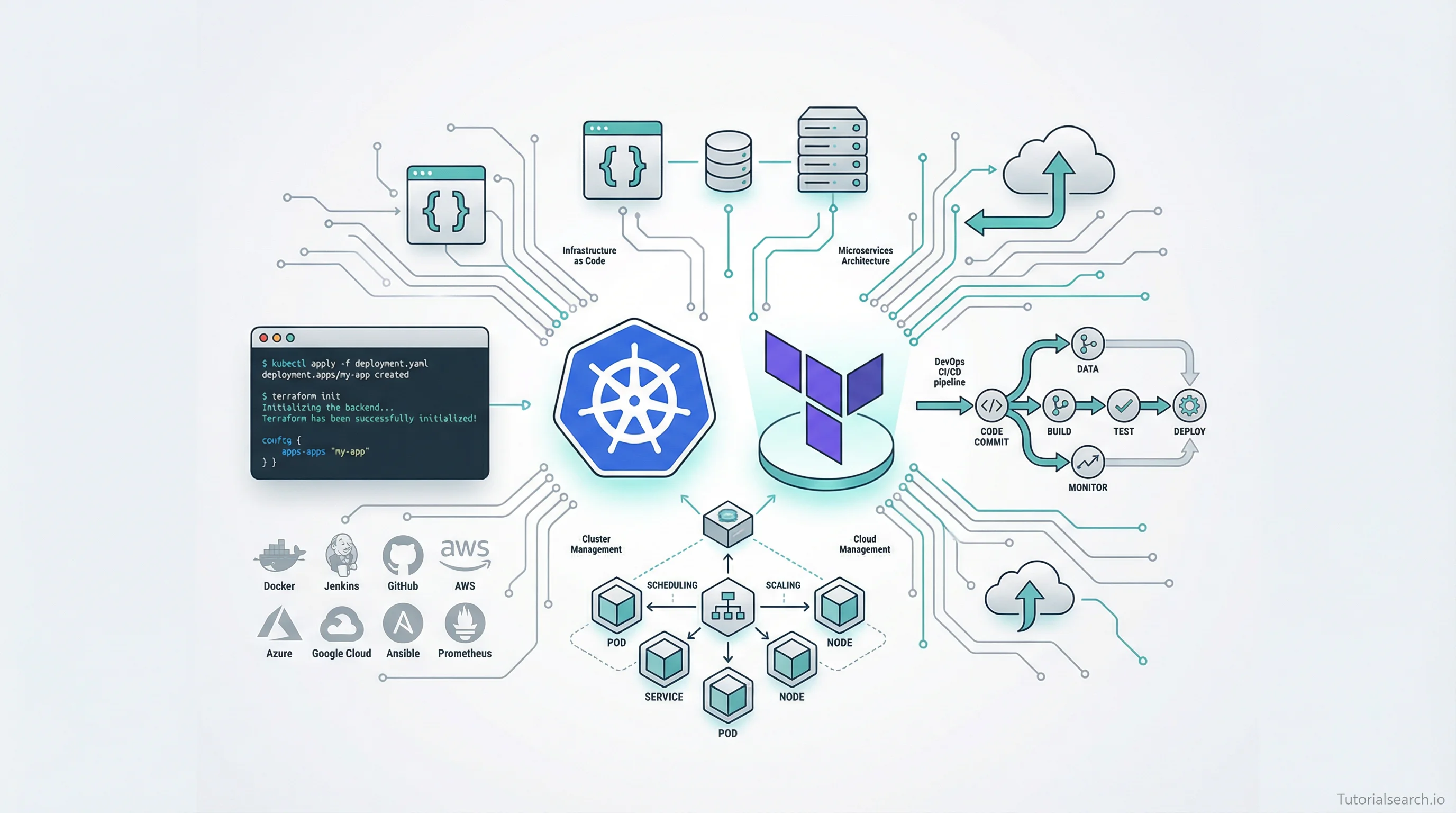
- Docker and Kubernetes handle the containers layer; Terraform and Ansible handle the infrastructure layer.
In This Article
- Where to Begin With Cloud DevOps
- Cloud DevOps Courses That Actually Teach You Something
- Free Cloud DevOps Resources That Hold Up
- Cloud DevOps YouTube Channels Worth Subscribing To
- Open Source Cloud DevOps Repositories Worth Starring
- Cloud DevOps Books That Shift How You Think
- Frequently Asked Questions About Cloud DevOps
- Related Cloud DevOps Skills Worth Exploring
Where to Begin With Cloud DevOps
Cloud DevOps is the practice of applying DevOps principles — automation, collaboration, continuous delivery — to cloud environments like AWS, Azure, and GCP.
That sounds broad because it is. A typical cloud DevOps stack might include Docker, Kubernetes, Terraform, Jenkins or GitHub Actions, Ansible, Prometheus, Grafana, and at least one cloud platform's native services.
Most people try to learn all of this at once. That's the mistake.
Start with Linux. Before you touch Kubernetes or Terraform, you need to be comfortable at the terminal. Almost every cloud DevOps tool runs on Linux. You can't debug a failing container if you can't navigate the filesystem or read a log.
From there, the path looks roughly like this:
- Linux fundamentals (2–4 weeks)
- One cloud platform — AWS or Azure for jobs, GCP for certifications (4–6 weeks)
- Containers — Docker first, then Kubernetes (4–6 weeks)
- CI/CD pipelines — GitHub Actions or Jenkins (2–3 weeks)
- Infrastructure as Code — Terraform is the industry standard (3–4 weeks)
- Monitoring — Prometheus + Grafana or cloud-native alternatives (2–3 weeks)
You can browse all 248 Cloud DevOps courses on TutorialSearch to find ones that fit wherever you are in that path.
If you're already solid on Linux Fundamentals, skip straight to cloud platforms and containers. But if the terminal still feels uncertain, do the Linux work first. Everything else depends on it.
Cloud DevOps Courses That Actually Teach You Something
Here are the courses worth your time, organized by where they fit in the learning path.
For Building the Full Stack
1. DevOps Deployment Automation with Terraform, AWS and Docker (Udemy) [Editors' Choice]
21,000+ students, a 4.8 rating, and it covers the three things you actually use in a real cloud DevOps job: Terraform for infrastructure, AWS for the cloud platform, and Docker for containers. The instructor builds real deployments — not toy examples. You'll finish with something you can show in a portfolio.
Unlike courses that teach tools in isolation, this one shows how Terraform, Docker, and AWS fit together in a working pipeline. That integration is exactly what new cloud DevOps engineers struggle with most.
2. Zero to Hero in Cloud: Learn Azure + AWS + Azure DevOps (Udemy)
For anyone who wants to cover multiple cloud platforms, this packs in Azure, AWS, and Azure DevOps. Nearly 7,500 students, rated 4.5. Comprehensive without being padded — a good choice for people who need breadth before going deep.
3. Linux for Cloud & DevOps Engineers (Udemy) [Editors' Choice]
The most popular course in this list at 57,500+ students. AR Shankar's teaching style is methodical and beginner-friendly. This is the one to take before anything else if you're not comfortable with Linux. Strong on bash scripting, which shows up constantly in real cloud DevOps work.
4. Google Cloud DevOps — Learn to Create CI/CD Pipelines in GCP (Udemy)
Rated 4.77 — a smaller course (446 students) but unusually high quality. J Garg focuses on Google Cloud's CI/CD tooling: Cloud Build, Cloud Deploy, and GitOps workflows on GCP. If you're targeting the Google Professional Cloud DevOps Engineer certification, start here before the practice tests.
Hands-On and Pipeline-Focused
5. Integrating DevOps Tools into a CI/CD Pipeline in AWS (Udemy)
This course does what most don't: it shows how DevOps tools wire together. CodeCommit, CodeBuild, CodeDeploy, Jenkins — all inside a real AWS pipeline. Rated 4.5. The difference between knowing tools in isolation and knowing how to connect them is exactly what this course closes.
6. DevOps Automation with ChatGPT: From Beginner to Expert (Udemy)
Rated 4.7 with 3,200+ students. This covers how to use AI tools to speed up DevOps workflows — automation scripts, infrastructure templates, debugging assistance. Useful for anyone who wants to work faster without sacrificing quality.
Google Cloud Certification Prep
7. Professional Cloud DevOps Engineer Exam Practice Test (Udemy)
A small course (48 students) with a near-perfect 4.9 rating. Param Yadav's practice tests are thorough and closely match what Google actually asks. Pair this with the CI/CD course above in the two weeks before your exam.
8. Google Professional Cloud DevOps Engineer Practice Tests (Udemy)
Edu Explore's tests cover a wider range of questions across all exam domains. Rated 4.4 from 4,400+ students. Good for identifying knowledge gaps before exam day.
9. [NEW] Cloud & DevOps Interview Guide — AWS, Azure & GCP (Udemy) [Editors' Choice]
in28Minutes is one of the most reliable technical education brands on Udemy, and this interview prep course earns that reputation. Rated 4.65 with nearly 2,000 students. Covers questions that actually come up in cloud DevOps interviews across all three major platforms. Work through this once you've built some project experience.
10. Securing Cloud DevOps in PaaS, IaaS, and SaaS Settings (Pluralsight)
Most DevOps courses treat security as an afterthought. Chad Russell's Pluralsight course doesn't. If you're preparing for enterprise or compliance-heavy roles, this covers IAM, secrets management, and secure pipeline practices across all three service models in a way that's hard to find elsewhere.
Quick Picks: If You Only Have Time for Two
| Your Goal | Start Here |
|---|---|
| Build something real fast | DevOps Deployment Automation with Terraform, AWS and Docker |
| GCP certification prep | Google Cloud DevOps — CI/CD Pipelines in GCP |
| Starting from Linux | Linux for Cloud & DevOps Engineers |
| Interview preparation | [NEW] Cloud & DevOps Interview Guide |
Free Cloud DevOps Resources That Hold Up
Paid courses give you structure. But some of the best cloud DevOps material is free — you just need to know where to look.
roadmap.sh/devops is the clearest visual overview of the field available. It maps every tool and skill you'll need as a cloud DevOps engineer, with community-recommended resources at each node. Start here when the scope of the field feels overwhelming.
KodeKloud's 100 Days of DevOps is a free structured challenge. It takes you from Linux basics through Kubernetes, Terraform, and CI/CD over 100 guided days. The hands-on labs run in the browser — no local setup required. More useful than any free YouTube series for structured beginners.
The Google SRE Book (sre.google/sre-book/table-of-contents) is completely free online. Site Reliability Engineering (SRE) is how Google operationalizes DevOps at scale. This book explains error budgets, SLIs, SLOs, and incident management better than any course. Dense reading, but the concepts show up in every cloud DevOps interview.
GeeksforGeeks DevOps Tutorial covers DevOps fundamentals in digestible written lessons. Good for filling conceptual gaps between hands-on sessions.
Terraform Documentation (HashiCorp) is surprisingly readable. The tutorials walk you through writing Terraform config from scratch, provisioning AWS resources, and using modules. Most engineers learn more from the official docs here than from any paid course.
AWS Free Tier gives 12 months of free access to core services — EC2, S3, Lambda, RDS. Pair it with any course above and you can run real infrastructure without spending a dollar. Breaking a terraform apply in a real environment teaches things no course can.
Browse the DevOps Automation courses on TutorialSearch for 699 tutorials covering scripting and workflow automation tools that complement these free resources.
Cloud DevOps YouTube Channels Worth Subscribing To
Hire the developers behind TutorialSearch.io
We built this site — full-stack web apps, AI integration & automation. Tell us what you need and we'll build yours.
Not everything needs to be a structured course. Sometimes you just need to watch someone do the thing.
TechWorld with Nana (YouTube) is the best single channel for cloud DevOps beginners. Nana Janashia covers Kubernetes, Docker, Jenkins, and Terraform with diagrams that make the architecture actually make sense. Her tutorials are dense — 30 to 90 minutes of focused content per video. The Docker crash course has millions of views for a reason.
KodeKloud (YouTube) complements their paid platform with solid free content. Kubernetes labs, DevOps concepts, and certification prep in an animated format that keeps things clear. Better for hands-on learners than lecture-style channels.
DevOps Directive (YouTube) is better suited to intermediate learners. Less hand-holding, more real depth on GitOps, Helm, and cloud-native workflows. If TechWorld with Nana gets you started, DevOps Directive is where you go once you're moving.
Bret Fisher Docker & DevOps (YouTube) [Editors' Choice] is the most practitioner-focused channel here. Bret is a working consultant — his content reflects actual production concerns, not tutorial scenarios. If you plan to use Docker seriously (you will), subscribe to this channel before you start.
freeCodeCamp.org (YouTube) regularly posts 3–6 hour cloud DevOps courses at no cost. Search "DevOps tutorial freeCodeCamp" and you'll find full courses on Terraform, Kubernetes, AWS, and CI/CD that would run $30–$80 on Udemy.
If you're going deep on containers, both KodeKloud and Bret Fisher's channels connect directly to Docker Containers skills — the 411 courses there will give you the structured depth the YouTube content assumes.
Open Source Cloud DevOps Repositories Worth Starring
These GitHub repos aren't just reference material — they're active learning tools.
milanm/DevOps-Roadmap (GitHub) is the most structured roadmap for 2026, with curated links to resources at every stage. It covers CI/CD, IaC, containers, monitoring, cloud platforms, and security in a visual format that's easy to navigate.
MichaelCade/90DaysOfDevOps (GitHub) — Michael Cade documented his 90-day DevOps learning journey publicly, and the repo now contains three years of structured content covering DevOps principles, tools, cloud platforms, and security. Over 28,000 stars. This takes weeks to work through properly — it's a curriculum, not a quick reference.
bregman-arie/devops-resources (GitHub) is a no-frills collection of interview questions, study materials, and links for Linux, AWS, GCP, Azure, Docker, Kubernetes, Terraform, and more. 14,000+ stars. Useful for both structured study and last-minute interview prep.
NotHarshhaa/DevOps-Projects (GitHub) is exactly what it says: real-world DevOps projects from beginner to advanced. Deploying a Java app on AWS with a 3-tier architecture, setting up VPC configurations, building CI/CD pipelines — this is where theory becomes portfolio work.
For anyone exploring Network Automation, the bregman-arie devops-resources repo has a solid networking section that applies directly to cloud VPC and routing configurations.
Cloud DevOps Books That Shift How You Think
Technical tutorials teach you tools. Books change how you understand systems.
The Phoenix Project by Gene Kim, Kevin Behr, and George Spafford is a novel. Not documentation — a story. It follows an IT manager trying to save a failing deployment project and shows DevOps principles through narrative. You'll recognize the characters from real jobs. Read this first, before any technical course.
The DevOps Handbook by Gene Kim, Jez Humble, Patrick Debois, and John Willis is the practical companion. It explains how high-performing organizations implement DevOps — the flow, feedback, and learning principles behind everything. More applicable to real-world teams than any certification course.
Accelerate by Nicole Forsgren, Jez Humble, and Gene Kim is based on actual research — six years of data from thousands of organizations. The DORA metrics that everyone uses to measure DevOps performance came from this book. If you want to understand why specific practices work rather than just how, read this.
Infrastructure as Code by Kief Morris (O'Reilly) goes deep on the patterns behind Terraform and similar tools. Not a Terraform tutorial — a book about how to think about infrastructure as software. More valuable at the intermediate stage, after you've written your first few real Terraform configurations.
The DevOps Essentials courses on TutorialSearch bridge the gap between these conceptual books and hands-on tool practice — worth browsing after you've read one or two of the books above.
Frequently Asked Questions About Cloud DevOps
How long does it take to learn Cloud DevOps?
Most people build job-ready Cloud DevOps skills in 6–12 months with consistent practice. The timeline depends on your starting point — someone with a Linux or sysadmin background moves faster than someone starting from scratch. Hands-on projects matter more than hours logged; employers care what you've built, not what you've watched.
Do I need a degree to get into Cloud DevOps?
No. Most cloud DevOps engineers come from mixed backgrounds — sysadmin, software development, networking, and even non-technical fields. The field rewards practical skills and certifications (AWS, Azure, GCP DevOps) over degrees. Browse the Cloud DevOps learning paths on TutorialSearch to find starting points for any background.
Which cloud platform should I learn first — AWS, Azure, or GCP?
AWS has the largest market share and the most job postings, making it the safest default for career purposes. Azure is the strong choice for enterprise environments and Microsoft shops. GCP is the specialist pick — fewer jobs overall, but high demand and strong certifications. Don't try to learn all three at once. Pick one and go deep.
What's the difference between DevOps and Cloud DevOps?
Traditional DevOps is about culture and practice — breaking down silos between development and operations. Cloud DevOps applies those practices specifically to cloud infrastructure, adding cloud-specific tooling (AWS CloudFormation, Azure DevOps, Google Cloud Build) and cloud architecture knowledge to the mix. See DevOps Automation courses to see how the tooling side differs in practice.
What skills are essential for Cloud DevOps?
The core stack: Linux, Docker, Kubernetes, Terraform, and at least one CI/CD tool (GitHub Actions, Jenkins, or GitLab CI). Add Python or Bash scripting, one cloud platform in depth, and solid networking basics — DNS, load balancing, VPNs. The IT Expertise courses on TutorialSearch cover the broader infrastructure knowledge that makes cloud DevOps engineers effective.
Is Cloud DevOps a good career path?
Yes — cloud DevOps engineers rank among the highest-paid tech professionals. The role combines infrastructure, automation, and software engineering in a way that's hard to outsource or automate away. Demand has grown steadily as more companies move infrastructure to cloud providers, and the DORA research shows clear business ROI from Cloud DevOps adoption, so companies invest seriously in these hires.
Related Cloud DevOps Skills Worth Exploring
Cloud DevOps doesn't exist in isolation. These skills pair directly with it:
- DevOps Automation — 699 courses covering scripting and tooling for automation: Ansible, Chef, Puppet, and workflow orchestration that drives cloud infrastructure.
- Docker Containers — 411 courses on container fundamentals. Everything in cloud DevOps runs in containers; this is the mandatory companion skill.
- Linux Fundamentals — 515 courses on the OS that powers 90%+ of cloud infrastructure. Non-negotiable before starting cloud DevOps.
- DevOps Essentials — 336 courses covering the core principles, culture, and methodology that give cloud DevOps its foundations.
- Network Automation — 470 courses on automating network infrastructure — important when managing VPCs, load balancers, and multi-region deployments.
- IT Expertise — 914 courses on the broader IT knowledge base that cloud DevOps engineers draw from: security, compliance, and enterprise systems.
- Network Fundamentals — 272 courses on networking concepts that apply directly to cloud architecture and DevOps troubleshooting.
If you're starting from scratch, the path is clear: learn Linux, pick one cloud platform, containerize something, and build a CI/CD pipeline. The tools will keep changing — they always do. The core practice of automating and managing infrastructure at scale won't.
Your next move: browse the full list of Cloud DevOps courses on TutorialSearch and pick the one that matches where you actually are right now.