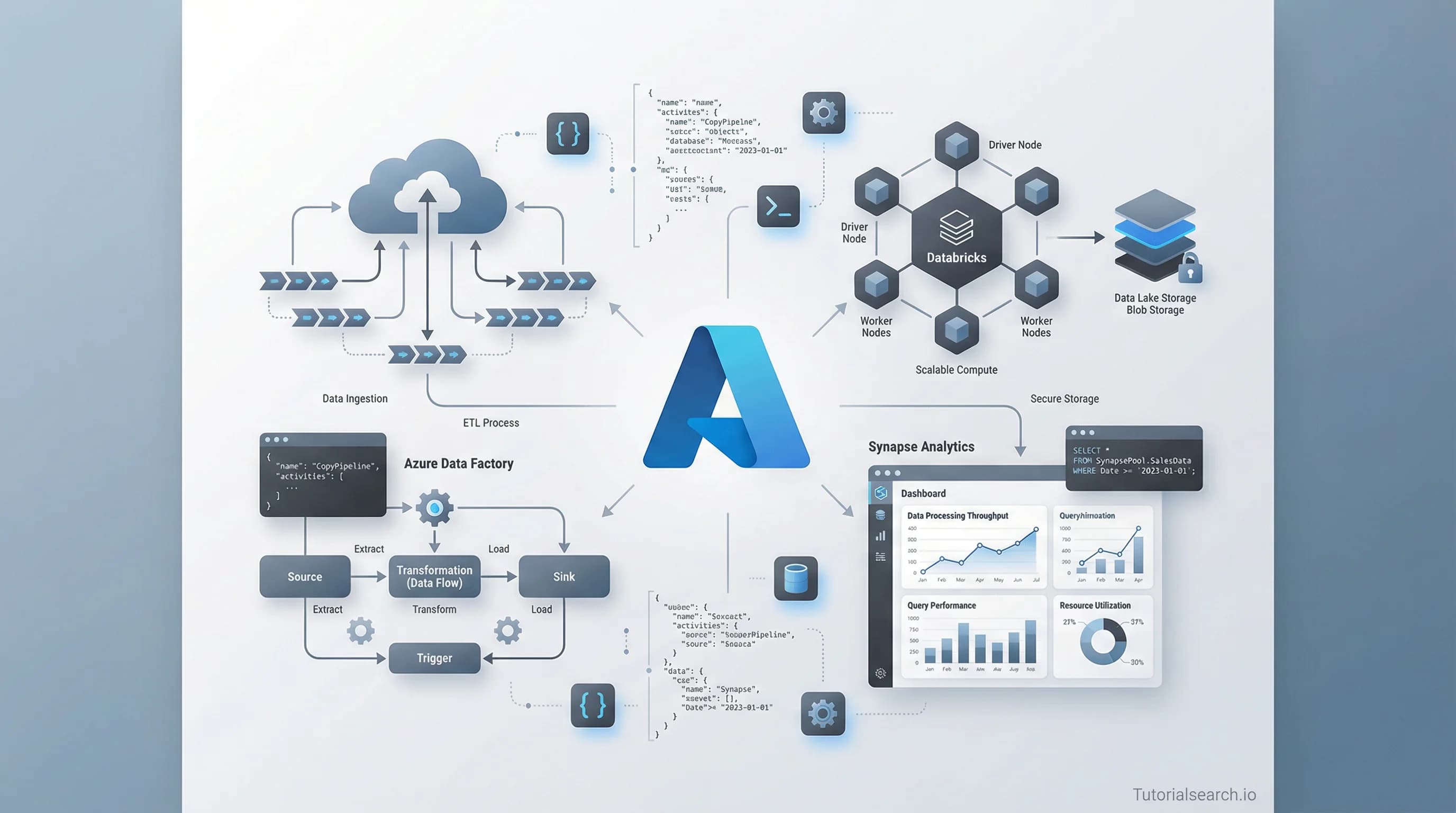
Cloud Data Solutions on Azure — A Practitioner’s Guide
Azure’s data ecosystem can feel overwhelming. This guide breaks down cloud data solutions on Azure into a clear learning path — from Data Factory to Synapse Analytics and Databricks.
Need a web app built? Hire the team behind TutorialSearch.io
We ship fast, production-grade full-stack apps (Next.js, React, edge infra) — the same stack that powers this site.
Cloud data solutions on Azure are some of the most in-demand skills in tech right now. Azure data engineers consistently rank among the top-paid cloud professionals — DP-203 certified engineers in the US average $115,000 to $130,000 annually. Yet most people who try to learn this area hit the same wall early on: Azure has at least seven major data services, and nothing explains which one to start with or how they connect.
This guide fixes that. It maps the Azure cloud data ecosystem into a logical learning order, points you to the courses and free resources worth your time, and skips the filler that most roundups pad with.
If you want to jump straight to browsing, we have 372+ cloud data solutions courses on TutorialSearch.io.
Key Takeaways
- Cloud data solutions on Azure center on four services: Data Factory, Synapse Analytics, Data Lake Storage Gen2, and Databricks.
- You don't need to learn all Azure data services at once — start with Data Factory and Synapse, then expand.
- Microsoft Learn offers free, structured DP-203 training that rivals most paid courses.
- Hands-on projects matter more than certificates alone — employers want engineers who have built real pipelines.
- The DP-203 certification is the clearest signal of Azure data engineering readiness for most hiring managers.
In This Article
- Before You Start With Cloud Data Solutions on Azure
- Cloud Data Solutions Courses That Actually Deliver
- Azure Cloud Data Solutions YouTube Channels Worth Following
- Free Cloud Data Solutions Resources From Microsoft
- Cloud Data Solutions GitHub Repos Worth Starring
- For When You Want to Go Deep With Cloud Data Solutions
- The Cloud Data Community: Where Azure Engineers Hang Out
- Related Cloud Skills Worth Exploring
- Frequently Asked Questions About Cloud Data Solutions
Before You Start With Cloud Data Solutions on Azure
The single biggest mistake beginners make is treating Azure data services as competing tools. They're not. They're designed to work as layers of a single stack.
Here's the mental model that makes everything click:
- Azure Data Factory (ADF) is your data mover. It ingests data from hundreds of sources and orchestrates pipelines across your entire platform.
- Azure Data Lake Storage Gen2 (ADLS Gen2) is your storage layer. Think of it as a petabyte-scale file system designed for analytics workloads — far cheaper than traditional data warehouses for raw data storage.
- Azure Synapse Analytics is your analysis layer. It combines SQL data warehousing, serverless SQL-on-demand, and Apache Spark in one workspace. You query data stored in ADLS without moving it first.
- Azure Databricks is your transformation engine. A managed Apache Spark environment with better tooling, MLflow integration, and Delta Lake support.
Build those four and you have a modern, scalable cloud data platform. Everything else — HDInsight, Stream Analytics, Cosmos DB — extends specific parts of that foundation.
What do you actually need before starting?
SQL is essential. You'll write T-SQL in Synapse and Azure SQL constantly. Python helps, especially once you're doing Databricks and PySpark work. You don't need prior Azure experience — the best courses build it inline.
The Modern Data Architecture using Microsoft Azure course is a smart entry point if you've never worked with Azure before. It explains how the services connect before drilling into individual ones, which saves you a lot of confused Googling later.
Cloud Data Solutions Courses That Actually Deliver
There are hundreds of Azure data courses across Udemy and Pluralsight. Most cover similar ground. The ones below stand out for specific reasons — and I'll tell you which reason for each one.
For Beginners: Building the Foundation
Modern Data Architecture using Microsoft Azure (Udemy, Beginner) — Vimal Vachhani's course has nearly 7,000 students. It starts with the architecture picture — how ADF, ADLS, Synapse, and Databricks fit together — before touching any individual service. If you're a SQL developer or analyst moving to cloud, this contextual approach saves weeks of confusion. Rating: 4.18 ★
Building Your First Data Pipeline in Azure Data Factory (Pluralsight) [Editors' Choice] — This is the Azure Data Factory course I'd hand to a friend on day one. It's focused, practical, and builds something real rather than surveying features. Pluralsight's interface makes it easy to revisit specific sections when you get stuck in your own projects. If you only have time for one ADF resource before moving to bigger courses, this is it. Rating: 4.2 ★
Azure Data Engineering with Hands-on Labs (Udemy) — The labs here are genuinely hands-on. Guided exercises walk through real pipeline scenarios with step-by-step instructions. Good for learners who need to see a concept in practice before it sticks. Rating: 4.5 ★
For Intermediate Learners: Building Real Skills
Azure Data Engineer Masterclass - The Complete Guide (Udemy) [Editors' Choice] — manish tiwari's masterclass covers ADF, Synapse Analytics, Azure Databricks, Data Lake, and DP-203 exam prep in one package. With a 4.48 ★ rating across 1,763 students, it's consistently the course that people recommend in data engineering forums. The exam-prep component is thorough — worth it even if you're not planning to certify immediately. Rating: 4.48 ★
Ultimate Azure Data Factory: Cloud Data Engineering (Udemy) — ADF is deep enough to deserve its own dedicated course. This one covers integration runtimes, triggers, linked services, mapping data flows, and monitoring in detail. Once you have the basics, this is where you go to fill gaps. Rating: 4.5 ★
Azure Databricks Basics: Getting Started with Big Data Analytics (Udemy) — Databricks is increasingly the transformation layer of choice on Azure. Step2C Education's course introduces clusters, notebooks, and Delta Lake without overwhelming you with Spark internals. Good entry to the Databricks ecosystem before tackling advanced Spark topics. Rating: 4.47 ★
For Advanced Learners: Production-Grade Depth
Data Engineering on Microsoft Azure: The Definitive Guide (Udemy) [Editors' Choice] — Wadson Guimatsa's course is structured like a reference guide for production work. It covers Azure RBAC (role-based access control), Key Vault, cost management, and Synapse in the kind of depth you need when you're building real pipelines, not just following tutorials. The SQL scripts and Jupyter notebooks are ready to use in your own projects. Rating: 4.27 ★, 4,911 students.
Big Data Engineering Project: PySpark, Databricks and Azure (Udemy) — This project-based course builds an end-to-end pipeline using the modern Azure data stack. PySpark plus Databricks plus Azure is what most enterprise data platforms run at scale. Building one yourself — even in a tutorial context — teaches you more than watching 20 hours of theory. Rating: 4.42 ★
Free Options Worth Your Time
Mastering Azure Data Engineering: Part 5 (Udemy, FREE) — This is the best free Azure data engineering course I've found on Udemy. Part 5 of Lakshmi Narayana Singilidevi's series has 1,270 students and a 4.51 ★ rating. It's free and worth more than some paid options. Start here if budget is a concern.
Mastering Azure Data Engineering: Part 3 (Udemy, FREE) — Another free installment from the same series. Good for filling specific gaps in Synapse and pipeline knowledge. Rating: 3.97 ★
If you only pick one paid course: Start with the Azure Data Engineer Masterclass (course 4 above) if you want both skills and certification prep in one go. If you prefer to build incrementally, start with Building Your First Data Pipeline (course 2), then layer in the Masterclass once you're comfortable with ADF basics.
Browse the full list at TutorialSearch.io cloud data solutions.
Azure Cloud Data Solutions YouTube Channels Worth Following
YouTube has some strong Azure data content, but a lot of channels blend beginner walkthroughs with exam cramming in ways that waste your time. Here's what's actually worth watching:
Microsoft Azure (YouTube, 299K+ subscribers) — The official channel covers every Azure service with product demos and technical deep dives. It's not structured for sequential learning, but it's excellent for understanding what a new feature actually does when Azure ships updates. Subscribe for the announcements, not the curriculum.
John Savill's Technical Training (YouTube) [Editors' Choice] — John Savill is the best free resource for Azure architecture understanding I've found anywhere. His Azure Data Engineering content breaks down how Synapse, ADF, and Databricks interact at a level most courses skip. If you're preparing for DP-203, his study cram videos are essential alongside your paid course. The depth here is unusual for free content.
Adam Marczak – Azure for Everyone (YouTube) — Adam's teaching style is methodical and clear. His AZ-900 full course is a good grounding in cloud economics and Azure service design before you go deep on data-specific tools. Less advanced than Savill but more approachable for absolute beginners.
Azure Academy (YouTube) — Run by a Microsoft Azure Principal Engineer with over 25 years of experience. The tone is more enterprise-focused, which is valuable if you're working in or moving toward corporate IT environments. Good for certification prep alongside practical implementation content.
If Cloud Data Solutions is your entry point into the Azure world, I'd also suggest following the Cloud Architecture content on YouTube once you have the data basics. Architecture context explains why Azure data services are designed the way they are — which makes them much easier to use correctly.
Free Cloud Data Solutions Resources From Microsoft
Need a web app built? Hire the team behind TutorialSearch.io
We ship fast, production-grade full-stack apps (Next.js, React, edge infra) — the same stack that powers this site.
Microsoft's own free learning content is better than most people realize. Microsoft Learn has invested seriously in structured training, and the DP-203 preparation material is genuinely comprehensive.
Get Started with Data Engineering on Azure (Microsoft Learn) — This is the official starting point. Free, structured as a learning path, and covers Azure data engineering fundamentals in sequence. It's updated when Azure services change, which most third-party courses aren't.
DP-203T00: Data Engineering on Microsoft Azure (Microsoft Learn) — The official training course for the DP-203 certification exam. Everything here maps directly to what Microsoft tests. Worth going through even if you're not planning to certify — it's a well-organized survey of the full Azure data stack.
Introduction to Data Engineering on Azure (Microsoft Learn) — A focused 30-minute module that explains what data engineers actually do on Azure, which services they use, and how they fit together. Use this as an orientation before starting any longer course.
Azure Synapse Analytics Documentation (Microsoft Learn) — Don't skip the official docs. The Synapse documentation includes end-to-end tutorials with real sample datasets that you can run in a free Azure account. The Get Started tutorial is hands-on and walks through all core Synapse features in sequence.
One thing many people miss: Microsoft offers a free Azure trial with $200 in credits. For data engineering practice, that's enough to spin up a Synapse workspace, build a Data Factory pipeline, and work through a data lake exercise — all the core services you'd practice in any paid course.
For those targeting credentials, the Cloud Certifications browse page has 917+ courses. The DP-203 is the primary Azure data engineer certification, and the DP-900 (Azure Data Fundamentals) is a solid entry point if you want a gentler start.
Cloud Data Solutions GitHub Repos Worth Starring
The GitHub ecosystem for Azure data engineering is active and useful for real-world projects.
data-engineering-roadmap — A complete data engineering roadmap covering Azure, AWS, GCP, Databricks, and Snowflake certifications. Good as a checklist of what to learn and in what order. If you want to see how Azure data skills fit into the broader cloud data landscape, start here.
End-to-End-Azure-DE-Project — A practical project migrating an on-premises SQL Server database to Azure, transforming the data, and reporting in Power BI. It uses ADF, ADLS, Spark, Databricks, Synapse, and Power BI — the full modern Azure data stack in one project. If you learn better by reading real code than following tutorials, this is the best free project I know of to study.
Azure-AW — A more compact end-to-end Azure data engineering project (on-prem database to cloud). More manageable to trace through in a single session than larger repos. Good for beginners wanting to see a complete pipeline without information overload.
azure-data-engineering GitHub Topics — The GitHub Topics page for Azure data engineering aggregates active repos, code samples, and student projects. Useful for finding real pipelines to study and contributors to follow.
A note about GitHub as a learning tool: reading production code from real projects teaches you patterns that no course covers — naming conventions, project structure, error handling, and how people document data pipelines. Even 30 minutes a week reading these repos adds up.
For When You Want to Go Deep With Cloud Data Solutions
Books are where you build the mental models that stick. Courses give you the how. Books give you the why — and the judgment to make good architecture decisions.
The Definitive Guide to Azure Data Engineering by Ron C. L'Esteve (Apress/O'Reilly) — This is the book I'd recommend to any working data engineer moving to Azure from another platform. It covers Data Factory, Databricks, Synapse Analytics, Snowflake, Azure SQL, Stream Analytics, Cosmos DB, and Data Lake Storage Gen2 with production-level depth. Not a beginner book — but thorough.
Data Engineering on Azure by Vlad Riscutia (Manning) — Riscutia built data infrastructure at Microsoft. The book is structured around building a production-grade data platform to the standards Microsoft uses internally. Better for intermediate learners than beginners, but the architecture discussions are worth it.
Azure Data Engineering Cookbook (Packt) — Recipe-format book with practical solutions for batch and streaming analytics on Azure. Better as a reference when you're stuck on a specific problem than as cover-to-cover reading.
All three are available through O'Reilly Learning subscription if your employer provides access. Worth checking before buying — many companies have active subscriptions their employees don't know about.
Everyone recommends books for fundamentals, but I'd push back slightly on reading-first for Azure data work: the services change fast enough that hands-on practice with current tooling teaches you more per hour than even a good book. Read books to understand principles; use the docs and hands-on labs for current implementation details.
The Cloud Data Community: Where Azure Engineers Hang Out
The Azure data community is active and worth being part of, especially if you're preparing for interviews or working through tricky implementations.
Microsoft Tech Community — Azure Data — Microsoft's official community for Azure data topics. Announcements and blog posts come directly from Azure engineering teams. Good for staying current with service changes.
r/dataengineering (Reddit) — The main data engineering subreddit has substantial Azure content. Career questions, tool comparisons, and candid takes from people working on real projects. One of the more honest communities for discussing what actually works vs. what vendor documentation claims.
Microsoft Q&A — The official support forum for Azure services. More useful than Stack Overflow for Azure-specific questions because Microsoft engineers respond directly on some threads.
If cloud security is part of your role — and for most data engineering jobs, it is — explore the Cloud Security courses too. RBAC, Key Vault, and managed identity are daily tools for Azure data engineers, not optional extras. And if you're building toward a broader cloud skillset, the Cloud Platforms browse page covers AWS and GCP data services alongside Azure.
Related Cloud Skills Worth Exploring
Cloud data solutions sit within a broader skillset. These related areas pair naturally with Azure data engineering:
- Cloud Certifications (917+ courses) — The DP-203 is the primary Azure data engineer credential. The DP-900 is a gentler starting point.
- Cloud Architecture (730+ courses) — Data pipelines don't exist in a vacuum. Architecture knowledge helps you design solutions that hold up at scale.
- Cloud Practitioner (789+ courses) — Foundational cloud knowledge before diving into data-specific services.
- Cloud Infrastructure (452+ courses) — Networking, compute, and storage basics that underpin every cloud data solution.
- Cloud Concepts (520+ courses) — If you're new to cloud entirely, start here to understand the economics and trade-offs.
- AWS Essentials (303+ courses) — Understanding Azure's design choices gets easier when you compare them to how AWS solved the same problems.
Frequently Asked Questions About Cloud Data Solutions
How long does it take to learn Cloud Data Solutions on Azure?
Most people reach job-ready skills in 3–6 months with consistent study. That assumes 8–10 hours per week, a mix of courses and hands-on projects, and using the DP-203 certification as a milestone to aim for. The fundamentals — ADF, ADLS Gen2, Synapse — take 4–6 weeks to understand at a working level. Real fluency, especially with Databricks and Spark-based transformations, takes longer.
Do I need to know Python to learn Azure Cloud Data Solutions?
SQL is more immediately essential than Python. Most Azure Synapse work uses T-SQL, and Azure Data Factory has a GUI-based pipeline builder that doesn't require code. Python becomes important once you're doing Databricks and PySpark transformations. You can start without Python and learn it in parallel — but you can't avoid SQL. See the Azure Data Engineer Masterclass for a course that covers both SQL and Python-based Azure data work.
Can I get a job with Azure Cloud Data Solutions skills?
Yes — Azure data engineers are in steady demand across industries. The DP-203 certification is recognized by most enterprise employers as a credible signal of skills. Finance, healthcare, retail, and tech all run Azure data pipelines at scale. Salaries for certified Azure data engineers average $115,000–$130,000+ in the US, according to recent industry surveys. Browse Cloud Data Solutions on TutorialSearch to find courses aligned to specific job requirements.
How do Cloud Data Solutions on Azure differ from on-premise data systems?
The short version: no hardware, no capacity planning, and you pay for what you use. Azure data services scale automatically to petabytes, then scale back down. The trade-off is more moving parts than a traditional SQL Server setup — which steepens the learning curve but also raises the value of the skills. For a deeper look at cloud-versus-on-prem trade-offs, browse Cloud Concepts.
What's the difference between Azure Synapse Analytics and Azure Databricks?
This is the question every Azure data beginner runs into. Synapse is Microsoft's all-in-one analytics platform — it combines SQL data warehousing, Apache Spark, and data integration in one workspace. Databricks is a managed Spark platform built by the team that created Apache Spark, with better MLflow integration and a more developer-focused interface. In practice, many enterprise Azure platforms use both: Synapse for SQL workloads and reporting, Databricks for heavy Spark transformations and machine learning pipelines.
What are the key components of Cloud Data Solutions on Azure?
The four core services are Azure Data Factory (pipeline orchestration), Azure Data Lake Storage Gen2 (scalable storage), Azure Synapse Analytics (SQL and Spark analysis), and Azure Databricks (managed Spark for transformations). Supporting services include Azure SQL Database for relational workloads, Azure Stream Analytics for real-time data, and Azure Cosmos DB for NoSQL scenarios. Most production Azure data platforms combine at least three of these services.