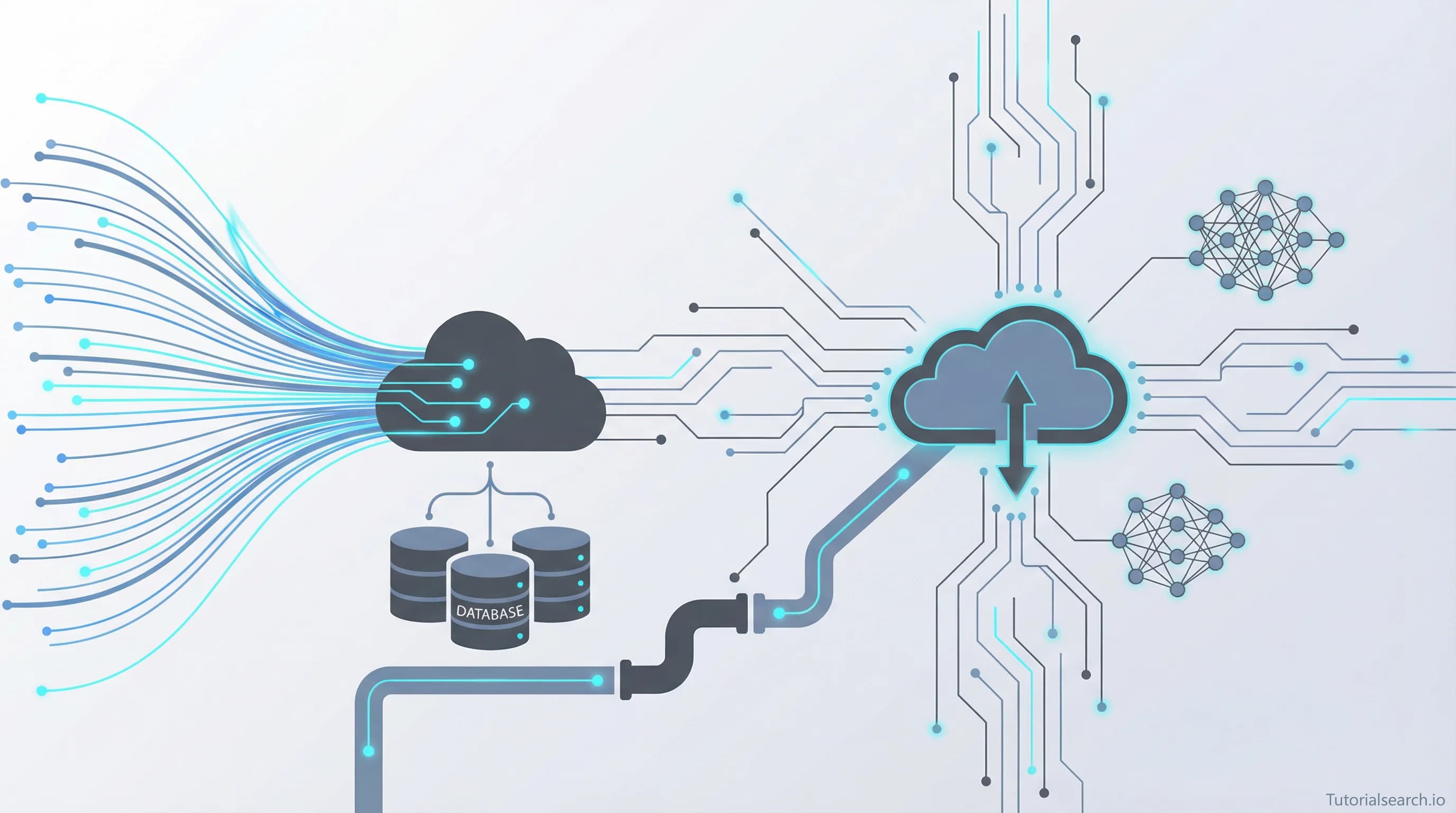
The Cloud Data Guide I Wish Existed When I Started
Learn cloud data with curated courses, free tools, YouTube channels, and GitHub repos. Build job-ready cloud data warehouse and engineering skills in 2026.
Want AI in your product? Hire the team behind TutorialSearch.io
LLM features, RAG, agents and automation wired into a real product — built by the devs who shipped this site.
Cloud data has become the backbone of modern analytics teams, and picking the right learning resources can cut your path to proficiency in half. Yet most people waste the first few months bouncing between platforms, watching tutorials that never connect theory to real pipelines.
I made that mistake myself — spending three months trying to learn AWS, Azure, and GCP data services simultaneously, convinced that broader exposure was better. What I actually built was shallow familiarity with all three and job-ready skills in none. The shift came when I picked one platform, built an end-to-end pipeline that ran in production, and expanded outward from there.
This guide reflects that lesson. It covers the cloud data courses, free resources, YouTube channels, GitHub repositories, and books worth your time in 2026 — starting from the cloud data courses on TutorialSearch and extending well beyond what any single platform offers.
Key Takeaways
- Cloud data skills — warehousing, integration, and analytics — rank among the fastest-growing requirements in data roles as of 2026
- Learning one cloud platform deeply beats spreading yourself thin across AWS, Azure, and GCP at the start
- Hands-on pipeline work teaches more than passive video watching in cloud data engineering
- Snowflake and BigQuery have emerged as dominant cloud data warehousing tools, regardless of which cloud provider your company uses
In This Article
- The Cloud Data Courses Worth Your Time
- Free Cloud Data Resources That Actually Teach
- YouTube Channels for Cloud Data That Skip the Fluff
- Cloud Data GitHub Repos Worth Bookmarking
- Books That Deepen Your Cloud Data Architecture Thinking
- Where Cloud Data Practitioners Actually Talk
- Cloud Data Warehouse Platforms: Honest Comparison
- Related Cloud Data Skills Worth Exploring
- FAQ
The Cloud Data Courses Worth Your Time
The best cloud data courses put you in front of real problems — broken pipelines, schema decisions, scaling constraints — not just syntax demos. These courses come closest to that standard.
1. Google Cloud Data Engineer: Realistic Practice Tests (Udemy) [Editors' Choice]
With a 4.59 rating from hundreds of students, this is the highest-rated cloud data resource in this roundup — and the exam-simulation format is precisely why. Priya Dw's questions are modeled after the actual Google Professional Data Engineer exam structure, which means you're working through BigQuery, Pub/Sub, and Dataflow decisions under realistic pressure rather than just reading about them. Two things make this course unusual: the questions force you to reason about architectural tradeoffs rather than recall facts, and the explanations for wrong answers are often more educational than the correct ones. Knowing why an answer is wrong — why you'd use Dataflow instead of Dataproc for a given workload, for example — is what builds the intuition that carries beyond the exam. If GCP certification is part of your plan, this is where to start.
It's worth noting what this course is not: it's not a conceptual introduction. You need to arrive with working knowledge of GCP data services before the practice tests become fully useful. Treat it as the final stage of your GCP cloud data preparation, not the first.
2. Informatica Cloud Data Integration - Automation Project (Udemy) [Editors' Choice]
Rated 4.47 by nearly 5,200 students, this course earns its marks by running you through a real automation project rather than isolated feature demos. Venkatesh K builds actual integration workflows, handles error scenarios systematically, and shows how cloud data pipelines fail — which is, realistically, half of what the job involves. Most cloud data integration courses stop at "here's how to configure a mapping." This one keeps going until you understand why pipelines break and how to recover them.
The automation project framing is what separates it from comparable Informatica content. You're not clicking through a demo environment — you're building something that has to work end-to-end. Useful for anyone who has touched Informatica Cloud but hasn't worked through a complete workflow with real error handling.
3. Snowflake Cloud Database with ELT (Airflow + Python + Talend) (Udemy) [Editors' Choice]
The most modern tech stack of any cloud data course in this list. Pradeep H C combines Snowflake with Apache Airflow orchestration and Python scripting — the three-tool combination that appears constantly in production data teams. The 4.38 rating from nearly 2,000 students reflects a high ratio of practical content to filler.
This isn't a beginner course — you need SQL confidence and at least one cloud platform exposure before it clicks — but if you have those foundations, this is where cloud data skills become applicable to real work. The ELT architecture covered here (extract, load, then transform inside Snowflake) represents how most modern cloud data teams actually move data, as opposed to traditional ETL approaches that transform data before loading it. That distinction matters more than most intro courses acknowledge.
For beginners who aren't ready for these three courses yet, there are solid introductory cloud data warehouse overview courses on TutorialSearch covering the concepts before you commit to a specific toolset.
Free Cloud Data Resources That Actually Teach
Paid courses provide structure. Free resources keep your knowledge current and fill the practical gaps that recorded courses can't cover. These are the ones that deliver both.
Microsoft Learn — Azure Data Architecture Guide is the best free reference for understanding how Azure's cloud data services connect. It's not a tutorial — it's architectural guidance, updated regularly by Microsoft's own engineers. The section on choosing between Azure SQL Database, Cosmos DB, and Azure Synapse Analytics makes design decisions legible that would otherwise take weeks of experimentation to understand. If your work touches the Microsoft ecosystem at all, this is essential reading.
Google Cloud Skills Boost offers hands-on lab environments where you work in actual GCP systems, not simulations. The BigQuery fundamentals path and the data engineering learning path are both strong and largely free at the entry level. You get roughly 10 hours of structured cloud data practice before credits become relevant. The lab format matters — seeing a query execute against real data in a real GCP environment teaches differently than watching a recorded demo.
AWS Skill Builder provides over 500 free courses covering AWS data services — Redshift, Glue, Kinesis, Lake Formation. The free tier includes AWS Cloud Practitioner Essentials, which is the right starting point before any AWS data specialization. I'd pair it with a free-tier AWS account and run labs hands-on as you go through the theory.
Snowflake Documentation and Quickstarts is underrated as a learning resource. The quickstart guides take you from account creation to running queries on actual datasets in under an hour. For commercial software, the documentation is unusually clear and practical. The Hands-On Essentials workshops are free and more rigorous than most vendor training.
Snowflake University deserves a separate mention. The free hands-on badge courses cover Snowflake data loading, performance tuning, and data sharing in concrete, lab-verified formats. If Snowflake is your target platform, completing the free badge sequence before purchasing any paid course is a smart move.
Databricks Academy offers free courses on Apache Spark and the Databricks Lakehouse Platform. If your work involves large-scale cloud data pipelines, the data lakehouse architecture is increasingly standard — and Databricks Academy explains it without requiring a sales conversation first.
For a more structured introduction to cloud integration concepts, Informatica Cloud - Data Integration covers the same ground in a video-first format with hands-on exercises.
YouTube Channels for Cloud Data That Skip the Fluff
Abstract concepts in cloud data engineering — distributed storage, query optimization, pipeline orchestration — benefit from visual explanation. These channels get that right.
Google Cloud Tech (YouTube) is the official GCP channel, and it's genuinely useful rather than purely promotional. The architecture deep-dives, customer case study breakdowns, and BigQuery feature demonstrations give you a realistic picture of cloud data at production scale. Start with the BigQuery architecture series and the data lakehouse overview videos. The content assumes some technical background, which keeps it from being dumbed down.
A Cloud Guru (YouTube) covers fundamentals across AWS, Azure, and GCP in a classroom-style format that works well for beginners. Their cloud data content is more accessible than vendor channels and more exam-prep focused — useful if certification is part of your near-term plan. The foundational AWS and Azure data overviews are solid starting points.
Seattle Data Guy (YouTube) [Editors' Choice] is the most practically useful cloud data YouTube channel I've found. Ben Rogojan worked as a data engineer for years before making content, and the experience shows throughout. He discusses architectural tradeoffs and tooling decisions with the kind of directness that only comes from having made those calls in real jobs — not from explaining them theoretically. The videos covering cloud data stack decisions (Snowflake vs. BigQuery, dbt integration patterns, ELT vs. ETL in modern contexts) are better than most paid resources on the same topics. Not the most polished production quality, but the information density justifies the rougher edges.
Andreas Kretz — Learn Data Engineering (YouTube) focuses on the full data engineering stack with emphasis on cloud-native tooling. His content on orchestrating cloud data pipelines with Airflow, designing Kafka-based streaming architectures, and integrating Spark into cloud environments connects concepts that most courses treat as separate disciplines. Good for understanding how the pieces fit together across a real cloud data architecture.
Browse more cloud data and warehousing tutorials by searching TutorialSearch for platform-specific courses not covered in this roundup.
Cloud Data GitHub Repos Worth Bookmarking
Want AI in your product? Hire the team behind TutorialSearch.io
LLM features, RAG, agents and automation wired into a real product — built by the devs who shipped this site.
GitHub is where the real opinions about cloud data tooling live — the curated lists, architecture templates, and honest comparisons that vendor marketing never includes.
awesome-data-engineering is the standard reference list for tools across the full data engineering stack: databases, stream processing, pipeline frameworks, cloud-native storage systems. Maintained actively and organized well enough to use as both a curriculum guide and a "what tool exists for this problem" reference. If you're trying to understand the landscape before choosing tools, start here.
awesome-opensource-data-engineering by Gunnar Morling focuses specifically on open-source tooling — which is where most cloud data infrastructure actually runs. Debezium for change data capture, dbt for transformation, Apache Iceberg for table formats: these are the kinds of tools this repo tracks, with context that explains their place in the ecosystem rather than just listing them.
data-engineering-roadmap provides a structured learning path that maps cloud data skills to AWS, Azure, and GCP equivalents side by side. Useful for building a self-study curriculum that doesn't depend on a single course vendor's framing of what matters.
These repos pair well with the Big Data courses on TutorialSearch, which cover the distributed computing foundations that cloud data platforms are built on top of.
Books That Deepen Your Cloud Data Architecture Thinking
Past tutorials, architecture-level thinking requires longer-form material. These two books hold up.
Fundamentals of Data Engineering by Joe Reis and Matt Housley (O'Reilly) is the most practically useful recent book in the cloud data space. It covers the full engineering lifecycle — ingestion, storage, transformation, serving — with platform-neutral discussion of how cloud systems implement each stage. The authors spent years working in the field, and the book reflects that. It makes opinionated calls, explains the reasoning, and doesn't pretend every tool is equally good for every situation. The chapters on cloud data warehousing, data lakes, and the emerging lakehouse architecture are particularly strong. Updated frequently since publication.
Designing Cloud Data Platforms by Danil Zburivsky and Lynda Partner (Manning) is more architectural and less tutorial-style than Reis/Housley. It addresses multi-cloud strategy, data governance frameworks, and the design decisions you won't encounter until you're building something at scale. A contrarian recommendation: most people read this book too early. It's most useful after you've shipped a real production cloud data pipeline and want to think beyond individual tools to platform design. Read Reis/Housley first.
Where Cloud Data Practitioners Actually Talk
r/dataengineering (Reddit) is the most active online community for cloud data and pipeline engineering questions. The weekly threads, real architecture discussions, and job market conversations are genuinely useful. Most participants work in the field, so you get direct experience rather than textbook answers. The monthly "what tools does your team use" threads are particularly revealing about how cloud data stacks actually look in practice versus how vendors describe them.
r/snowflake (Reddit) is narrower but valuable for Snowflake-specific questions — performance tuning, cost optimization, integration patterns with dbt and Airflow. More practitioners and fewer consultants than the general data engineering spaces.
Cloud Data Warehouse Platforms: Honest Comparison
Choosing a cloud data warehouse is one of the first real decisions you'll face, and vendor comparison guides tend to favor whoever is sponsoring them. Here's a more direct breakdown:
| Platform | Strongest Use Case | Pricing Model | Learning Curve | Free Access |
|---|---|---|---|---|
| Snowflake | Multi-cloud teams, SQL-first workflows | Credits per query + storage | Moderate | 30-day trial |
| BigQuery | GCP-native work, serverless analytics | Per byte processed | Low (pure SQL) | $300 GCP credit |
| AWS Redshift | AWS-heavy orgs, existing Glue/S3 pipelines | Cluster or serverless | Moderate | 2-month free tier |
| Azure Synapse | Microsoft ecosystem, hybrid on-prem/cloud | Pay-per-use | Steeper | 30-day trial |
| Databricks Lakehouse | Teams doing ML + data engineering together | DBU credits | High | Community Edition |
The honest assessment: Snowflake is the most portable across cloud providers and the most SQL-friendly for teams that don't want to think about infrastructure. BigQuery is the easiest entry point if your organization is on GCP — the serverless model means no cluster management, and the free tier is genuinely useful for learning. Redshift makes most sense when your organization is already AWS-native with existing Glue and S3 infrastructure. Databricks is the right choice when your team's work blurs the line between data engineering and machine learning.
Don't let anyone sell you a universal best choice. The right cloud data warehouse depends on your team's existing cloud footprint, the size and shape of your data, and whether your primary workload is analytics, ML, or operational reporting. For a hands-on look at how BigQuery handles large-scale analytics, Google Cloud's BigQuery documentation has the clearest getting-started guides of any major cloud data warehouse vendor.
Related Cloud Data Skills Worth Exploring
Cloud data skills are most valuable when they connect to adjacent disciplines:
- Data Engineering — The pipeline infrastructure beneath cloud data platforms. Orchestration patterns, ingestion architecture, and stream processing all live here and directly enable cloud data work.
- Data Visualization — Once data is accessible in your cloud warehouse, surfacing insights with Tableau, Power BI, or Looker becomes the natural next skill layer.
- Python Analysis — Python is the scripting layer in nearly every cloud data pipeline. Pandas for local data wrangling, PySpark for distributed processing, dbt for transformation logic — these are the relevant entry points.
- Data Science Methods — The analytical thinking that determines what questions your cloud data platform should be able to answer. Strong cloud data skills and weak analytical framing produces well-organized data that nobody extracts value from.
FAQ
How long does it take to learn cloud data?
Basic functional fluency — moving and querying data in a cloud warehouse — takes 2–4 months of consistent practice. Job-ready cloud data engineering skills take 6–12 months, depending on your programming background and how much project work you complete alongside coursework. Certification timelines vary by platform: the Google Professional Data Engineer exam typically requires 3–6 months of focused preparation.
Do I need SQL experience to learn cloud data?
SQL is essentially a prerequisite. Snowflake, BigQuery, Redshift, and Azure Synapse all use SQL as their primary interface. Get comfortable with standard SQL — JOINs, window functions, aggregations, subqueries — before moving into cloud-specific features. Python becomes important for pipeline automation but isn't strictly required at the start.
Can I get a job with cloud data skills?
Cloud data engineering roles are growing consistently across industries. Titles like cloud data engineer, analytics engineer, and data platform engineer appear frequently across job boards, with salaries typically ranging from $90,000 to $160,000+ depending on experience and location. Certifications help signal intent early in your career, but interviewers consistently report that real project experience matters more. A GitHub repo with a working cloud data pipeline impresses more than a certificate without one.
What are the main benefits of using cloud data platforms?
Cloud data removes the infrastructure management burden of traditional on-premise data warehousing. Independent scaling of storage and compute, pay-per-use pricing, global accessibility, and built-in redundancy make cloud data the default architecture for modern analytics teams. The hands-on cloud data courses on TutorialSearch cover these concepts in practical detail.
Is cloud data more secure than on-premise solutions?
Major cloud providers invest more in security infrastructure than most organizations could justify on-premise — physical facility security, encryption at rest and in transit, compliance certifications across major regulatory frameworks. That said, security in cloud data environments depends heavily on configuration: access controls, identity management, and data governance. A cloud platform with poorly configured permissions is less secure than a well-managed on-premise system, regardless of the vendor's certifications. Cloud shifts the security responsibility model, not the responsibility itself.