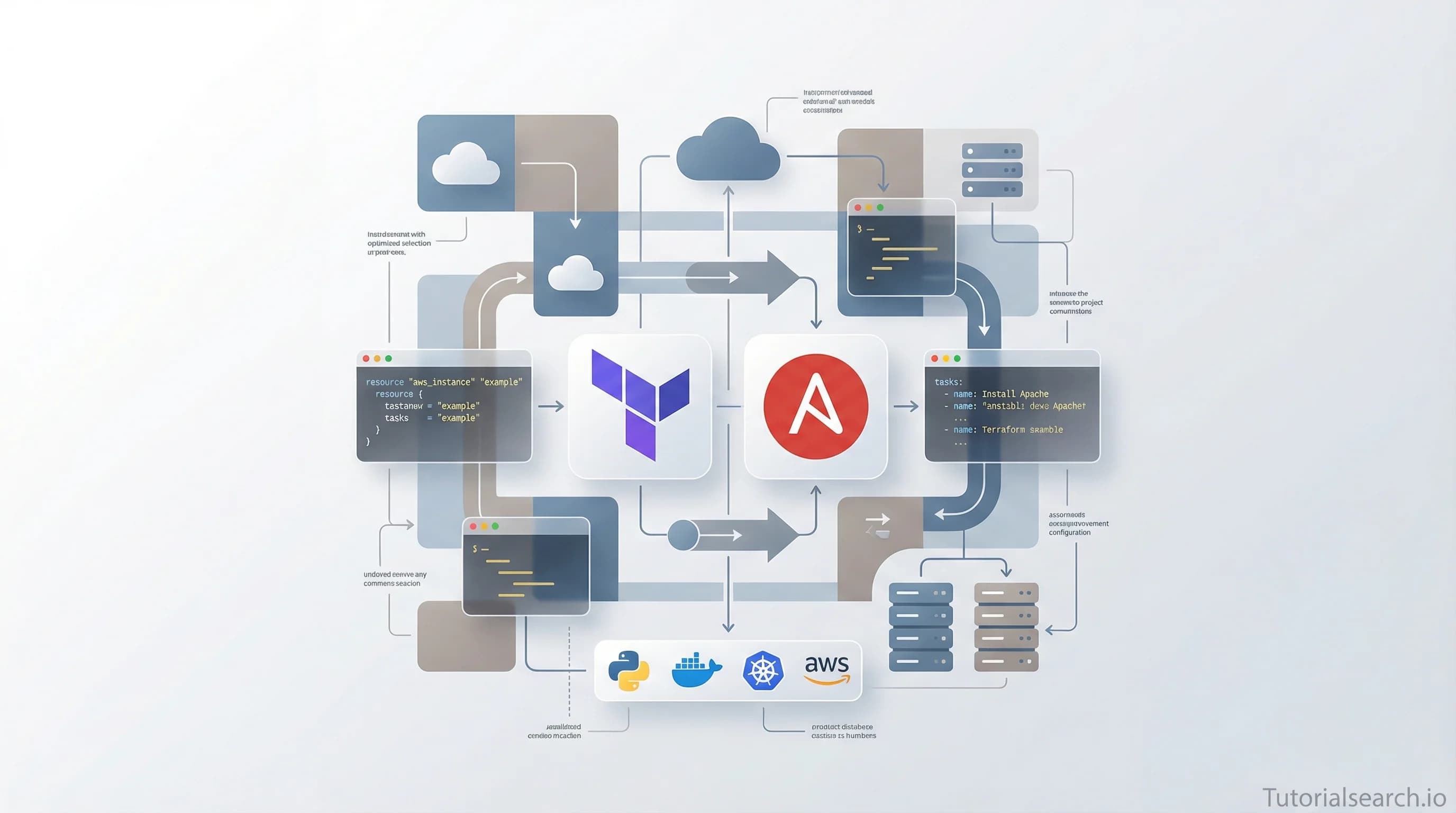
Cloud Automation Decoded: Courses, Tools, and Where to Start
Cloud automation turns manual infrastructure work into repeatable, code-driven workflows. Here is a guide to the best courses, free resources, GitHub repos, and tools to build this career-defining skill.
Hire the developers behind TutorialSearch.io
We built this site — full-stack web apps, AI integration & automation. Tell us what you need and we'll build yours.
Cloud automation is the skill that separates DevOps engineers who fight fires every week from those who sleep well at 2 a.m. Here's an honest guide to the best courses, tools, and free resources to build this skill — whether you're starting from scratch or upgrading from manual deployments.
Key Takeaways
- Cloud automation lets you provision and manage infrastructure with code instead of clicking through dashboards by hand.
- Terraform and Ansible are the two most-used cloud automation tools, and they solve different problems.
- You can start learning cloud automation for free with official tutorials from HashiCorp and Ansible.
- Cloud automation skills rank among the highest-paying in tech, with senior roles regularly commanding six-figure salaries.
- The fastest path to real competency is hands-on practice — write code, break things, and fix them.
In This Article
- The Mistake That Costs Engineers Weeks
- Cloud Automation Courses Worth Taking
- Which Cloud Automation Tool Should You Learn First?
- Free Cloud Automation Resources That Hold Up
- Cloud Automation GitHub Repos Worth Starring
- Cloud Automation on YouTube: Channels That Deliver
- Build Real Cloud Automation Projects
- Related Cloud Automation Skills Worth Developing
- Frequently Asked Questions About Cloud Automation
The Mistake That Costs Engineers Weeks
The first time I managed cloud infrastructure, I did it the wrong way.
I clicked through the AWS console, created EC2 instances, configured security groups by hand, and felt pretty good about it. Then the server needed to be rebuilt for a staging environment. I had no idea how I'd set it up. Zero documentation. Zero reproducibility.
That's the mistake most engineers make at the start. They treat the cloud like a GUI application instead of a programmable system. Cloud automation fixes this entirely. It lets you write infrastructure as code (IaC) — meaning every server, network rule, and permission is described in text files, stored in Git, and reproduced in minutes.
The cloud automation browse page on TutorialSearch.io has 267+ courses if you want to explore what's available before committing to a path.
Cloud Automation Courses Worth Taking
The market for cloud automation courses is noisy. These are the ones that justify your time.
The Cloud Automation Courses I'd Recommend to a Friend
1. AI-Driven Infrastructure as Code (IaC) and Cloud Automation ⭐ 4.6 · Udemy
Instructor: Gourav J. Shah · 6,400+ students
[Editors' Choice] This course combines IaC fundamentals with AI-assisted automation workflows — a pairing that's rapidly becoming standard in modern DevOps teams. Shah explains the "why" behind every tool choice, not just the commands. He covers Terraform, cloud provisioning patterns, and how AI tools can accelerate infrastructure work.
If you can only take one course on this list, this is my pick. The AI-integration angle makes it genuinely forward-looking rather than just a rehash of docs you could read for free.
2. Terraform Masterclass with AWS ⭐ 4.7 · Udemy
This is the most hands-on Terraform course I've seen at this rating. It walks through real AWS scenarios — VPCs, IAM roles, S3 buckets, EC2 instances — and teaches you to manage all of them with Terraform state files.
[Editors' Choice] The strength here is its entirely practical approach. You write actual Terraform code from the first hour, not after two hours of slides. The state management section alone is worth the cost.
3. AWS DevOps & CI/CD with AWS CodePipeline for Engineers ⭐ 4.7 · Udemy
Instructor: Pravin Mishra · 4,600+ students
This course covers CI/CD pipeline automation using native AWS tools — CodePipeline, CodeBuild, CodeDeploy. It's ideal for AWS-focused teams who want to automate deployment workflows without adding third-party tooling. Pravin's teaching style is methodical: he explains each service before wiring them together, so nothing feels like magic.
4. Ansible Mastery: Complete Guide to Infrastructure Automation ⭐ 4.3 · Udemy
Ansible gets less hype than Terraform, but it's often more practical for teams that need to configure servers after they're running. Terraform provisions; Ansible configures. This course covers playbooks, roles, and inventory management — the core Ansible concepts you'll use daily.
Want to understand where Ansible fits in the larger DevOps picture? The DevOps Automation courses on TutorialSearch.io (699+ courses) cover the full deployment pipeline that cloud automation plugs into.
5. Learn Ansible 2.x for Continuous Delivery and DevOps ⭐ 4.5 · Udemy
This one's a strong alternative if you want more depth on Ansible's continuous delivery patterns. It focuses on automating application deployments rather than just server configuration — a useful distinction once you move past basics.
6. Python Scripting for DevOps: AWS, GitHub, CI/CD with Jenkins ⭐ 4.4 · Udemy
Instructor: Shikhar Verma
Python is the glue that holds most cloud automation workflows together. This course teaches AWS automation scripts, GitHub integration, and Jenkins pipelines. It's a practical complement to any Terraform or Ansible course — the scripting knowledge transfers to virtually every cloud automation context.
7. AI for Cloud Infrastructure: Automating AWS with StationOps ⭐ 4.1 · Udemy
Instructor: Anton Voroniuk · 7,600+ students
Voroniuk's course covers AWS automation with an emerging AI-ops angle. The high enrollment (7,600+ students) signals that this resonates with people who want cloud automation skills with a modern slant. Good choice if you're interested in how AI tooling is reshaping infrastructure management.
Which Cloud Automation Tool Should You Learn First?
This is the question every beginner asks. The answer depends on your situation.
| Tool | Best For | Learning Curve | Works With |
|---|---|---|---|
| Terraform | Provisioning any cloud infrastructure | Medium | AWS, Azure, GCP, and 1,000+ providers |
| Ansible | Configuring servers after provisioning | Low (uses YAML) | Agentless — works with anything |
| AWS CloudFormation | AWS-only teams | Medium | AWS only |
| Pulumi | Teams that already know Python or TypeScript | Higher | All major clouds |
Here's a contrarian take: most tutorials push Terraform as the first tool to learn. But for AWS-only teams, starting with CloudFormation makes more sense. You learn IaC concepts without adding a third-party dependency, and every piece of knowledge transfers directly to real AWS work. Pick Terraform when you need multi-cloud support or when your team already uses it.
Pulumi is genuinely underrated. If you know Python, writing infrastructure in Python instead of HCL (Terraform's config language) removes a lot of friction. The AWS CDK in TypeScript course covers a similar approach with AWS's own IaC framework.
Free Cloud Automation Resources That Hold Up
Paid courses aren't necessary to get started. These free resources are genuinely good.
Hands-On Introduction to Infrastructure as Code with Terraform — FREE on Udemy ⭐ 4.7
[Editors' Choice for free resources] The highest-rated free option on this list. It covers Terraform basics with actual hands-on exercises — no theoretical filler. You create real infrastructure in AWS from the first lesson. Hard to beat at zero cost.
HashiCorp Terraform Tutorials (Official)
HashiCorp's own tutorials are the best starting point for Terraform. They're code-complete, maintained by the Terraform team, and organized by provider (AWS, Azure, GCP, Docker). Start with the "Get Started" path for your target cloud. These are better than most paid introductions.
Terraform Documentation (Official)
Once you understand the basics, the official docs become your daily reference. The configuration language section is especially useful when you're writing your first modules or troubleshooting state issues.
Ansible Getting Started Guide (Official)
Red Hat's Ansible documentation is genuinely good for beginners. The getting started guide walks through installation, your first playbook, and basic inventory management — the three things you need to actually run Ansible. It uses YAML, which most people find more readable than Terraform's HCL.
AWS CloudFormation Documentation (Official)
If your infrastructure lives in AWS, CloudFormation's official docs and sample templates are worth studying. AWS maintains dozens of example templates for common patterns. Reading them is a faster way to learn CloudFormation than most courses.
IBM: Automate Hybrid Cloud Infrastructure with Terraform and Ansible
This IBM tutorial shows exactly how Terraform and Ansible complement each other in a real project. Terraform provisions the infrastructure; Ansible configures it. Seeing these roles defined clearly in a working project will save you hours of confusion about which tool to use for what.
A well-structured tutorial that covers Terraform from first installation to managing complex state. The diagrams explaining how Terraform tracks what it's already built are some of the clearest I've seen.
EdgeDelta: How to Use Terraform and Ansible Together
If the IBM tutorial whetted your appetite, this one goes deeper into integration patterns — dynamic inventories, provisioner blocks, and real-world coordination between the two tools.
Red Hat: Multi-Cloud Automation with Ansible and Terraform
Red Hat's perspective on combining these tools is useful because they build Ansible. The blog post is practical and explains how the tools divide responsibilities in real enterprise environments.
If you're curious about where cloud automation intersects with networking, the Network Automation courses on TutorialSearch.io (470+ courses) show how these skills transfer to infrastructure beyond compute.
Cloud Automation GitHub Repos Worth Starring
Hire the developers behind TutorialSearch.io
We built this site — full-stack web apps, AI integration & automation. Tell us what you need and we'll build yours.
The definitive curated list of Terraform resources — modules, tools, tutorials, and blog posts organized by category. Start here when you're looking for something specific that Google can't find. This repo is actively maintained with thousands of stars and covers everything from testing tools to production-grade modules.
ansible-collections/cloud.terraform
The official Ansible collection for running Terraform within Ansible playbooks. This is the "glue" that lets you use both tools together cleanly. Reading the README will give you a solid understanding of the integration patterns before you try to implement them yourself.
DevOpsPlayground/Hands-on-with-Terraform-and-Ansible
Workshop code for combining Terraform with Ansible in a real scenario. This is a repo you clone and run through, not just read. Great for solidifying concepts after finishing a course.
awesomelistsio/awesome-terraform
A broader collection of Terraform resources including modules, providers, and learning materials. Useful when you move beyond basics and need references for production-quality code patterns.
This one focuses on practical, runnable Terraform examples — ranging from simple setups to complex multi-cloud architectures. Each example is clear and meant for hands-on learning.
Solid Linux Fundamentals knowledge (515+ courses) makes these repos much more accessible. Most cloud automation runs on Linux servers, and bash scripting shows up constantly in playbooks, pipeline scripts, and provisioner blocks.
Cloud Automation on YouTube: Channels That Deliver
Nana's production quality is unusually good for a DevOps channel. Her Terraform, Kubernetes, and CI/CD tutorials are thorough without being bloated. She explains the concept before showing the code, which helps the "why" land before the "how." Her full Terraform course on YouTube is a popular entry point for good reason.
Viktor Farcic's channel covers real-world cloud automation scenarios — the kind that production systems actually use. Less beginner-friendly than Nana's content, but the depth is unmatched. Watch after you have the basics down. Viktor is one of the few creators who regularly challenges conventional DevOps practices rather than just explaining them.
Amazon Web Services (Official)
AWS's official YouTube channel has underrated tutorials for CloudFormation, CDK, and CodePipeline. The re:Invent conference sessions in particular often cover cloud automation patterns that don't appear in any course. Search for "re:Invent" plus your specific tool to find deep-dive talks.
Red Hat's channel covers Ansible Automation Platform with tutorials from actual Red Hat engineers. The content reflects enterprise-scale automation — useful if you're heading toward a DevOps role at a mid-to-large company where Ansible is a standard tool.
Docker Containers knowledge pairs naturally with cloud automation (411+ courses). Containers are almost always part of automated cloud deployments, and you'll see them in YouTube tutorials regularly once you move past basic IaC.
Build Real Cloud Automation Projects
Reading and watching only gets you partway there. These projects will cement your skills in ways that courses can't.
Project 1: Provision a VPC with Terraform
Create a complete AWS VPC — subnets, route tables, internet gateway, security groups — using only Terraform code. The goal isn't the infrastructure itself; it's understanding Terraform state and how to make changes safely without destroying what's already running.
Project 2: Configure a Web Server With Ansible
Use Ansible to take a blank Ubuntu server and install Nginx, configure it, and deploy a static site. Write the whole thing as an Ansible playbook with roles. This teaches idempotency — the principle that running your automation twice gives the same result as running it once.
Project 3: Build an End-to-End CI/CD Pipeline
Wire together GitHub Actions (or Jenkins), Terraform for infrastructure, and Ansible for configuration. Push a code change and watch everything deploy automatically. The AWS DevOps & CI/CD with CodePipeline course covers this in detail and is worth revisiting once you've done Projects 1 and 2.
Project 4: Migrate a Manual Setup to IaC
Take something you already manage manually — even a single server — and write Terraform and Ansible code to reproduce it from scratch. This project teaches more than any tutorial because you already know what the correct end state looks like.
Looking to expand into broader IT infrastructure work? The IT Expertise browse page has 914+ courses covering the full range of IT skills that cloud automation engineers draw on.
Related Cloud Automation Skills Worth Developing
Cloud automation doesn't live in a vacuum. These skills make your automation work significantly more effective:
- DevOps Automation — 699 courses covering CI/CD, Jenkins, GitHub Actions, and the full deployment pipeline that cloud automation integrates with
- Docker Containers — 411 courses on containerization, which is the delivery mechanism for most automated cloud deployments today
- Linux Fundamentals — 515 courses on the OS that runs most cloud infrastructure; essential for writing effective automation scripts and understanding what your playbooks are doing
- Network Automation — 470 courses on automating network configuration, which pairs directly with cloud infrastructure provisioning
- DevOps Essentials — 336 courses providing the cultural and process context for why cloud automation matters in modern software teams
Frequently Asked Questions About Cloud Automation
How long does it take to learn Cloud Automation?
Expect 3-6 months to become productive with one tool like Terraform or Ansible. Getting comfortable across multiple tools and cloud providers takes 12-18 months of consistent practice. The AI-Driven IaC and Cloud Automation course is a solid 10-15 hour starting investment.
What are the key benefits of Cloud Automation?
Cloud automation removes human error from infrastructure management. That means faster deployments, consistent environments across dev/staging/production, and the ability to reproduce an entire infrastructure in minutes. For teams shipping frequently, this difference is enormous — it's also a major factor in passing compliance audits.
Do I need scripting or programming experience to learn Cloud Automation?
Some experience helps but isn't required to start. Terraform's HCL is relatively easy to read and write even without a programming background. Ansible uses YAML, which is even more readable. Python becomes useful later — mainly for writing custom scripts that integrate your tools. The Python Scripting for DevOps course covers exactly what you need at that stage.
What tools are used for Cloud Automation?
The most common tools are Terraform (infrastructure provisioning), Ansible (configuration management), AWS CloudFormation (AWS-native IaC), and increasingly Pulumi (IaC using general-purpose languages). Most teams use a combination — typically Terraform plus Ansible, or CloudFormation plus Ansible.
Can I get a job with Cloud Automation skills?
Cloud automation skills are actively sought across DevOps, Site Reliability Engineering (SRE), and Cloud Engineer roles. Terraform proficiency appears in a significant share of senior DevOps job listings. Pairing cloud automation with a cloud certification — AWS Solutions Architect or HashiCorp Terraform Associate — strengthens your candidacy significantly. See the broader DevOps & IT category for related skills worth developing alongside cloud automation.
Is Cloud Automation necessary for cloud security?
Yes, and this surprises a lot of people. Automated infrastructure enforces consistent security configurations across every environment. When security policies are in code, they can't be accidentally skipped the way manual setups can. Automated compliance checks, role enforcement, and vulnerability patching become much easier once your infrastructure is managed through code.
The fastest path forward is straightforward: pick one tool (Terraform for most situations), complete one structured course, and immediately start a hands-on project. Theory without practice doesn't stick in cloud automation. An afternoon breaking and rebuilding a real AWS environment is worth more than a week of videos.
You can search all 267+ cloud automation courses on TutorialSearch.io to find exactly what fits your current level and cloud platform.