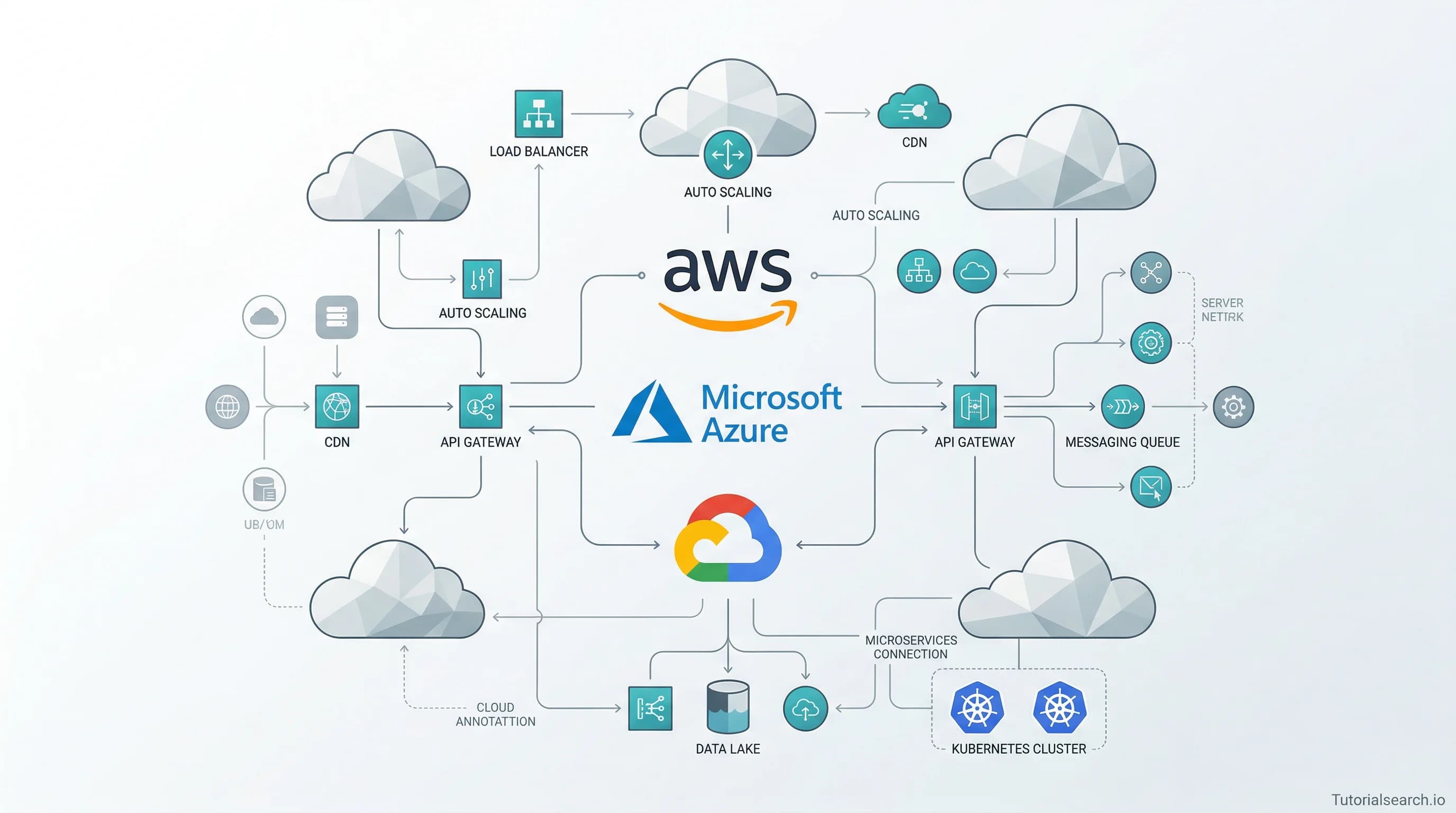
The Cloud Architect's Playbook: Every Resource You Need to Design at Scale in 2026
A practitioner's guide to the best cloud architecture courses, free resources, GitHub repos, YouTube channels, and books in 2026 — organized around building real design skills, not just passing certification exams.
Need a web app built? Hire the team behind TutorialSearch.io
We ship fast, production-grade full-stack apps (Next.js, React, edge infra) — the same stack that powers this site.
Your Monday Morning Architecture Review Is in 10 Minutes
Picture this: you're staring at a whiteboard covered in boxes and arrows. Someone just asked why the system went down last Tuesday, and your proposed fix involves three AWS services you've never actually configured. The senior architect is nodding politely, but you can tell she's already mentally redesigning your entire approach.
I've been in that room. And the gap between "I understand cloud concepts" and "I can design a system that survives Black Friday traffic" is wider than most people realize. Cloud architecture isn't just about knowing which services exist — it's about understanding why you'd pick one pattern over another, what breaks at scale, and how to make tradeoffs that won't haunt you at 3 AM.
The good news? The resources available for learning cloud architecture in 2026 are genuinely excellent. The bad news? There are so many that choosing where to start feels like its own architectural decision. So I spent considerable time sorting through courses, repos, books, and communities to build the guide I wish someone had handed me when I first started designing systems beyond "throw it on a single EC2 instance and pray."
If you're exploring this space, TutorialSearch.io has 730+ cloud architecture courses across platforms — but let me save you some scrolling and point you to what actually matters.
Get Your Hands Dirty: The Courses That Build Real Skills
Not all cloud architecture courses are created equal. Some teach you to pass a certification exam. Others teach you to think like an architect. The best ones do both, and these are the ones I'd stake my professional reputation on.
The Multi-Cloud Masterclass
Cloud Architecture Pro: Design & Engineer AWS, Azure, GCP! (Udemy) — [Editors' Choice]
Brian Newman built something rare here: a single course that meaningfully covers all three major cloud providers without being superficial about any of them. At a 4.5 rating, this is the course I recommend when someone says "I don't know which cloud to learn first." The answer is: learn the patterns, not the provider. Newman gets that.- Covers AWS, Azure, and GCP architectural patterns side by side
- Focuses on design principles that transfer across platforms
- Ideal for beginners who want a vendor-neutral foundation
Microsoft Azure: Cloud Architecture Case Studies (Udemy) — [Editors' Choice]
Memi Lavi's case-study approach is what makes this stand out from every other Azure course. With 9,600+ students and a 4.47 rating, it's proof that people learn architecture best by studying real systems, not abstract diagrams. Each case study walks through an actual architectural problem, the tradeoffs considered, and the solution implemented.- Real-world case studies, not just theory
- Intermediate level — you should know basic Azure before jumping in
- Excellent for understanding architectural decision-making
Learning Cloud Architecture: From Ideas to Practical Design (Udemy)
Ashish Prajapati's course (4.64 rating) bridges the gap between whiteboard ideas and actual implementations. The "from ideas to practical design" subtitle isn't marketing fluff — it genuinely walks you through the translation process that trips up most junior architects.
AWS-Specific Deep Dives
AWS Cloud Architecture For Java Spring Boot Developers (Udemy)
If you're coming from a Java background, Vinoth Selvaraj's course (4.52 rating, 3,890+ students) meets you where you are. Most cloud courses assume you're starting from scratch — this one assumes you already know how to build applications and focuses on how to architect them for the cloud. That distinction matters.AWS Hands-On Guide: Build and Deploy Full Cloud Architecture (Udemy)
Kevin Kim's course has a perfect 5.0 rating (small sample size, but still). It's purely hands-on — you build and deploy a complete architecture from scratch. No slides-only sections. If you learn by doing, start here.
Everyone recommends starting with fundamentals courses, and they're not wrong — but I think most people get stuck in "tutorial purgatory" by taking too many introductory courses. Pick ONE fundamentals course, then jump to something hands-on. If you want a broader foundation, the Master Course in Cloud Computing and Cloud Architecture on Udemy has 32,000+ students and covers the basics comprehensively.
For those interested in the certification path, you'll want to explore cloud certifications as a next step — but don't make the mistake of optimizing for cert exams before you can actually design systems.
Structured Training That Goes Beyond Basics
Pluralsight's Architecture Series
Pluralsight quietly has some of the best cloud architecture content available, and it doesn't get enough credit.
Foundations for Cloud Architecture (Pluralsight) — [Editors' Choice]
James Bannan's foundations course is where I'd send anyone who needs to understand the why behind cloud architecture, not just the how. It covers the principles that don't change when a new service launches or a provider updates their console.Cloud Design Patterns for Azure: Availability and Resilience (Pluralsight)
Barry Luijbregts' series on Azure design patterns (4.8 rating) is criminally underrated. The availability and resilience module covers queue-based load leveling, retry patterns, and throttling — the exact patterns that separate architectures that survive failures from ones that cascade into outages.Reliable Google Cloud Infrastructure: Design and Process (Pluralsight)
This is Google Cloud's own course delivered through Pluralsight. If GCP is your platform, this is non-negotiable. It covers everything from cost optimization to disaster recovery, taught by the people who built the platform.CCSP: Cloud Architecture and Concepts (Pluralsight)
Kevin Henry's CCSP prep course is excellent even if you're not pursuing the certification. The security architecture perspective it provides is something most general cloud courses skip entirely, and it's arguably the most important dimension of architecture to understand deeply.
| Course | Platform | Best For | Rating |
|---|---|---|---|
| Cloud Architecture Pro (Newman) | Udemy | Multi-cloud beginners | 4.53 |
| Azure Case Studies (Lavi) | Udemy | Real-world design thinking | 4.47 |
| Foundations (Bannan) | Pluralsight | Conceptual understanding | 4.4 |
| Azure Design Patterns (Luijbregts) | Pluralsight | Resilience patterns | 4.8 |
| GCP Design & Process | Pluralsight | GCP-specific architecture | 4.5 |
If you're building expertise across cloud platforms generally, mixing courses from different providers actually accelerates your learning. You start seeing the shared patterns beneath the different service names.
Open Source Goldmines: GitHub Repos Worth Starring
Some of the best cloud architecture education lives on GitHub, entirely free. Here are the repos that have genuinely shaped how I think about designing systems.
Learn to Cloud (L2C) — [Editors' Choice]
This is the repo I recommend most often. It's a structured, phased learning path from absolute beginner to cloud engineer, and it's maintained by an active community. The genius is in its opinionated sequencing — it doesn't just list resources, it tells you what order to learn things in. Phase 1 covers Linux and networking fundamentals, and it builds systematically from there. If you're the type who needs a clear roadmap, this is your north star.
Awesome Cloud Architect covers the breadth that most other resources miss. It spans distributed systems theory, scalability patterns, and operations — the computer science fundamentals that underpin good cloud architecture. This isn't a beginner resource; it's where you go when you've passed your first certification and realize you need to actually understand why things work.
DevOps Roadmap by milanm is technically a DevOps roadmap, but cloud architecture and DevOps are deeply intertwined in 2026. You can't design a modern cloud system without understanding CI/CD, infrastructure as code, and monitoring. This roadmap provides a visual learning path with links to resources for each skill.
Awesome Azure Learning — Architecture is specifically curated for Azure architecture topics, including solution designs, technical recommendations, and reference architectures. If Azure is your primary platform, bookmark this immediately.
For anyone interested in the infrastructure side of things, cloud infrastructure courses complement these repos nicely — they provide the guided instruction while GitHub provides the self-directed exploration.
Hit Play: YouTube Channels That Teach Architecture Thinking
Need a web app built? Hire the team behind TutorialSearch.io
We ship fast, production-grade full-stack apps (Next.js, React, edge infra) — the same stack that powers this site.
YouTube is flooded with cloud content, but most of it is either too shallow or too certification-focused. These creators actually teach you to think architecturally.
AWS — This Is My Architecture — [Editors' Choice]
AWS's own series features real customers explaining their actual architectures. Over 400 videos covering everything from startup MVPs to enterprise-scale systems. What makes this invaluable is the diversity — you see how different industries solve different problems with the same building blocks. Skip the marketing intros and jump straight to the architecture diagrams.
TechWorld with Nana covers DevOps and cloud from a practitioner's perspective. Nana's teaching style is structured and clear, and she doesn't waste your time with fluff. Her Kubernetes and Docker content is particularly relevant for modern cloud architecture.
A Cloud Guru on YouTube provides free previews and fundamentals content. Their "ACG Fundamentals" playlist covers core concepts across AWS, Azure, and GCP. Good for getting a taste before committing to a paid platform.
freeCodeCamp regularly publishes full-length cloud courses — 4-8 hour deep dives — completely free. Their AWS and Azure full courses are legitimate alternatives to paid content. The production quality varies, but the information density is hard to beat at zero cost.
Adam Marczak — Azure for Everyone focuses specifically on Azure with a practical, no-nonsense approach. His AZ-900 and AZ-305 content walks through concepts with real Azure Portal demonstrations.
Quick hot take: YouTube is better than most paid courses for understanding individual services and concepts. Where paid courses win is in providing a structured learning path and hands-on labs. Use both.
Read Your Way Deeper: Books That Shape Architectural Thinking
Courses teach you services. Books teach you principles. The best cloud architects I know read broadly, not just technically.
Cloud Computing: Concepts, Technology & Architecture by Thomas Erl remains the foundational text. It's not exciting, but it's comprehensive and precise in a way that courses often aren't. Think of it as your reference manual — not something you read cover to cover, but something you consult when you need to understand a concept deeply.
Architecting the Cloud by Michael Kavis is more practical and opinionated than Erl's book. Kavis covers service model selection (IaaS vs PaaS vs SaaS) from a business perspective, which is something technical courses consistently underweight. Architecture isn't just about technology — it's about making tradeoffs that serve business objectives.
Building Microservices by Sam Newman deserves mention even though it's not strictly a "cloud" book. Microservices architecture is so fundamental to modern cloud systems that understanding Newman's patterns for service decomposition, communication, and deployment is essentially required reading for cloud architects.
The DevOps Handbook by Gene Kim et al. covers CI/CD, deployment strategies, and operational practices that directly inform how you design cloud systems. Blue/green deployments, feature flags, and observability patterns all influence architectural decisions.
For those pursuing AWS specifically, the AWS Certified Solutions Architect Study Guide by Ben Piper and David Clinton doubles as an architecture bootcamp even if you never take the exam. The exam prep structure forces a comprehensive coverage of patterns that organic learning might miss.
If you're also exploring cloud security, pair these books with a security-focused resource — architecture without security consideration isn't architecture, it's wishful thinking.
Free Doesn't Mean Shallow: Zero-Cost Resources That Deliver
The free tier of cloud architecture education has gotten remarkably good. Here's what's genuinely worth your time without spending anything.
AWS Well-Architected Framework (documentation) is the single most important free resource for cloud architects. Period. The six pillars — operational excellence, security, reliability, performance efficiency, cost optimization, and sustainability — provide a framework for evaluating any architectural decision. I reference this weekly.
Google Cloud Architecture Framework (documentation) is Google's equivalent, and it's worth reading even if you're primarily an AWS shop. The different perspective highlights principles that are truly cloud-agnostic versus AWS-specific assumptions you might not realize you're making.
Microsoft Azure Architecture Center (documentation) provides reference architectures, design patterns, and best practices. The architecture patterns section is particularly valuable — it's like having a senior architect's cheat sheet.
Educative.io Cloud Computing Fundamentals offers interactive, browser-based courses that let you code along without any local setup. For hands-on learners who hate watching videos, this format is a revelation.
AWS Cloud Practitioner Essentials is the official free AWS training that covers core services and architectural concepts. Not deep enough on its own, but an excellent starting point.
IBM Cloud Fundamentals offers a vendor-neutral overview of cloud models and service types — surprisingly good for understanding the big picture before diving into provider-specific content.
There's a myth that free resources are only good for beginners. The Well-Architected Framework documents are advanced material that practicing architects reference constantly. Don't skip them because they're free.
Browse more free and paid options across the full cloud computing category — there's genuinely something for every learning style and budget.
Join the Conversation: Where Cloud Architects Actually Hang Out
Learning architecture in isolation is like learning to cook without ever eating at a restaurant. You need to see how others solve problems, ask questions about your own designs, and stay current with how the field evolves.
r/aws, r/azure, and r/googlecloud on Reddit are where practitioners share war stories, ask design questions, and debate architectural tradeoffs. The comments on architecture review posts are often more educational than formal courses.
AWS Community Builders (Slack) is an invite-only program, but anyone can apply. Once in, you get direct access to AWS employees and a community of serious practitioners. The architecture channel discussions are gold.
The Amazon Web Services Discord is more accessible — it's open to everyone and has active channels for architecture discussions. Great for real-time help when you're stuck on a design decision.
KCD (Kubernetes Community Days) and AWS re:Invent recordings provide annual deep dives into architectural patterns. Even if you can't attend, the session recordings are free and cover cutting-edge patterns.
For ongoing learning, the cloud concepts and AWS essentials topic pages on TutorialSearch.io surface new courses as they're published — useful for keeping your skills current without manually searching.
If You Only Have 30 Minutes
Pick one of these three starting points based on where you are:
Total beginner? Watch the first module of freeCodeCamp's AWS course on YouTube, then read the first pillar of the AWS Well-Architected Framework. You'll know within an hour whether cloud architecture excites you enough to invest more time.
Know the basics, want to level up? Take Brian Newman's Cloud Architecture Pro course and star the Learn to Cloud repo. That combination of structured learning plus a self-directed roadmap will carry you further than any single resource.
Already working with cloud, want to architect better? Read Memi Lavi's Azure Case Studies course (even if you're not on Azure — the thinking transfers), dig into the Well-Architected Framework for whichever provider you use, and join the Reddit communities for your platform.
The gap between knowing cloud services and designing cloud systems is real, but it's crossable. Every architect I respect started exactly where you are — staring at a whiteboard, unsure which box connects to which arrow. The resources exist. The communities are welcoming. The only architectural decision left is choosing to start.
Frequently Asked Questions
What are the key components of Cloud Architecture?
Cloud architecture involves designing the structure of cloud-based systems, including compute, storage, networking, and security layers. The focus is on building systems that are scalable, reliable, and cost-optimized. Understanding the cloud platforms — AWS, Azure, and GCP — gives you the building blocks, while architectural patterns tell you how to assemble them.
How long does it take to learn cloud architecture?
Most learners take 4-8 months to grasp fundamentals and up to a year to reach intermediate proficiency. If you have existing programming or IT experience, you can accelerate this significantly. The key is balancing theory (courses, books) with practice (building actual systems, reviewing real architectures).
Do I need certifications to work as a cloud architect?
Certifications help, but they're not sufficient. The AWS Solutions Architect and Azure Solutions Architect Expert certifications demonstrate baseline knowledge, but hiring managers increasingly look for practical design experience. Use certifications as milestones in your learning journey, not as the destination. Explore cloud certifications to find the right one for your career path.
What's the difference between cloud architecture and traditional IT architecture?
Cloud architecture shifts from managing physical infrastructure to designing logical, scalable solutions within cloud environments. This means leveraging services like IaaS, PaaS, and SaaS for greater agility and resource efficiency. The core design principles — separation of concerns, loose coupling, fault tolerance — remain the same, but the implementation patterns are fundamentally different.
Which cloud provider should I learn first?
AWS has the largest market share and most job postings. Azure dominates in enterprise environments, especially Microsoft shops. GCP leads in AI/ML and data engineering. My recommendation: learn cloud-agnostic patterns first, then specialize in whichever provider your current or target employer uses. Browse cloud data solutions if your interest leans toward the data side of architecture.