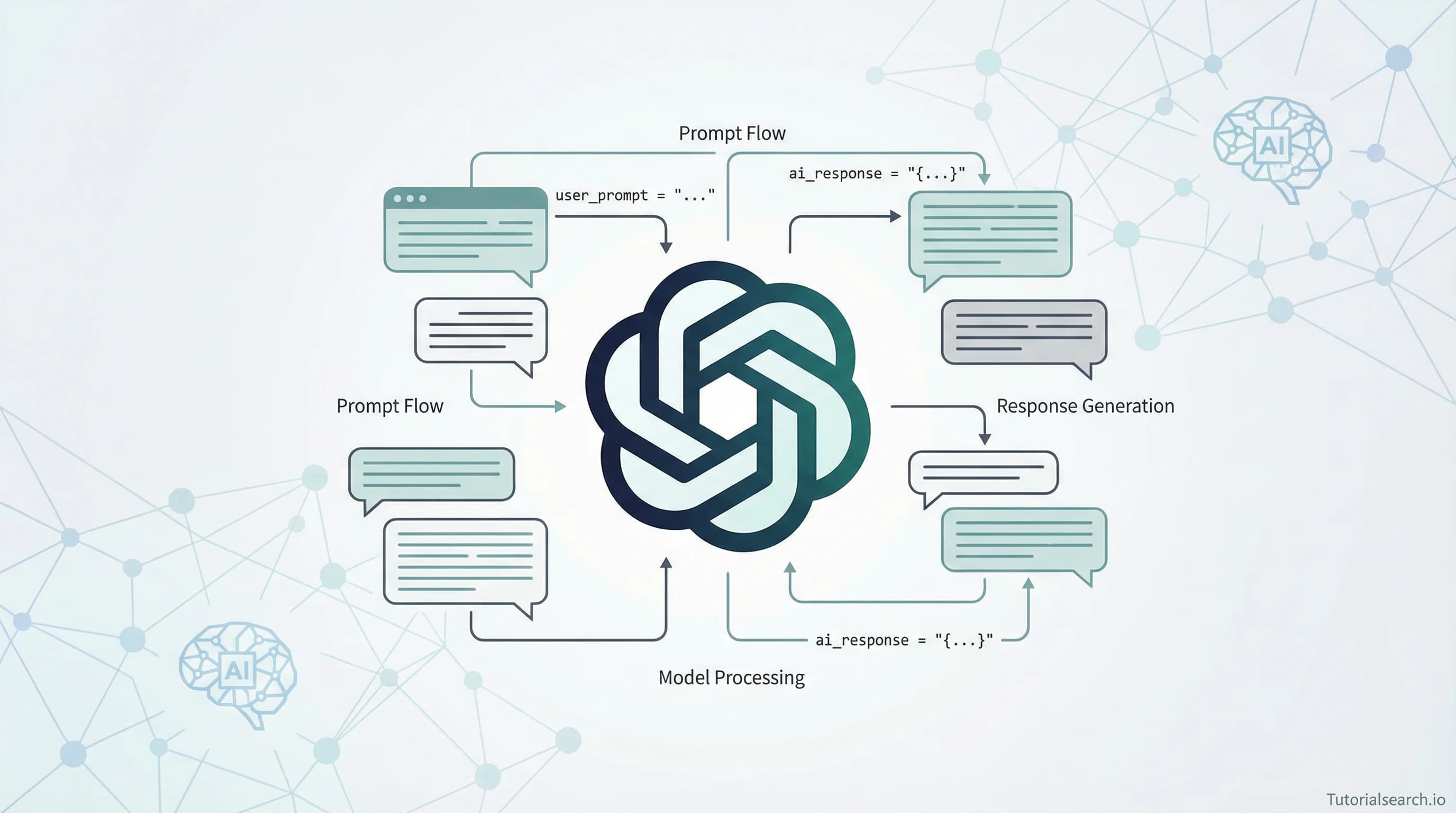
ChatGPT Prompt Engineering for Real Results
ChatGPT prompts control everything about what you get from the AI. Here are the best courses, free resources, YouTube channels, and GitHub repos to help you write prompts that actually deliver.
Want AI in your product? Hire the team behind TutorialSearch.io
LLM features, RAG, agents and automation wired into a real product — built by the devs who shipped this site.
ChatGPT prompts are the lever that controls everything you get from the AI. A weak prompt gives you a weak answer. A specific, context-rich prompt with a clear output format can turn ChatGPT into a genuinely useful thinking partner.
Most people never learn this. They type a vague question, get an okay response, and assume that's just how AI works. The truth is, the quality gap between a careless prompt and a carefully written one is enormous — and it's a gap you can close faster than you'd expect.
There are 138+ courses covering ChatGPT prompt engineering on TutorialSearch, plus a growing collection of free resources, YouTube channels, and books covering everything from fundamentals to advanced techniques. This guide brings the best together.
Key Takeaways
- ChatGPT prompt quality directly controls response quality — vague in, vague out.
- Specificity, context, and format instructions are the three fundamentals that matter most.
- Free resources like Learn Prompting rival paid courses for foundational skills.
- The best ChatGPT prompts include a role, a task, relevant context, and a desired output format.
- Prompt engineering skills transfer — what works in ChatGPT works with Claude, Gemini, and other LLMs (large language models).
In This Article
- Where Most ChatGPT Prompts Go Wrong
- The ChatGPT Prompt Courses Worth Your Time
- Free ChatGPT Prompt Tutorials That Don't Waste Your Time
- ChatGPT Prompt Engineering on YouTube
- ChatGPT Prompt GitHub Repos Worth Starring
- For When You Want to Go Deep With ChatGPT Prompts
- Where ChatGPT Prompt Writers Actually Connect
- Related AI Skills That Pair Naturally With ChatGPT Prompting
- Frequently Asked Questions About ChatGPT Prompts
Where Most ChatGPT Prompts Go Wrong
The first time I actually wrote a structured prompt — with a clear goal, relevant context, and a requested output format — I got something three times more useful than anything I'd gotten before. No template, no five-step system. I just stopped treating ChatGPT like a search engine and started treating it like a smart colleague who needs a proper brief.
The most common mistake is under-specifying. "Write a cover letter" gives ChatGPT almost nothing to work with. "Write a one-page cover letter for a senior product manager applying to a fintech startup, confident tone, highlighting agile delivery and data-driven decisions" gives it a real target.
The Prompt Upgrade: Three Levels
| Version | What You Write | What You Get |
|---|---|---|
| Basic | "Write me a business email" | Generic, bland template |
| Better | "Write a follow-up email to a client after a sales demo" | Relevant but still generic |
| Good | "Write a 3-paragraph follow-up email to a B2B client after a product demo. Friendly but professional. Reference their pain point around team onboarding. Suggest a 20-minute call." | Specific, usable, on-brand |
The formula isn't complicated: role + task + context + format. That's it.
Most prompt guides want to sell you a more complex system — RICE, CRISPE, CO-STAR, and a dozen others. These are just formalized versions of "be specific and give context." They work, but they're not where you should start. Internalize the four-part formula first. Then layer in techniques like chain-of-thought prompting (telling ChatGPT to "think step by step"), few-shot examples (showing it an example before the main task), and role assignment (asking it to respond as a domain expert).
The resources below build that progression cleanly.
The ChatGPT Prompt Courses Worth Your Time
The market for ChatGPT prompt courses is enormous — and uneven. These are the ones worth your time and money.
Start Here: Courses for Beginners
ChatGPT 101: Learn ChatGPT Prompts & ChatGPT Smart Tips — Peter Alkema — Beginner
Over 15,000 students make this one of the most-enrolled ChatGPT prompt courses on the platform. Alkema explains how to craft prompts, use smart tips for better outputs, and understand why ChatGPT responds differently to different inputs. Good entry point if you're starting from zero.
ChatGPT Prompts Mastery: 50,000 Prompts | 20 Courses in 1 — Paul Nene — All Levels
The name sounds like marketing, but the breadth is real. This spans 20 use cases — content creation, coding, customer service, and more — and gives you an adaptable prompt library alongside the theory. Good for someone who wants both understanding and a ready-made toolkit to start from.
226 ChatGPT Prompts: A-Z ChatGPT Prompt Engineering BootCamp — Passive Income Gen Z — All Levels
What this course does well is structure. It walks through prompt engineering from A to Z with 226 worked examples. You see the reasoning behind each prompt — not just the output. Rated 4.53 with nearly 1,000 students. An underrated pick.
For Writers and Content Creators
ChatGPT Copywriting Secrets + 7 ChatGPT Prompts — Sumner Hobart — All Levels [Editors' Choice]
Rated 4.81 with over 5,500 students — the standout course for anyone using ChatGPT for writing. Hobart goes beyond "how to use ChatGPT" and gets into copywriting strategy: prompting for persuasion, structure, hooks, and calls to action. Unlike Alkema's broader intro course, this one goes deep specifically on writing. The included prompt templates for specific tasks are genuinely useful day-one.
Great Writing with ChatGPT: A Complete Hands-On Guide — Luke Priddy — All Levels
Luke Priddy has a talent for making practical things actually practical. This course is hands-on from the start — you're working with real prompts and editing outputs, not just watching explanations. Rated 4.69. A solid companion to Hobart's course if you want more ground-level practice.
For the Technically Inclined
Prompt Engineering: Core Concepts + Hands-On in 2.5 Hours — Ujjwal Singh — All Levels
8,175 students and a focused 2.5-hour runtime. Singh covers chain-of-thought prompting, zero-shot vs. few-shot approaches, and prompt chaining (connecting multiple prompts in sequence for complex tasks). Better for someone who already knows the basics and wants to go deeper technically without a long course commitment.
Deep Dive into OpenAI Models: Master o3, o4-mini & Beyond — Anton Voroniuk — All Levels [Editors' Choice]
Over 13,000 students and rated 4.48. This course covers how different OpenAI models behave — when to use o3 vs. o4-mini (OpenAI's reasoning-focused models), and how prompt strategies change based on the model. If you care about getting the most from the full ChatGPT ecosystem rather than just one default model, this is the course to take.
Niche Picks With Outsized Value
ChatGPT Prompts To Understand & Analyse Financial Statements — Imran Zakir — All Levels [Editors' Choice]
Just 120 students, but rated 4.95 — the highest-rated course in this list. It's focused on using ChatGPT prompts for financial data and statement analysis. The prompt techniques Zakir teaches for structured data interpretation transfer remarkably well to other complex, data-heavy tasks — even if finance isn't your world.
AI Mastery: ChatGPT Prompts & MidJourney Image Creation — Chetan Pujari — All Levels
Nearly 11,000 students. This pairs ChatGPT prompt engineering with MidJourney image prompting — making it the best pick for designers, marketers, or anyone working in creative fields. If you're interested in generative AI beyond text, this course covers more ground than most.
You can search the full catalog of ChatGPT prompts courses on TutorialSearch to see what else is available.
Free ChatGPT Prompt Tutorials That Don't Waste Your Time
Paid courses have their place. For foundational skills, though, free resources are remarkably strong.
Learn Prompting is the most comprehensive free resource in the space. It's open-source, with 25+ chapters. The content starts with basic prompt structure and works up to chain-of-thought reasoning, few-shot learning, and AI agents. Over 221,000 learners have enrolled. The beginner path takes about an hour. The advanced material goes much deeper.
If you want something shorter and more authoritative, OpenAI's official prompt engineering guide and their ChatGPT-specific best practices article are both worth bookmarking. Short, regularly updated as models change, and written by the team that built ChatGPT. Read these before you commit to a full course.
PromptingGuide.ai goes more technical. It covers prompt injection, adversarial prompting, and model-specific techniques — without requiring any coding background. Good for the systematic learner who wants to understand why certain prompts work, not just what to write.
LearnPrompt.org takes a different approach. Instead of teaching theory, it gives you ready-made prompts organized by use case — learning, research, writing, productivity. A practical shortcut when you need results fast and don't want to start from scratch.
FlowGPT is a community platform where people share their best prompts — searchable, categorized, and tested by real users. Browse it for 20 minutes and you'll have a clear sense of what effective ChatGPT prompts look like in practice.
For interactive learning, the ChatGPT for Everyone course on Learn Prompting is the cleanest free option available. Self-paced, takes about one hour, covers prompt basics and DALL-E image creation (generating images with AI text commands), and has no paywall.
ChatGPT Prompt Engineering on YouTube
Want AI in your product? Hire the team behind TutorialSearch.io
LLM features, RAG, agents and automation wired into a real product — built by the devs who shipped this site.
YouTube is probably the fastest way to see what good ChatGPT prompts look like in action — not described in text, but demonstrated live with real outputs.
The AI Advantage (Igor Pogany) is one of the more practical channels around. Instead of explaining AI theory, Pogany shows workflows — how he uses ChatGPT for research, writing, automation, and business tasks. Prompts appear on screen. You see the output in real time. That kind of show-don't-tell approach is hard to match in any text-based course.
Skill Leap AI does a better job than most channels at comparing the same prompt across different models — ChatGPT, Claude, Gemini — which matters when you're deciding where to focus your time. The channel also covers new ChatGPT features faster than most. Good for staying current.
Sentdex goes deeper on the technical side. The channel covers prompt engineering with data science applications and Python integrations with the OpenAI API (the programming interface developers use to connect ChatGPT to other software). More technical than the others, but thorough and worth following if you're in a technical role.
For beginners, OpenAI's official YouTube channel has gotten significantly better. Their walkthrough videos for new features are clear and well-produced. Not a substitute for a course, but a good supplement for staying current with changes.
There's also a strong YouTube playlist built into the ChatGPT for Everyone course on Learn Prompting — short, focused lessons that build on each other. Better than most standalone YouTube content for structured learning.
ChatGPT Prompt GitHub Repos Worth Starring
f/awesome-chatgpt-prompts has 154,000+ GitHub stars — one of the most-starred AI repositories in existence. It's a massive community library of prompts, categorized by use case, maintained by contributors worldwide, and free with zero restrictions (CC0 license). The interactive web version lives at prompts.chat. Browse it to understand the full range of what's possible with well-crafted ChatGPT prompts.
promptslab/Awesome-Prompt-Engineering is more research-oriented. It tracks academic papers, tools, and guides focused on prompt engineering across GPT, Claude, PaLM, and other models. If you want to understand prompt engineering as a technical discipline — not just a collection of tips — this repo points you to the papers and projects worth reading.
ai-boost/awesome-prompts curates prompts from the top-rated GPTs in the GPT Store. These prompts have been tested in real GPT builds — a different angle than community-contributed collections, and often more refined.
If you're interested in AI agents — which automate multi-step tasks using chains of connected prompts — many of the most useful agent frameworks are on GitHub and build directly on advanced prompt engineering principles. Exploring that territory is a natural next step once the fundamentals are solid.
For When You Want to Go Deep With ChatGPT Prompts
Courses and free guides cover the surface well. Books go deeper, and a few stand out.
The Art of Prompt Engineering with ChatGPT by Nathan Hunter reads like a hands-on workbook. Each chapter has exercises, examples, and prompts to try. Good for someone who learns by doing and wants structured practice outside a screen-based course.
ChatGPT for Beginners: Prompt Engineering & Moving Beyond Basic Prompts by Dr. Andy Williams was published in early 2026. It covers current features — Projects, Canvas, Agent Mode, Custom GPTs — making it one of the most up-to-date books in the space. If you want a recent print resource that doesn't reference outdated versions, this is the one.
For a more technical audience, Prompt Engineering for LLMs (O'Reilly) by John Berryman and Albert Ziegler is the reference book. It covers prompt patterns, system prompts, and how to work with LLMs at a deeper level — including API usage for developers. Dense but comprehensive.
Prefer free reading? The Best Prompt Engineering Resources guide from Generative Programmer maintains an updated list of free online books and papers. Worth a bookmark.
For those building AI skills professionally, the Professional Certificate in Prompt Engineering and AI Skills goes further than a typical intro course and is aimed at people who want verifiable credentials alongside the knowledge. It pairs well with everything in this section.
Where ChatGPT Prompt Writers Actually Connect
r/ChatGPT has 1.8 million members. It's the default landing spot for everything ChatGPT — tricks, use cases, hot takes on new features, and prompts shared by the community. Useful for staying current and discovering prompt approaches you'd never think of on your own.
r/PromptEngineering (13,000+ members) is smaller and more focused. People share prompts for feedback, discuss techniques, and post tutorials. Less noise than the main subreddit.
FlowGPT's Discord is one of the largest active ChatGPT prompt communities online. People share and stress-test prompts for ChatGPT, Claude, Stable Diffusion, and others — useful for live feedback on specific prompt ideas.
Learn Prompting's Discord is attached to the learning platform. People work through the same material, ask questions, and share discoveries. Good if you're learning systematically and want a study group rather than a general community.
If you're using ChatGPT for AI content creation — writing, image generation, video scripts — there are also niche communities within those verticals worth finding once the fundamentals are solid.
Related AI Skills That Pair Naturally With ChatGPT Prompting
Learning ChatGPT prompts opens doors to a whole ecosystem of AI skills. If prompting interests you, these related areas are worth exploring:
Generative AI — The broader field ChatGPT sits within. Understanding generative AI gives you context for why prompts work the way they do. 2,000+ courses available.
AI Assistance — How to use AI tools effectively in real workflows. Many prompt engineering skills apply directly here. 1,000+ courses.
AI Practitioner — Moving from user to practitioner. Covers how to evaluate AI outputs, build AI-powered workflows, and develop AI literacy at a professional level. 1,000+ courses.
AI Agents — Agents use prompt chains (sequences of connected prompts) to automate multi-step tasks. If you want to go beyond manual prompting into automation, this is the natural next step.
Applied AI — How AI is used in specific industries. Prompt engineering is often the entry skill for applied AI work in healthcare, legal, finance, and marketing.
ML Fundamentals — Understanding the machine learning (ML) concepts behind ChatGPT. Not required for prompt engineering, but it helps explain why certain approaches work and others don't.
Browse the full AI & Machine Learning course category to see how these topics connect.
Frequently Asked Questions About ChatGPT Prompts
How long does it take to learn ChatGPT prompt engineering?
You can get functional in a day. The basics — specificity, context, format — can be understood in an hour and applied immediately. Getting genuinely good takes 2–4 weeks of regular practice and deliberate experimentation. Advanced techniques like chain-of-thought and few-shot prompting take longer but aren't required for most real-world tasks. Start with the ChatGPT prompt courses on TutorialSearch and practice daily.
Do I need to know coding to write effective ChatGPT prompts?
No. Most prompt engineering doesn't involve code. You're writing natural language instructions — not programming syntax. Coding becomes relevant only if you want to build applications using the OpenAI API (the interface that lets developers connect ChatGPT to other software). For everyday use, writing, research, and business tasks, no coding knowledge is needed at all.
Can ChatGPT prompt skills help my career?
Yes, and increasingly so. Companies across nearly every sector want people who can use AI tools well — and prompt engineering is one of the most transferable AI skills available. It applies in marketing, operations, finance, design, and product roles. The AI Practitioner category on TutorialSearch covers more on how this skill maps to specific professional paths.
What's the difference between a good and bad ChatGPT prompt?
A bad prompt is vague and gives ChatGPT no direction — "write a blog post" or "explain this." A good prompt includes a role (who ChatGPT should be), a task (what it should produce), context (relevant background information), and a format (what the output should look like). The difference in output quality is significant. The Prompt Engineering: Core Concepts + Hands-On course walks through this in detail with practical examples.
Can ChatGPT prompts be used to help with AI model training?
Yes, in specific ways. ChatGPT can generate synthetic data — example inputs and outputs — that can fine-tune smaller AI models. It can also write data preprocessing scripts, generate labeled training examples, and help structure datasets. This is covered in the more technical courses on the platform, particularly in the AI & Machine Learning category. The Prompt Engineering for LLMs O'Reilly book goes deepest on this use case.
Wherever you start — a free Learn Prompting module, one of the Udemy courses above, or just the OpenAI guide — the key is to start practicing on real tasks you care about. Good ChatGPT prompts aren't found; they're built through iteration. The faster you start testing and refining, the faster the gap between you and casual ChatGPT users widens.