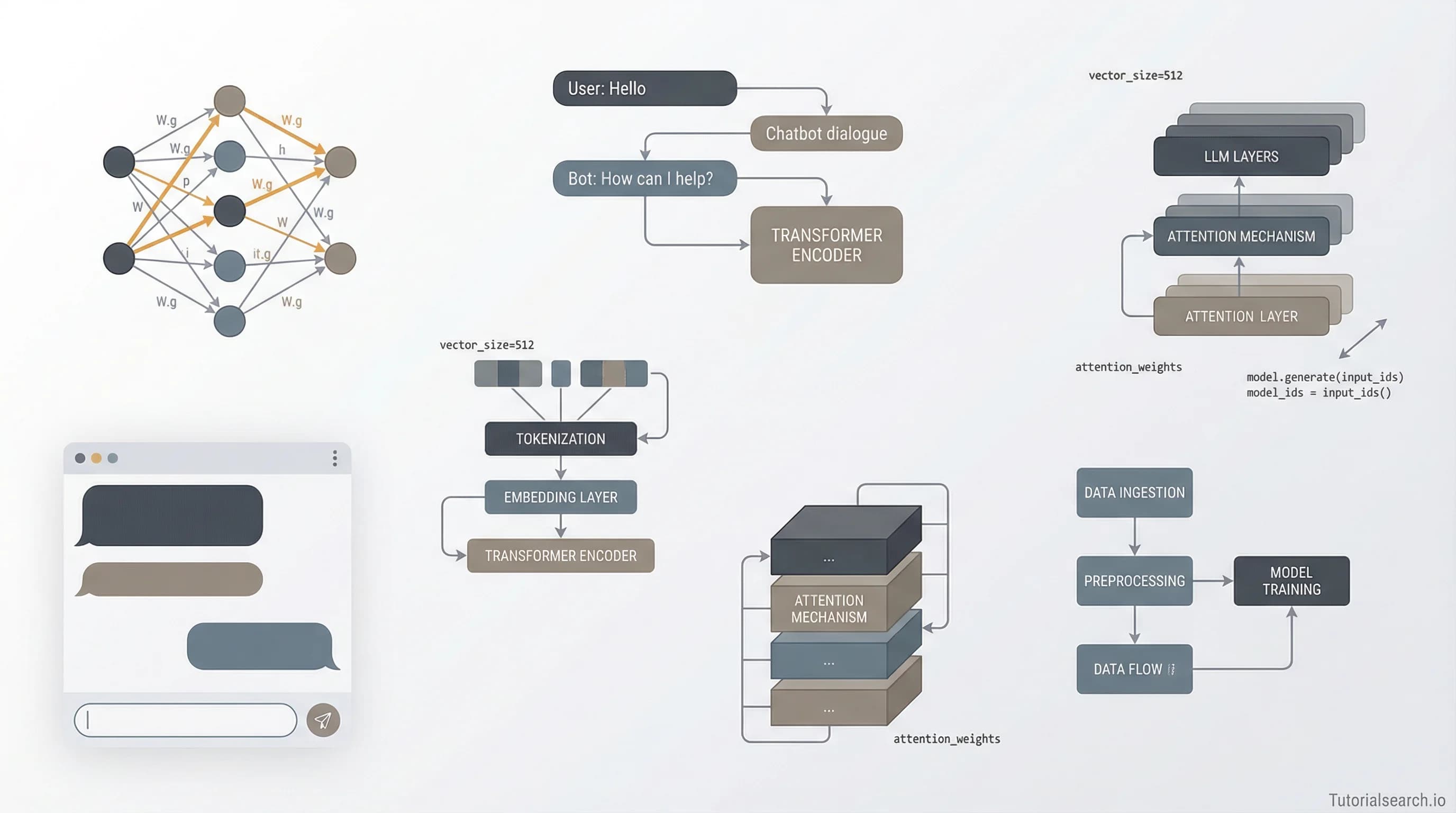
How Chatbots Actually Work: From Architecture to Real-World Deployment
Master chatbot development with this guide to architecture, NLP, dialogue management, and real-world implementation. Learn no-code and technical approaches.
Want AI in your product? Hire the team behind TutorialSearch.io
LLM features, RAG, agents and automation wired into a real product — built by the devs who shipped this site.
Conversational AI is everywhere now. Every company wants a chatbot. But most of them fail—either they dont understand what users are asking, or they respond with canned answers that feel robotic and unhelpful.
The difference between a chatbot that frustrates users and one that delights them comes down to smart architecture, proper training, and understanding how natural language processing actually works. This guide walks you through the real skills and resources you need to build chatbots that feel like talking to someone who actually gets it.
In This Article
- Understanding Chatbot Architecture and Components
- The Role of Natural Language Processing in Conversational AI
- Dialogue Management and Conversation Flow Design
- Platforms for No-Code Chatbot Building
- Machine Learning and Deep Learning for Advanced Chatbots
- Real-World Implementation Strategies
- Common Mistakes and How to Avoid Them
- FAQ: Chatbot Development Questions
- Related Topics to Explore
Key Takeaways
Chatbots succeed when they understand user intent, manage conversation flow smoothly, and integrate with business systems. NLP enables this understanding, while dialogue management keeps conversations coherent. You can build chatbots without coding using drag-and-drop platforms, or go deeper with Python, machine learning, and LLM integration. Modern chatbots handle customer support, lead generation, and FAQ automation—reducing costs while improving response times.
Understanding Chatbot Architecture and Components
Building an effective chatbot requires understanding its core parts. Think of chatbot architecture like building a house—the foundation, walls, roof, and plumbing all need to work together seamlessly.
A chatbot has several key layers:
User Interface - This is how people talk to your bot. It could be a website chat window, WhatsApp, Slack, or voice-based. The interface needs to feel natural and responsive. Good UIs load fast and dont clutter screens.
Intent Recognition Engine - This figures out what users want. When someone types "I need help with my order," the bot recognizes "get order status" intent, not just words. This engine is critical—wrong intent means everything else fails.
Dialogue Management System - This handles conversation flow. It tracks whats been said, maintains context, and decides what the bot says next. Without this, conversations become disjointed.
Knowledge Base or LLM - The chatbots brain. Could be a FAQ database, ML model, or GPT-like model generating responses. Your choice impacts cost, latency, and quality.
Backend Services - These connect to real systems—databases, CRMs, payment processors. Without these, your bot is just entertainment.
Analytics and Monitoring - Understanding chatbot performance. How satisfied are users? Where do conversations break down? Without monitoring, youre flying blind.
The most common design pattern uses the Observer pattern for handling messages and the Factory pattern for creating conversations. Many teams use the State pattern to manage conversation position.
The Role of Natural Language Processing in Conversational AI
Natural language processing gives chatbots the ability to understand messy human language. Without NLP, chatbots are just rigid lookup tables.
NLP works in layers. First, the bot normalizes input—converting variations to standardized form. Second, it tokenizes the message—breaking it into pieces. Third comes intent recognition—learning that "Can you check my order?" and "Wheres my order?" mean the same thing.
Named Entity Recognition (NER) extracts specific information. When you say "I ordered last Tuesday," the bot identifies "Tuesday" as a date. This matters because the bot can search your order history.
Part-of-Speech tagging identifies whether words are nouns, verbs, adjectives, etc. This helps understand grammar and context.
Sentiment analysis detects emotion. "I love this product" is positive. "This is terrible" is negative. Smart chatbots escalate negative sentiment to humans immediately.
Finally, the bot generates responses using Natural Language Generation (NLG). This creates new sentences tailored to specific situations, not just pattern matching.
[Editors Choice] Dialogue Management and Conversation Flow Design
Dialogue management is where many chatbot projects fail. Your bot might understand intent perfectly, but poor flow management frustrates users.
There are several approaches:
Rule-Based Dialogue Management - You define exact rules: "If intent is product_inquiry, ask product category." Simple to implement, but breaks with unexpected inputs. Real customers dont follow your rules.
State Machine Dialogue Management - Conversations have defined states like "waiting_for_category" or "ready_to_checkout." The bot transitions between states based on inputs. Works for linear workflows like booking, but becomes unwieldy when users jump around.
Machine Learning-Based Dialogue Management - The bot learns from training data and predicts next best response. More flexible but requires more data and computational power.
Hybrid Approaches - Use rules for simple conversations, ML for complex ones. Amazon Alexa uses this—straightforward commands get rule-based responses, open-ended questions get ML responses.
Slot-Filling Dialogue Management - The bot asks questions to fill required information slots. "Whats your account number?" "What product?" Once all slots are filled, the bot takes action. Great for customer service.
The key design principle is understanding user intent. Before building, brainstorm what users want. Document conversation paths for each intent. Group similar intents. Prioritize common scenarios first.
No-Code and Low-Code Chatbot Platforms
Not every team needs to build chatbots from scratch. No-code platforms let marketers and business owners create functional bots in hours.
[Editors Choice] Landbot uses visual conversation design. Drag and drop flows, no coding required. Includes live chat fallback for smooth escalation. The platform emphasizes neuroscience-inspired messaging—teaching you how to phrase questions that convert.
ManyChat focuses on social media automation. Build bots for WhatsApp, Instagram, Facebook Messenger. Popular with ecommerce brands because it drives direct sales through messaging apps.
Tidio combines chatbot and live chat. Start with automation for common questions, escalate to humans smoothly. Real companies save thousands in support costs.
Simplified AI offers intuitive visual building with templates. Build functioning chatbots in under an hour. Templates save weeks of planning.
No-code advantages: speed, lower cost, quick testing without developers. Disadvantages: limitations—advanced customization usually requires coding. For straightforward use cases (FAQ automation, booking, lead capture), no-code is the smart choice.
[Editors Choice] Machine Learning and Deep Learning Approaches
When no-code platforms hit limits, you need machine learning.
Building ML chatbots starts with training data. With 100 support conversations, extract intents and train classifiers. Popular libraries: spaCy for NLP, Scikit-Learn for machine learning. Start simple—use logistic regression, graduate to sophisticated models.
Deep learning adds power. Transformer models like BERT and GPT understand context better. BERT reads entire sentences at once, understanding word relationships. Modern LLM-powered chatbots sound more human.
Sequence-to-sequence models (Seq2Seq) generate natural responses. An encoder processes user input, decoder generates responses word by word. LSTM cells help remember important context.
Word embeddings represent words as numbers capturing meaning. "King - man + woman ≈ queen." Your chatbot understands that "expensive" and "costly" are similar, even without seeing them together.
The most practical path: start with Rasa, an open-source framework combining NLU and dialogue management. Has pre-trained models, so you dont need massive datasets. Build functional chatbots with hundreds of training examples.
For advanced language understanding, integrate large language models (LLMs). OpenAI ChatGPT, Googles Gemini, Anthropics Claude. Advantage: minimal training—the LLM understands language. Disadvantage: cost and latency per API call.
Real-World Implementation Strategies
Want AI in your product? Hire the team behind TutorialSearch.io
LLM features, RAG, agents and automation wired into a real product — built by the devs who shipped this site.
Building the chatbot is one thing. Deploying and maintaining it is another.
Start with one use case. Dont build a bot handling everything. Pick your biggest pain point—common support questions—and build for that. Once working, expand. This reduces complexity and enables quick wins.
Measure what matters. Success isnt conversation count—its satisfaction and business impact. Track: conversation completion rate (did users get what they needed?), handoff rate (escalations to humans), user sentiment. A 70% resolution rate with 30% escalation is valuable.
Plan graceful escalation. Your bot wont be perfect. Design smooth handoff to humans. Users should never feel abandoned. Summarize what youve learned so humans dont repeat questions. This improves satisfaction dramatically.
Continuous improvement requires data. Every conversation teaches. Log successes and failures. Review monthly. Find patterns—maybe 20% of failures are about one product feature your bot doesnt understand. Fix those gaps. This never stops.
Security and privacy matter. Chatbots collect customer information. Handle passwords, payment data, personal information securely. Use encryption. Follow GDPR and CCPA guidelines globally. Never log sensitive information unnecessarily.
Common Mistakes and How to Avoid Them
Mistake 1: Expecting perfection. Ambitious chatbots fail. Trying to handle 50 intents with minimal data causes failures. Build for happy path first. Get that working well. Then add edge cases. V1.0 should handle three problems really well, not 30 poorly.
Mistake 2: Forgetting context. User asks "How much does it cost?" Your bot doesnt know if they mean a specific product or entire service. Good systems ask clarifying questions. "Are you asking about Premium or enterprise?" One extra turn, drastically better accuracy.
Mistake 3: Ignoring frustration signals. "Can I speak to someone?" means frustration. Critical escalation moment. Offer human support immediately. Dont add friction. Escalation isnt failure—its smart resource allocation.
Mistake 4: Building without understanding users. Talk to support teams first. What questions come most? What frustrates customers? What do they misunderstand? Research informs whether you need a chatbot. Maybe the problem is documentation, not chatbots.
Mistake 5: Not planning updates. Language evolves. Products launch. Processes change. Chatbots need to be maintainable. Document how to update intents, add responses, modify flows. If only one person understands your bot, when they leave, it becomes legacy code nobody touches.
[Editors Choice] Course Deep Dives for Chatbot Developers
Building Chatbots Without Coding
Chatbot Development Course: Automate Sales & Support (Udemy) - Khadin Akbar uses ResolveAI, no-code platform. Learn fundamentals, flow planning, deployment to websites and messaging apps. For entrepreneurs, freelancers. 14K+ students, 4.2/5.
AI Chatbot Development & Marketing Masterclass 2025 (Udemy) - Abhijeet Sarkar teaches ManyChat, Tidio, Landbot. Emphasizes marketing—generating leads, boosting conversions, scaling. For business growth through chatbots.
Chatbot Development Full-Cycle: From Concept to Growth (Udemy) - Tom and Angela Hathaway cover Landbot. Includes demos with ChatGPT, Bard, Claude. 2,990 students, 4.3/5.
Learning the Technical Path
Chatbot Development Project Using Machine Learning 2025 (Udemy) - Arun Nachalam teaches building from scratch with Python, NLP, deep learning. Design networks, train, deploy. Free, 6K+ students.
Complete Chatbot Development Using ChatGPT API - 2025 (Udemy) - Yubaraj Gautam leverages ChatGPT. Use Streamlit for web interfaces, deploy to cloud. 4.6/5 stars.
Conversational AI: LLM Driven Development (Udemy) - ChatGPT, WhatsApp API, Flask/Django. Build 10 projects including chatbots, assistants, language learning bots.
Advanced Topics
QnA Chatbot Development: Concept to Deployment (Udemy) - Ar Awesome covers Q&A chatbots pulling answers from documentation. Uses LangChain. 1,745 students.
NLP - Natural Language Processing with Python (Udemy) - Foundation knowledge. NLTK, SpaCy, scikit-learn, deep learning. Entity recognition, sentiment, classification.
AI Chatbot Developer Expert Practice Test (Udemy) - Prepares for certification. NLP, dialogue management, deployment, monitoring.
Practical Frameworks
Build Interactive Chatbot || React ChatGPT OpenAI (Udemy) - 2-hour project. React-based chatbot with ChatGPT. Fast hands-on.
Alexa Skills Kit: Practical Chatbot Development (Udemy) - Nathan Glover teaches voice for Alexa. DynamoDB, AWS integration.
Gemini AI Made Simple (Udemy) - Googles Gemini API. Luca Alessi shows practical applications.
Open Source Frameworks
Hexabot on GitHub: Open-source builder supporting multiple channels, languages. LLM integration (Ollama, ChatGPT, Mistral, Gemini).
Rasa: Most popular open-source framework. Handles NLU and dialogue management. Commercial teams start here.
Golem: Python framework giving conversation structure. Cleaner than building from scratch.
Frequently Asked Questions
How does chatbot AI use natural language processing?
NLP enables chatbots to understand language variations. It normalizes inputs, identifies intent, extracts information, generates responses. Without NLP, only exact keyword matches work.
What are the key components of chatbot AI?
Natural Language Understanding (NLU—interprets intent), Dialogue Management (controls flow), and Natural Language Generation (NLG—creates responses). These work together for coherent conversations.
What skills are needed to develop advanced chatbots?
Minimum: Python, machine learning concepts, NLP libraries (TensorFlow, PyTorch, spaCy). APIs and databases help. LLM work needs prompt engineering knowledge. Business domain knowledge is equally important.
Is chatbot AI a subset of machine learning?
Chatbots are specialized ML applications, particularly deep learning. They use ML models learning from data. Rule-based chatbots dont use ML. Modern conversational AI chatbots do.
What are current limitations of chatbots?
Chatbots struggle with ambiguous questions, complex multi-turn reasoning, true context understanding. They hallucinate—confidently state false information. Work best on narrow domains (customer support, FAQ) not general conversation. Inherit training data biases.
How do I choose between no-code and technical development?
No-code: straightforward needs (FAQ automation, booking, lead capture). Technical: deep system integration, custom logic, building a product not just a feature.
Related Topics to Explore
Ready to go deeper? Check these learning paths on TutorialSearch.io:
- Explore Generative AI courses for modern chatbot foundations
- Learn AI Assistance to understand how chatbots help users
- Discover AI Agents for autonomous decision-making
- Study AI Learning to understand improvement
- Explore Applied AI for real-world patterns
Final Thoughts
Chatbot development isnt magic. Its architecture, training data, continuous improvement. Start simple. Pick one use case. Measure success. Iterate.
Most failing chatbots fail because teams overestimated capabilities or underestimated training data needs. Be realistic. Great chatbots solve specific problems well, not all problems poorly.