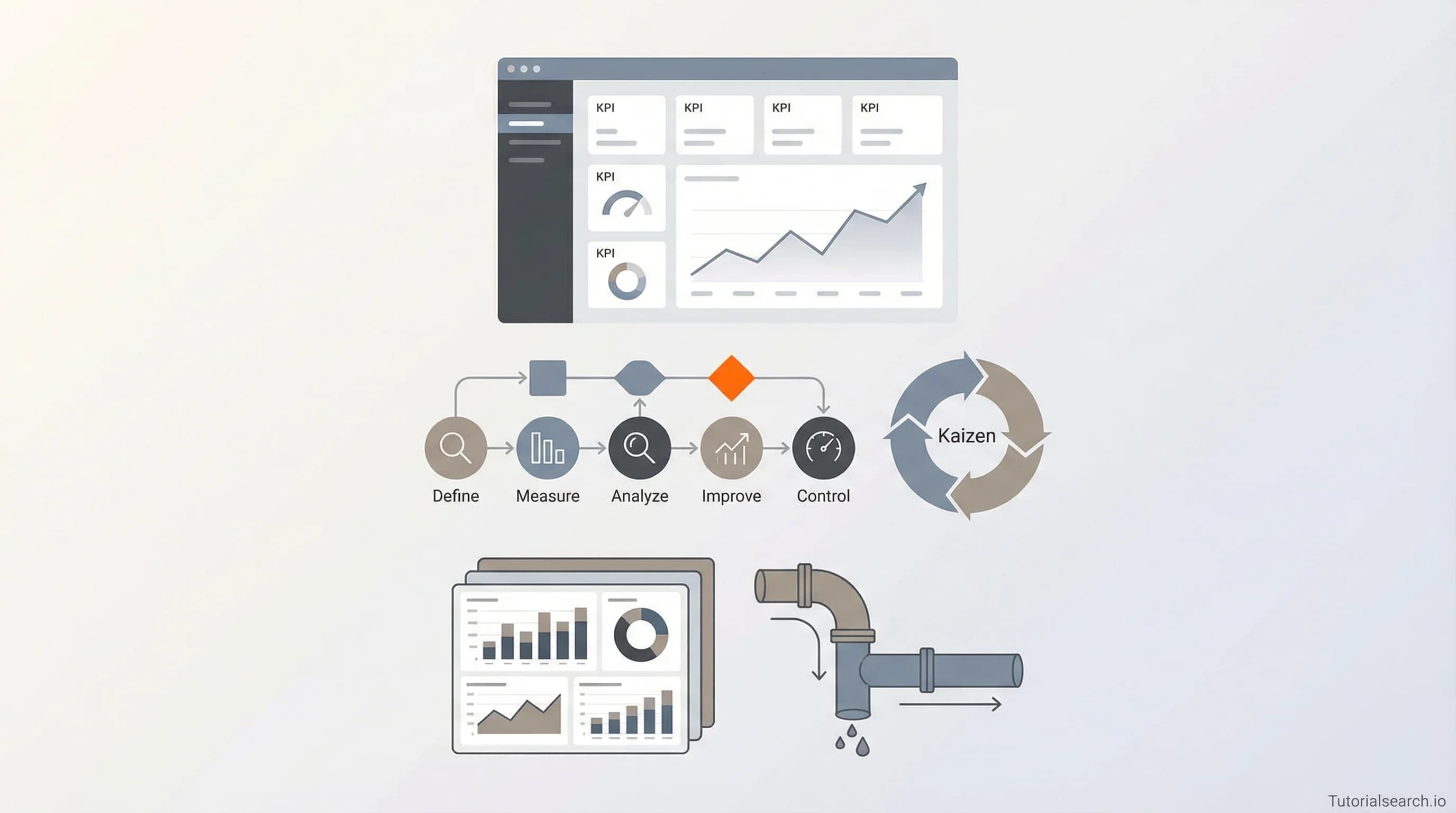
Business Efficiency Training That Moves the Needle
Business efficiency separates companies that scale from those that stay stuck. Here are the best courses, free resources, YouTube channels, and books to actually improve your operations — covering Lean, Six Sigma, Kaizen, and OEE.
Need a SaaS MVP shipped fast? Hire the TutorialSearch.io team
Auth, billing, dashboards and AI features — a launch-ready product built by the devs behind this site.
Business efficiency is the single biggest factor separating companies that scale from those that stay stuck. McKinsey research found that nearly 70% of large-scale business transformations fail — and the main culprit isn't a bad strategy. It's poor execution discipline and unmeasured processes.
That number stuck with me. We're not talking about scrappy startups running their first experiment. These are mature organizations with dedicated teams, full budgets, and outside consultants — still failing to make their operations work better.
The good news: improving business efficiency is a skill, not a talent. There are clear methodologies, real tools, and a body of knowledge you can learn. The challenge is knowing where to start — and not wasting time on the wrong resources first.
This guide covers the best courses, free resources, YouTube channels, books, and communities to help you actually move the needle on operational performance.
Key Takeaways
- Business efficiency isn't about doing things faster — it's about eliminating waste and doing the right things well
- OEE (Overall Equipment Effectiveness) is the standard metric for measuring how well a process actually performs
- Lean, Six Sigma, and Kaizen are distinct methodologies — the right choice depends on your specific problem
- The best business efficiency courses pair methodology with hands-on data analysis, not just theory
- Free resources like Asana's methodology guides and Alison's courses are solid entry points before committing to paid training
In This Article
- The Business Efficiency Courses Worth Your Investment
- The Free Business Efficiency Resources That Actually Help
- Business Efficiency on YouTube: Channels Worth Watching
- Business Efficiency GitHub Repos Worth Bookmarking
- The Business Efficiency Books Leaders Recommend
- Business Efficiency Communities Worth Joining
- Related Business Efficiency Skills Worth Exploring
- Frequently Asked Questions About Business Efficiency
The Business Efficiency Courses Worth Your Investment
Most people learning business efficiency start by Googling "Six Sigma certification." That's not wrong — but it's also not always the right first step.
Six Sigma is a rigorous, data-heavy methodology built for large manufacturing or service organizations. If you're a small business owner or a manager trying to cut waste from a 10-person team, it's overkill. You'll spend months on DMAIC frameworks before you get to anything practical.
My honest take: start with process simplification and Kaizen. Get quick wins. Then layer in the heavier methodology once you know where the real bottlenecks are.
Here are the courses I'd recommend based on quality, enrollment numbers, and what they actually teach:
1. Business Process Simplification: Certification [Editors' Choice]
Platform: Udemy | Rating: 4.7/5 | Students: 8,700+
This is where I'd send a first-time learner. The course focuses on practical tools for cutting complexity out of existing workflows — not theoretical frameworks you'll never apply. The certification is a bonus, but the real value is in learning how to map, measure, and simplify processes step by step.
The instructor team (Business Improvement & Transformation Courses) has strong production quality and clear examples drawn from real operations. It covers process mapping, waste identification, and hands-on simplification techniques. Worth every dollar for managers who need to deliver results fast.
- Process mapping and analysis
- Identifying high-waste activities
- Simplification frameworks used by consultants
- Practical tools you can apply the same week
2. Streamline Your Business With Process Improvement [Editors' Choice]
Platform: Udemy | Rating: 4.8/5 | Students: 3,000+
One of the highest-rated courses on TutorialSearch.io in this category — and it earns the rating. Expert Academy delivers a tight, no-fluff course on operational streamlining. The emphasis is on identifying bottlenecks, removing non-value-adding steps, and building sustainable improvement habits.
If you only take one course from this list, this might be it. The 4.8 rating with thousands of students is hard to argue with.
- Workflow analysis and bottleneck identification
- Value stream mapping
- Process improvement cycle management
- Sustainable efficiency habits
3. Kaizen Practitioner Masterclass for Quality Management
Platform: Udemy | Rating: 4.6/5 | Students: 7,800+
Kaizen is the philosophy of small, continuous improvements. It's originally a Toyota concept but applies to any business. This masterclass by Suhas Dakhole is the most practical introduction to Kaizen I've found on the platform. It's not just theory — the course walks through how to run Kaizen events, engage frontline teams, and measure improvement cycles.
If you're skeptical of big transformation projects (and you should be, given that 70% fail), Kaizen's incremental approach is a compelling alternative.
4. Lean & Quality Management, Six Sigma, Continuous Improvement
Platform: Udemy | Rating: 4.4/5 | Students: 10,000+
The biggest enrollment number on this list, which tells you something. This course bundles Lean, Six Sigma, and continuous improvement into one comprehensive program. It's broad by design — good for people who want an overview before committing to a specific methodology.
The trade-off is depth. You won't become a Six Sigma Black Belt from this course. But you'll finish with a clear understanding of how these methodologies relate to each other and where each one fits.
5. Application of OEE Measurement on Business Profitability (Free)
Platform: Udemy | Rating: 4.2/5 | Students: 6,400+
OEE (Overall Equipment Effectiveness) is a metric that measures three things: how available your equipment or process is, how fast it performs, and how many defects it produces. The combined score tells you exactly how much productivity you're leaving on the table.
This course is free — and genuinely valuable. It focuses specifically on OEE measurement and how it connects to profitability. If you're in manufacturing or running operations with measurable output, this is essential knowledge. The 6,400+ students and free access make it an easy first step.
6. Boost Operations Efficiency with Daily Management System
Platform: Udemy | Rating: 5.0/5 | Students: 110
Perfect score, small audience. Eduard Pchelkin's course on Daily Management Systems is niche but excellent. DMS is a structured approach to tracking daily operational performance — think visual boards, daily standups, and real-time KPI monitoring. It's the operational backbone that most process improvement methodologies assume you already have.
If you find yourself firefighting the same problems every week, this course explains why — and shows you how to fix it systemically.
7. Optimizing Business with Advanced ERP Strategies
Platform: Udemy | Rating: 5.0/5 | Students: 10
ERP (Enterprise Resource Planning) systems are the operational backbone of most mid-to-large businesses. This course covers advanced strategies for extracting more efficiency from ERP platforms. Small audience so far, but a perfect rating. Worth it for anyone managing or working within an ERP environment.
You'll also find 250+ additional business efficiency courses and a full Business & Management library on TutorialSearch.io — including options from Skillshare and Pluralsight, not just Udemy.
Quick Comparison: Which Methodology Fits Your Problem?
Before you pick a course, pick your methodology. The wrong framework will waste your time.
| Methodology | Best For | Core Focus | Time to First Results |
|---|---|---|---|
| Lean | Operations with lots of steps and handoffs | Cutting waste, streamlining flow | Weeks |
| Six Sigma | Processes with defect or variation problems | Data analysis, reducing errors | Months |
| Kaizen | Teams looking for continuous culture improvement | Daily small improvements | Ongoing |
| OEE | Manufacturing, production, service throughput | Measuring actual vs. ideal performance | Immediate |
Most organizations end up using a blend. If you're deciding where to start, Lean and Kaizen typically show faster wins. Six Sigma is better for systemic quality problems with measurable defect rates.
The Free Business Efficiency Resources That Actually Help
Paid courses are great, but they're not required to build solid business efficiency knowledge. Some of the best introductory material is free.
Asana's Process Improvement Methodologies Guide is one of the clearest written introductions to Lean, Six Sigma, Kaizen, and related frameworks. It's not a course — it's a structured article — but it's better organized than most paid training. Start here if you want to understand how the methodologies relate before committing to a full course.
Kissflow's Complete Business Process Improvement Guide covers BPI (Business Process Improvement) end to end: how to identify inefficiencies, which tools to use, and how to measure results. Updated for 2026, it's practical and well-sourced.
NetSuite's Business Efficiency Article covers the fundamentals from a financial lens — how efficiency connects to margins, cash flow, and operational costs. If you need to make a business case for improvement projects to senior leadership, this framing is valuable.
Monday.com's Workflow Optimization Guide is more action-focused. It walks through process documentation, waste identification, and automation opportunities with concrete examples. Useful for ops managers and team leads.
Alison's Free Business Courses offer full certificate-style programs at no cost. Alison has solid coverage of quality management systems, operations management, and process improvement. The certificates won't carry the same weight as a Lean Six Sigma belt — but for building foundational knowledge, they're hard to beat for free.
Class Central aggregates free courses from universities on Coursera and edX. You can audit business process management courses from institutions you'd otherwise pay thousands to attend. The content is high quality; you just don't get the formal credential without paying.
Invensis's Practical Efficiency Tips for 2026 is a quick, actionable read covering KPI tracking, automation priorities, and team delegation frameworks. Good for a quick reset when you're not sure where to focus.
If you're exploring related operational skills, the Business Processes and Business Improvement topic pages on TutorialSearch.io have hundreds of additional options worth browsing.
Business Efficiency on YouTube: Channels Worth Watching
Need a SaaS MVP shipped fast? Hire the TutorialSearch.io team
Auth, billing, dashboards and AI features — a launch-ready product built by the devs behind this site.
YouTube isn't the first place most people look for business efficiency content — but it should be. Some of the best walkthroughs of Lean, Kaizen, and process mapping happen on camera, not in PDFs.
HubSpot's YouTube channel is stronger than you'd expect for efficiency content. They cover business automation, CRM optimization, and AI-powered workflow tools with genuine depth. Less focused on manufacturing and more on service operations — good for marketing, sales, and customer success teams.
Thomas Frank isn't a business efficiency channel per se, but his coverage of productivity systems and team workflows is some of the most practically useful content on YouTube. He's excellent at explaining why common approaches fail and what to do instead. His video on task management systems directly applies to operational efficiency.
Lean Enterprise Institute (LEI) posts lectures, case studies, and practitioner talks on Lean principles. Less production value, more substance. If you want to hear from people who've actually implemented Lean transformations at scale, this is where they talk about it.
For general business thinking that shapes how you approach efficiency, the entrepreneurship-focused channels (Y Combinator's videos, a16z talks) are worth occasional visits. They cover scaling operations and building processes at growth-stage companies in ways that pure methodology channels don't.
One honest note: YouTube is good for concepts and inspiration. For actual skill development — especially methodology training — structured courses deliver better outcomes. Use YouTube to understand what Kaizen is. Use a course to learn how to run a Kaizen event.
Business Efficiency GitHub Repos Worth Bookmarking
GitHub isn't just for developers. There's a surprisingly rich collection of business process resources there.
awesome-bpm is a curated list of Business Process Management (BPM) tools, engines, frameworks, and resources. It covers both software tools and learning materials, including book recommendations and online courses. If you're evaluating BPM software for your organization, this is the most comprehensive starting point available.
process-improvement GitHub topic aggregates repositories related to operational improvement. You'll find tools for process mapping, OEE calculators, and automation scripts. It's uneven — some repos are abandoned, others are actively maintained — but worth browsing when you're looking for practical tooling.
process-optimization topic covers algorithmic and data-driven approaches to process improvement. More technical, useful if you're working on data analysis or building efficiency dashboards.
For business intelligence tools that support efficiency measurement, awesome-business-intelligence is a well-maintained resource covering BI platforms, dashboards, and analytics tools.
The Business Efficiency Books Leaders Recommend
Popular business efficiency opinion says to start with Six Sigma. I'd push back on that for most readers. Six Sigma is excellent, but it's also complex — the books are dense, and the methodology takes months to implement.
For most managers and business owners, The Toyota Way by Jeffrey Liker is a better first book. It explains the 14 principles behind Toyota's operational excellence in plain language. This isn't a certification prep book — it's a philosophy book that changes how you think about process design and continuous improvement. You can find sections of it freely referenced in university course materials online.
Lean Six Sigma For Dummies by John Morgan sits at the opposite end of the accessibility spectrum. It's explicitly written for people who want the core concepts without the dense technical language. If you need to explain Lean or Six Sigma to a skeptical executive or board, this is the book to have read first.
Epiphanized by Bob Sproull takes a narrative approach — it's a business novel that shows how Theory of Constraints, Lean, and Six Sigma work together in a real (fictional) company. The story format makes the integration of methodologies much more intuitive than reading three separate textbooks. Recommended especially if you're working with multiple frameworks and struggling to see how they connect.
For those pursuing formal certification, the Lean Six Sigma Green Belt Certification Study Guide 2026–2027 by Miles Jefferson is a practical prep resource. It walks through DMAIC methodology and quality improvement tools with practice questions. A technical book, but well-structured.
The Quality Management section on TutorialSearch.io also covers related reading and course resources worth exploring alongside these books.
Business Efficiency Communities Worth Joining
This is where the knowledge compounds. Reading books and taking courses builds your framework. Talking to practitioners shows you how it actually works in messy, real-world conditions.
r/BusinessOperations and r/Entrepreneur on Reddit have active threads on process improvement, team efficiency, and operational scaling. The signal-to-noise ratio varies, but the high-voted threads often contain genuine practitioner insight you won't find in published guides.
For operational excellence specifically, the Global OPEX Forum brings together leaders in efficiency, transformation, and process development. The 2026 event is worth following even if you can't attend — they publish talks and session recaps.
LinkedIn groups focused on Lean, Six Sigma, and Business Process Management are underrated. Search for "Lean Six Sigma community" or "Process Excellence Network" — these groups have consistent discussions from practitioners in manufacturing, healthcare, finance, and service industries.
If you want real-time discussion with people who care about productivity and working efficiently, the Studio productivity Discord (searchable via The Hive Index) offers structured co-working sessions and accountability check-ins. It's less methodology-focused and more about applied daily habits — a good complement to the formal learning.
Staying connected to the Management Skills and People Strategy communities on TutorialSearch.io is also worth doing — efficiency improvements that don't account for the human side of change rarely stick.
Related Business Efficiency Skills Worth Exploring
Business efficiency rarely exists in isolation. Here are the skills that pair most naturally with it:
Business Strategy — Efficiency without strategic direction is just optimization for its own sake. Understanding which processes to prioritize requires strategic clarity. 1,500+ courses available.
Business Systems — Designing systems that hold improvements over time is as important as making the improvements in the first place. Explore 700+ courses on business systems design.
Business Growth — Efficiency gains create capacity. How you deploy that capacity for growth is a separate skill worth building. 750+ courses cover this directly.
Business Processes — The technical side: process documentation, workflow design, BPMN modeling, and automation. 640+ courses dive deep here.
Business Improvement — A closely related category covering change management, transformation programs, and organizational development. 700+ courses available.
Quality Management — Quality and efficiency are two sides of the same coin. Improving one usually improves the other. 600+ courses on ISO standards, TQM, and quality frameworks.
Management Skills — Implementing efficiency improvements requires people to actually change how they work. Management skills are the delivery mechanism for every methodology on this list.
You can also search all business efficiency resources on TutorialSearch.io to find options filtered by platform, level, and price.
Frequently Asked Questions About Business Efficiency
How long does it take to learn business efficiency?
You can apply the core concepts in days, but mastering them takes months of practice. A basic understanding of process mapping and waste identification — enough to start improving your own team's workflows — can come from a 10-15 hour course. Formal certifications like Lean Six Sigma Green Belt typically require 30-80 hours of study plus project work. For most managers, focusing on one methodology and applying it to a real problem is faster than chasing certifications.
Do I need a business degree to learn business efficiency?
No. Most business efficiency methodologies were developed for frontline operators and managers, not MBA holders. Lean and Kaizen originated on factory floors. The best practitioners are often people closest to the work, not those with the most formal education. Start with a course like Business Process Simplification and build from practical application — not credentials.
Can improving business efficiency lead to a higher-paying career?
Yes, consistently. Operations managers, process improvement specialists, and Lean Six Sigma practitioners are in demand across manufacturing, healthcare, finance, and technology. Certified Lean Six Sigma Black Belts routinely earn $90,000–$130,000+ in the US market. Even without formal certification, demonstrating measurable efficiency improvements on your resume — with real numbers — is a strong signal to employers. The Management Skills and Business Improvement pages on TutorialSearch.io have career-oriented courses worth exploring.
What's the fastest way to improve business efficiency in a small team?
Start by tracking where time actually goes for one week. Most teams are surprised. Then identify the three tasks that take the most time but deliver the least value — these are your first targets. The Kaizen approach of small, daily improvements beats large transformation projects for small teams. The Streamline Your Business With Process Improvement course is built exactly for this.
How does OEE relate to business efficiency?
OEE (Overall Equipment Effectiveness) is a specific metric that measures three things: availability (is the process running when it should be?), performance (is it running at full speed?), and quality (are outputs defect-free?). World-class OEE is considered 85%+. Most businesses measure in the 40-60% range — meaning 40-60% of their potential productivity is being lost somewhere. The free OEE course on TutorialSearch.io walks through how to calculate and apply this metric.
What's the difference between business efficiency and business effectiveness?
Efficiency is doing things right. Effectiveness is doing the right things. You can be highly efficient at a task that shouldn't exist. The goal is both — processes that run well and that are worth running. Peter Drucker's original distinction between the two is still the clearest framing: "Efficiency is doing things right; effectiveness is doing the right things." Business efficiency work should always start with a check that you're optimizing the right processes. The Business Strategy resources on TutorialSearch.io address the effectiveness side.
The practical path forward is simpler than most people make it: pick one process that's costing you time or money, learn one methodology to address it, and measure before and after. That's the loop. Scale what works.
The 250+ business efficiency courses on TutorialSearch.io give you plenty of options to find the right fit — whether you're starting from zero or looking to level up an existing skill set.