Big Data Starter Kit — Courses, Tools and Resources
Ready to learn Big Data? Here are the best courses, free resources, GitHub repos, and tools to get you started with Hadoop, Spark, and beyond.
Want AI in your product? Hire the team behind TutorialSearch.io
LLM features, RAG, agents and automation wired into a real product — built by the devs who shipped this site.
Big Data is everywhere — and that's not an abstraction. Every Google search you run, every Netflix recommendation you get, every fraud alert your bank sends in real time — all of it runs on Big Data infrastructure. The global Big Data market crossed $220 billion in 2023, bigger than the entire global aviation industry. It's projected to nearly double by 2028.
That size matters for one reason: it means companies are actively hiring people who know how to work with it. Browse through Big Data courses on TutorialSearch.io and you'll find 314+ courses covering everything from beginner Hadoop fundamentals to advanced Spark streaming and cloud-native data pipelines.
Here's what most guides get wrong, though. They dump a list of tools on you — Hadoop, Spark, Kafka, Hive, Flink — and leave you to figure out where to start. This guide won't do that. Instead, it's organized the way an actual Big Data practitioner would structure your learning: from first principles to job-ready projects.
Key Takeaways
- Big Data means working with datasets too large or fast for traditional databases to handle
- Apache Hadoop and Apache Spark are the two core Big Data tools worth learning first
- You don't need a CS degree — several free Big Data courses cover the full ecosystem in weeks
- Big Data skills feed directly into data engineering and data science careers, two of the highest-paid roles in tech
- The fastest path combines structured video courses with hands-on projects using real-world datasets
In This Article
- Big Data Courses That Actually Teach You Something
- Which Big Data Course Fits Your Goal?
- Free Big Data Resources for Getting Started
- Big Data GitHub Repos Worth Starring Right Now
- Big Data YouTube Channels Worth Watching
- Big Data Books for Going Deep
- Build Your First Big Data Project
- Big Data Communities Where People Actually Help
- Related Big Data Skills Worth Exploring
- Frequently Asked Questions About Big Data
Big Data Courses That Actually Teach You Something
The best Big Data courses don't just explain what Hadoop is — they put you in front of a cluster. These are the ones I'd recommend based on instructor quality, practical depth, and whether they're actually kept up to date.
1. Big Data and Hadoop Essentials — Nitesh Jain (Udemy)
[Editors' Choice — Best Free Starting Point]
Rating: 4.2 | 182,000+ students | Free
This is the course I'd hand to anyone who asked "where do I start with Big Data?" Big Data and Hadoop Essentials covers the full Hadoop ecosystem — HDFS, MapReduce, Hive, Pig, HBase, Sqoop — in a logical sequence that actually makes sense for beginners.
The fact that it's free and has 182,000 enrolled students tells you something. Nitesh Jain knows how to explain distributed systems without losing beginners in technical jargon. It's not the most up-to-date course on the market, but the fundamentals don't change. Hadoop's core architecture works the same way it did five years ago.
What it covers:
- HDFS architecture and how data gets distributed across nodes
- MapReduce programming model (plus why Spark replaced it for most use cases)
- Hive for SQL-style querying on large datasets
- Pig for data flow scripting
- HBase as a NoSQL store on top of HDFS
Start here. It's free and it works.
2. Master Apache Spark — Hands On! (Udemy)
[Editors' Choice — Best Spark Course Overall]
Rating: 4.8 | Paid
Spark has largely replaced MapReduce for real-time and batch processing. If you're serious about Big Data engineering, you need Spark. Master Apache Spark — Hands On! is the best pure-Spark course I've seen.
The 4.8 rating is not a fluke. The instructor builds up from RDDs (resilient distributed datasets — Spark's core data structure) through DataFrames and finally into Spark SQL and Spark Streaming. By the end, you're building real pipelines, not just following tutorials.
Everyone recommends starting with Hadoop before Spark. Honestly? If your goal is a data engineering job in 2026, you could go straight to Spark. The demand for Hadoop-only skills has declined. Most companies run Spark on top of cloud storage anyway.
What it covers:
- Spark core, DataFrames, Datasets, and Spark SQL
- Machine learning with Spark MLlib
- Streaming with Spark Structured Streaming
- Integration with Hive, Cassandra, and S3
3. Big Data Engineering Bootcamp with GCP and Azure Cloud — Krish Naik (Udemy)
Rating: 4.6 | 13,450 students | Paid
Krish Naik is one of the most reliable data science educators on Udemy. Big Data Engineering Bootcamp with GCP and Azure Cloud is his most comprehensive Big Data offering, and it fills a gap that most Hadoop/Spark courses miss: the cloud.
In the real world, nobody runs a bare-metal Hadoop cluster anymore. You spin up Google Dataproc or Azure HDInsight and let the cloud manage the cluster. This course teaches that workflow. It covers data pipelines on GCP, Azure Data Lake, and integrates with tools like BigQuery and Databricks.
If you already know Hadoop basics and want to make the jump to cloud-native Big Data engineering, this is the course to take.
4. Big Data Hadoop and Spark with Scala — Harish Masand (Udemy)
Rating: 4.4 | 39,293 students | Paid
Scala is Spark's native language. Most people learn Spark via Python (PySpark), which is fine — but if you want to work at companies running Spark at serious scale, Scala will open more doors. Big Data Hadoop and Spark with Scala teaches both languages simultaneously.
The course assumes you know some programming. It's not beginner-friendly on the Scala side. But if you're already comfortable with Python or Java, the learning curve levels off fast.
5. Data Engineering Master Course: Spark, Hadoop, Kafka, MongoDB (Udemy)
Rating: 4.4 | Paid
This end-to-end data engineering course bundles four tools that actually work together in production pipelines: Spark for processing, Hadoop for storage, Kafka for real-time data streams, and MongoDB as a NoSQL database. It's one of the few courses that shows how these pieces connect into a real architecture rather than teaching each tool in isolation.
6. Big Data Internship Program — Foundation (Udemy)
Rating: 4.4 | 43,716 students | Free
[Editors' Choice — Best Free Hands-On Program]
Big Data Internship Program — Foundation is structured like an internship bootcamp rather than a lecture series. You get real projects, checkpoints, and a progression that mirrors what data teams actually ask interns to do. For anyone building a portfolio, this is worth the time.
7. Big Data in Advertising — Ben Silverstein (Udemy)
Rating: 4.3 | 17,180 students | Free
Most Big Data courses focus on the technical stack. Big Data in Advertising takes a different angle — it explains how Big Data gets used in marketing, ad targeting, and consumer analytics. It's a smart choice if your goal is a data analyst or marketing analytics role rather than a pure engineering position.
8. Data Lake Mastery: Big Data and Data Engineering (Udemy)
Rating: 4.5 | Paid
Data lakes — centralized repositories for storing raw structured and unstructured data at any scale — are the architecture behind most modern Big Data systems. Data Lake Mastery covers the design, implementation, and management of data lakes on cloud platforms. If cloud data architecture is your target, this one belongs in your list.
Which Big Data Course Fits Your Goal?
| Your Goal | Start With | Then Move To |
|---|---|---|
| Total beginner | Big Data and Hadoop Essentials (free) | Big Data Internship Program |
| Spark & Python | Master Apache Spark — Hands On! | Data Engineering Master Course |
| Cloud engineering | Big Data Engineering Bootcamp (GCP/Azure) | Data Lake Mastery |
| Scala + Spark | Hadoop Essentials → | Big Data Hadoop and Spark with Scala |
| Business/analytics | Big Data in Advertising (free) | Power BI or Python Analysis courses |
Browse the full collection at TutorialSearch.io Big Data search for even more options.
Free Big Data Resources for Getting Started
You don't have to spend anything to get a solid foundation in Big Data. These free resources are genuinely good — not just filler.
DataFlair's Big Data Tutorial Series — One of the most complete free Big Data curricula online. DataFlair covers the full ecosystem: Hadoop, Spark, Kafka, HBase, Hive, Pig, and more. Each tutorial is written for beginners and moves logically. The downside? It's text-heavy. If you're a visual learner, pair it with YouTube.
edX Big Data Courses — Several universities offer free Big Data courses on edX. UC San Diego has a well-regarded Big Data Specialization that covers Hadoop, Spark, and graph analytics. You can audit it for free — you just don't get a certificate.
Coursera Big Data Courses — Coursera's financial aid option is underused. If you qualify (it's income-based and actually accessible), you can get paid courses completely free. Worth applying if the course costs are a barrier.
Apache Official Documentation — Not glamorous, but the official Hadoop docs are clearer than people expect. Once you've finished a beginner course, reading the official docs gives you a much more accurate mental model of how HDFS and YARN actually work under the hood.
Google Cloud Skills Boost — Big Data Fundamentals — Google offers free labs for running Hadoop and Spark on Google Cloud Dataproc. These give you a real cluster environment without the overhead of setting one up yourself. For hands-on learners, this is one of the fastest ways to run your first Spark job.
If you're also working on Python Analysis skills alongside Big Data, PySpark will be the bridge — Python syntax with Spark's distributed computing power.
Big Data GitHub Repos Worth Starring Right Now
Want AI in your product? Hire the team behind TutorialSearch.io
LLM features, RAG, agents and automation wired into a real product — built by the devs who shipped this site.
GitHub is where the serious Big Data learning lives. These repos are the real reference material.
oxnr/awesome-bigdata — The canonical awesome list for Big Data. It organizes every major framework, tool, and resource by category: batch processing, stream processing, distributed filesystems, NoSQL databases, SQL on Big Data, visualization, and more. 12,000+ stars. If you want to understand the full Big Data landscape — not just Hadoop and Spark — start here.
awesomelistsio/awesome-big-data — A more architectural take on the same territory. This repo organizes resources around Big Data architectures (Lambda, Kappa, Data Lake) rather than just tools. It's more useful for understanding the "why" behind the technical choices, which is exactly what job interviews tend to probe.
academic/awesome-datascience — A broader data science repo, but it has excellent Big Data sections covering MOOCs, tutorials, and books in order of commitment level. Good for mapping out a self-study curriculum.
These repos connect neatly with Data Science Methods if you want to see how Big Data fits into the broader data science picture.
Big Data YouTube Channels Worth Watching
Some people just learn better from video. These channels deliver real Big Data education — not just surface-level overviews.
Edureka (YouTube) — Edureka's Big Data and Hadoop full course series is the most-watched free Big Data content on YouTube. It covers HDFS, MapReduce, Hive, Pig, HBase, Sqoop, Oozie, and real use cases. It's long, but thorough. Their Spark series is a solid follow-up.
Andreas Kretz — The Data Engineering Podcast on YouTube — If your goal is Big Data engineering specifically, Andreas Kretz is one of the best educators in the space. His content is production-grade — he explains real pipeline architectures, not toy examples. Episodes on Kafka, Airflow, and data lakes are particularly strong.
Seattle Data Guy (YouTube) — Practical, opinionated, and updated regularly. Seattle Data Guy covers modern data stack topics including Spark, dbt, and cloud data warehouses. Less beginner-oriented than Edureka, but more useful for job preparation.
Data Engineer Academy (YouTube) — Structured content specifically for people building toward a data engineering career. Good coverage of system design, Spark optimization, and interview preparation.
These channels also feed into Data Visualization skills — because once you can process Big Data, the next challenge is communicating what it means.
Big Data Books for Going Deep
Learning Spark by Holden Karau et al. (O'Reilly) [Editors' Choice]
The definitive Spark book, updated for Spark 3. Written by engineers who actually built Spark at Databricks. It covers RDDs, DataFrames, Spark SQL, Streaming, and MLlib — with performance tuning sections that you won't find in any online course. The second edition specifically covers the shift from RDDs to the DataFrame API, which is what production Spark code looks like in 2026.
Hadoop: The Definitive Guide by Tom White (O'Reilly) — The authoritative reference for Hadoop. It's dense, but it explains exactly how HDFS stores and replicates data at the block level, how YARN manages cluster resources, and how MapReduce actually executes. Worth having even if you never write a MapReduce job — understanding Hadoop deeply makes you better at debugging Spark.
Designing Data-Intensive Applications by Martin Kleppmann — Not specifically a Big Data book, but every serious Big Data engineer treats it as required reading. Kleppmann explains the theory behind distributed systems — replication, partitioning, transactions, consensus — in a way that finally makes sense. After reading this, Kafka's architecture and Spark's fault tolerance become obvious rather than mysterious.
These books complement Business Analytics courses too — the systems thinking in Kleppmann's book applies directly to analytics infrastructure decisions.
Build Your First Big Data Project
Courses give you knowledge. Projects give you proof.
The honest truth about Big Data: most beginner projects use datasets that aren't actually "big." A 500MB CSV file isn't Big Data. But the tools and patterns you practice on small data transfer directly to terabyte-scale work — the architecture is the same.
Here are three project ideas that will actually show up well in a portfolio:
1. Build a movie recommendation pipeline with MovieLens — The GroupLens research group publishes the MovieLens dataset with 25 million ratings. Process it with Spark, build a collaborative filtering model with Spark MLlib, and serve recommendations. This hits machine learning, distributed processing, and data engineering in one project.
2. Real-time Twitter/X stream processing with Kafka + Spark Streaming — Set up Kafka to ingest social media data, then process it with Spark Structured Streaming. Even a small sample pipeline demonstrates you understand real-time data flow, which is what most modern Big Data systems do.
3. NYC Taxi dataset on cloud — The NYC Taxi dataset is publicly available on Google BigQuery and AWS S3. Process it using cloud-native tools (Google Dataproc, AWS EMR, or Azure HDInsight), run queries with Hive or Spark SQL, and build a dashboard with your findings. It's a recognized dataset that interviewers know, which means they can evaluate the quality of your work properly.
If you're combining Big Data with analytics dashboards, the Power BI Analysis courses on TutorialSearch show you how to connect processed data to visualization tools.
Big Data Communities Where People Actually Help
Learning Big Data in isolation is slow. These communities make it faster.
r/dataengineering (Reddit) — The most active Big Data community on Reddit. Questions get answered by working data engineers, not just students. The weekly discussion threads on tool comparisons (Kafka vs Kinesis, Spark vs Flink) are worth reading even if you don't post.
r/datascience (Reddit) — 190,000+ members covering data science broadly, with strong coverage of Big Data tools and career questions.
Analytics Vidhya Discussion Forum — More structured than Reddit, with dedicated sections for Hadoop and Spark questions. Good for getting detailed technical answers.
PyData Discord — A community of nearly 3,000 data practitioners. Useful if you're working with PySpark or Python-based Big Data tooling.
These communities connect naturally with Data Science Skills development — the people in these communities are building those skills every day.
Related Big Data Skills Worth Exploring
Big Data doesn't exist in a vacuum. These related skills pair directly with what you're learning:
- Data Engineering — The discipline of building the pipelines that move and transform Big Data. If Big Data is the "what," data engineering is the "how."
- Data Visualization — Processing Big Data means nothing if you can't communicate the insights. Data viz skills complete the pipeline.
- Python Analysis — PySpark runs on Python. Strong Python skills make every Big Data task easier and faster.
- Data Science Methods — Machine learning at scale is one of the most in-demand Big Data applications. ML methods built on Big Data infrastructure are where the real value creation happens.
- Business Analytics — Big Data skills and business analytics overlap heavily. Understanding how to translate data into business decisions makes you more valuable than a pure engineer.
Also worth considering: Spatial Analysis, which applies Big Data techniques to geographic data — a fast-growing field in logistics, urban planning, and climate tech.
Frequently Asked Questions About Big Data
How long does it take to learn Big Data?
The honest answer: 3-6 months to get job-ready, assuming consistent study. A beginner course on Hadoop takes 20-30 hours. Spark takes another 20-30 hours. After that, project work and cloud certification prep fill the remaining time. People who set aside 10-15 hours per week typically land their first data engineering role within six months.
Do I need to know programming to learn Big Data?
Yes — but not at an expert level. Python or Java basics are enough to start. Most Big Data courses teach the distributed systems concepts first, then show you how to write Spark jobs in Python (PySpark) or Scala. If you're starting from zero on programming, spend 4-6 weeks learning Python through the Python Analysis courses on TutorialSearch before jumping into Hadoop.
What's the difference between Hadoop and Spark?
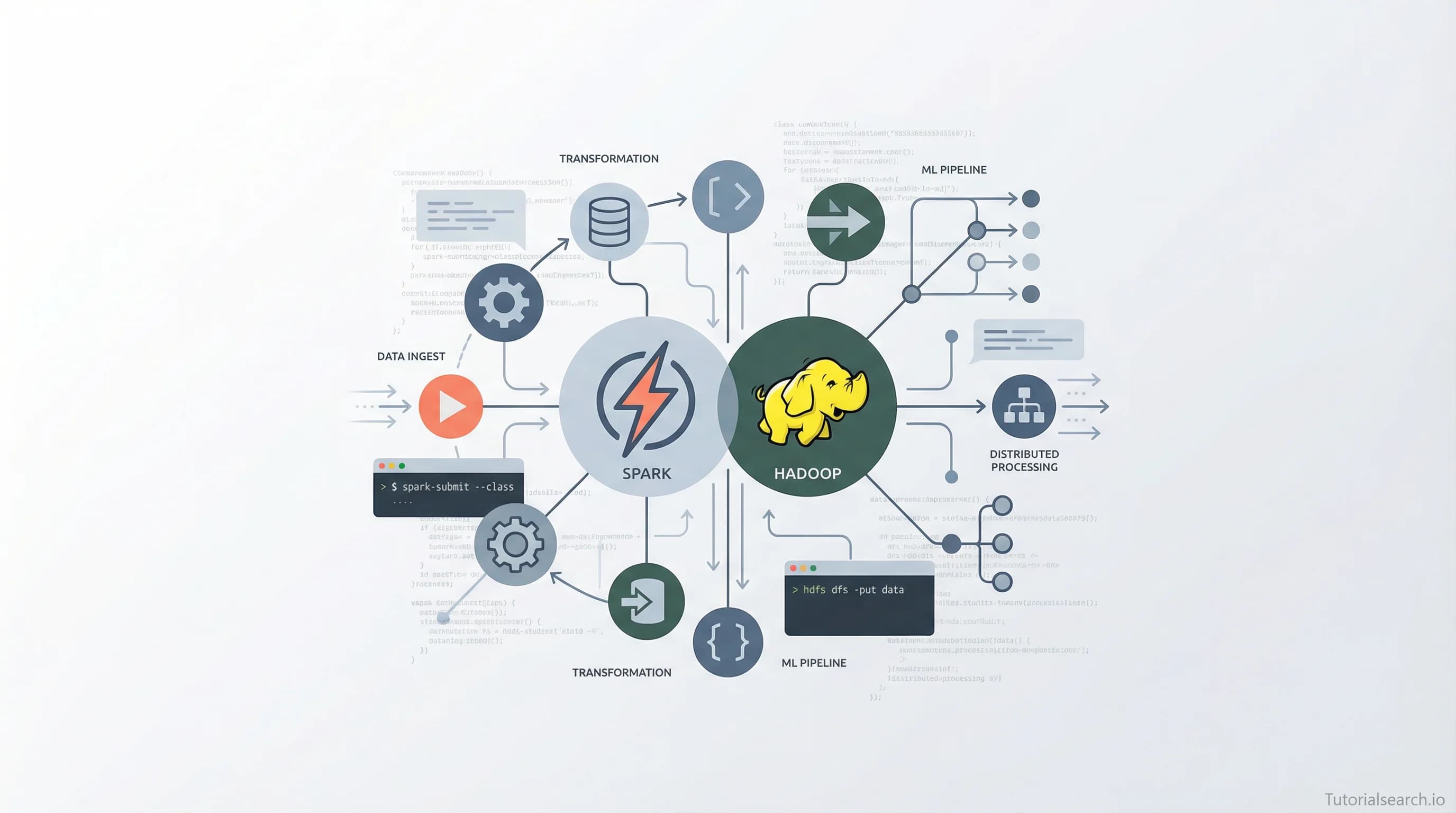
Hadoop introduced the idea of distributing data and computation across clusters. Spark improved on it by doing most computation in memory rather than writing intermediate results to disk — making it 10-100x faster for iterative tasks like machine learning. Today, most production Big Data systems use Spark for processing while using HDFS or cloud storage (S3, Azure Data Lake) for storage. You'll see both in job descriptions.
Can I get a job with Big Data skills?
Data engineering roles explicitly require Big Data skills, and the demand is high. According to LinkedIn data, data engineering job postings grew 50%+ over 2022-2024. The typical entry point is a junior data engineer role, which expects Spark knowledge, SQL proficiency, and familiarity with cloud platforms (AWS, GCP, or Azure). Browse the Data Science category on TutorialSearch.io to see courses that map directly to these job requirements.
What's a data lake and do I need to learn it?
A data lake is a centralized repository that stores raw data — structured, semi-structured, and unstructured — at any scale. Unlike traditional databases, it doesn't require a schema upfront. Most large organizations use a data lake (often on Amazon S3, Azure Data Lake Storage, or Google Cloud Storage) as the foundation of their Big Data architecture. Yes, you should learn it. The Data Lake Mastery course listed above is the right place to start.
Is Big Data different from data science?
They overlap but aren't the same. Data science focuses on statistical modeling, machine learning, and insight generation. Big Data focuses on the infrastructure — storage, processing, and pipeline engineering — that makes working with large datasets possible. A data scientist needs to know enough Big Data tooling to process large datasets. A Big Data engineer needs to know enough about analytics to build the right infrastructure for data scientists to use.
The tools in this guide — Hadoop, Spark, Kafka, cloud platforms — are the building blocks of modern data infrastructure. You don't need to master all of them at once. Pick the free Hadoop Essentials course, finish it, and then run your first Spark job. That's the real start.
Browse 314 Big Data courses on TutorialSearch.io to find more options at every skill level and price point.