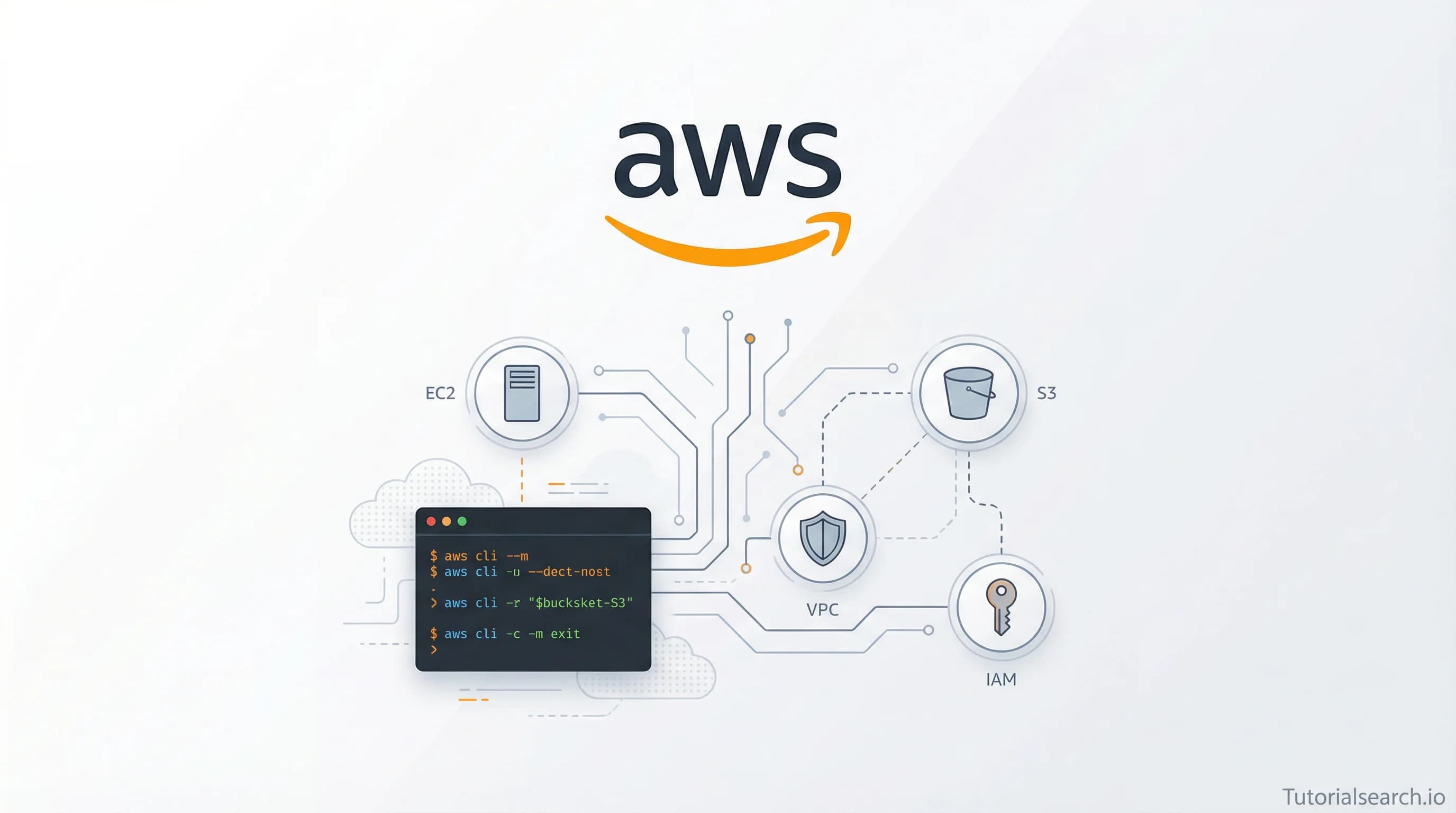
AWS Fundamentals: The Resources I'd Tell a Friend
AWS Fundamentals — EC2, S3, VPC, and IAM — are the foundation of every cloud career. Here's the curated set of courses, free resources, and tools I'd actually recommend.
Need a web app built? Hire the team behind TutorialSearch.io
We ship fast, production-grade full-stack apps (Next.js, React, edge infra) — the same stack that powers this site.
AWS Fundamentals are the foundation of one of the most in-demand skill sets in tech, and as of 2026, the sheer volume of resources available to learn them has become its own problem. AWS controls roughly a third of the global cloud market. Nearly every company running meaningful infrastructure touches Amazon's services — or is actively migrating to them. That kind of market dominance means the people who actually understand EC2, S3, VPC, and IAM are not just hireable; they're essential on most infrastructure teams.
The problem I've seen consistently is that new learners pick the wrong entry point. They end up in a course that names forty services and builds real understanding of none, or they read documentation for weeks without ever opening the AWS console. I spent my early cloud days exactly like that — finishing a course that felt comprehensive, then realizing I couldn't set up a basic VPC with public and private subnets from scratch. That gap between "completed the course" and "can actually build things" is where most people get stuck on AWS Fundamentals.
If you want a quick starting point, Introduction to AWS — Understand AWS Basics in 4 Hours! on Udemy has 67,000+ students and a 4.6-star rating for good reason. It keeps the scope narrow — core services, practical context, no padding. Below is everything else I'd actually recommend: curated courses, free resources, YouTube channels, GitHub repos, books, and communities with a real track record.
Key Takeaways
- AWS Fundamentals — EC2, S3, VPC, and IAM — are the building blocks behind virtually every modern cloud architecture
- Hands-on time with the AWS Free Tier accelerates AWS Fundamentals learning faster than any video course alone
- AWS Fundamentals knowledge is a direct path to cloud certifications and roles like cloud engineer or solutions architect
- You don't need to master every AWS service to get hired — solid AWS Fundamentals get you further than surface knowledge of everything
- The strongest learning paths combine one structured course with free hands-on tools and a community where you can ask real questions
In This Article
- The AWS Fundamentals Courses Worth Recommending to a Friend
- Free AWS Fundamentals Resources That Actually Hold Up
- YouTube Channels That Teach AWS Fundamentals Properly
- AWS Fundamentals GitHub Repos Worth Starring
- Books That Take AWS Fundamentals Seriously
- Where the AWS Fundamentals Community Actually Lives
- Free vs. Paid: An Honest Look at AWS Fundamentals Learning Paths
- Related Cloud Skills That Build on AWS Fundamentals
- FAQ
The AWS Fundamentals Courses Worth Recommending to a Friend
Finding a good AWS Fundamentals course isn't hard. Finding one that stays focused, builds real understanding, and doesn't collapse under the weight of its own service list — that's harder. Here are the ones I'd actually point someone to.
1. Introduction to AWS — Understand AWS Basics in 4 Hours! (Udemy) [Editors' Choice]
Rick Crisci's course (linked in the intro above) does something most AWS courses don't: it respects your time. Four hours, focused scope, and it covers the core services — EC2 (virtual servers), S3 (object storage), IAM (access control), and networking basics — without padding. Over 67,000 students have taken it, and the 4.6-star rating isn't a fluke. Each service gets enough context that you understand what it does and why it exists, not just which buttons to click. If someone told me they had a weekend to build solid AWS Fundamentals, I'd start them here.
2. AWS Fundamentals with 2 Projects: Cloud for Beginners (Udemy) [Editors' Choice]
Instructor Pravin Mishra — an AWS Certified Solutions Architect — builds this course around two hands-on projects rather than a service-by-service lecture. That's exactly the right approach. Building actual things with EC2, S3, and IAM is what moves AWS Fundamentals from memory to instinct. With 21,000+ students and a 4.3-star rating, it's a well-tested curriculum. One of the few beginner courses that gives you something deployable at the end, not just something you can explain in an interview.
3. AWS Fundamentals for The Absolute Beginners — Hands-On (Udemy)
For the person who needs maximum scaffolding before they feel comfortable navigating the AWS console. The "absolute beginners" framing is accurate — it assumes very little prior knowledge — and the hands-on emphasis means you're working inside the real AWS environment throughout, not just watching diagrams. Rated 4.2 stars. A good choice if the first two courses feel too fast.
4. Amazon Web Services (AWS) Fundamentals for System Administrators (Pluralsight)
Elias Khnaser's Pluralsight course approaches AWS Fundamentals through the lens of infrastructure and operations — a different, and genuinely useful, frame if you're already comfortable with Linux, networking, and virtualization. Rated 4.5 stars. Maps well to enterprise environments where IAM and VPC complexity grows fast, and treats sysadmins as the primary audience rather than an afterthought.
5. Cloud Computing and Amazon Web Services (AWS) Fundamentals (Udemy)
With over 78,000 students, one of the most enrolled AWS Fundamentals courses on the platform. It starts with cloud computing concepts before moving into AWS-specific services, which helps if you're genuinely new to cloud — not just new to AWS. The 4.1-star rating reflects solid, broad content: useful for context, though thinner on depth per topic than the top two picks.
Free AWS Fundamentals Resources That Actually Hold Up
The conventional wisdom says you need a paid course to learn AWS Fundamentals properly. That's wrong, and I'll push back on it directly. AWS has invested more in free learning infrastructure than almost any other major technology company. You can cover a surprising amount before spending a dollar — if you know where to look.
AWS Skill Builder is the first stop. Amazon's own learning platform offers 600+ free digital courses. The "AWS Cloud Practitioner Essentials" free course is genuinely good — official, updated regularly, and it covers EC2, S3, IAM, VPC, pricing, and billing in structured form. You don't need a third-party subscription to work through solid AWS Fundamentals content.
AWS Getting Started is the place AWS sends new users officially. The tutorials here are service-specific — launching an EC2 instance, hosting a static site on S3, setting up a VPC — and they run inside the actual AWS console. Short enough to finish in an afternoon, specific enough to produce real results.
AWS Free Tier deserves its own mention. Most people treat this as a billing detail, but it's really a learning tool. With the Free Tier, you can spin up EC2 instances, read and write to S3, configure IAM users and roles, and experiment with Lambda and RDS — every core AWS Fundamentals service — without getting charged during the first 12 months. Learning by doing in the real AWS environment beats any simulation.
AWS Documentation is consistently underrated. The "What Is" and "Getting Started" sections for each service are written for humans, and they cover concepts with more precision than most courses. When you're confused about how security groups differ from network ACLs, the docs explain it better than a 10-minute video.
roadmap.sh/aws gives you a visual learning path showing which services to learn in what order. Useful as a sanity check if you feel like you're jumping around without structure.
AWS Training has free digital training tracks and, in some regions, free instructor-led content. Worth checking before assuming everything costs money.
YouTube Channels That Teach AWS Fundamentals Properly
YouTube is one of the best places to learn AWS Fundamentals — not in a passive way, but because some of the free content here genuinely rivals paid courses in quality. Here's what's worth your time.
freeCodeCamp.org (YouTube) [Editors' Choice]
freeCodeCamp's AWS Cloud Practitioner Essentials course — a 14-hour deep dive developed with ExamPro's Andrew Brown — is the resource I'd put ahead of most paid alternatives. It covers AWS Fundamentals comprehensively: EC2, S3, IAM, VPC, networking, pricing, billing, and cloud security. Andrew Brown teaches with practical detail that builds real architectural intuition, not just surface familiarity. Free, well-paced, and updated for the current CLF-C02 exam.
Amazon Web Services (YouTube) [Editors' Choice]
The official AWS YouTube channel is more useful than most people expect. Beyond polished product announcements, it has re:Invent talks, service deep dives, and "Getting Started" walkthroughs for every major service. Once you have the core AWS services down, the "AWS What's New" playlist is worth bookmarking to track what's changing in the ecosystem.
TechWorld with Nana (YouTube)
Nana Janashia's channel blends AWS content with DevOps topics — Docker, Kubernetes, Terraform — which becomes important fast once you have AWS Fundamentals and want to understand how they plug into a real engineering workflow. Her explanations are unusually visual and clear. Not exclusively AWS, but highly relevant for anyone building toward cloud engineering rather than just certification.
AWS Fundamentals GitHub Repos Worth Starring
Need a web app built? Hire the team behind TutorialSearch.io
We ship fast, production-grade full-stack apps (Next.js, React, edge infra) — the same stack that powers this site.
GitHub is where the AWS practitioner community builds its reference material. A few repos here are essential bookmarks regardless of where you are in your learning.
donnemartin/awesome-aws — 14,000+ stars
The canonical curated list for all things AWS. Libraries, open source tools, guides, SDKs, and code samples organized by service — the kind of resource you reference at every stage of your cloud journey. The star count reflects years of curation and consistent quality. Bookmark it immediately.
A comprehensive written guide covering AWS tools, services, and certifications. Useful as a companion when you're working through AWS Fundamentals and want documentation organized differently from the official AWS docs.
ptcodes/awesome-aws-certifications
If your AWS Fundamentals learning has a certification goal — Cloud Practitioner or Solutions Architect — this repo is a curated list of the best prep materials, practice exams, and community resources. Actively maintained and useful for knowing exactly what to study.
AWS's official samples repository. When you're learning about Lambda, S3 event notifications, or VPC configurations, seeing working code from AWS engineers gives you better pattern recognition than piecing things together from documentation alone.
Books That Take AWS Fundamentals Seriously
Honest take on AWS books: they go out of date. AWS releases updates constantly, and a book from three years ago is already missing things. That said, AWS Fundamentals — the conceptual model around compute, storage, networking, and access control — changes slowly. A good book on these foundations stays useful longer than you'd expect.
AWS Certified Cloud Practitioner Study Guide by Ben Piper and David Clinton
The most recommended starting point in written form. Covers the full Cloud Practitioner exam scope, which maps almost perfectly to AWS Fundamentals: EC2, S3, IAM, VPC, billing, and basic security concepts. Clear writing, logical structure, and exam-quality practice questions throughout. If you prefer reading to video, start here.
Mastering the AWS Certified Cloud Practitioner (CLF-C02)
A newer option targeting the current CLF-C02 exam version, with 1,000+ practice questions included. Useful once you've worked through foundational material and want to stress-test your knowledge with realistic exam scenarios. Better as a supplementary resource than a primary text.
Prefer video over reading? The Practice Exams for the AWS CLF-C02 Certification course on Udemy (4.7 stars) covers similar exam-prep ground in an interactive format.
Where the AWS Fundamentals Community Actually Lives
Learning AWS Fundamentals alone is inefficient. There are too many small configuration details and "wait, why did that fail?" moments that a community answers in minutes versus hours of solo debugging.
r/aws is the largest AWS community online — hundreds of thousands of members, active daily, and genuinely welcoming to beginners asking real questions. The community excels at practical troubleshooting: "why is my security group blocking this traffic" and "what's the cheapest way to run this workload" are exactly the questions that get useful, specific answers here.
AWS Discord is a community-led server with 10,000+ members — more real-time than Reddit. Good for quick responses, career path questions, and finding people preparing for the same certifications. Beginner questions are explicitly welcomed in the community guidelines.
AWS re:Post is AWS's official Q&A community — Stack Overflow for AWS-specific questions. Answers here are often written by AWS employees or certified professionals, so the technical depth is unusually high. Less conversational than Reddit, but more precise on specific service behavior.
Free vs. Paid: An Honest Look at AWS Fundamentals Learning Paths
Most comparisons on this topic try to be diplomatic. This one won't.
| Free Path | Paid Course | |
|---|---|---|
| Best for | Self-directed learners who learn by doing | People who need structure and accountability |
| Starting point | AWS Skill Builder + AWS Free Tier | Any of the top Udemy courses listed above |
| Time to functional knowledge | 3–6 weeks with daily practice | 1–3 weeks (course + exercises) |
| Certification prep | Requires supplementing with practice exams | Most courses cover exam content directly |
| Cost | $0 (Free Tier has usage limits) | $10–30 per course during Udemy sales |
| Community support | Reddit, Discord, re:Post | Usually course-specific forums |
| Honest verdict | Excellent if you're disciplined | Worth the cost if structure helps you finish |
The contrarian take: don't buy a course until you've spent a weekend with AWS Skill Builder and the Free Tier. Most people quickly discover whether they're comfortable with self-directed learning or whether they want more structure. Either answer is fine — but you'll know faster if you test the free path first, before spending money on something you might not finish.
Related Cloud Skills That Build on AWS Fundamentals
Once you have AWS Fundamentals down, these adjacent skills build naturally on top of them:
- Cloud Certifications — The AWS Cloud Practitioner and Solutions Architect certifications formalize your AWS Fundamentals knowledge into industry-recognized credentials
- Cloud Architecture — Once you know the core building blocks, understanding how they fit into scalable, resilient systems is the natural next step
- Cloud Security — IAM is one of the AWS Fundamentals, but cloud security goes much deeper: compliance, data protection, and threat modeling at scale
- Cloud Infrastructure — Terraform, CloudFormation, and infrastructure-as-code are how AWS environments get built and managed in production
FAQ
How long does it take to learn AWS Fundamentals?
Most people get functionally comfortable with AWS Fundamentals in 4–8 weeks if they practice daily. That means working through one structured course or AWS Skill Builder content, then spending real time in the console building things. The hands-on work is what makes the difference. You can watch videos for a month and still feel uncertain — 30 minutes of configuring an EC2 instance with a properly scoped security group teaches more than an hour of passive watching.
Do I need networking or Linux experience to learn AWS Fundamentals?
You don't need deep expertise, but basic networking concepts help significantly. If you know what an IP address is, what a firewall does, and roughly how DNS works, you have enough to start. VPC — one of the core AWS Fundamentals services — becomes much more intuitive when you understand subnets and routing at a basic level. Linux command-line basics also help when working directly with EC2 instances.
Can I get a job with AWS Fundamentals skills?
AWS Fundamentals alone won't land you a cloud engineering role — you'll also want scripting skills, some infrastructure-as-code experience, or a certification. But AWS Fundamentals knowledge is often the deciding factor in technical interviews for roles that touch cloud infrastructure: DevOps engineer, solutions architect, cloud operations, and backend engineering positions where teams manage their own infra. Pair your fundamentals with a Cloud Practitioner certification and a deployed project, and you're a genuinely competitive candidate for entry-level cloud roles.
What AWS services should I focus on first?
EC2 (virtual compute), S3 (object storage), IAM (identity and access management), and VPC (virtual networking) are the non-negotiables. Everything else in AWS either builds on these four or uses them in combination. Lambda (serverless compute) and RDS (managed databases) are good second-layer additions once you have the core four solid. Resist the temptation to explore every AWS service before you understand these well.
Is the AWS Free Tier actually useful for learning AWS Fundamentals?
Yes, substantially. The Free Tier gives you 750 hours of t2.micro EC2 per month, 5 GB of S3 storage, 25 GB of DynamoDB, and a Lambda allowance large enough to experiment freely — all at no charge for 12 months after account creation. That's enough to deploy real small-scale applications and work through every core AWS Fundamentals concept hands-on. Set up a billing alert when you create your account so you're notified if you approach any limit.