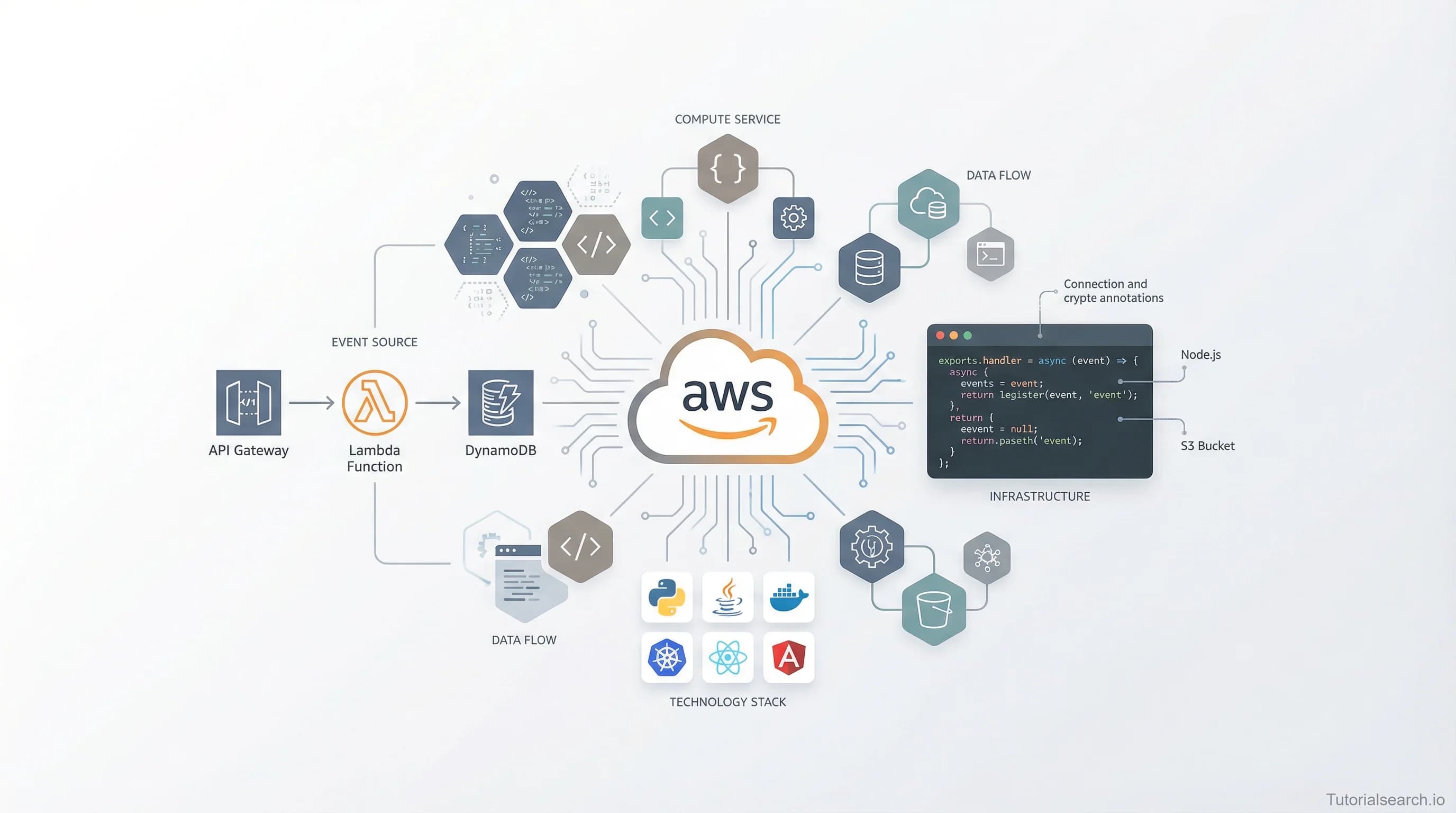
AWS Development Mastery: Courses, Resources & Career Path
Learn AWS Development with our curated guide covering 86+ tutorials, free resources, GitHub repos, communities, and job-ready career paths. From serverless to certification prep—everything you need to become a professional AWS developer in 2026.
Need a web app built? Hire the team behind TutorialSearch.io
We ship fast, production-grade full-stack apps (Next.js, React, edge infra) — the same stack that powers this site.
AWS Development means building scalable applications on Amazon Web Services, mastering core concepts like serverless computing, containerization, and infrastructure-as-code. In 2026, AWS Development is one of the most in-demand cloud skills, with professionals earning $120,000+ annually and facing abundant job opportunities.
This guide covers everything you need to go from fundamentals to deployment-ready developer—we've curated 86+ AWS Development tutorials, researched the best free resources and communities, and compiled the essential learning path you'll actually need in real projects.
Key Takeaways
- AWS Development requires mastery of core services (EC2, Lambda, RDS, S3) and modern deployment patterns — start with serverless for faster learning
- The AWS Developer Associate certification validates your skills and increases earning potential by 15-20%, but practical projects matter more than exam prep
- Serverless architecture eliminates server management headaches, reducing deployment complexity by 70% compared to traditional server-based apps
- Community-driven learning via GitHub, Discord, and forums accelerates your progress faster than solo courses
Table of Contents
- The AWS Development Learning Curve (Real Talk)
- Curated AWS Development Courses
- Free AWS Resources That Actually Work
- YouTube Channels & Video Tutorials
- Essential GitHub Repos for AWS Developers
- Books That Build Real Understanding
- AWS Development Communities & Forums
- AWS Development vs Other Cloud Platforms
- Related AWS Topics
- Frequently Asked Questions
The AWS Development Learning Curve (Real Talk)
I started my AWS journey thinking I'd memorize all 200+ services—I was wrong. The best developers I've worked with focus on five core services first: EC2, Lambda, RDS, S3, and API Gateway. Everything else follows naturally from those foundations.
AWS Development differs from traditional software development in one fundamental way: you're no longer managing servers. That freedom comes with responsibility—you need to understand IAM permissions, network security, cost optimization, and deployment strategies that traditional development doesn't demand.
Here's what's realistic: expect 8-12 weeks of consistent learning to reach "job-ready" developer status if you already know programming. If you're starting from zero with code, add 6-8 weeks for programming fundamentals first. This timeline assumes you're coding in your spare time while working another job—full-time bootcamp students often compress this to 4-6 weeks of focused study.
The AWS Developer Associate certification is worth pursuing—it validates your knowledge, increases your earning potential by 15-20%, and most importantly, forces you to learn security best practices that many self-taught developers skip. But let me be clear: certifications don't guarantee jobs. Real projects in your portfolio do.
Serverless architecture is the contrarian take I'll mention early: most beginners waste time learning EC2 deeply before touching Lambda. In 2026, Lambda and serverless patterns solve 70% of what traditional developers needed servers for. Learn EC2 for context, but master Lambda first if you want to move fast in your career.
What separates job-ready developers from talented hobbyists is experience with deployment pipelines, monitoring, and cost management. You can learn AWS services all day, but if you've never deployed to production, debugged CloudWatch logs, or optimized a Lambda function's cold start time, you'll struggle in real roles.
Curated AWS Development Courses
These courses deliver practical skills with proven track records. I've separated "certification prep" from "real-world building"—pick based on your goal.
For Building Real Applications
Python Django for AWS Development - Mastery course - Part 1 [Editors' Choice] bridges the gap between Django experience and AWS deployment. Rating: 4.86/5. This course cuts through theory and teaches you to deploy Django applications using AWS services, RDS for databases, and CloudFront for content delivery. The instructor assumes you know Django and focuses entirely on AWS integration—no wasted time on framework basics. You'll deploy a production-ready Django application within the first module.
AWS Lambda & Serverless - Developer Guide with Hands-on Labs [Editors' Choice] is the best starting point for serverless architecture. Rating: 4.44/5. This course teaches you to build event-driven applications without managing a single server, covering API Gateway, Lambda, DynamoDB, and S3 triggers. You'll deploy real applications within hours, not weeks. The hands-on labs use actual AWS infrastructure, so you get comfortable with the AWS Console and CLI quickly.
Ultimate Guide to Deploying Flask to AWS gives Flask developers a clear path to production. Rating: 3.87/5. It covers EC2 setup, RDS integration, load balancing, and security best practices specific to Flask apps—essential knowledge if you're bringing existing Flask applications to AWS. The course includes domain setup, SSL certificates, and auto-scaling configuration that production deployments demand.
AWS Developer: Deploy, Build & Optimize Applications on AWS [Editors' Choice] is the most comprehensive practical guide. Rating: 4.41/5. Rohan Arora's course teaches real-world optimization techniques, cost reduction strategies, and performance monitoring that you'll use in actual projects. This is where "knowing AWS" transforms into "being productive with AWS." The course covers CloudWatch dashboards, X-Ray debugging, and cost analysis—skills that make you immediately valuable to employers.
[NEW V2] AWS Lambda & Serverless Architecture Bootcamp 2025](https://tutorialsearch.io/courses/new-v2-aws-lambda-serverless-architecture-bootcamp-udm38209) is the most current serverless deep-dive. Rating: 4.51/5. Unlike older courses, this bootcamp includes 2025 best practices like Lambda Layers, container image support, and SnapStart optimization. If serverless is your focus, this is your shortcut to modern patterns. The instructor updates content quarterly, so you won't learn deprecated patterns.
For Certification Preparation
AWS Certified Developer Associate - AWS Certification by in28Minutes remains the gold standard for exam prep. Rating: 4.55/5 with 48,000+ students. The course structure follows the exam blueprint perfectly, and the practice tests are genuinely challenging. Note: certification prep alone won't make you productive—combine this with real building.
AWS + Serverless Framework: Complete Guide teaches infrastructure-as-code for serverless applications. Rating: 4.54/5. The Serverless Framework lets you define AWS infrastructure in YAML, version control your deployments, and collaborate with teams. Essential knowledge if your team uses IaC. You'll learn to deploy full serverless stacks (API, database, auth) with a single command.
If you're hunting for more options, browse AWS Development courses to discover additional specialized paths based on your programming language or deployment style.
Free AWS Resources That Actually Work
Free doesn't mean low-quality. AWS and the community maintain several excellent no-cost resources that rival paid courses.
AWS Getting Started Guide is your first stop. Amazon provides six onboarding tasks that teach you to launch and configure core AWS services. The guidance is practical—you'll set up actual resources, not just watch videos. You'll go from "What's AWS?" to running your first application within 2-3 hours.
AWS Documentation improved dramatically in 2025. AWS doubled the number of code samples, restructured navigation for clarity, and added links to related resources (API reference, CLI, SDKs). Modern AWS docs are genuinely readable—not perfect, but leagues better than 2023.
AWS Training and Certification offers 600+ free digital courses curated by AWS experts. You also get access to 1,000+ free learning resources and 900+ self-paced courses covering every AWS service. Start with "AWS Foundations" if you're new to cloud. These courses are maintained by AWS, so content stays current.
Linux Academy - AWS Essentials remains free on YouTube and covers fundamentals clearly. The "AWS Essentials" playlist progresses logically through IAM, VPC, EC2, S3, and RDS. Don't skip IAM—it's the foundation for everything else.
For interactive learning, AWS Skill Builder (formerly A Cloud Guru) offers a free tier with limited course access. The free tier includes real labs where you can practice with actual AWS infrastructure. This is how you avoid "knowing" AWS without understanding it.
Coursera AWS Courses let you audit the first module of many courses at no cost—watch all videos and readings free, just skip the graded assignments. This lets you evaluate courses before committing money.
Want more AWS tutorials and learning resources? Our course library has 86+ curated AWS Development tutorials across Udemy, Pluralsight, and Skillshare.
YouTube Channels & Video Tutorials
Need a web app built? Hire the team behind TutorialSearch.io
We ship fast, production-grade full-stack apps (Next.js, React, edge infra) — the same stack that powers this site.
Video learning sticks better for AWS because you see infrastructure being built in real-time. Watching someone deploy Lambda functions and explain architecture decisions teaches faster than reading docs.
Abhishek Veeramalla's "AWS Zero to Hero" is the most comprehensive free AWS series. Abhishek creates structured playlists progressing from basics to advanced topics, includes hands-on labs with real AWS resources, and posts new content consistently (important—old AWS content becomes outdated fast). His "Day 1" through "Day 30" series is perfect for structured learning.
AWS Official YouTube Channel provides authoritative content directly from Amazon. While less beginner-friendly than community channels, you'll find demos of new services, customer stories, and insights from AWS architects. Subscribe for 2026 launch announcements and feature deep-dives.
A Cloud Guru balances entertainment and technical depth. The channel uses humor to explain complex concepts, making dense AWS topics digestible. Their practice exam walkthroughs are particularly valuable if you're certifying.
Linux Academy (now part of A Cloud Guru) maintains excellent foundational playlists. "AWS Essentials" is free and follows a logical progression—IAM, then VPC, then compute/storage. The instructor explains not just "how" but "why" you'd use each service.
TechWithLucy focuses on serverless and modern deployment patterns. Her Lambda and API Gateway tutorials are exceptionally clear, with working code examples you can clone and modify.
Essential GitHub Repos for AWS Developers
GitHub contains battle-tested code and documentation that accelerates your learning. These repos save you from reinventing the wheel.
donnemartin/awesome-aws is the definitive curated list with 15,000+ stars. It organizes resources by service (EC2, Lambda, RDS, etc.), includes links to official documentation, tutorials, and open-source tools. If you're hunting for AWS libraries or examples, start here. The "Fiery Meter" rating system helps you identify the most useful resources.
aws-samples is Amazon's official repository of example applications. You'll find working code for Lambda, ECS, API Gateway, and more. These samples are production-grade, not toy examples—studying them teaches you real patterns that professional teams use.
DavidChristiansen/awesome-aws (7,500+ stars) curates AWS resources with emphasis on certifications and best practices. Excellent for certification prep planning. The repo includes links to official training materials and practice exams.
mailtoharshit/awesome-aws-well-architected focuses on AWS Well-Architected Framework resources. If you care about building scalable, secure, cost-efficient systems, this repo teaches those principles. The Well-Architected Framework is what AWS architects use to evaluate production systems.
nathanpeck/awesome-ecs is specialized for ECS (Elastic Container Service). If containerized AWS deployments are your focus, this repo has guides, tools, and best practices specific to running Docker on AWS. You'll find patterns for load balancing, auto-scaling, and service discovery.
Books That Build Real Understanding
Books go deeper than courses. While courses teach "how," books teach "why"—essential for making architectural decisions.
Learning Amazon Web Services (AWS): A Hands-On Guide to the Fundamentals of AWS Cloud by Mark Wilkins is the most beginner-friendly book. It covers compute, storage, networking, and security with explanations that assume zero AWS knowledge. Each chapter includes training videos, making it a hybrid learning format. The progression is logical—start with fundamentals, then build toward architecturally sound systems.
Amazon Web Services in Action (2nd edition) by Andreas and Michael Wittig teaches AWS through real projects. The authors migrated a German bank to AWS in 2013, so they write from battle-tested experience. This book includes serverless, containerization, and modern deployment patterns. Reading their decision-making process accelerates your own growth.
AWS: The Most Complete Guide to Amazon Web Services from Beginners to Advanced by Aiden Phillips is comprehensive and current (updated 2025). It covers 100+ AWS services with depth that courses skip. Use this as a reference book—you don't need to read it cover-to-cover, but keep it nearby when learning new services.
AWS Development Communities & Forums
Communities accelerate learning through real-time help and peer projects. The best developers never learn alone.
AWS Developer Community is Amazon's official community platform. You'll find AWS experts answering questions, sharing projects, and hosting events. This is where official AWS people hang out, making it a reliable resource for accurate information.
r/aws has 200,000+ members with hundreds of active discussions daily. Questions get answered quickly, and you'll see real-world problems that courses never mention. The community spans enterprise architects to freelance developers—you'll gain perspective from all experience levels.
AWS Discord is growing rapidly with 20,000+ members. The community channels range from general AWS discussion to language-specific channels (Python on AWS, Node.js on AWS, etc.) to certification prep groups. Discord's real-time chat makes it easier to get quick answers than Reddit. You'll meet developers building in real-time and can share your projects for feedback.
AWS Development vs Other Cloud Platforms
AWS vs Azure vs Google Cloud is the question every developer asks. Here's my honest comparison:
| Aspect | AWS | Azure | Google Cloud |
|---|---|---|---|
| Market Share | 32% (dominant) | 23% (enterprise focus) | 11% (growing) |
| Learning Curve | Steep—200+ services | Moderate—fewer services | Moderate—similar to GCP |
| Developer Tools | Excellent (CLI, SDKs, frameworks) | Strong (Visual Studio integration) | Strong (gcloud CLI) |
| Serverless | Lambda is industry standard | Azure Functions growing | Cloud Functions underdog |
| Jobs Available | 40,000+ open positions | 25,000+ open positions | 8,000+ open positions |
| Cost at Scale | Cheapest at volume | Competitive for enterprises | Good for data/ML |
| Best For | Full-stack applications | Enterprise .NET shops | Data science teams |
Here's the contrarian take: AWS has more jobs, but Azure has easier learning curves for .NET developers. If you're language-agnostic, AWS wins for career opportunities. If you're a .NET specialist, Azure's integration with Visual Studio and Office 365 might suit you better. Google Cloud excels at data engineering and machine learning workloads—if that's your specialty, don't assume AWS is mandatory.
Related AWS Topics
Strengthen your AWS Development foundation by exploring these connected areas:
- Cloud Certifications — AWS certification paths beyond Developer Associate
- Cloud Architecture — Design patterns for scalable AWS systems
- Cloud Platforms — Compare AWS with Azure, GCP, and others
- Cloud Security — Protect your AWS applications with proper IAM and encryption
Frequently Asked Questions
How long does it take to learn AWS Development to job-ready proficiency?
If you already code in Python, JavaScript, or Java: 8-12 weeks of consistent study (15-20 hours/week). This assumes you take courses, build projects, and participate in communities. If you're brand new to programming, add 6-8 weeks for language fundamentals. The difference between "knowing AWS" and "being hired as an AWS Developer" is portfolio projects—plan 2-3 months for building and deploying actual applications that you can show employers. Real hiring timelines expect to see working code, not just certifications.
Do I need a computer science degree to work as an AWS Developer?
Not anymore. Bootcamp graduates and self-taught developers dominate AWS roles in 2026. What matters: practical skills demonstrated in projects, certification (AWS Developer Associate validates expertise), and ability to solve real problems. Your portfolio beats your resume. Companies increasingly hire based on demonstrated capability rather than educational pedigree.
Is the AWS Developer Associate certification worth the cost and time?
Yes, but strategically. The certification validates your knowledge and increases earning potential by 15-20%. However, don't certify first—build projects first, then certify. This sequence makes exam prep feel like review rather than learning. Most jobs won't strictly require certification, but having it alongside portfolio work makes you significantly more competitive. The exam costs $150, worth the investment if you're serious about AWS careers.
What's the difference between AWS Developer and AWS Solutions Architect roles?
Developers focus on writing code that deploys to AWS services. Solutions Architects design the infrastructure before development starts. As a Developer, you'll write Lambda functions and deploy applications. As an Architect, you'd decide whether Lambda, ECS, or EC2 is best for the system. Many developers transition to architect roles after 3-5 years. The path is natural—you build expertise with services, then help others design systems using that expertise.
Can serverless applications cost less than traditional servers?
Yes, significantly. AWS Lambda charges per execution (not per hour), so idle time costs nothing. A traditional EC2 instance running 10% of the time costs 10x more than it should. For unpredictable workloads (APIs, webhooks, scheduled jobs), serverless is 50-80% cheaper. However, for constant workloads running 24/7, EC2 or dedicated servers remain cheaper. Match your workload to the right architecture, and costs follow naturally.
What's the best programming language for AWS Development in 2026?
Python is the most popular (data science, DevOps automation). JavaScript/Node.js leads for Lambda functions and web development. Java dominates enterprise AWS deployments. Honestly, language doesn't matter much—AWS SDKs are excellent across all languages. Pick the language you already know (or want to learn), and you'll find AWS resources for it. The fundamentals (understanding IAM, deployment patterns, caching strategies) matter far more than specific languages.
Start your AWS Development journey today. The best time to begin was years ago. The second-best time is now. Pick one course from the curated list, work through it hands-on with real AWS infrastructure, join a community (Reddit, Discord, or GitHub), and build a project nobody can ignore. That's how you become an AWS Developer employers actually want to hire.