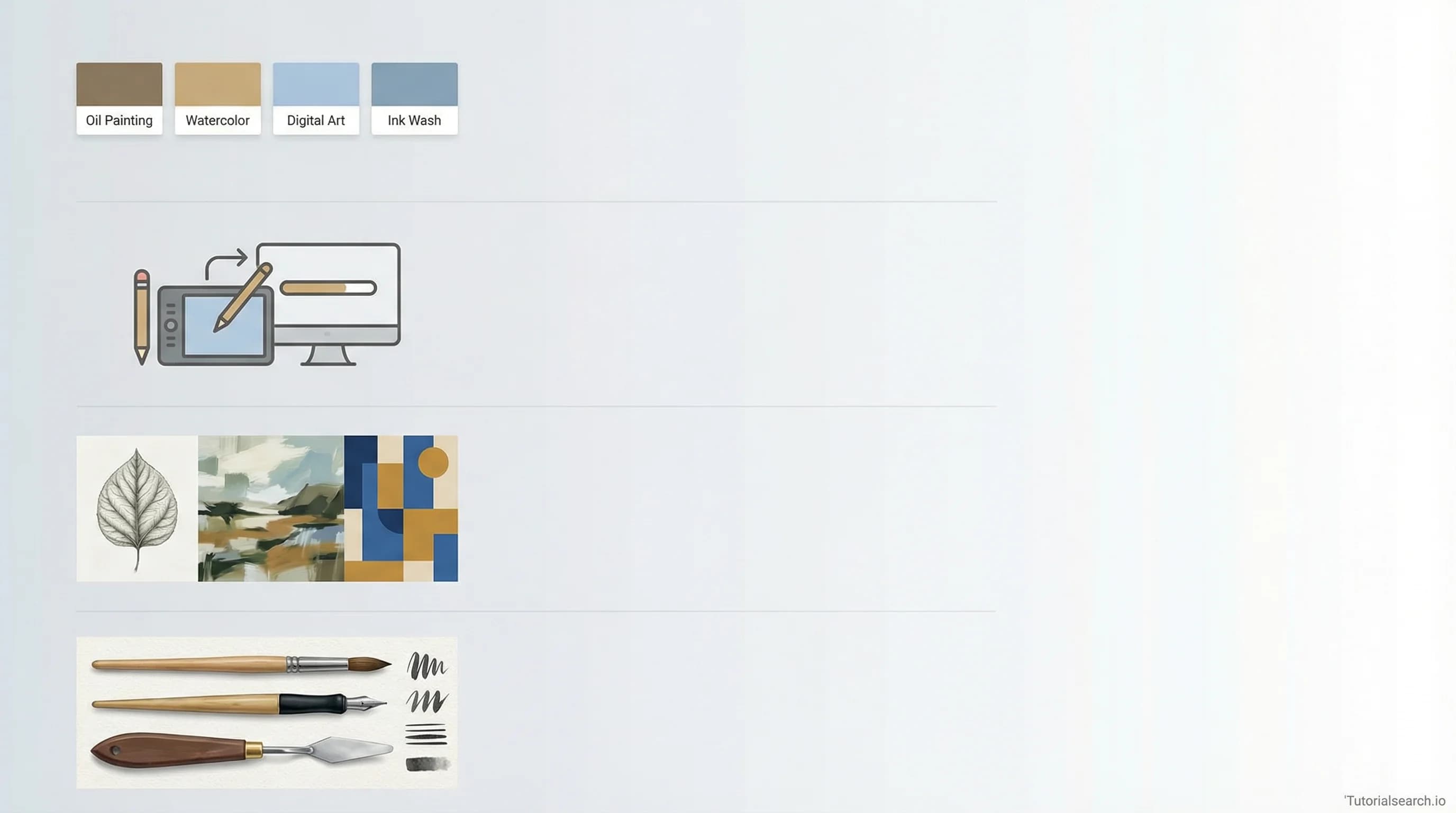
Art Style: Where Should You Actually Start?
Find your personal art style with the best courses, free resources, YouTube channels, and exercises—covering Skillshare, Udemy, and free sites for all skill levels.
Hire the developers behind TutorialSearch.io
We built this site — full-stack web apps, AI integration & automation. Tell us what you need and we'll build yours.
The search for your own art style starts with an uncomfortable truth: copying other artists doesn't get you there. This guide rounds up the best courses, free tools, exercises, and communities to help you build a visual identity that's genuinely yours — across platforms from Skillshare to Udemy and beyond.
Key Takeaways
- Finding your art style takes active experimentation, not passive watching
- Art style courses work best when they give you specific exercises to complete
- Free resources like Proko and DrawABox cover fundamentals that many paid courses skip
- The fastest path to your signature art style is making a lot of art and studying what you gravitate toward
- Mixing digital and traditional practice usually speeds up art style development
In This Article
- The Art Style Trap Every New Artist Falls Into
- Building Your Art Style Foundation: Where to Start
- Art Style Courses That Build Something Real
- Free Art Style Resources Worth Bookmarking
- Art Style YouTube Channels Worth Your Time
- Pick Your Art Style Path: A Quick Comparison
- Art Style Books That Changed How Artists Think
- Art Style Communities That Help You Grow
- Related Art Styles and Skills Worth Exploring
- Frequently Asked Questions About Art Style
The Art Style Trap Every New Artist Falls Into
Most people searching for their art style end up in the same loop. They find an artist they love, try to draw like them for a while, get frustrated when it doesn't feel natural, then move on to the next inspiration.
Sound familiar?
The problem isn't the copying itself — studying artists you admire is genuinely useful. The problem is expecting it to hand you a style. Your style is what remains after you've filtered influences through your own habits, preferences, and obsessions. No tutorial can give that to you.
But the right exercises can help you find it faster.
You can browse 340+ art style courses on TutorialSearch.io to start. Here's what's actually worth your time among them — and the free resources that should come first.
Building Your Art Style Foundation: Where to Start
Before worrying about style, you need some foundation under your feet.
This means basic drawing skills, a grasp of light and shadow, and some understanding of color relationships. Style without fundamentals looks thin. Think of it like cooking — seasoning matters, but you still need to know how to cook first.
Two courses stand out at this early stage.
The Complete Art Fundamentals Course (Udemy) covers shape, line, value, and composition — the grammar that all visual styles are written in. With over 6,200 students and a solid 4.46 rating, it does the foundational work well without padding. See it on TutorialSearch.io.
Discover Your Art Style by Ria Sharon on Skillshare takes a different angle entirely. It's not about fundamentals in the technical sense — it's about knowing yourself as an artist. Sharon guides you through identifying what you're drawn to visually and why. With 7,200+ students, it's one of the most popular art style courses on the platform. Find it here.
If you're also interested in illustration techniques, this is a good time to start combining fundamentals with style exploration. The two feed each other.
Art Style Courses That Build Something Real
A lot of "find your style" content is vague. It tells you to "experiment more" and "look inward." That's not bad advice, but it's not a plan.
The courses below give you actual exercises to work through.
Structured Paid Art Style Courses
1. Develop Your Digital Art Style: Draw One Illustration Six Ways [Editors' Choice]
By Stephanie Fizer Coleman on Skillshare. 5,315 students, rated 4.58.
The premise is smart: you draw the same subject six different ways, back to back. That repetition forces you to articulate what you're actually changing and why. It's about 90 minutes long but packs more real insight into your style preferences than a 10-hour inspiration course ever could. View this course.
2. Develop Your Signature Style: Overcoming Obstacles with a 5-Day Art Challenge [Editors' Choice]
On Skillshare. 5,934 students, rated 4.74.
Five days of structured challenges that push you in different directions and force you to commit to decisions. The "overcoming obstacles" framing is honest — it addresses the real blockers: perfectionism, comparison to other artists, lack of consistency. These are the things that actually stop people from developing a signature style, and this course names them directly. See this course.
3. Sketchbook to Style: Discover Your Art Style Through Drawing [Editors' Choice]
By Christine Nishiyama on Skillshare. 1,124 students, rated 4.75.
Nishiyama's teaching is warm and structured at the same time. This course uses the sketchbook as a laboratory: you experiment with materials, mark-making, and subject choices until patterns start emerging naturally. If you learn better by doing rather than watching, this is excellent. Find it on TutorialSearch.io.
4. How to Develop Your Signature Art Style
By Jeanetta Gonzales on Skillshare. Rated a perfect 5.0 (409 students).
A shorter, focused class with a clear framework for identifying what makes your work distinctive. It works best for artists who already have some work under their belt and want to understand what they've been doing instinctively. See it here.
5. Procreate Sketch Book: Develop Your Art Style, Achieve Consistency and Find Inspiration Anywhere
By Thais Queiroz on Skillshare. Rated 5.0 with 239 students.
If you work on an iPad and want a course that ties sketchbook practice to Procreate-specific workflows, this one fills a gap. It goes beyond tool tutorials into the actual practice of building consistency. View this course.
6. Discover Your Style: Easy Exercises in Procreate to Find Your Artistic Voice
On Skillshare. Rated 4.65 with 480 students.
Another solid option for Procreate users who want exercises specifically designed to surface their artistic preferences. View it here.
7. Find Your Style in 7 Days (Udemy, rated 4.82, 199 students)
A week-long structured approach with short daily exercises. The constraint of finishing each exercise in one day reduces overthinking, which is a genuine advantage. See it on TutorialSearch.io.
One course I'd flag with caution: Find Your Art Style: 7 Exercises to Explore Your Visual Identity by Gio Vescovi. The 3.67 rating reflects real complaints about unclear instruction. The concept is good, but execution is uneven. It's on TutorialSearch.io if you want to judge for yourself — but start elsewhere.
Here's where I'll push back on common advice: most recommendations tell beginners to start with the basic-level classes and only move to intermediate once they're "ready." For artists with even six months of practice, the intermediate courses like Stephanie Fizer Coleman's give you more to work with. Don't wait too long to step up.
Free Art Style Resources Worth Bookmarking
You don't need to spend anything to start developing your art style. Several of the best resources are completely free.
Proko.com offers 100+ free lessons built around figure drawing and human anatomy. These aren't directly "style" lessons, but they give you the visual vocabulary that every style is written in. Stan Prokopenko's teaching is precise, memorable, and well-paced.
DrawABox.com takes a different approach: it's an exercise-based curriculum focused on spatial reasoning and confident mark-making. The lessons are free, the community is active, and the structured homework assignments mean you actually practice instead of just watching. Fair warning — it's rigorous work. That's exactly the point.
TheVirtualInstructor.com by Matt Fussell covers drawing and painting across multiple mediums: charcoal, graphite, colored pencil, acrylic, and watercolor. Exploring several mediums is useful when you're still figuring out which one fits your developing style. The free library is substantial.
EmptyEasel.com has a large collection of free tutorials that lean practical rather than theoretical. Strong for painters looking at specific techniques — wet-on-wet oil, underpainting, color mixing.
ArtLex's free tutorials include video walkthroughs that show actual creative processes from start to finish. If you learn better watching over someone's shoulder than reading theory, these are worth exploring.
Artists Network covers watercolor, pastel, and oil painting with free instruction content. It's aimed at traditional media artists, which makes it a good balance if you're spending a lot of time in digital tools and want some grounding in physical media.
A useful pairing for watercolor illustration learners: combine TheVirtualInstructor.com's free watercolor lessons with a structured paid course to get both technical skill and style direction working in the same direction.
Art Style YouTube Channels Worth Your Time
Hire the developers behind TutorialSearch.io
We built this site — full-stack web apps, AI integration & automation. Tell us what you need and we'll build yours.
Some of the best art style education is free on YouTube — if you know which channels are actually useful versus which ones just look polished.
Proko (YouTube) — Over 3 million subscribers. The figure drawing content is what the channel is known for, but the podcast episodes and critique videos go much further into what makes an artist's work visually distinctive. Stan Prokopenko makes technical knowledge feel interesting, which is rarer than it sounds.
Marco Bucci — A working illustrator who talks about craft the way practitioners do: specific, honest, and without unnecessary mysticism. His videos on color, light, and digital technique are genuinely useful. The ones where he discusses artistic philosophy and process are where he stands out from other channels. His video on "developing your artistic language" is worth finding early.
Drawing Wiff Waffles — 2.8 million subscribers. Kasey Golden's channel is approachable without being dumbed down. The drawing challenge videos are fun, but the ones where she reflects on how her own style has evolved over the years are the most useful for style-development purposes. She's honest about what changed and why.
Mark Crilley — 3 million subscribers, with a focus on manga and anime styles. If those styles are part of your interest area, Crilley is the clearest teacher in that space. His breakdown videos show the mechanical elements of specific styles, not just the end result. Pairs well with the Procreate illustration courses if you work digitally.
JeyRam Art — More technical than the others, focused on character design and illustration. If you're drawn toward stylized characters, his channel fills gaps that general drawing channels don't. Also has free worksheets and beginner tutorials on his website.
Pick Your Art Style Path: A Quick Comparison
Not every approach works for every artist. Here's a quick breakdown to help you choose where to start:
| Your situation | Best starting point |
|---|---|
| Total beginner, no fundamentals yet | DrawABox + The Complete Art Fundamentals Course |
| Have basics, want structured style exploration | Sketchbook to Style (Nishiyama) + Proko free lessons |
| Digital artist on iPad | Discover Your Style in Procreate + Drawing Wiff Waffles YouTube |
| Want to finish fast with daily structure | Find Your Style in 7 Days (Udemy 7-day challenge) |
| Intermediate artist, ready to commit | Develop Your Digital Art Style (Fizer Coleman) |
| Exploring AI-assisted art styles | AI Art Style Guide for Midjourney |
The conventional wisdom says: do fundamentals first, style exploration second. I'd push back on that for one specific group. If you're a complete beginner who wants to maintain momentum, doing both simultaneously often works better than waiting until you feel "ready." Taking Discover Your Art Style alongside a free fundamentals resource produces better forward movement than a rigid sequence.
Art Style Books That Changed How Artists Think
Some questions about creative identity are too slow to work through in video format. These books go deeper.
The Artist's Way by Julia Cameron is a 12-week program for unblocking your creativity. It's more about inner life than technical skill, but that matters for style development. Cameron's core practice — "morning pages" — teaches you what you actually care about. And caring is the raw material of personal style.
Art & Fear by David Bayles and Ted Orland is the most honest book about making art there is. Short chapters, direct language, no toxic positivity. The section on why artists abandon their work is uncomfortably accurate. Short enough to read in one afternoon. Worth it.
The War of Art by Steven Pressfield names "Resistance" — the internal force that keeps you from doing creative work. If you've been telling yourself you'll "start working on your style" for months, this book is worth an afternoon of your time.
Color and Light by James Gurney is a technical deep dive into how painters across different styles have approached light and color. It's practical and specific in a way that actively influences how you make visual decisions. Unlike most color theory books, it connects the theory to actual art-making.
The Creative Act: A Way of Being by Rick Rubin. Short, meditative chapters that reframe what creative work is actually for. Useful when you're getting tangled up in whether your style is "original enough" — a thought that slows down almost every developing artist at some point.
Pair these books with creative expression courses — the combination of reading and practice produces better results than either alone.
Art Style Communities That Help You Grow
You develop art style faster with feedback than without. These communities are worth joining.
r/learnart on Reddit has 200,000+ members and a genuinely supportive culture. Post your work, ask specific questions, and you'll get real responses. The range of skill levels means you can find people at your exact stage.
r/ArtFundamentals is structured and technically focused — it's the community companion to DrawABox. If you're working on fundamentals alongside style exploration, the critique here is specific and actionable rather than just encouraging.
Art Prof Discord is run by professor Clara Lieu and has a moderated, thoughtful culture. It's less chaotic than open Reddit and more focused on learning. Good for artists who want consistent mentorship-style feedback over time.
Schoolism Discord Study Groups — Schoolism is an online art school used by industry professionals, and their Discord is full of serious learners. If you're at an intermediate level and want to be around people working at a high standard, this is worth joining.
DeviantArt still has a massive community of artists working in every conceivable style. The critique culture can be uneven, but the sheer volume of work visible across all styles makes it useful as a reference for seeing what visual languages are possible.
For mixed media art and beginner art learners, Reddit and Discord communities are often where the most useful informal advice lives — outside of any structured course.
Related Art Styles and Skills Worth Exploring
Art style doesn't develop in isolation. These skills connect directly to style work:
- Illustration Techniques — 1,354 courses covering the technical side of mark-making and image construction. The foundation for almost any style direction you choose.
- Watercolor Illustration — 1,095 courses. Watercolor's constraints force interesting stylistic decisions. Worth exploring even if it's not your primary medium.
- Watercolor Techniques — 653 courses. More focused technique work that pairs well with the style exploration courses above.
- Procreate Illustration — 571 courses. Many of the art style courses listed here use Procreate as the working tool. Dedicated courses speed up your workflow.
- Creative Expression — 661 courses. More focused on the expressive dimension of art-making, which is ultimately what style is about.
- Photoshop Techniques — 929 courses. For digital artists working outside the iPad/Procreate ecosystem.
Frequently Asked Questions About Art Style
How long does it take to develop a personal art style?
Most artists start seeing consistent patterns in their work after 1-2 years of regular practice. That's an average, not a deadline. Style emerges gradually as you make more decisions, not all at once. Structured exercises in courses like Sketchbook to Style can speed up the process by making those decisions more conscious.
Do I need drawing fundamentals before working on my art style?
Not necessarily. You can explore art style and build fundamentals at the same time. Having basic drawing skills helps, but plenty of artists develop a distinctive style before they've "mastered" proportion or perspective. Starting with beginner art courses alongside style exploration often works better than waiting until you feel technically ready.
What actually defines an art style?
An art style is the combination of choices you consistently make: line quality, color palette, subject matter, level of detail, compositional habits, and how you handle light. Some of those choices are deliberate. Many aren't — they're just what you do naturally. Finding your style is partly about becoming conscious of that second category.
Is understanding different art styles useful for illustrators?
Very much so. Knowing the conventions of different styles — Impressionism, flat design, ink-wash, graphic realism — gives you more tools to work with and helps you recognize what you're borrowing from when you mix influences. It's also practically useful: illustrators often need to shift between stylistic registers depending on the client or project.
How does digital art affect traditional art style development?
Digital tools make it easier to experiment quickly. You can undo, try new color palettes, and change line weights without starting over. That can speed up style discovery. The risk is that the ease of undoing reduces commitment to decisions. Many artists find that a mix of traditional practice (where choices stick) and digital experimentation gives them the fastest feedback loop on what their style actually looks like.
Pick one exercise-based course from the list above and commit to finishing it before looking for the next one. Style doesn't come from researching the perfect resource. It comes from making things.