ANOVA Analysis: The Courses and Resources I'd Actually Recommend
ANOVA analysis is the go-to statistical test for comparing three or more groups — here are the courses, free tutorials, books, and communities that actually teach it well.
Want AI in your product? Hire the team behind TutorialSearch.io
LLM features, RAG, agents and automation wired into a real product — built by the devs who shipped this site.
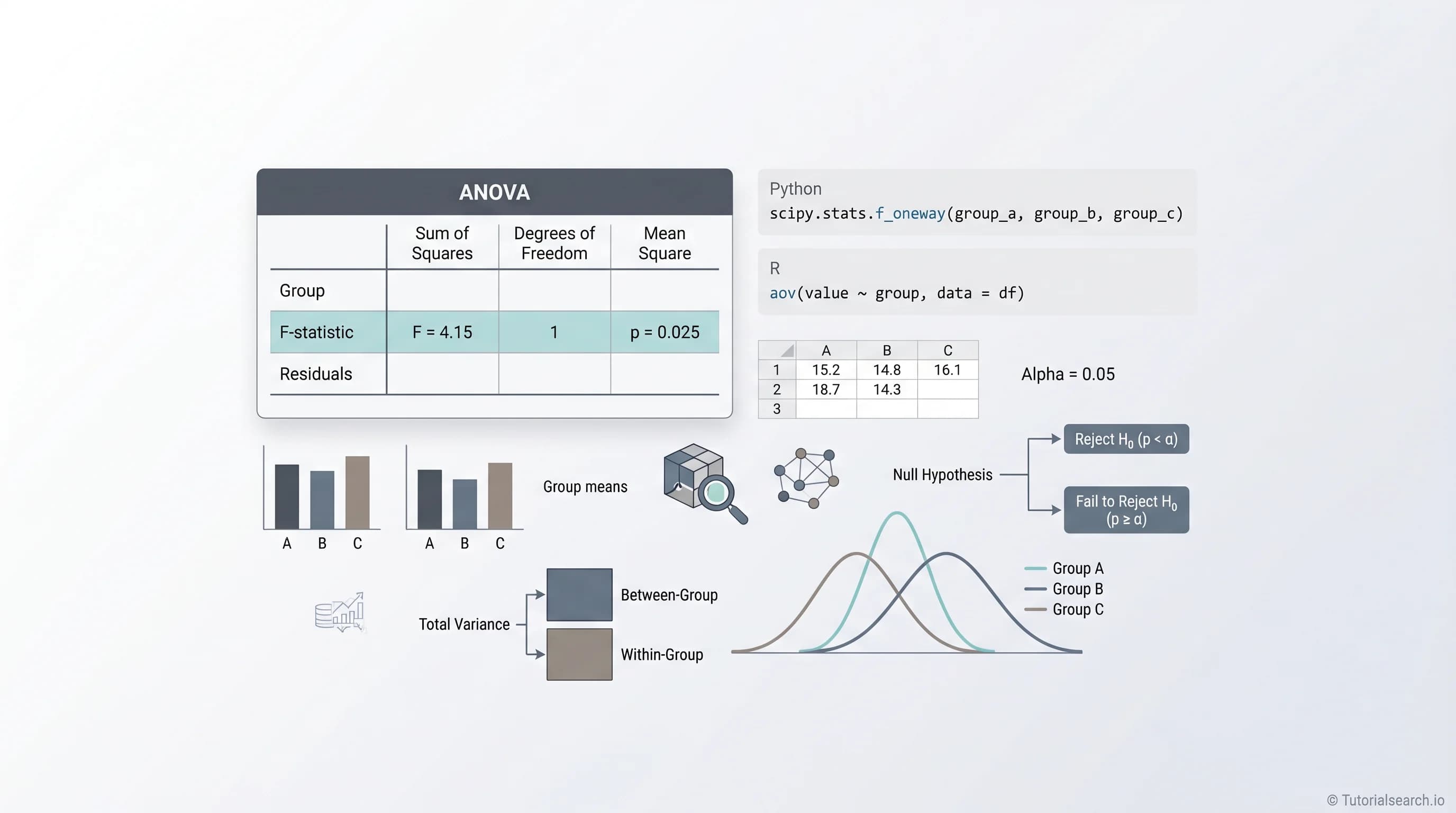
ANOVA analysis is one of the most powerful statistical tools in a data scientist's toolkit — and one of the most misunderstood. Whether you're comparing the effectiveness of three drug treatments, evaluating measurement system reliability with Gage R&R, or testing whether different machine settings produce statistically different outputs, ANOVA (Analysis of Variance) is the right tool for the job. As of 2026, it remains a core skill for anyone working in data science, quality engineering, academic research, or Six Sigma methodology.
If you're new to ANOVA, explore our curated ANOVA analysis courses to get oriented — there are 71 courses ranging from Excel-based tutorials to full Python and R implementations.
Key Takeaways
- ANOVA analysis lets you compare means across three or more groups, telling you whether differences are statistically significant or just random noise
- ANOVA analysis comes in several flavors — one-way, two-way, repeated measures — and choosing the right one depends entirely on your experimental design
- ANOVA analysis skills are in demand across data science, manufacturing, research, and quality control roles
- Free ANOVA analysis resources from platforms like Khan Academy, StatTrek, and DataCamp make it accessible without spending a cent
- Mastering ANOVA analysis in Python or R opens doors to advanced statistical modeling and machine learning workflows
In This Article
- The ANOVA Courses I'd Actually Recommend
- Free ANOVA Resources That Are Surprisingly Good
- YouTube Channels for Learning ANOVA the Visual Way
- ANOVA on GitHub: Repos Worth Bookmarking
- Books That Actually Explain ANOVA Well
- One-Way vs. Two-Way vs. Repeated Measures: Pick Your ANOVA Path
- Communities Where ANOVA Questions Get Real Answers
- Related ANOVA Skills Worth Exploring
- FAQ
Browse around to see what pairs well with ANOVA in a modern analytics curriculum — start with the data science methods section for broader statistical foundations.
The ANOVA Courses I'd Actually Recommend
The courses below cover ANOVA from Excel-based practical workflows to deep statistical theory. I've ranked them by value for different learner profiles — not just star ratings.
Performing Crossed ANOVA Gage R&R Using Excel 365 (Udemy) — [Editors' Choice] This is the most focused ANOVA course for quality engineers. Instructor Joshua Day walks you through Measurement System Analysis (MSA) using the crossed ANOVA method inside Excel 365 — no specialized stats software required. It covers Gage Repeatability and Reproducibility (Gage R&R) hands-on, which is exactly what Six Sigma Green and Black Belt practitioners need. If you work in manufacturing, this is the one course on this list that pays for itself almost immediately. The combination of ANOVA theory with practical Gage R&R application is rare, and the Excel-only approach removes software barriers entirely.
Data Analysts Toolbox: Excel, Python, Power BI, PivotTables (Udemy) — [Editors' Choice] With 19,000+ students and a 4.48 rating, this course from Simon Sez IT is the best value for anyone who wants statistical analysis skills across multiple tools. It doesn't go as deep on ANOVA as a dedicated course, but the breadth is unmatched — you'll learn the context in which ANOVA fits within a real data analyst's toolkit.
Truth About Data: Getting Started with Lean Six Sigma Analytics (Pluralsight) — Craig Gygi's course takes a practical Lean Six Sigma approach to data analysis. It's beginner-friendly and contextualizes ANOVA within the broader framework of quality improvement and statistical process control. A strong choice if you're pursuing a Six Sigma certification.
Measures of Dispersion (Udemy, Free) — Don't let the modest title fool you. This free course on variance and dispersion is the prerequisite most people skip before tackling ANOVA — and skipping it is why ANOVA confuses them. With 1,671 students and a solid 4.54 rating, it fills the conceptual gaps quietly and effectively.
Data Analysis on Titanic Dataset Using Python (Udemy) — [Editors' Choice] For Python learners, this project-based course uses a real dataset to practice statistical analysis, including variance-based comparisons. It's the closest thing to "ANOVA in the wild" for beginner Python practitioners. Working through a real dataset beats watching someone else's toy examples. If Python ANOVA interests you, the Python Analysis section has several courses worth exploring.
Free ANOVA Resources That Are Surprisingly Good
Paid courses aren't the only path. These free resources cover ANOVA deeply — some rival what you'd get in a graduate statistics course.
GraphPad's Ultimate Guide to ANOVA — This is the best single-page ANOVA reference on the internet. GraphPad covers one-way, two-way, three-way, repeated measures, nested, and non-parametric ANOVA alternatives. The formulas are shown, assumptions are explained practically, and there are worked examples with graphs. Bookmark this one — you'll return to it every time you forget which ANOVA to use.
StatTrek ANOVA Tutorial — Paced for self-study, this step-by-step tutorial is designed for learners with basic statistics familiarity but no prior ANOVA experience. It covers assumptions, the F-statistic logic, and hypothesis testing with clear, jargon-light writing.
Scribbr: One-Way ANOVA — When and How to Use It — Scribbr's statistics tutorials are consistently excellent. The one-way ANOVA guide walks through a full example in 7 steps — from loading data to interpreting and reporting results. A great reference to keep open alongside a paid course.
Khan Academy: Analysis of Variance — Khan Academy's ANOVA library is free, clear, and video-based. Start here if you want the conceptual foundation before touching software.
DataCamp: ANOVA Test — An In-Depth Guide — DataCamp's written tutorial covers ANOVA in Python with SciPy step by step. Particularly useful for Python practitioners who want code they can copy and adapt. For a more structured learning path, the Performing Crossed ANOVA Gage R&R course covers similar ground in an applied manufacturing context.
Our Coding Club ANOVA Tutorial — Written by researchers for researchers, this R-focused tutorial strikes a strong balance between theory and application. It's free, reproducible, and covers assumption checking alongside model execution.
Excel-Easy (excel-easy.com/examples/anova) — Short, screenshot-heavy tutorial showing how to run a one-way ANOVA using Excel's built-in Data Analysis Toolpak. If you need to get something done in Excel today, this is the fastest path.
YouTube Channels for Learning ANOVA the Visual Way
ANOVA clicks faster when you watch someone work through it. These channels offer the best visual explanations.
Statistics PL13 — ANOVA Playlist (YouTube) — [Editors' Choice] This dedicated ANOVA playlist from the Statistics 101 series is the most thorough free video resource on the topic. It starts from first principles and covers the F-statistic, one-way ANOVA, two-way ANOVA, and post-hoc testing. The pacing is deliberate and the explanations don't skip the math.
Crash Course Statistics #33: ANOVA (YouTube) — The Crash Course team packs a strong conceptual overview of ANOVA into under 12 minutes. Watch this before diving into a longer tutorial so the big picture clicks first.
ANOVA: A Visual Introduction — Brandon Foltz (YouTube) — Brandon Foltz's statistics videos are slow, deliberate, and built for people who struggle with math anxiety. His visual introduction to ANOVA is genuinely beginner-friendly and doesn't assume you remember anything from your last stats class.
MarinStatLectures (YouTube) — Prof. Mike Marin's channel covers ANOVA extensively within a large library of R and statistics videos. Particularly useful for learners who want to follow along in R. Search for ANOVA analysis tutorials on TutorialSearch to supplement these channels with structured courses.
ANOVA on GitHub: Repos Worth Bookmarking
Want AI in your product? Hire the team behind TutorialSearch.io
LLM features, RAG, agents and automation wired into a real product — built by the devs who shipped this site.
The open-source statistics community has produced excellent ANOVA tools and learning materials on GitHub.
mljs/anova (JavaScript) — A clean JavaScript implementation of Analysis of Variance. Useful if you're building browser-based statistical tools or want to see ANOVA implemented from scratch. Includes a one-way ANOVA function with configurable significance levels.
iamericfletcher/awesome-r-learning-resources — A curated and actively maintained collection of free R learning resources, including many that cover ANOVA in depth. The best starting point if you want to learn ANOVA through R.
anova · GitHub Topics — The GitHub topic page for ANOVA aggregates dozens of repos covering Python, R, and Julia implementations. Worth browsing for language-specific tools and example notebooks. Pairs well with our Data Science Methods courses for a theory-plus-implementation learning path.
CrumpLab/statisticsLab — Chapter 8: ANOVA — An R Markdown chapter from a university statistics lab manual. Covers ANOVA with reproducible R code, pedagogical explanations, and exercises. Free, thorough, and written for actual students.
Books That Actually Explain ANOVA Well
Most statistics textbooks cover ANOVA. Very few cover it well. These ones do.
"A Student's Guide to Analysis of Variance" by Maxwell Roberts and Riccardo Russo (Routledge) — The most genuinely readable ANOVA book on the market. Roberts and Russo start from sampling and hypothesis testing basics, then work through variance analysis in a way that actually builds intuition rather than just showing formulas. Reviewers consistently praise how the material is "handled extremely well." Recommended for anyone who's tried to learn ANOVA from a standard textbook and hit a wall.
"Analysis of Variance, Experimental Design, and Multivariate ANOVA" by Dr. Dawn Iacobucci (Amazon) — A more recent and comprehensive text that covers experimental design alongside ANOVA, including multivariate extensions (MANOVA). Best for practitioners who need to move beyond one-way ANOVA and understand how experimental structure drives statistical choices. Prefer video? The Data Analysts Toolbox course on Udemy covers practical statistical analysis across multiple tools without requiring a book.
"Introductory Statistics 2e" by OpenStax — The ANOVA chapter is peer-reviewed, university-level, and completely free. The cleanest free text option for learners who want proper academic grounding without the price tag of a textbook.
One-Way vs. Two-Way vs. Repeated Measures: Pick Your ANOVA Path
The single biggest source of confusion in learning ANOVA is choosing the right type. Here's a direct comparison:
| ANOVA Type | When to Use | Example |
|---|---|---|
| One-Way | One categorical factor, 3+ groups | Does fertilizer brand affect crop yield? |
| Two-Way | Two categorical factors | Does fertilizer brand AND field location affect yield? |
| Repeated Measures | Same subjects measured multiple times | Does patient blood pressure change across 4 time points? |
| Nested | Factor levels differ within another factor | Different machines in different factories |
| Non-parametric (Kruskal-Wallis) | Data isn't normally distributed | Ranked survey data across 3 groups |
The most common mistake is using one-way ANOVA when two-way is appropriate. If you have two categorical variables influencing your outcome, using one-way ANOVA will miss the interaction effect entirely — and that interaction is often the most interesting finding. The GraphPad Ultimate Guide to ANOVA has a decision tree that walks you through this systematically.
A contrarian take worth stating plainly: most ANOVA tutorials spend too much time on formulas and not enough on post-hoc testing. The F-test in ANOVA only tells you that groups differ — it doesn't tell you which groups differ. Post-hoc tests like Tukey's or Dunnett's are where the real analytical work happens, and they're routinely treated as an afterthought. Don't skip them.
Communities Where ANOVA Questions Get Real Answers
Statistics can be lonely when you're stuck. These communities are where practitioners help each other.
r/statistics on Reddit — The most active English-language statistics community online. Questions about ANOVA model selection, assumption violations, and interpretation get thoughtful answers from practitioners and academics. The community norms are strong — questions need to show effort, but they get real responses.
Posit Community (formerly RStudio Community) — If you're doing ANOVA in R, this is the best forum. It focuses on R and the tidyverse ecosystem, and questions about ANOVA, emmeans, and afex get detailed, code-level answers.
Statistics By Jim (statisticsbyjim.com/anova) — Not strictly a community, but Jim Frost's ANOVA article series is one of the most practically oriented free resources available. He writes from a practitioner's perspective and explains concepts without unnecessary mathematical overhead. The comment sections are active and frequently contain useful follow-up questions with real answers.
Related ANOVA Skills Worth Exploring
If ANOVA analysis interests you, these related skills pair naturally with it:
- Data Visualization — Visualizing ANOVA results with violin plots, interaction plots, and forest charts makes findings communicable to non-statisticians. A critical complement skill.
- Business Analytics — ANOVA shows up in A/B testing, pricing experiments, and operational analysis. Business analytics courses contextualize when and why to reach for it.
- Data Engineering — Building clean pipelines for the data you'll analyze with ANOVA is a foundational step that's often overlooked in statistics curricula.
- Big Data — As datasets grow, classical ANOVA assumptions get tested. Big data courses cover the tools and techniques that scale statistical analysis beyond what Excel can handle.
FAQ
How long does it take to learn ANOVA analysis?
For basic one-way ANOVA, most learners with introductory statistics background are productive within 5–10 hours of focused study. Running and interpreting ANOVA in Excel can be done in a single afternoon. Two-way ANOVA and repeated measures take longer — plan for 20–30 hours to feel genuinely confident. Mastering post-hoc testing and assumption checking is an ongoing process, not a destination.
Do I need advanced math to learn ANOVA analysis?
Not really. You need comfort with basic algebra and the concept of mean and variance. The formulas behind ANOVA are handled by software — what matters is understanding which test to run, whether your data meets the assumptions, and how to interpret the F-statistic and p-value. The intuition matters more than the computation.
How is ANOVA analysis different from a t-test?
A t-test compares the means of exactly two groups. ANOVA extends that to three or more groups simultaneously. Technically, a one-way ANOVA with two groups produces the same result as a t-test. The key advantage of ANOVA is that it controls the familywise error rate — running multiple pairwise t-tests would inflate your false positive rate significantly.
What statistical software supports ANOVA analysis?
All the major statistical platforms support ANOVA: R (using base aov() or the afex package), Python (via scipy.stats.f_oneway or statsmodels), Excel (Data Analysis Toolpak for one-way), SPSS, SAS, Minitab, and GraphPad Prism. For quality engineering and Gage R&R specifically, Minitab is the industry standard. Excel works well for simple one-way ANOVA and is the lowest barrier to entry.
Can I get a job with ANOVA analysis skills?
Yes — ANOVA is explicitly listed in job descriptions for data analysts, quality engineers, clinical data statisticians, research scientists, and Six Sigma practitioners. It's not a career in itself, but it's a foundational skill that frequently appears in technical interviews and job requirements. Combined with Python or R proficiency, it significantly strengthens a data science or analytics candidacy. Browse our Data Science Skills courses to see what employers look for alongside ANOVA.
What are the main assumptions of ANOVA analysis?
ANOVA requires three core assumptions: the data within each group should be approximately normally distributed, the variances across groups should be roughly equal (homoscedasticity), and observations should be independent. ANOVA is fairly robust to mild normality violations, especially with larger sample sizes. When equal variance can't be assumed, Welch's ANOVA is a reliable alternative. When normality is severely violated, the Kruskal-Wallis test (the non-parametric version) is the right substitute.