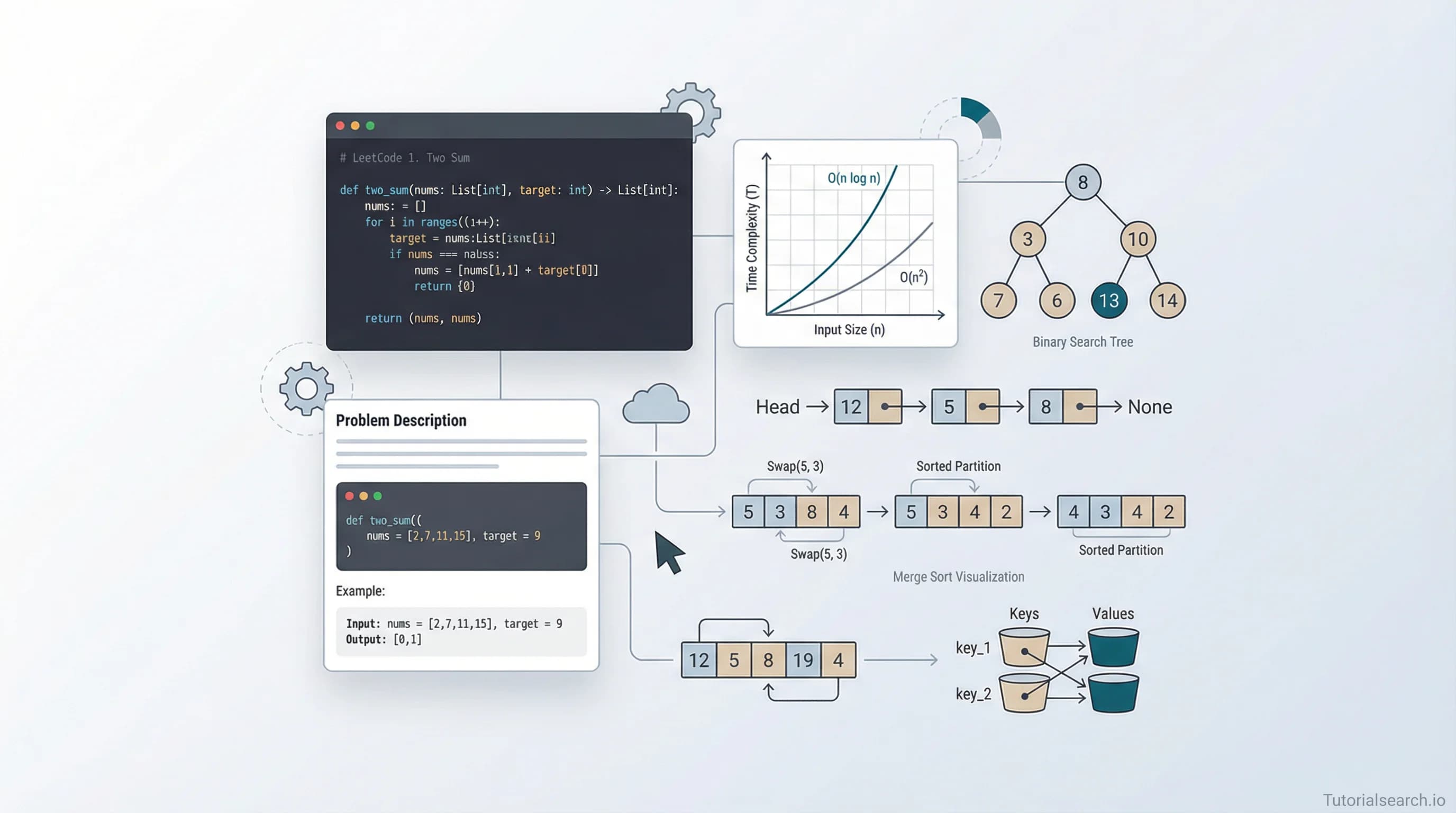
Algorithms Interviews: How I'd Prepare If Starting Over
Algorithms interviews trip up even experienced engineers — not because they're hard, but because most people prepare wrong. Here's the pattern-based roadmap that leads to offers.
Need a web app built? Hire the team behind TutorialSearch.io
We ship fast, production-grade full-stack apps (Next.js, React, edge infra) — the same stack that powers this site.
Algorithms Interviews: How I'd Prepare If Starting Over
Algorithms interviews are the gatekeepers for jobs at Google, Meta, Amazon, and hundreds of other tech companies. Most candidates get this type of interview completely wrong — not because they're bad engineers, but because they prepare with the wrong strategy.
Here's the pattern I've seen over and over: someone spends 3 months solving random LeetCode problems. They hit 300+ solutions. Then they sit down in the actual interview, see a medium-difficulty problem they've never seen before, and freeze. Not because they haven't worked hard — but because memorizing solutions is different from building pattern recognition.
The best algorithms interview courses teach you to recognize problem types, not recite answers. That's the whole game. And once you understand that, your prep looks completely different.
Key Takeaways
- Algorithms interview prep is about learning 15-20 patterns, not grinding hundreds of random problems
- Free resources like NeetCode and the Tech Interview Handbook cover most of what you need
- Python is the most popular language for algorithms interviews, but any language you know well works
- Time and space complexity analysis is non-negotiable — you must be able to explain your reasoning
- Consistent daily practice (1-2 hours) beats marathon weekend sessions every time
In This Article
- What Most Candidates Get Wrong About Algorithms Interviews
- The Algorithms Interview Courses I'd Recommend Without Hesitation
- Free Algorithms Interview Resources That Are Surprisingly Good
- Algorithms Interview Practice Platforms: A Quick Comparison
- Algorithms Interview YouTube Channels Worth Following
- Algorithms Interview GitHub Repos Worth Starring Right Now
- For When You Want to Go Deeper With Algorithms Interviews
- Related Skills That Pair Well With Algorithms Interviews
- Frequently Asked Questions About Algorithms Interviews
What Most Candidates Get Wrong About Algorithms Interviews
There's a persistent myth in the tech community: grind 300-500 LeetCode problems and you'll pass any algorithms interview. This advice has sent a lot of talented engineers through months of miserable prep with mediocre results.
The engineers who pass consistently? They know 15-20 core patterns cold. Sliding window. Two pointers. BFS (breadth-first search) and DFS (depth-first search). Binary search on answer spaces. Union-Find. Dynamic programming with memoization (caching results so you don't recompute them). When they see a new problem, they ask: "Which pattern does this resemble?" — not "Have I solved this exact problem before?"
I've seen engineers fail Google loops after solving 400+ LeetCode problems. And I've seen engineers pass with under 100. The ones who passed had internalized the why behind each solution type. The ones who failed could recite solutions they'd memorized but couldn't adapt when the problem changed slightly.
Another thing that gets underrated: communication. Algorithms interviews test whether you can think out loud, explain your reasoning, and walk through trade-offs. You can solve the problem perfectly in your head and still get a "no hire" because you said nothing for 10 minutes. Practice explaining your thinking as you code — out loud, to a friend, to a rubber duck if needed.
With those two ideas in mind — patterns over problems, and communication over silence — let's look at the resources that support this approach.
The Algorithms Interview Courses I'd Recommend Without Hesitation
There are hundreds of courses claiming to help you crack algorithms interviews. Most are fine. These are the ones I'd point a friend to without hesitation.
1. The Complete Data Structures and Algorithms Course in Python [Editors' Choice]
The Complete Data Structures and Algorithms Course in Python has 96,415 students — the largest enrollment in this category — and earns its popularity. It builds everything from scratch: arrays, linked lists, stacks, queues, trees, graphs, sorting, searching. The Python-first approach is smart for interview prep since Python lets you focus on logic instead of syntax.
Rating: 4.43 | Platform: Udemy | Level: Beginner to Intermediate
If you're coming from a non-CS background or it's been a few years since you touched data structures, this is where I'd start. Don't let the beginner label fool you — it goes deep.
2. Python for Data Structures, Algorithms, and Interviews! [Editors' Choice]
Python for Data Structures, Algorithms, and Interviews! by Jose Portilla has 87,928 students and a 4.5 rating. What separates this course from a general DSA course is the interview focus. Portilla includes mock interview walkthroughs where you watch him think through problems in real time — including the false starts and backtracking.
Rating: 4.53 | Platform: Udemy | Level: Intermediate
That's what you actually need to practice: not just the solution, but the process of arriving at it under pressure.
3. Cracking Coding Interview: Data Structure & Algorithm in 2025
Cracking Coding Interview: Data Structure & Algorithm in 2025 takes a different approach. It's organized by company difficulty tiers and focuses on the communication piece — framing your approach, responding when stuck, discussing trade-offs clearly. 18,820 students, 4.63 rating.
Rating: 4.63 | Platform: Udemy | Level: All levels
Most courses skip this. This one doesn't.
4. 50 Days of LeetCode in Python: Algorithms Coding Interviews
50 Days of LeetCode in Python: Algorithms Coding Interviews is structured as a daily practice program — one manageable chunk at a time, organized by problem pattern. If you've already absorbed the fundamentals and need to shift into execution mode, this works well. 21,096 students, 4.47 rating.
Rating: 4.47 | Platform: Udemy | Level: Intermediate
The pacing matters. This is designed to be sustainable for people who are also working full-time.
5. Dynamic Programming Masterclass (2025) [Editors' Choice]
Dynamic Programming Masterclass (2025) is a specialist course. Dynamic programming — DP — trips up more candidates than any other topic in algorithms interviews. The course covers both the conceptual framework (memoization, tabulation, space optimization) and the tactical patterns you'll see in real interviews. 4.85 rating.
Rating: 4.85 | Platform: Udemy | Level: All levels
Everyone recommends just doing DP problems until they click. But for most people, clicking never happens that way. A structured DP course actually explains the underlying logic. This one does that.
6. Data Structures & Algorithms Mastery (2025): Practice Test [Editors' Choice]
Data Structures & Algorithms Mastery (2025): Practice Test is built for the final weeks before your interview. Timed practice tests, organized by concept, designed to surface your gaps before the real thing does. 4.88 rating — the highest in this list.
Rating: 4.88 | Platform: Udemy | Level: Beginner
Use this after you've gone through a primary course. It's a diagnostic and a drilling tool, not a teaching resource.
7. Mastering Critical SKILLS in Data Structures Using Python
Mastering Critical SKILLS in Data Structures Using Python by Dr. Moustafa Saad is worth mentioning for a specific reason: it emphasizes understanding over pattern matching. Dr. Saad builds intuition for why data structures work the way they do. 4.66 rating.
Rating: 4.66 | Platform: Udemy | Level: All levels
If you find yourself passing courses but blanking in actual interviews, this approach might be the missing piece.
You can also search the full algorithms interview resource library on TutorialSearch to find options by language, level, or platform.
Free Algorithms Interview Resources That Are Surprisingly Good
Paid courses are helpful, but you can get 80% of what you need for free. Here's what deserves your time — and what might surprise you.
NeetCode.io
NeetCode is the best free structured resource for algorithms interview prep right now. The site organizes LeetCode problems into 16 pattern categories with free video solutions for every problem. The NeetCode 150 — a curated set of the 150 most important problems — is a better starting point than any random "just do LeetCode" advice.
All NeetCode YouTube videos are free. FreeCodeCamp also hosts a full 38-hour NeetCode 150 walkthrough on their YouTube channel — just search "NeetCode 150 freeCodeCamp" on YouTube.
If you only use one free resource, make it this one.
Tech Interview Handbook
The Tech Interview Handbook covers the full interview preparation journey. It has study cheatsheets for every major data structure and algorithm, curated problem sets, and advice on resumes and offer negotiation. Created by the author of Blind 75.
It's free, comprehensive, and well-maintained. The GitHub repo has 120,000+ stars.
LeetCode (Free Tier)
LeetCode's free tier gives you access to hundreds of problems and the "Explore" section, which has guided topic cards for arrays, binary search, and more. You don't need premium to get started — the free version covers 60-90 days of meaningful prep without hitting a wall.
One honest note: LeetCode's problem quality varies wildly. Following a structured list (NeetCode 150, Blind 75, or Grind 75) beats picking problems randomly.
AlgoMonster
AlgoMonster was built by Google engineers and is specifically designed around pattern recognition. The free tier covers the 14 core patterns with explanations and example problems. Worth using alongside NeetCode if you want a second take on why certain approaches work.
GeeksforGeeks
GeeksforGeeks has the most thorough algorithm explanations on the internet. When you're stuck on why an algorithm works — not just how — GFG almost always has a detailed article that covers it. It's not a structured learning path, but as a reference when you get confused, it's unmatched.
GFG also runs a Discord server with daily DSA problem discussions and a community of people actively prepping.
HackerRank
HackerRank is free and organized by topic. It's valuable for one specific reason: many companies use HackerRank for their online assessments. If you're applying to companies that use HackerRank OAs, practicing in that environment is smart — you get used to the interface and the time pressure.
VisuAlgo
VisuAlgo is a small gem. It animates data structure and algorithm operations — sorting, tree traversal, graph BFS/DFS, shortest paths. If you're a visual learner struggling to picture how something like Dijkstra's algorithm actually progresses through a graph, spend 20 minutes here. It sticks in a way that written explanations don't.
For community support, r/cscareerquestions on Reddit is genuinely useful — people share recent interview questions, prep strategies, and feedback on their timelines.
Algorithms Interview Practice Platforms: A Quick Comparison
Need a web app built? Hire the team behind TutorialSearch.io
We ship fast, production-grade full-stack apps (Next.js, React, edge infra) — the same stack that powers this site.
Not sure which platform fits your situation? Here's the honest breakdown:
| Platform | Free Content | Pattern-Focused | Company-Specific Problems | Best For |
|---|---|---|---|---|
| LeetCode | Partial | No | Yes | Volume practice, realistic problems |
| NeetCode | Mostly free | Yes | No | Structured pattern learning |
| AlgoMonster | Partial | Yes | No | Understanding the "why" behind patterns |
| HackerRank | Yes | Partial | Yes | OA practice for specific companies |
| AlgoExpert | No | Yes | No | Premium guided video prep |
The short version: start with NeetCode for structure, use LeetCode for the most realistic problems, and check HackerRank if you know which companies you're targeting.
Algorithms Interview YouTube Channels Worth Following
Watching someone work through a problem in real time — including the wrong turns — is some of the best interview prep you can do. It trains you to think out loud, which is exactly what interviewers want to see.
NeetCode (YouTube)
NeetCode's YouTube channel covers every problem in the NeetCode 150 plus hundreds more. The structure is consistent: brute force solution first, then the optimized approach. He annotates his thinking at each step and explains why the optimization works. This is the closest you'll get to watching a great interview performance.
Nick White
Nick White focuses on LeetCode walkthroughs — usually under 15 minutes, clear and concise. When you get stuck on a specific problem and want a quick, no-fluff explanation, this channel is the one to pull up.
William Fiset
William Fiset goes deeper than interview prep. His graph theory and advanced algorithms series are genuinely educational at a CS-course level. If you're targeting senior roles or companies known for theory-heavy interviews, his content fills gaps that practice-focused channels leave.
Back to Back SWE
Back to Back SWE builds intuition for algorithms rather than just teaching solutions. The channel is good at explaining why a particular approach is the right mental model for a problem type. If you keep solving problems correctly but can't explain your reasoning clearly, this is the channel to add.
Abdul Bari
Abdul Bari's algorithms course on YouTube is one of the most thorough free algorithm resources available. It covers algorithms at a CS-degree level — completely free, no paywall. If you want deep theoretical grounding before you tackle interview-specific prep, start here.
Algorithms Interview GitHub Repos Worth Starring Right Now
Coding Interview University
Coding Interview University — 307,000+ GitHub stars. This is a complete self-study plan created by an engineer who taught himself CS fundamentals and landed a job at Amazon. It covers everything from data structures and algorithms to operating systems and databases. The scope is intentionally broad.
You don't need to complete all of it for interviews — think of it as a buffet, not a checklist. But for anyone bridging from self-taught to FAANG-ready, it's the most complete free roadmap available.
Tech Interview Handbook
Tech Interview Handbook — 120,000+ stars. More interview-focused and faster to work through than Coding Interview University. It has algorithm cheatsheets, the complete Blind 75 problem list, and practical study guides organized by topic. Created by the author of Blind 75 itself.
If you're working through Python Basics alongside this, the combination of Python fluency and these structured problem lists is a strong foundation for any interview.
Awesome LeetCode Resources
Awesome LeetCode Resources is a curated collection of templates, pattern guides, and reference sheets specifically for interview prep. Once you're in active practice mode and want quick cheat sheets to review before a session, this is the repo to bookmark.
Awesome Algorithms
Awesome Algorithms is a broader curated list — online courses, books, open-source implementations, and visualization tools. A good starting point if you want to explore beyond the standard interview-prep pipeline.
For When You Want to Go Deeper With Algorithms Interviews
Some people want more than online courses and GitHub repos. These books are worth the investment.
Cracking the Coding Interview — Gayle Laakmann McDowell
Cracking the Coding Interview is the classic. 189 problems organized by topic, with behavioral interview prep and company-specific tips for Google, Amazon, Facebook, and others. It's not perfect — some explanations are cleaner in online resources — but it's comprehensive and has been battle-tested by hundreds of thousands of candidates.
Everyone serious has a copy. There's a reason.
Beyond Cracking the Coding Interview
Beyond Cracking the Coding Interview is the sequel, co-authored by McDowell along with Aline Lerner and others. It draws from 100,000+ mock interview sessions and adds 150+ new problems. It's more useful if you're already at an intermediate level and want to sharpen your edge — especially on the behavioral and offer negotiation side.
Grokking Algorithms — Aditya Bhargava
Grokking Algorithms is for anyone who finds the standard CS treatment of algorithms intimidating. It's heavily illustrated, written for people who think visually, and genuinely approachable. Recursion, quicksort, graphs, dynamic programming — all explained with drawings and plain language. A free version is accessible online.
If the math-heavy approach of other resources makes you want to close the laptop, start here.
Elements of Programming Interviews (EPI)
Elements of Programming Interviews is for candidates targeting the highest bars — senior roles at Google or Meta, for example. Over 250 problems, harder on average than CTCI, with solutions in Java and Python. Use this after you've mastered the fundamentals, not as a starting point.
Related Skills That Pair Well With Algorithms Interviews
Algorithms interview prep doesn't happen in a vacuum. These related skills come up alongside it or open doors once you've passed:
- Python Basics — Python is the dominant language for algorithms interviews. Getting fluent in it before tackling interview prep saves time and reduces friction during actual problems.
- Programming Fundamentals — Solid programming fundamentals make algorithmic thinking faster. If you're newer to coding, this is worth building first.
- Java Objects — Java remains widely used in interviews at enterprise companies and some FAANG roles. Java Objects courses can sharpen your fluency if Java is your interview language.
- JavaScript Development — If you're a front-end engineer, JavaScript is a perfectly valid interview language and JS problem-solving skills transfer well.
- Object Programming — OOP concepts come up in design problems and class-based implementations. Understanding them deeply makes you more versatile.
- Modern Languages — Once you've nailed your primary interview language, exploring modern languages like Go, Rust, or Kotlin can open different job categories.
- Python Applications — After you've landed the role, Python application skills help you turn interview knowledge into real-world work.
- Automation Development — Automation skills complement algorithmic thinking well in engineering roles that involve scripting, tooling, and workflow optimization.
Frequently Asked Questions About Algorithms Interviews
How long does it take to prepare for algorithms interviews?
Most people need 2-4 months of consistent prep — about 1-2 hours per day. If you already have strong programming fundamentals, a focused 6-8 weeks using pattern-based study can get you to a solid level. The key is consistency over intensity: daily practice beats marathon weekend sessions.
Do I need a CS degree to pass algorithms interviews?
No. Many successful candidates are self-taught or come from bootcamps. Resources like Coding Interview University exist specifically for this path. What matters is your ability to solve problems and explain your reasoning — not your degree.
That said, CS fundamentals do help at senior levels. You can learn the relevant CS concepts through dedicated prep without a formal degree.
What programming language should I use for algorithms interviews?
Python is the most popular choice. It's concise, readable, and lets you focus on logic rather than syntax. Java and C++ are also widely accepted, especially at companies that care about performance. JavaScript works too.
Pick one language, get very comfortable with it, and don't switch mid-prep. Browse programming fundamentals courses if you need to strengthen your foundation before diving into interview practice.
Can I get a job at a top tech company without solving 300+ LeetCode problems?
Yes. The number matters far less than depth of understanding. Candidates who pass consistently know 15-20 patterns well and can apply them to unfamiliar problems. That's different from surface-level familiarity with 300+ specific solutions.
Focus on understanding why solutions work. That understanding is what you can actually apply in an interview.
How are algorithms interviews different from coding interviews?
Algorithms interviews specifically test data structures and algorithmic patterns — time complexity, space complexity, and efficient solutions. A general coding interview might include debugging, code review, or system design. At most top tech companies, the algorithms round is a dedicated step in the process, separate from design and behavioral rounds.