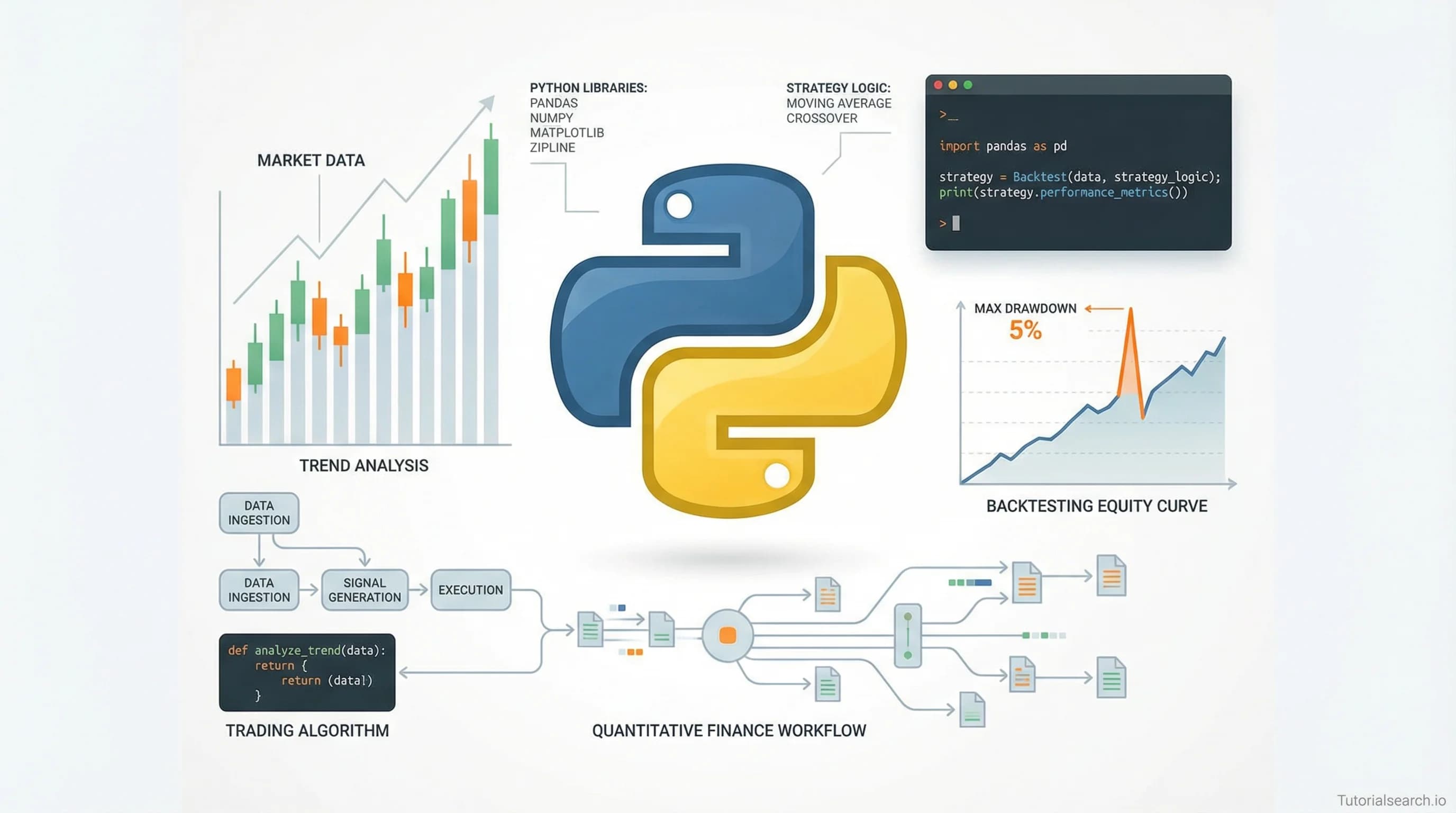
What Does It Actually Take to Learn Algorithmic Trading?
Algorithmic trading isn't just for quants with PhDs. Here are the best courses, free Python resources, GitHub repos, and tools for building and backtesting real trading strategies.
Want AI in your product? Hire the team behind TutorialSearch.io
LLM features, RAG, agents and automation wired into a real product — built by the devs who shipped this site.
Algorithmic trading has a reputation problem. The finance industry loves to present it as the exclusive domain of hedge funds with billion-dollar infrastructure and teams of PhDs. But plenty of working algo traders built their first strategies with a free brokerage account and a Python environment. The libraries they used cost nothing.
This guide cuts through that mystique. You'll find the best courses, free tools, GitHub repos, and communities for building real algorithmic trading systems. The guide covers everything from backtesting a first momentum strategy to deploying live trading bots. Browse 123+ algorithmic trading courses on TutorialSearch.io to get a sense of the landscape.
Key Takeaways
- Algorithmic trading requires Python basics and market fundamentals — not a finance degree
- Learning to backtest properly matters more than finding the "perfect" strategy
- Free platforms like QuantConnect and Alpaca let you run paper trades without risking real money
- GitHub's curated algorithmic trading repos are among the best free learning guides available
- Most beginners focus on strategies before understanding risk management — that's the order wrong
In This Article
- Before You Write Your First Algorithmic Trading Strategy
- The Algorithmic Trading Courses I'd Actually Recommend
- Free Algorithmic Trading Resources That Are Surprisingly Good
- Algorithmic Trading Platforms at a Glance
- Algorithmic Trading GitHub Repos Worth Starring
- Algorithmic Trading YouTube Content Worth Your Time
- For When You Want to Go Deep With Algorithmic Trading
- Related Skills Worth Exploring
- Frequently Asked Questions About Algorithmic Trading
Before You Write Your First Algorithmic Trading Strategy
The common advice is to start with a course on trading strategies. The better advice is to understand what you're actually building before you build anything.
Algorithmic trading means using code to automate trading decisions — entering, managing, and exiting positions based on rules rather than emotions. That sounds simple. What makes it hard is the gap between what a strategy does in backtesting (testing against historical data) and what it does in live markets. Understanding that gap is the real skill.
The prerequisites aren't steep. You need Python basics — variables, functions, loops, basic data manipulation with pandas. You need enough market knowledge to understand what a stock order looks like. Knowing what a limit order is versus a market order, and how prices move in liquid markets, is plenty. That's it.
You do NOT need a finance degree, a statistics PhD, or expensive data subscriptions. Free data from Yahoo Finance, Alpaca Markets, and Interactive Brokers is enough to learn with.
The single biggest mistake beginners make: they find a strategy that backtests well, get excited, and trade it live. They never stop to ask why it worked historically or whether those conditions still exist. Learn to backtest rigorously first. Everything else follows from there.
Once you're oriented, the algorithmic trading search on TutorialSearch.io is a good way to see the full range of courses across skill levels and platforms.
The Algorithmic Trading Courses I'd Actually Recommend
With 120+ courses available on this topic, the choice is genuinely overwhelming. Most are decent. A few are exceptional. Here's what I'd pick for each stage of the learning path.
1. Algorithmic Trading A-Z with Python, Machine Learning & AWS [Editors' Choice]
Algorithmic Trading A-Z with Python, Machine Learning & AWS by Alexander Hagmann
★ 4.5 | 45,600+ students | Udemy | Paid
This is the course I'd hand to someone who wants to take algorithmic trading seriously and not just experiment. Hagmann takes you from strategy development all the way through deployment on AWS — meaning you understand what it actually looks like when a trading bot runs in the real world rather than just in a Jupyter notebook.
The machine learning section is substantive rather than cosmetic. He shows how to apply ML to signal generation in ways you can actually debug and understand, not just drop in a black-box model and hope it works. The AWS deployment section is rare among trading courses and makes this one stand out.
At 45,600+ students and a 4.5 rating, it earns the numbers it has.
2. Algorithmic Trading: Backtest, Optimize & Automate in Python [Editors' Choice]
Algorithmic Trading: Backtest, Optimize & Automate in Python by Mohsen Hassan
★ 4.5 | 19,700+ students | Udemy | Paid
If the A-Z course feels like too much scope to start with, this one is a better entry point for the fundamentals. Hassan focuses tightly on the core workflow: build a strategy, test it against historical data, optimize the parameters, then automate execution. That's the actual loop of algorithmic trading, and he teaches it cleanly.
The course covers vectorbt and backtesting.py — two Python libraries you'll actually encounter in real-world work, not just toy examples built from scratch.
I'll be direct about something: many beginners skip this kind of course because "backtest" sounds less exciting than "machine learning trading bot." That's backwards. Solid backtesting is what separates strategies that survive live markets from ones that looked great in a spreadsheet.
3. Algorithmic Trading & Quantitative Analysis Using Python
Algorithmic Trading & Quantitative Analysis Using Python by Mayank Rasu
★ 4.4 | 43,200+ students | Udemy | Paid
Mayank Rasu has produced several of the most popular algorithmic trading courses on Udemy, and this is his flagship. It covers quantitative analysis — the math-driven process of identifying tradeable signals — alongside Python implementation. It's longer and goes deeper on strategy methodology than most competitors.
If you're more interested in the quantitative finance angle than the automation angle, this is the right starting point. Rasu's teaching style is methodical rather than flashy, which is exactly what you want for this topic.
4. Algorithmic Trading using Interactive Broker's Python API
Algorithmic Trading using Interactive Broker's Python API by Mayank Rasu
★ 4.5 | 12,400+ students | Udemy | Paid
Once you understand backtesting, the next gap is live execution — and Interactive Brokers (IBKR) is the most used brokerage among serious retail algo traders for good reasons: low fees, a robust API, and support for equities, options, futures, forex, and more. This course fills a gap most others leave completely empty: it teaches you how to connect Python to the IBKR API to place and manage real orders.
Not a beginner course. Do the backtesting fundamentals first.
5. Algorithmic Trading Robots Without Programming (17 Hrs) MT5
Algorithmic Trading Robots Without Programming (17 Hrs) MT5 by Saad T. Hameed
★ 4.4 | 33,600+ students | Udemy | Paid
Not everyone wants to write Python, and that's a legitimate choice. This course uses MetaTrader 5's visual strategy builder to create trading robots without code — specifically for forex markets. The enrollment numbers (33,600+) suggest it delivers on what it promises.
The honest tradeoff: MT5's no-code approach has real limits compared to Python. You can build many common strategies, but anything sophisticated or data-heavy requires code eventually. If you're a forex trader who wants automation without a programming learning curve, this is the realistic best option.
Also worth looking at: Algorithmic Trading with Python: Technical Analysis Strategy by Lucas Inglese for technical analysis-driven approaches, and Algorithmic Trading In Forex for ForexBoat's practical robot-building course.
Free Algorithmic Trading Resources That Are Surprisingly Good
Here's where I'll push back on the conventional "you need a paid course" advice: the free resources for algorithmic trading are unusually good. Better than free resources in most other technical fields.
freeCodeCamp: Algorithmic Trading with Python (YouTube, Free)
A 4-hour course by Nick McCullum covering algorithmic trading basics, API connections, and three real project builds. It's one of the most-watched free resources on this topic — and it's a complete course, not a teaser.
freeCodeCamp: Machine Learning & Quant Strategies (YouTube, Free)
A separate, more advanced free course from Lachezar Haralampiev covering ML-based trading strategies in Python. Three parts, covering different strategy types. If you've already done the intro Python work, jump to this.
QuantStart [Editors' Choice] (Website, Free)
QuantStart is the written resource I'd bookmark above almost anything else for free content. It covers backtesting frameworks, quantitative strategy development, and the practical realities of running a retail algo trading operation. Their Beginner's Guide to Quantitative Trading is one of the clearest overviews of how to approach this field as a self-taught trader. No hype, no "I made 300% in a month" clickbait.
Alpaca Markets — Learn (Website, Free)
Alpaca is a commission-free brokerage with a clean Python API. Their learning section covers how to build and deploy strategies on their platform, and — this is the important part — they offer a free paper trading environment. Paper trading means simulated trades with no real money at risk. It's the most realistic way to test live order execution without the financial consequences. See their Algorithmic Trading in Python with Alpaca: Part 1 as the starting point.
Interactive Brokers Campus (Website, Free)
IBKR publishes free educational content for quant traders using their platform. The Python algorithm examples connect directly to a real brokerage environment, so what you learn here is immediately applicable.
DataCamp: Python for Finance Tutorial (Website, Free)
Solid free tutorial covering Python data manipulation and time-series analysis with a trading focus. Best for building the data skills side of algorithmic trading rather than the strategy side.
Algorithmic Trading Platforms at a Glance
Want AI in your product? Hire the team behind TutorialSearch.io
LLM features, RAG, agents and automation wired into a real product — built by the devs who shipped this site.
Choosing a platform is genuinely confusing at first. Here's a quick comparison of the main options:
| Platform | Best For | Free to Start? | Code Required? |
|---|---|---|---|
| QuantConnect | Backtesting + live deployment | Yes (backtesting) | Python or C# |
| Alpaca | Paper + live trading | Yes | Python |
| Interactive Brokers | Live execution | Market data fees | Python / many |
| MetaTrader 5 | Forex robots | Yes | MQL4 or no-code |
| Zipline | Backtesting only | Yes | Python |
For most beginners: start with Alpaca's paper trading environment. Once your strategy is solid, graduate to IBKR or QuantConnect for live deployment.
Algorithmic Trading GitHub Repos Worth Starring
The open-source community around algorithmic trading is unusually generous. These repos contain more practical knowledge than most paid resources.
awesome-algorithmic-trading by joelowj
The classic curated list. Covers frameworks, libraries, books, communities, and educational resources across every major category of algo trading. Start here when you want to orient yourself in the ecosystem. Think of it as the index to everything else.
best-of-algorithmic-trading
A ranked, regularly updated list of open-source libraries, frameworks, bots, and educational materials. Rankings are based on actual usage metrics — not just subjective picks. The "best of" framing is genuinely more useful than a flat list when you're deciding where to spend your time.
awesome-systematic-trading
Broader than just algorithmic trading — covers crypto, stocks, futures, options, CFDs, and FX. If you're interested in systematic trading beyond simple equity strategies, this is the more comprehensive resource.
Zipline by Quantopian
Quantopian shut down as a business, but Zipline lives on as open source. It's an event-driven backtesting library for Python and one of the most referenced backtesting frameworks in educational materials. Understanding how it works teaches you a lot about how backtesting systems are architected, even if you eventually use a different library.
Awesome Quant Machine Learning Trading
If you want the ML-focused angle — neural networks for trading, reinforcement learning, deep learning applied to price prediction — this curated list goes deep into that specific corner of the field.
This whole area connects tightly to ML Fundamentals and Applied AI — algorithmic trading increasingly means machine learning, and the skills transfer in both directions.
Algorithmic Trading YouTube Content Worth Your Time
The quality variance on YouTube for this topic is extreme. There's genuinely great educational content, and there's an enormous amount of "watch me make $10,000 in a day" content that will teach you nothing useful. Here's what's actually worth watching:
freeCodeCamp's YouTube Channel — Both free courses I mentioned earlier (the 4-hour Python course and the ML & Quant Strategies course) are delivered as YouTube videos. They're structured, long-form, and built for actual learning rather than engagement farming. Start here.
QuantInsti — QuantInsti is an algorithmic trading education organization with a substantial YouTube presence. Their webinar recordings cover practical topics from building trading systems to quantitative career paths. The content is serious — aimed at people who actually want to trade, not just watch trading content.
StrategyQuant — Specifically useful if you want the no-code approach to forex strategy building. Their AlgoLab series covers using AI to build and test forex and futures strategies without programming. Free, structured, and specific enough to be actionable.
One genuinely useful test for any YouTube trading channel: do they discuss drawdowns and losing periods, or only winning trades? Any educator worth following talks at least as much about how strategies fail as how they succeed.
For When You Want to Go Deep With Algorithmic Trading
Books are where algorithmic trading education gets genuinely interesting — and where the gap between practitioners and casual learners becomes visible.
Python for Algorithmic Trading by Yves Hilpisch [Editors' Choice]
The book for Python-focused algo traders. Hilpisch covers the full stack: data sourcing, strategy development, backtesting, and cloud deployment. It goes beyond syntax into the architecture of a real trading system. O'Reilly publishes it — check your library for access through O'Reilly Online Learning.
Algorithmic Trading: Winning Strategies and Their Rationale by Ernie Chan
Chan writes like a practitioner, not an academic. The book covers the practical realities of running an algo trading operation — data sourcing, strategy development, risk management, and crucially, the specific ways strategies fail in live trading that don't appear in backtests. Honest in a way that most trading books aren't.
Machine Learning for Algorithmic Trading by Stefan Jansen
The most comprehensive treatment of ML applied to trading strategies available. Covers everything from linear regression to deep reinforcement learning, and demonstrates how to build, backtest, and evaluate trading strategies with real data. Jansen also publishes all the code on GitHub for free — so you can explore the exercises before buying.
Inside the Black Box by Rishi K. Narang
Less hands-on, more conceptual. This book explains how institutional quantitative trading systems actually work from the inside. Useful for understanding the industry you're trying to enter, rather than just building individual strategies.
Related Skills Worth Exploring
Algorithmic trading sits at the intersection of multiple disciplines. These related skills pair naturally with it:
- Generative AI — Using LLMs for market sentiment analysis and strategy generation is a growing area. Explore 2,000+ Generative AI courses to see what's possible.
- ML Fundamentals — The stronger your machine learning foundations, the more sophisticated your algorithmic trading strategies can become. 679+ courses available.
- AI Agents — Building autonomous AI agents is conceptually similar to building trading bots: both involve designing systems that observe environments and take rule-based actions. See 725+ AI Agents courses.
- Applied AI — Practical AI implementation skills transfer directly to building trading systems that incorporate model predictions.
- AI Practitioner — If you're serious about algorithmic trading as a career path, broader AI practitioner skills set you apart from traders who only know one approach.
The full AI & Machine Learning category covers all of these areas and more — algorithmic trading is firmly part of that world, especially as ML-based strategies become standard.
Frequently Asked Questions About Algorithmic Trading
How long does it take to learn algorithmic trading?
Most people can build and backtest a simple strategy in 2-3 months with consistent practice. Getting to a live trading system with solid risk management typically takes 6-12 months. The timeline depends heavily on your Python background — if you're starting from zero coding experience, add 2-3 months for Python fundamentals first. Browse algorithmic trading courses by level to find the right entry point for your background.
Do I need a math or finance degree to learn algorithmic trading?
No. You need enough statistics to understand what a moving average and a standard deviation are, and enough market knowledge to understand what you're trading. Both can be learned through free resources. Many of the best-rated courses on the algorithmic trading browse page are specifically designed for people coming from non-finance backgrounds.
How does algorithmic trading use machine learning?
Machine learning gets applied to identify patterns in market data that are too complex to express as explicit rules. Common uses include predicting price direction, classifying market regimes (trending vs. ranging markets), and automatically optimizing strategy parameters. The ML Fundamentals browse page covers the underlying skills, and several algorithmic trading courses integrate ML directly.
Can I get a job in algorithmic trading without a quant background?
Yes, but it's competitive. The most accessible entry points are fintech companies building trading tools, prop trading firms that train new hires, and treating retail algo trading as a portfolio-building exercise. A portfolio of working, documented strategies matters more than credentials at many firms. Pairing algorithmic trading with AI Agents or Generative AI knowledge builds a stronger overall profile.
How does algorithmic trading differ from high-frequency trading?
Algorithmic trading uses pre-programmed rules to execute trades — the speed ranges from seconds to days. High-frequency trading (HFT) is a specific subset where trades execute in microseconds, often thousands per second, exploiting tiny price differences. HFT needs specialized hardware and co-location infrastructure that most retail traders don't have access to. The courses and resources in this guide focus on strategies at the minutes-to-days timescale — achievable with standard retail brokerage tools.
Algorithmic trading rewards people who build things, test them rigorously, and learn from what breaks. The first time I backtested a moving average crossover strategy, the results looked incredible — strong returns over five years of historical data. Then someone pointed out I'd introduced look-ahead bias: my code was accidentally using future prices to make past decisions. Strip that out, and the strategy was basically random. That's the lesson most beginners learn the expensive way. Learning to backtest correctly is worth more than any specific strategy.
The resources above cover the full path — from getting Python set up and backtesting your first strategy, to deploying live systems and going deep into quantitative finance theory. Start with one course and one paper trading account. The feedback loop of building and testing is where the actual learning happens.