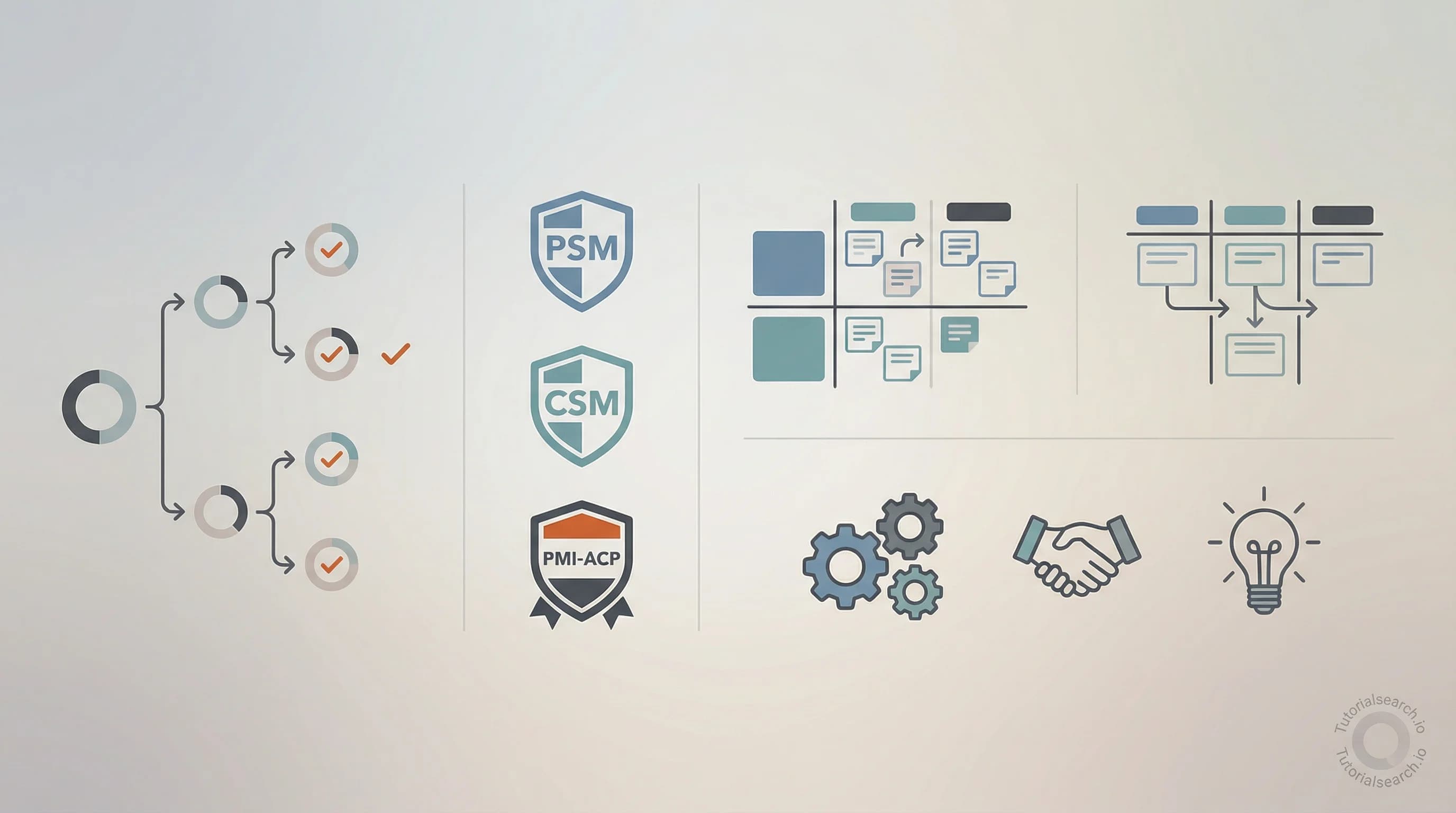
Agile Certification Decoded: Which Path Is Right for You
Agile certification options are confusing — PSM, CSM, PMI-ACP, SAFe, ICAgile. This guide breaks down which path fits your role, with the best courses, free study resources, and a clear comparison table.
Hire the developers behind TutorialSearch.io
We built this site — full-stack web apps, AI integration & automation. Tell us what you need and we'll build yours.
Agile certification is one of the most confusing decisions in a project manager's career. You search for advice and find a dozen credentials — PSM, CSM, PMI-ACP, SAFe, ICAgile, AgilePM — each with a vendor insisting theirs is the one that will transform your career. Meanwhile, your LinkedIn feed is full of people who got certified and immediately pivoted to selling certification prep courses.
This guide cuts through that noise. It's a decision framework built around your actual career situation, paired with the best agile certification courses and free resources available right now.
Key Takeaways
- Agile certification value depends on your role: PSM/CSM for Scrum Masters, PMI-ACP for project managers, SAFe for large enterprise teams
- PSM I (Scrum.org) is the most cost-effective agile certification at $200, with no mandatory training required
- Free resources — the Scrum Guide, Google Agile Essentials — can genuinely get you ready without expensive bootcamps
- Most agile certifications can be earned within 4–8 weeks of focused self-study
- Pairing agile certification with PMP exam prep or agile management skills sends a much stronger signal to employers
In This Article
- Choosing Your Agile Certification Path
- The Agile Certification Comparison Table
- Agile Certification Courses Worth the Investment
- Free Agile Certification Resources That Actually Deliver
- Agile Certification YouTube Channels and Podcasts
- Agile Certification GitHub Repos Worth Bookmarking
- The Books Behind the Agile Certifications
- Where the Agile Certification Community Lives
- Related Skills Worth Pairing With Agile Certification
- Frequently Asked Questions About Agile Certification
Choosing Your Agile Certification Path
Picture this: you're a project manager at a mid-size company. Your team has been "doing Scrum" for two years. Your job description now says "agile experience preferred." You've been asked to lead a certification initiative for the team. And you have no idea which credential to pursue first.
That's the situation most people are actually in. Not a blank slate beginner, not a seasoned Agile coach — somewhere in the messy middle.
Here's a framework that makes the decision much clearer.
You're a Scrum Master or want to become one. Start with PSM I (Scrum.org) or CSM (Scrum Alliance). Both test your knowledge of the Scrum framework. PSM I costs $200 and has no mandatory training. CSM requires attending a two-day certified course ($250–$2,495 total). PSM I has a higher minimum passing score (85% vs. 74%) and is generally considered more rigorous by technical hiring managers.
You're a project manager shifting toward agile methods. PMI-ACP is the right credential. It covers Scrum, Kanban, Lean, XP, and test-driven development. It costs more — $435–$495 for the exam alone — and requires documenting two years of agile project experience before you can apply. But in traditional enterprise and government settings, PMI credentials carry significant weight. It pairs well with project exam prep resources you may already be using.
You work in a large enterprise implementing agile at scale. SAFe (Scaled Agile Framework) certifications, specifically SAFe Agilist or SAFe Practitioner, are what many large organizations require. They're expensive (~$995 including training) and need annual renewal. But if your company runs SAFe, having the credential matters.
You want a framework-neutral foundation. ICAgile's ICP (Agile Certified Practitioner) is a vendor-neutral entry credential with no prerequisites. ICAgile offers 27 certification programs across 15+ languages, covering everything from team agility to enterprise transformation. It's underrated in job listings but valued by practitioners who care about thinking over memorizing.
One thing worth pushing back on: many articles recommend CSM as "the easiest to get." That's not wrong. But "easy to pass" is also why some hiring managers in tech don't value it as highly as PSM I. If you're in a technical environment and self-directed enough to study from a guide, PSM I gives you more bang for the cost. If you want structured learning and the Scrum Alliance name recognition, CSM is defensible.
The Agile Certification Comparison Table
Here's the comparison I wish existed when I started researching this:
| Certification | Best For | Prerequisites | Exam Cost | Renewal |
|---|---|---|---|---|
| PSM I (Scrum.org) | Scrum Masters, team members | None | $200 | Lifetime |
| CSM (Scrum Alliance) | Scrum Masters, US/Canada markets | 2-day training required | $250–$2,495 total | Every 2 years |
| PMI-ACP | Project managers with agile experience | 2 yrs experience + 21 hrs training | $435–$495 | Every 3 years (PDU) |
| SAFe Agilist | Enterprise-scale teams | SAFe training recommended | ~$995 total | Annual ($200/yr) |
| ICAgile ICP | Broad agile foundation, any role | None | Varies by provider | None |
| AgilePM (DSDM) | UK/European project managers | None | ~$400 | None |
One note this table doesn't cover: PMI-ACP's total investment often runs $1,000–$1,500 once you factor in study materials and training hours. CSM's cost is wildly variable depending on training provider. Always check what's bundled with the exam fee before registering.
For the project management path, PMI-ACP + PMP is an unusually strong combination. PMI's own salary data puts PMI-ACP holders at roughly 20% higher compensation than non-certified counterparts. That gap is worth taking seriously.
Agile Certification Courses Worth the Investment
There are 160+ agile certification courses available on TutorialSearch. Here are the ones that stand out — and why.
1. IC Agile (ICAgile) — Certified Agile Learning [Editors' Choice]
Instructor: Mohammad N. Khan — Agile Coach, SAFe Trainer (SPC)
Platform: Udemy | Rating: 4.5 | Students: 13,441
This is the strongest overall course in the category. Mohammad Khan is both a SAFe Program Consultant and a certified ICAgile trainer, which is a rare combination. He explains agile principles from first principles rather than just teaching exam patterns.
What makes it different from exam-cram alternatives: you finish understanding why agile practices work, not just which answer to pick. If the ICAgile ICP is on your list — or if you want a rigorous foundation before tackling PSM I — start here.
View the IC Agile course on TutorialSearch
2. Ultimate Agile Scrum Master Certification Course [Editors' Choice]
Platform: Udemy | Rating: 4.7 | Students: 5,220
The highest-rated Scrum Master prep course I found with meaningful enrollment. A 4.7 average across 5,000+ students is genuinely rare in the exam prep category — these courses typically get punished by people who expected a rubber stamp and were surprised by the rigor.
This one is honest about how hard PSM I actually is. The mock tests closely mirror the real exam's question style. If your goal is PSM I on the first attempt, this course earns its rating.
View the Ultimate Agile Scrum Master course
3. Agile Certification for Managers: Master Scrum
Instructor: Skill Development | Platform: Udemy | Rating: 4.5 | Students: 149
Built specifically for managers and team leads rather than aspiring Scrum Masters. The focus is on applying Scrum principles in your organization, not just passing a test. This is the course I'd recommend to a department head who asked "how do I actually run an agile team?" rather than "how do I get certified?"
If you're on the agile management track — leading teams rather than facilitating them — this one makes more sense than the exam-cram alternatives.
View the Agile Certification for Managers course
4. Scrum Master Certification + 2 Mock Tests
Platform: Udemy | Rating: 4.4 | Students: 3,461
The "98% passing rate" in the title is marketing. But the two full mock tests at the end are genuinely valuable. PSM I is an open-book assessment with real time pressure. Speed and pattern recognition matter. These tests build both.
View the Scrum Master Certification + Mock Tests course
5. PMI-ACP Exam Prep and Simulator [Editors' Choice]
For PMI-ACP candidates, exam prep alone is rarely enough. The PMI-ACP covers Scrum, Kanban, Lean, XP, and more — it's a broad knowledge base that benefits from structured practice testing.
Pairing the PMI-ACP Exam Prep course with a dedicated PMI-ACP simulator is the most effective preparation strategy. The simulator gives you realistic exam conditions. The prep course builds the conceptual foundation you need to reason through unfamiliar questions.
If you want additional SAFe practice, the SAFe Framework Practice Exams covers 225 practice tests for scaled agile scenarios.
6. Kanban Metrics for Agile Teams: Measure & Improve Flow
Instructor: GenMan Solutions | Platform: Udemy | Rating: 4.3 | Students: 23,870
This one surprised me. It's technically a Kanban course, not an agile certification prep course. But it's the most popular by far in this entire category by student enrollment.
PMI-ACP candidates get real value from it. Kanban flow metrics appear on the exam, and this course explains them better than any dedicated PMI-ACP prep I've found. It also applies directly to day-to-day agile practice in ways that pure certification prep doesn't.
View the Kanban Metrics course
Browse the full range of options in the agile certification course library.
Free Agile Certification Resources That Actually Deliver
Hire the developers behind TutorialSearch.io
We built this site — full-stack web apps, AI integration & automation. Tell us what you need and we'll build yours.
You don't need to spend $500 on a bootcamp to pass an agile certification exam. These resources, used together, are genuinely sufficient for most credentials.
The Scrum Guide (Scrum.org) — Free [Editors' Choice]
For PSM I, this is your exam text. The Scrum Guide is 13 pages, free, and available in 30+ languages. The entire PSM I exam is drawn directly from it. Read it three times. Every ambiguous sentence is a potential exam question.
PMI-ACP Exam Content Outline — Free
PMI publishes its Exam Content Outline for free. Download it. It tells you exactly what topics the exam covers and their relative weight. Study to the outline, not to a random course syllabus.
Google Agile Essentials — Free
Google's free agile course takes under 10 hours and covers agile fundamentals, Scrum artifacts, and sprint planning. It's not enough to pass a rigorous exam on its own, but it's excellent as a foundation — especially for people who've been doing agile loosely and need to formalize their understanding.
Great Learning's Free Agile Certification for Beginners
Great Learning offers a structured free course covering the Agile Manifesto, Scrum, Kanban, and XP basics. Well-organized for complete beginners. If you're starting from zero, begin here before jumping into exam prep.
Simplilearn SkillUp Free Scrum Course
Simplilearn's free Scrum Master course includes video lessons and a free completion certificate. It's good supplemental material for PSM I prep — particularly the sections on Scrum events and artifact definitions, which are reliable exam topics.
ICAgile Certification Roadmap — Free
The ICAgile website outlines all 27 of their programs and how they connect. Even if you're pursuing a different certification, it's a useful mental model for understanding how agile competencies stack up across roles and career stages. They've recently added AI for Products and Leadership Styles tracks worth exploring.
If you're also developing broader project concepts alongside your certification prep, mixing structured courses with these free resources keeps your preparation grounded in practice.
Agile Certification YouTube Channels and Podcasts
Most agile YouTube content falls into two camps: oversimplified theory and hour-long webinar recordings that feel like sitting through a quarterly review. These stand apart.
Scrum.org Official YouTube Channel
Scrum.org posts free webinars with Professional Scrum Trainers (PSTs) discussing real-world application — not just exam prep. Their "Ask a PST" series answers practitioner questions with depth you won't find in certification courses. Subscribe for the facilitation and sprint goal content especially.
Agile for Humans Podcast (Ryan Ripley & Todd Miller)
Ryan Ripley and Todd Miller run Agile for Humans, one of the most respected practitioner-focused resources in the Scrum world. They're both Professional Scrum Trainers and co-authored Fixing Your Scrum. The podcast covers the human side of Scrum — which is exactly what PSM I exams test when they ask about Scrum Master responsibilities and organizational impediments.
Available on Apple Podcasts, Spotify, and their YouTube channel.
YouTube search: "PSM I exam experience [current year]"
Counterintuitive suggestion, but hear me out: searching YouTube for recent "passed my PSM I" videos is one of the most valuable things you can do before your exam. Practitioners share their specific study approaches, which questions tripped them up, and how they managed time. These firsthand accounts are more useful than most paid courses for setting realistic expectations.
Agile Certification GitHub Repos Worth Bookmarking
lorabv/awesome-agile — 1.5k stars
A well-organized, public-domain list of agile resources covering Scrum, Kanban, Lean, and XP. Strong sections on user stories, retrospectives, and product roadmapping. Less useful as pure exam prep; more useful once you're actually leading teams and need to go deeper on specific practices.
SaadAAkash/awesome-agile-essentials
More concise than the awesome-agile list. Focused on practical agile essentials with clear links to core concepts and articles that tie directly to certification exam topics. A better starting point if you want curated rather than comprehensive.
Unusually broad. Covers Disciplined Agile (DA), SAFe, Scrum, Kanban, and more in one place. If you want to understand the full certification landscape before committing to one path, this repo gives you that overview faster than reading eight different vendor websites.
These repos complement the agile scrum courses you're likely already exploring — they provide the broader context that most individual courses skip.
The Books Behind the Agile Certifications
The Scrum Guide — Jeff Sutherland & Ken Schwaber (Free)
Already mentioned, but it belongs here too: this 13-page document is the actual foundation of PSM I. Read it before any other book. Don't skip it in favor of something longer. Available free at scrumguides.org.
Scrum: The Art of Doing Twice the Work in Half the Time — Jeff Sutherland
Sutherland co-created Scrum, and this book explains why it works at a conceptual level. It's not an exam prep book — it's better than that. Reading it first means every rule in the Scrum Guide makes intuitive sense instead of feeling arbitrary. Available via Amazon and most public libraries.
Agile Estimating and Planning — Mike Cohn
For PMI-ACP prep, this is required reading. The exam tests planning practices in detail — story points, velocity, release planning. Cohn's explanations are the clearest available. Available at libraries and on Mountain Goat Software's website.
The Agile Manifesto and 12 Principles (Free, Online)
Read the original Agile Manifesto and the 12 Principles behind it. Both PMI-ACP and ICAgile exams test your understanding of the manifesto's intent, not just its content. This is 10 minutes of reading that explains the next decade of the agile movement. It matters more than any flashcard set.
Where the Agile Certification Community Lives
r/agile (Reddit)
The subreddit has active daily posts on certification questions, exam experiences, and career debates. Search for "PSM I passed" or "PMI-ACP experience" before your exam — these threads contain firsthand accounts of what the actual test is like, which questions surprise people, and how long preparation really takes.
Scrum.org Community Forum
The Scrum.org forum hosts threads specifically for PSM I, PSM II, PSM III, and PSPO exam discussion. Responses tend to come from certified practitioners, which means you get higher-quality guidance than on general forums. There are even PSM III study groups forming on Discord organized through the forum.
Agile Open Community (Discord)
The Agile Open Community Discord is an active server connecting practitioners across all agile frameworks. Less exam-focused than the Scrum.org forum, more oriented toward real coaching and implementation questions. It's the community to join after certification when you're actually applying what you learned.
PMI Learning Community
PMI members access study groups and local chapter events through the PMI Learning portal. For PMI-ACP candidates, local chapters often organize study groups where you can compare notes with others working toward the same credential.
Related Skills Worth Pairing With Agile Certification
Agile certification rarely stands alone in a strong project management resume. These related skills pair directly with what you'll learn — and with the roles that require agile credentials:
- Agile Scrum — 716+ courses on the day-to-day mechanics of running Scrum teams. Essential companion to any Scrum certification.
- Agile Management — 335+ courses on leading organizational agile transformation. Pairs with PSM II, SAFe, and leadership-track ICAgile programs.
- PMP Exam — PMI-ACP and PMP are complementary. Many professionals pursue both. 539+ prep courses available.
- Project Exam Prep — 344+ courses on exam strategies that transfer across project management certifications.
- Project Delivery — Covers sprint delivery, stakeholder management, and retrospective facilitation — the practices you'll use every day after certification.
- Project Planning — Agile release planning and backlog refinement are testable topics on both PMI-ACP and PSM exams. 232+ courses here.
Frequently Asked Questions About Agile Certification
How long does it take to get agile certification?
For PSM I, most people are ready within 2–4 weeks of focused daily study using the Scrum Guide and practice tests. PMI-ACP takes longer — typically 8–12 weeks — partly because the knowledge base is broader and partly because you need to document your project experience in your application before you can sit the exam. ICAgile certifications typically require attending a workshop (1–2 days), so timeline depends on course availability in your area.
Do I need project management experience to get agile certified?
Only for PMI-ACP, which requires two years of general project experience and one year of agile project experience within the last five years. PSM I, CSM, and ICAgile have no experience prerequisites. Anyone can sit them after self-study. If you're building foundational background before attempting PMI-ACP, explore project essentials courses — 777+ courses covering core project management concepts.
Is Scrum Master certification a type of agile certification?
Yes. CSM (Certified Scrum Master by Scrum Alliance) and PSM I (Professional Scrum Master by Scrum.org) are both agile certifications that specialize in the Scrum framework. Since Scrum is the most widely adopted agile methodology, Scrum Master certifications are usually the first credential people pursue. They're often called "agile certifications" interchangeably in job descriptions.
Which agile certification is best for project managers?
PMI-ACP. It covers multiple frameworks, is globally recognized, and carries strong salary premium data behind it — PMI's surveys consistently show 20% higher compensation for PMI-ACP holders. The prerequisite experience requirement means it signals real-world practice, not just exam preparation. If you already hold PMP, PMI-ACP is the natural next step. If you're earlier in your career, PSM I is a better starting point.
What's the difference between CSM and PSM I?
CSM (Scrum Alliance) requires attending a two-day certified training course before you can even sit the exam. PSM I (Scrum.org) has no mandatory training — you can prepare entirely through self-study and sit the exam when ready. PSM I has a higher minimum passing score (85% vs. 74% for CSM) and is widely considered more rigorous. CSM tends to have broader brand recognition in corporate HR systems. PSM I tends to be more respected in technical and engineering-adjacent roles where practitioners know what the score requirements actually mean.
The most important step is matching the credential to your actual career situation. If you're self-directed and comfortable studying from the Scrum Guide, start with PSM I prep resources. If structured learning matters to you, CSM training is worth the cost. And if project management leadership at scale is where you're headed, give PMI-ACP the preparation time it actually deserves — which is more than most people budget.